Uncategorized

SCIENCE CORNER | Coding initiative to train 10K learners without computers

CODING skills development initiative Coding 4 Youth has set a target to train 10 000 young people in coding, in February and March, through the Unplugged Coding project.

Coding 4 Youth is a Leva Foundation project run in partnership with the Nelson Mandela University. The aim of the project is to reach 10 000 local learners by the end of March, using three coding apps: Rangers, Boats and Tanks.

Each month, the Leva Foundation, a social upliftment organisation, partners with a registered non-profit organisation to focus on specific initiatives, enabling it to serve communities in all stages of life.

The organisation empowers teachers in disadvantaged communities with various “Unplugged Coding” tools to teach learners coding skills, without the use of computers. The coding games available in Tanks, Rangers and Boats apps have already been used to reach thousands of learners directly, while hundreds of schools have received the coding kits, according to Leva Foundation.

The approach is to use physical activities such as games, and pen-and-paper exercises to introduce learners to coding, instead of computers.

The initiative offers coding kits which interact with the Boats (Grade R to 3) and Tanks (Grade 4 and higher) coding apps, to impart skills to the young learners using tangible tokens and image recognition.

Tanks has 35 levels, whereby players need to get the tank to the destination in each level. The tank can only be moved when the player uses the physical puzzle pieces they are given to build the code. Once the code has been pieced together, learners use the smartphone’s camera to upload a picture and move the tank.

Going offline and teaching coding through hands-on games and learning activities is gaining momentum, with industry insiders saying unplugged coding can be just as effective as online learning, when the right approach is taken.

Professor Jean Greyling, HOD of the Department of Computing Sciences at Nelson Mandela University, describes the Unplugged Coding project as a “low-tech solution” for the skills needed in a “high-tech” digital economy.

“The 10 000 target will be reached as a team effort, with teachers, NGO workers and ‘coding evangelists’ presenting workshops which are held at schools, in libraries or in communities where NGOs operate. This is truly a solution from Africa for Africa,” explains Greyling.

“Our project makes use of customised tokens (puzzle pieces), image recognition and standard smartphones to introduce learners to coding concepts. We also develop offline lessons which interact with our apps to introduce not only coding and algorithms, but also digital design, computational thinking and digital citizenship to the lessons.”

The initiative is sponsored by AWS in Communities, a corporate social responsibility initiative by Amazon to help thousands of students worldwide gain access to science, technology, engineering, the arts and mathematics education opportunities in fun and imaginative ways.

The Rangers and Boats apps were developed by Byron Batteson, a computing sciences honours student at Nelson Mandela University, in 2017.

The project is now endorsed by the university as an important engagement project, winning various local, national and global accolades, including a plenary invite to Unesco’s Mobile Learning Week in Paris. Last year, it was a top winner in the Falling Walls awards, organised from Berlin, Germany.

The Unplugged Coding seeks to reach learners beyond the borders of SA, with other African countries being reached through partnerships in Botswana, Tanzania, Kenya, Uganda, Nigeria, Ghana and Burkina Faso.

It will culminate in various physical and virtual coding tournaments towards the end of March.

“For me what makes the Rangers and Boats apps so exciting is that it is not only genuinely fun and easy to learn, but that it bypasses the need for expensive technology in Africa,” says Ryan le Roux, CEO of Leva Foundation.

“The project happens within the context of the fourth industrial revolution and the desperate shortage of software developers in most of the world. The sharp move to more online activities because of COVID 19 has resulted in an even higher need for programmers and the learning experience is accessible and attractive to both learners and educators.”

-ITWeb

Uncategorized

CLASSROOM CORNER| E-learning technology made available to more than 2 000 learners

A South African-developed e-learning education system has been made available to more than 2 000 pupils in the Eastern Cape, Limpopo, KwaZulu-Natal, the Free State and Gauteng – many of them underprivileged.

The system, which was developed by education technology (ed-tech) business Odin Education – a division of South African technology company Jendamark Automation – comprises a locked digital tablet that can only be used for educational purposes, curriculum-aligned content which is personalised for each user, and full-time online support.

The technology uses behavioural data to learn which educational content pupils are enjoying most and then pushes more of it to them.

The aim of the system is to supplement in-person schooling. Each device is loaded with mobile data, educational apps and learning platforms, and is tailored to each pupil’s subject choices. It then gathers information from its user’s interactions and serves them more of the academic and extramural content in which they are interested.

The e-learning system, which is being distributed privately through corporate social investment (CSI) initiatives, will next be provided to learners in the Western Cape.

The most recent recipients of the system were 215 Grade 12 pupils at Gqeberha’s Woolhope Secondary School, in the Eastern Cape, who received their digital devices towards the end of January. The donation was sponsored by couplings supplier SJM Flex, financial company DG Capital and technology developer Rockwell Automation.

“If this is used effectively, every pupil who has one will benefit,” Woolhope Secondary School principal AJ Jaram said at the handover event last month.

He said Odin Education’s ed-tech system would help equip pupils for the Fourth Industrial Revolution, which was changing the way we lived and worked.

Woolhope Secondary School student leader Beyonce Jacobs, who had the opportunity to trial the Odin Education system with fellow students last year, claimed it had helped deliver a 100% pass rate for her Grade 11 class – despite the disruptions caused by Covid-19.

“It’s quite stressful, not coming to school every day and knowing that there are trials and final exams coming up. The Odin Education system will take a bit of the pressure off because our textbooks are on it, plus it also has many more ways to explore and learn,” she explained.

Woolhope Secondary School learner Sinovuyo George added that the system represented a significant leap forward from the WhatsApp chat forums they had previously used for learning during lockdown.

“This is better, because there are videos explaining the entire lesson, among other learning resources,” she said.

SJM Flex human resources manager Rajes Padayachie – a Woolhope Secondary School alumna – said many of the company employees’ children attended the school.

“Our social responsibility initiatives are aimed at the empowerment of both our employees and the broader community. We believe that enriching the lives and minds of young people is investing in a self-reliant, dynamic and independent generation,” she said.

Padayachie said the company would explore ways to donate additional devices to learners.

For Rockwell Automation, one of the standout features of the Odin Education system was that it was designed in such a way that pupils could not use mobile data for social media or applications other than e-learning.

“Therefore, we are able to monitor the real value of the programme to learners,” said Rockwell Automation industry account manager Devendree Ankiah.

The opportunity to provide access to educational resources and being able to choose the beneficiary school for the donation of the devices were attractive aspects to the company.

“We have invested heavily in [science, technology, engineering and mathematics] education. To collaborate with a company focused on education is something that speaks to our hearts,” she said.

“Education is where our future opportunities lie, and we regard education as the backbone of any promising career. Being able to support this cause by way of technological investment is a great way for DG Capital to assist in shaping the lives of our future leaders,” added DG Capital director David Edwards.

Odin Education head Ajit Gopalakrishnan noted that CSI was key to getting more digital devices rolled out countrywide.

“It’s a [CSI] programme that has a quantifiable impact and can be tailored to any company’s regional footprint, while also delivering real-time [return on investment] impact reports and [broad-based black economic empowerment] points in return,” he concluded.

-Engineering News

Uncategorized

SPORTS CORNER | Nine West African Sports Stars Taking a Stand for Equality, Ending Poverty, and More

FOR many children across Africa, playing sports on the big stage is a childhood dream — scoring the winning goal in a major tournament; throwing that last-minute 3-pointer to clinch the victory at the NBA playoff finals; testing their skills alongside the finest players in the world and rubbing shoulders with other sport icons.

For some, sport is the hope of an exit plan from the communities in which they grew up.

Sports also have a unique power to unite divided groups of people. Just one powerful and symbolic example came in South Africa in the early 90s, amid great tension over the appointment of Nelson Mandela as the country’s first Black president.

Yet, after the South African National Rugby team clinched the World Cup at home in 1995, the crowd filled mostly with white South Africans quickly forgot their animosity. Both white and Black South Africans started chanting with excitement “Nelson! Nelson! Nelson!” across Johannesburg’s Ellis Park Stadium. This moment in time will always be remembered as one of, as the New York Times puts it, the “ultimate examples of sport’s power to heal”.

Sports also help to promote human development. And according to Makhtar Diop, the current International Finance Corporation’s Managing Director and Executive Vice President, “reviving school sports in elementary schools — particularly in the most impoverished areas where children do not have access to sports infrastructure or physical education programs — is an investment for life.”

Many sport stars, on finding success, are returning to their roots and contributing to the economic growth and development of the communities they came from, via poverty alleviation schemes, supporting charitable causes, or investing in facilities to encourage more children to participate in sports. Like Nelson Mandela once said, “Sport has the power to change the world…Sport can create hope where once there was only despair.”

We’ve put together a (non-exhaustive) list of some of West Africa’s biggest sport stars, who are using their platforms to help make a positive impact, transform lives, and uplift their communities.

1. Didier Drogba

Drogba’s name continues to echo in the minds of global football fans three years after the former captain and all-time highest goal scorer for Côte d’Ivoire retired from playing football.

Aside from his prowess on the football pitch, Drogba is also known for his philanthropic work in his home country.

In 2005, during the country’s civil unrest and just moments after Côte d’Ivoire qualified for the 2006 World Cup, Drogba leveraged his global reputation and used his voice to call on his country to end the conflict.

“From the north, south, centre, and west, we proved today that all Ivorians can coexist and play together with a shared aim — to qualify for the World Cup,” Drogba said, in a speech in front of a TV crew gathered with the players in the dressing room of the stadium. “We promised you that the celebrations would unite the people — today we beg you on our knees.”

“The one country in Africa with so many riches must not descend into war,” he continued. “Please lay down your weapons and hold elections.”

Described by the BBC as “one of football’s most extraordinary tales”, change did follow in the weeks and months following Drogba’s speech — which continued to be played on TV sets across the country — and a ceasefire was signed.

Since then, Drogba’s humanitarian activities through the Didier Drogba Foundation, have earned him a quite stunning list of awards and recognitions — including an honorary degree from a university in his home town, Abidjan. 

He was appointed as a Goodwill Ambassador for the United Nations Development Programme in 2007; in 2020, received the UEFA President’s Award, which recognises both professional excellence and exemplary personal qualities; and in October 2021, he became a Goodwill Ambassador for Sports and Health with the World Health Organisation (WHO). Meanwhile in 2009, he also donated £3 million from an endorsement with Pepsi to build a hospital in Abidjan. A champion in every sense of the word.

2. Sadio Mané

Mané, the player of the tournament of the just concluded Africa Cup of Nations (AFCON), is one player who doesn’t shy away from giving back to his hometown. In June 2021, the one-time African Footballer of the Year donated almost $700,000 to help fund the construction of a hospital in his home of Bambali in Senegal. The hospital will reportedly become the first in the village, which is about 400 kilometers outside Senegal’s capital city Dakar.

He’d previously, in 2019, also donated close to $350,000 to build a new secondary school in Bambali, and in 2018, gifted 300 Liverpool shirts to locals there to wear during the UEFA Champions League final. Amid the COVID-19 outbreak, Mané also donated £41,000 to health authorities in Senegal. Without a doubt, despite his success, Mané hasn’t forgotten his roots and the community that raised him.

3. Antonio Rüdiger

The German-born Sierra Leonean, Antonio Rüdiger, is a one-time winner of Europe’s most prestigious soccer accolade — the UEFA Champions League (UCL) — with Chelsea football club. Just last month, the Chelsea FC centre-back launched his charitable foundation for education in his home country of Sierra Leone.

Rüdiger pledged $40,000 to the foundation, as well as auctioning off his signed Chelsea shirt, to help improve the life and access to quality education of the people in his local community. According to him: “This foundation means a lot to me, but I don’t want it to be a one-man show, I want everyone to admire it, especially the younger generation.” He is a player much loved back home in Sierra Leone.

4. Masai Ujiri

Ujiri is a Nigerian professional basketball executive, former player, and the current vice-chairman and president of Canada-based Toronto Raptors Basketball Club.

Back in 2003 and inspired by the impact basketball has had in his own life, Ujiri co-founded the nonprofit Giants of Africa, aiming to use basketball as a way to encourage young children across Africa to dream big. In September 2021, Ujiri and the foundation announced a commitment to build 100 basketball courts across Africa over the next 10 years, including in Nigeria, Kenya, Tanzania, Côte d’Ivoire, and Burkina Faso.

“Sports are one of the best ways that we can help our young people achieve their goals and I look forward to hearing the stories of the thousands of young people who will be able to utlise these courts to help make their communities stronger over the next 10 years and beyond,” Ujiri said.

5 & 6. The Ogwumike Sisters

Next on the list are the Nigerian-American Ogwumike sisters, Nneka and Chiney. Both sisters currently play as forwards for the Los Angeles Sparks professional basketball team, while Nneka also currently serves as president of the Women’s National Basketball Association (WNBA) players’ union.

In 2014, just a few weeks after the abduction of the Chibok schoolgirls — which sparked the #BringBackOurGirls movement — the Ogwumike sisters challenged girls’ basketball teams to intensify their support for the work UNICEF is doing in Nigeria to protect and promote the rights of women and girls.

The Ogwumike sisters partnered with the U.S. Fund for UNICEF’s Girls’ Education Project, with the aim of helping millions of girls better access quality education — with a focus on Northern Nigeria — through getting more children in school, developing scholarships for female teachers, and creating safe spaces for girls.

In a 2019 charity visit to Queens College, in Lagos, Chiney Ogwumike said that “there is more to basketball than having the regular skills set,” further emphasising the need for young children to be focused on their dreams, in a society where it can be hard to do so.

And in 2020, Nneka Ogwumike led WNBA players in advocating for reduced gender pay gaps in the sport. The 8-year collective bargaining agreement for WNBA players will increase the salary cap for women in the sport, as well as creating a variety of career and quality of life benefits for WNBA players — including childcare stipends and full salary during maternity leave.

7. Kamaru Usman

Kamarudeen “Kamaru” Usman is a Nigerian-American professional mixed martial artist and the current UFC Welterweight Champion. In June 2021, during a visit to his home country Nigeria, the UFC champ decided to collaborate with the Lagos Food Bank Initiative to donate and personally share food items to about 1,000 underserved kids in Lagos.

“Being born in a place like Nigeria helped mould me into the man I am today,” he reportedly said at the event.

With it’s 12,000-strong volunteer network, the Lagos Food Bank Initiative, the first indigenous food bank in Nigeria, has been able to reach 1.6 million people in more than 130 communities in Nigeria. You can read more about their work here.

8. Wilfried Zaha

Dazet Wilfried Armel Zaha is a professional footballer for Premier League club Crystal Palace and the Côte d’Ivoire’s national team. The English-Ivorian national uses his Zaha Foundation, spearheaded by him and his family, to help rebuild inner-city areas so young people can better engage in social activities in a secure, accessible environment. 

According to the foundation, this is a “passion” of Zaha’s, “who himself grew up silently developing his craft with his friends on the streets and in park areas.” Zaha has also spoken about how he was left homeless at the age of six while growing up in London, where he moved at age four with his family.

Through his foundation, Zaha also funds an orphanage run by his sister back home and donates 10% of his earnings to these good causes.

9. Anthony Joshua

Anthony Oluwafemi Olaseni Joshua OBE, 32, is a British-Nigerian professional boxer. The 2012 London Olympics gold medallist and two-time former unified World Heavyweight Champion is a strong believer in giving back. On multiple occasions, he’s worked to support the Forever Hope Foundation, a nonprofit that partners with children’s charities and organisations on fundraising.

In 2017, for example, Joshua and the Forever Hope Foundation raised £10,000 to support Great Ormond Street Children’s Hospital in the UK. Alongside this, as highlighted by the foundation, he’s also worked to help raise money for anti-gang crime charities, donated money to help support the rehabilitation of offenders, and donated numerous items for charity auctions — such as a pair of signed boxing gloves.

-Global Citizen

Uncategorized

Nzimande Publishes A Technical Report On the Critical Skills List of the Department of Home Affairs

HIGHER Education, Science and Innovation Minister, Dr Blade Nzimande, has published a technical report on the Critical Skills List of the Department of Home Affairs.

Higher Education, Science and Innovation Minister, Dr Blade Nzimande, has published a technical report on the Critical Skills List of the Department of Home Affairs.

The Critical Skills List technical report provides details of all the processes undertaken in the development of the Critical Skills List, and the actual list gazetted by Home Affairs Minister, Dr Aaron Motsoaledi, on 2 February 2022.

The report follows a Memorandum of Agreement signed by the Higher Education and Training and Home Affairs Departments in January 2020 to facilitate the development of the Critical Skills List.

In terms of the MOA, the Department of Higher Education and Training was mandated to undertake research and produce the technical report which includes the methodology and consultation processes involved in the evidence-based Critical Skills List. The department handed the list to the Department of Home Affairs for consideration.

Nzimande said the Department of Higher Education and Training undertook the research and produced the technical report, titled “Finalisation of the Critical Skills List”, through a major research programme on Labour Market Intelligence.

The Minister said that South Africans live in a globalised economy, where countries often source workers from all over the world to fill gaps in their local economies, and it is therefore, “not surprising that many countries, especially Western countries, regularly compile and publish lists of occupational shortages”.

“The Migration Advisory Committee in the UK publishes a Skilled Occupation List, which is used by immigration authorities to grant special skills visas for potential immigrants. The Australian government also publishes a Skilled Occupation List regularly to draw skilled people into the country. 

“Similarly, Canada regularly publishes a list of Occupations of Demand, which it uses to apply its skilled worker visa. In South Africa, the Critical Skills List forms the basis to offer suitably skilled foreign nationals a Critical Skills visa in occupational areas where there is a dire domestic shortage,” Nzimande said.

Nzimande explained that the development of the new list required extensive collaboration between Higher Education and Training, through the Labour Market Intelligence partnership programme, Home Affairs, a host of other government departments, and representatives from business, labour, community and the broader public.

The technical report can be accessed on the department’s Labour Market Intelligence website: https://lmi-research.org.za and the Department of Higher Education and Training website: https://www.dhet.gov.za

Uncategorized

Four teachers from Sekoko Primary School in the Free State killed in horror car crash

STAFF REPORTER |

FOUR teachers, one School Governing Body (SGB) member, one cleaner of Sekoko Primary School in Free State were killed in a tragic accident on Friday night. They were driving back home after attending a workshop in Tweeling when the accident occurred.

Free State Department of Education spokesperson, Howard Ndaba said a minibus taxi overturned on the N5 road about six kilometres from Bethlehem.

“On 25 Friday 2022 at about 21:00 a white 22 seater Mercedes Benz Sprinter minibus taxi overturned on the N5 road about six kilometres from Bethlehem. The passengers were teachers and SGB members of Sekoko Primary school in Paul Roux,” said Ndaba.

The spokesperson said five people died at the scene – four females and one male. The other one died in a hospital on Saturday.
He further added that those who sustained serious injuries were rushed to hospital.

“Seven sustained serious injuries and were transported to Dihlabeng regional hospital, Phekolong hospital and at Medi-Clinic hospital,” Ndaba said.

Free State Education Mec, Dr Tate Makgoe has expressed shock and sadness following the death of Sekoko primary school officials.

“Free State Education Mec, Dr Tate Makgoe has expressed shock and sadness after four teachers, 1 SGB member, 1 cleaner of Sekoko Primary School in Paul Roux, Thabo Mofutsanyane District were killed in a tragic accident on Friday night.”

Makgoe sent his sincere condolences to the affected families and the school.

“We wish to convey our sincere condolences to the family and the entire school population. We are with them in our prayers during this difficult period of grief,” said MEC Makgoe.

The MEC is set to visit the school and grieving families on Tuesday.

The police are investigating the cause of the accident.

Ndaba said that teachers, parents and pupils will be offered counselling.

Meanwhile, in a separate accident, 20 learners were admitted to a hospital for observation in QwaQwa
after a bus they were traveling overturned.

– Inside Education

Shock drop in school test marks in South Africa
Uncategorized

Shock drop in school test marks in South Africa

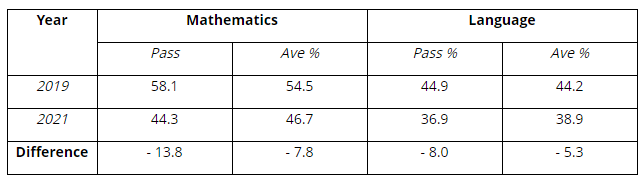
THE Western Cape Education Department has published its latest systemic test results, showing that the COVID-19 pandemic has had a significant impact on learning and teaching in the country.

While schools have now returned to full-time attendance, the test results conducted in the Western Cape in October 2021 provide the clearest, internationally benchmarked and independent analysis of learning losses suffered by the learners in the province, said provincial minister of education Debbie Schäfer.

“While we are the only province to conduct such tests, it is an indication of what the effects of this pandemic are on learners across South Africa. Unfortunately, the results are dire.

“The 2021 results are seen in comparison to tests conducted in 2019, as testing could not take place in 2020. While we had previously made great progress with a steady increase in performance in years preceding 2020, these gains have unfortunately been reversed as a result of the pandemic.”

The results are as follows:

Grade 3 

Grade 6 

Grade 9 

Overall, learners have fallen up to 70% of a school year behind previous cohorts in language, and up to 106% of a year behind in mathematics. The greatest learning losses can be seen in the foundation phase, Schäfer said.

“We have always maintained that the loss of contact (face-to-face) teaching time would affect our youngest learners the most as they do not have the same self-discipline, maturity or structure that our older learners would have to cope with rotating timetables and learning at home.

“The WCED is studying these results and accompanying diagnostics with a focus on updating its learning recovery plans to address these losses.”

The department said it already has a number of programmes underway to improve literacy and numeracy, which we are looking at expanding.

“Most importantly, the extent of learning loss needs to be determined at the classroom level by the teacher. The diagnostics emanating from the systemic testing will be presented as a useful aid to direct the teacher in planning learning programmes for the learners in specific skills and core competencies for each of the grades and subject areas.

“Ultimately, the most important way to claw back these losses is to ensure that every child is at school every day, that teaching and learning time is maximised, and that every effort is made to promote a learning culture beyond the school. Our administrative data from Temporary Revised Education Plans (TREPs) show that between closures and rotating timetables, 155 school days were lost in 2020 and 2021 in our province.”

Schäfer further warned that further disruptions will only exacerbate the existing losses.

– BusinessTech

Uncategorized

COVID learning losses: what South Africa’s education system must focus on to recover

VIJAY REDDY |

THE South African education system is big (13 million learners), unequal and socially graded. Although improving, the achievement outcomes are still low, fragile and susceptible to shocks.

The COVID-19 pandemic has dealt the education system a major blow, especially for poor and vulnerable learners.

In March 2020 South Africa, like most of the world, went into total lockdown, including school closures. The education system was unprepared for this. Schools, teachers and administrators were forced to build emergency remote-learning systems almost immediately. This threw the spotlight on access to digital devices, connectivity, having a quiet place to work in, and the problem of stubborn inequality.

Better resourced homes and schools were able to move to digital forms of learning and proceed with curriculum coverage. For the majority of learners, despite the best intentions, there was very little structured learning.

From June 2020, schools were reopened. Most schools followed a rotational timetable where learners attended school every second or third day. This rotational timetable continued in 2021.

Education scholars estimate that there was a loss of 60% of school contact time in 2020 and 50% in 2021. There were higher losses of school contact time in the less-resourced schools.

It’s uncertain exactly how much learning (knowledge and skills) has been lost and how wide the gaps may be for disadvantaged children. The global literature reports that:

learners from poorer countries and households experienced higher learning losses,earlier grades were more susceptible to learning losses than secondary learners,learning losses were higher for mathematics than for reading andgirls were more affected.

Learning losses in South Africa

For South Africa we estimated that the loss of school learning time in 2020 moved the education system backwards to the achievement levels as they were in 2015 – a regression by five years. The learning loss for learners from less resourced schools was 4.2%, higher than learners in more affluent schools at 3.4%. COVID-19 worsened already wide achievement gaps.

Studies measuring reading proficiencies in under-resourced South African primary schools in 2020 reported that grade 2 (8-year-olds) and grade 4 learners lost between 60% to 80% of a year of learning when compared to their pre-pandemic peers.

South African researchers compared pre-COVID grade 3 reading scores to grade 4 reading scores during the pandemic. They found that grade 4 home language learners were more than 1.25 years behind and English first additional language learners were half a year behind. The also found that learners were writing much less.

The World Bank cautions against underestimating the extent of the learning losses, saying that “the global education crisis is worse than we thought”.

Close the gap

Children from poorer households have missed substantially more classroom instruction time than children from higher-income households. Education researchers caution about the effectiveness of digital technology and e-learning to support learners who are out of school. The consequences of lost contact classroom will be felt for years.

In January 2022, South Africa’s Department of Basic Education gazetted that all learners would fully return to school and fully return to school and introduced measures to catch up on teaching and learning that was lost during school closures.

We don’t have a playbook of how learning recovery should happen. Drawing on past experiences and experiences in other countries, South Africa should consider implementing the following four components for education and learning recovery:

consolidation and trimming the content of the curriculum,increasing the efficiency of instruction,supporting out-of-school education programmes andnurturing the well-being of all actors involved in education.

While it’s unclear whether the schooling system can recover the two years of disrupted schooling and learning time, the education system should use this moment to reduce content in the National Curriculum Statement. Countries like the Philippines, Guyana and Tanzania have revised the primary school curricula to focus on practical learning and literacy and numeracy skills.

South Africa reduced the content of the curriculum just for 2020. This reduced curriculum should form the basis of a new curriculum, especially for primary schools which should focus on building foundational knowledge and skills.

To enhance learning, younger children must be in stimulating environments which focus on first language development and reading with meaning, basic computational skills and writing simple sentences. Learners must demonstrate proficiency in reading, writing and computation before progressing to the next grades.

For most learners from vulnerable homes and who, pre-COVID, had low learning outcomes, in-person schooling is the only place for meaningful learning opportunities. To increase the efficiency of instruction, the first step is to keep schools open and try to avoid future school disruptions.

Educators and learners must be at school every day. Pre-COVID, South Africa experienced high levels of learner and educator absenteeism and late coming. No more learning time should be lost in schools and school time must be used efficiently and effectively with high quality engagements. National, provincial and district officials must monitor and mitigate the levels of absenteeism of educators and learners.

Learning recovery requires both in-school and out-of-school programmes. Small group out-of-school tutoring programmes should be expanded, especially for high school learners. Primary school learners must be supported by parents with reading activities and cognitively stimulating educational television and radio programmes.

The last two years of learning under COVID-19 conditions have placed tremendous strain on everyone in the education system  (learners, educators, administrators, departmental officials). We must recognise how tired the system is and move forward gently, avoiding too many ambitious changes to an already fragile education system.

– The Conversation

Uncategorized

UCT students with outstanding fees can now register

STAFF REPORTER |

THE University of Cape Town (UCT) has announced on Tuesday that students with outstanding debt can register for the 2022 academic year.

This is after the university’s council decided to lift the fee blocks for all students who are eligible to re-register on academic grounds.

“Following the UCT Council meeting on Monday,21 February, Council called on the leadership of UCT to put in place a working group, to coordinate and facilitate the process of registering students who are able to continue their studies due to Council’s decision to lift fee blocks,” said the UCT council chairperson Babalwa Ngonyama.

Earlier this month, the Minister of Higher Education, Science, and Technology, Dr Blade Nzimande reported that R16.5 billion was owed by students to public universities in South Africa.

The cumulative fee debt at the UCT currently stands at R317.8 million.

“At the same time, we provide financial support every year to about 50% of our undergraduate students and about 35% of our postgraduate students. For the 2021 academic year, this financial support amounted to approximately R1.7 billion,” said Ngonyama.

Ngonyama said that some student’s council agreed to suspend the block on students re-registering for the 2021 academic year.
She further added that the suspension was for one year only and, for the 2022 academic year, students with fee arrears of more than R10 000 have so far not been permitted to register, subject to appeal.

“We also know that there are students with fee debt higher than R10 000 who have the potential to complete their courses of study. The special meeting of Council was called to consider the plight of these students,” she said.

The outcomes of Council’s deliberations resulted in the following decision:

1. The current fee block on student registrations should be removed for the 2022 academic year for all students who are eligible to re-register on academic grounds. This concession will apply to students who are South African citizens, South African Permanent Residents, from SADC countries and from other countries in Africa. It will not apply to students registered for courses at the Graduate School of Business (GSB), or who are international students from continents other than Africa. 
2. The university executive will review current financial aid and fees policies, to develop proposals for reform that will align with Vision 2030 with the objective of ensuring that allocation of financial assistance is aligned with demonstrable financial need.
Proposals will be brought to Council for consideration in time for implementation for the 2023 academic year.
3. The Students’ Representative Council (SRC) will be invited to take part in a joint working group with university management, to ensure that students who will benefit from the additional fee block concessions for 2022 can complete their registrations as rapidly as possible, so that their academic progress is not compromised.

-Inside Education

Uncategorized

Police probe arson case after fire breaks at Mpumalanga primary school

STAFF REPORTER |

A school in Mpumalanga was gutted by fire on Wednesday, according to the Mpumalanga Department of Education.

“The Mpumalanga Department of Education has learnt that one of the classrooms of Sekemisa Primary School in Verena at Thembisile Hani Local Municipality in Nkangala District caught fire,” the department said.

The fire extinguishers were called to put down the flames.

“Members of the community tried their best to extinguish the fire until the fire extinguishers arrived and helped to put down the flames.”

The police were at the scene and a case of arson will be investigated.

At the moment, the department said the circumstances that caused the fire is still unknown.

More updates will be provided as more information comes to light.

Last week, the community of Luka Village near Rustenburg in North West woke up to shocking news that their school called Ramotse Primary School has burnt down.
The Department’s spokesperson, Elias Malindi said the cause of the fire is still unknown, however, they suspect that it was a criminal activity.

The fire destroyed a computer lab, National School Nutrition Programme storage and a block of toilets for the girls and boys.

“The cause of the fire is still unknown but the school community suspects that it was criminal activities. The fire destroyed a computer lab with 40 computers, photocopiers, printers, Mathematics lab (1 projector, one screen, manipulative cupboard, interactive board and 18 tables), National School Nutrition Programme storage (food for learners) and Learner Teaching Supply Material (Stationery and textbooks) and a block of toilets for the girls and boys,” said Malindi.
The MEC for Education, Mmaphefo Matsemela condemned in ‘strongest terms the alleged burning of the school. “I take this moment to condemn in its strongest terms the alleged burning of Ramotse Primary school. Such incidents are clearly targeted at delaying the
provisioning of education to an African child, “she said.

Inside Education

Budget 2020 | Finance Minister Enoch Godongwana to allocates R32.6 billion in funding to NSFAS
Uncategorized

Budget 2020 | Finance Minister Enoch Godongwana to allocates R32.6 billion in funding to NSFAS

STAFF REPORTER |

FINANCE Minister Enoch Godongwana has announced an allocation of R32.6 billion for financial support to current bursary holders and first-year students under the National Student Financial Aid Scheme.

Godongwana tabled his maiden budget speech in Parliament on Wednesday afternoon.

“In 2017, the government announced a policy for fee-free higher education. We are announcing an additional allocation of R32.6 billion for financial support to current bursary holders and first-year students under the National Student Financial Aid Scheme,” he said.

Godongwana indicated that further shortfalls will be funded from within the baseline of the Department of Higher Education.

The minister has commended teachers for sacrifices during the pandemic in ensuring that children get educated.

“Madam Speaker, at the height of the COVID-19 our teachers had to make tremendous sacrifices to ensure that our children get education,” said Godongwana.

Last year, Minister of Higher Education, Science and Innovation, Dr Blade Nzimande said that the student debt is growing in the university system.

Nzimande said it is extremely worrying to note that inequitable patterns of student success still prevail. 
He said this was especially true for African and coloured male students.

Adding that this category of students continues to be the least successful in the university system.

“There are four categories of affected students that have been identified. They include NSFAS [National Student Financial Aid Scheme] students, students who are recipients of other scholarships and bursaries, self-paying students – including the so-called ‘missing middle’ students, and international students,” said Nzimande.

The minister added that his department and higher education stakeholders have acknowledged that there have sometimes been delays in the processing of historic debt of NSFAS qualifying students. 

He said the main challenges are linked to administrative challenges in resolving the debt.

“The Department is working with NSFAS and institutions to ensure a speedy resolution of the processing of historic debt claims,” he said.

Inside Education has previously reported that student historic debt to universities has escalated to approximately R14 billion.

Analysts say this has caused a sustainability crisis in our higher education institutions.

According to the Universities South Africa (USAf), this crisis has been ongoing for decades and that it is now time for a government-led policy process that produces a long-term, sustainable solution.
At the time, USAf’s Chief Executive Officer Professor Ahmed Bawa said student debt cannot possibly be resolved at the institutional level.
“USAf must signal now, as we did in December 2017, that the long-term sustainability of this bursary programme is of deep concern to us,” said Bawa.

-Inside Education

ReplyReply allForward