Uncategorized

We have the knowledge of where and how our children learn – Motshekga

CLOSE to a quarter (22%) of the 165 059 teaching and managerial staff in the Early Childhood Development (ECD) sector do not have any formal training or qualification, underpinning the enormity of the sector’s challenges, the country’s first-ever census has shown.

It is not all doom and gloom, however, as the ECD 2021 Census conducted by the Department of Basic Education (DBE) in partnership with the LEGO Foundation reveals that more than a quarter (26%) took part in an accredited skills programme, about four out of six (42%) obtained an NQF Level 4 or 5 education, and 10% had an NQF Level 6 or higher.

But the sector is desperate for expansion of ECD programmes, training of practitioners, and the need for better allocation of funds. Interviewed recently after the launch, Minister of Basic Education Angie Motshekga reckons the findings will inform future crucial actions of ECD in the country, responsibility for which is now under her watch following the switch from the Department of Social Development on April 1.

The first ECD census aimed to gather reliable data and information to move towards a centralised management information system to improve ECD centres’ resource allocation and oversight management across the country. It was released in May.

“While significant progress has been made in terms of providing better ECD programmes since 1994, the sector still faces challenges, including those related to infrastructure, quality of the programmes offered, practitioners’ qualifications and training, and institutional capacity and funding,” said Motshekga.

Field workers for the project visited every ward in the country to get information on Early Learning Programmes (ELPs) and gather basic information on them. Multiple strategies were employed to locate ELPs, and a variety of stakeholders from the ECD sector were enlisted to support the process.

In total, 42 420 ELPs were counted during the census. Gauteng had the highest number of ELPs (25%), followed by KwaZulu-Natal (19%), the Eastern Cape and Limpopo (both 13%).

“It will inform a lot given the enormity of the programme,” said Motshekga. “But it also is a relief that as much as there are 46 000 centres, it’s not too many kids when compared to a (schools) sector where we have 26 000 schools. But we’re servicing 16 million children. So, it also gives a sense of the spread and the balance between learners and practitioners. So, it’s very helpful in terms of planning, and any information that you need also for resourcing to say, here are the main issues,” Motshekga said.

Regarding teacher development at ECD centres, the minister said she expected or had assumed that more practitioners were not qualified to teach than the 22% identified in the census.

“So, I’m not surprised, but I think I’m pleasantly relieved that we don’t have too many educators in that space who are not qualified. In terms of the size of the sector, I knew it was big,” she said.

But the minister said while there are encouraging signs where the realities are better than prior estimates, through the census they were able to identify focused areas of improvement to inform the better allocation of resources to ensure the next generation receives the foundation they need to build a brighter and better future.

Motshekga said the census provided a sense of the spread and the balance between learners and practitioners. It’s also helpful in terms of planning and any information needed for resourcing, etc.

She said it was pleasing to learn that almost 77% of children at the centres are fed, ensuring that their nutritional needs are met. In laying a solid foundation, Motshekga warned that if it doesn’t go well, that’s where the development stops.

“If you have not done a proper preparation, it’s not going to thrive. That is why it is key to build a solid foundation for our children because the shape of your house depends on education. I have no doubt in my mind that we’re on the right track to get our children on the right path towards development as they grow up.”

The minister said ensuring that the foundation for a better ECD sector was just one of the most important steps taken as a country.

“I am very appreciative of the support from the NGOs in the space, experts in that space, but also, business partners who are helping us. It’s a new space that we’ve not yet gathered enough information, resources and skills, and therefore need lots of support from outside government to solidify this foundation.”

Although the great majority (94%) of ECD programmes charge fees, most (62%) of them also allow at least some children to attend the ECD programme without having to pay a fee. The average monthly fee charged by ECD programmes was R509. However, significant differences exist between provinces, with monthly fees in the Western Cape and Gauteng more than three times higher than fees in the Eastern Cape.

Differences in fee amounts were also clearly discernible between socio-economic quintiles. Parents of children attending quintile 5 programmes were paying significantly higher fees compared to the other primary caregivers. The average quintile 1 and 2 caregiver paid about half of the value of the child support grant at the time of the census.

The census found that ECD programmes subsidised by the Department of Social Development charge much lower fees (average of R208) than ECD programmes that were not subsidised (average of R649). The primary funding source for ECD programmes were fees (69%), followed by government subsidies (27%). The remaining 4% depended on donations, fund-raising and other sources of income.

The highest poverty rates for young children are in Limpopo, KwaZulu-Natal and the Eastern Cape. The census shows that while a large proportion of centres in these provinces were receiving DSD subsidy support, a higher proportion of ECD centres in the Free State also received DSD subsidies.

Elaborating on the importance of the work of the private sector partner LEGO in compiling the groundbreaking census, Motshekga said she was grateful to the business sector for playing an active role with funding and support.

The minister said the department also hosted a continental programme on learning through play.

“This is not the first time they’ve (LEGO) donated items on many occasions, including the bricks that we use to train in schools and the bricks we use for the computing and robotics programme. And what is nice about the relationship is that it is project-based specific, it’s targeted, and we will agree on what needs to be done. We work in collaboration as we agree on what should be the priority areas,” she said.

Kasper Ottoson Kanstrup, Head of Programmes at the LEGO Foundation, said the foundation has been involved in South Africa for more than a decade. “A number of the challenges we see in the census have been of a narrative. What probably was most surprising about the ECD space was the little time children have for free play. To me, that is a bit worrisome because children develop a hunger through free play, where they get collaboration skills that are developed socially or emotionally.”

But in both instances, the study found that about half (54% and 45%, respectively) of the ECD programmes allow less than 30 minutes for free play per day.

Nicholas Dowdall, Programme Specialist at the LEGO Foundation, said: “Overall, the impression left by the findings is that we need to do more, both in terms of changing mindsets of practitioners, but also in terms of providing ELPs with suitable materials for play and learning.”

Evidence shows that playful learning approaches in the early years improve academic performance and holistic development by unlocking essential skills that children can apply to more complex tasks throughout their lives. Play-based learning is a fundamental principle for the DBE and is embedded in the National Curriculum Framework for children from birth to four years.

Edwin Naidu is with tech-education start-up Higher Education Media Services.
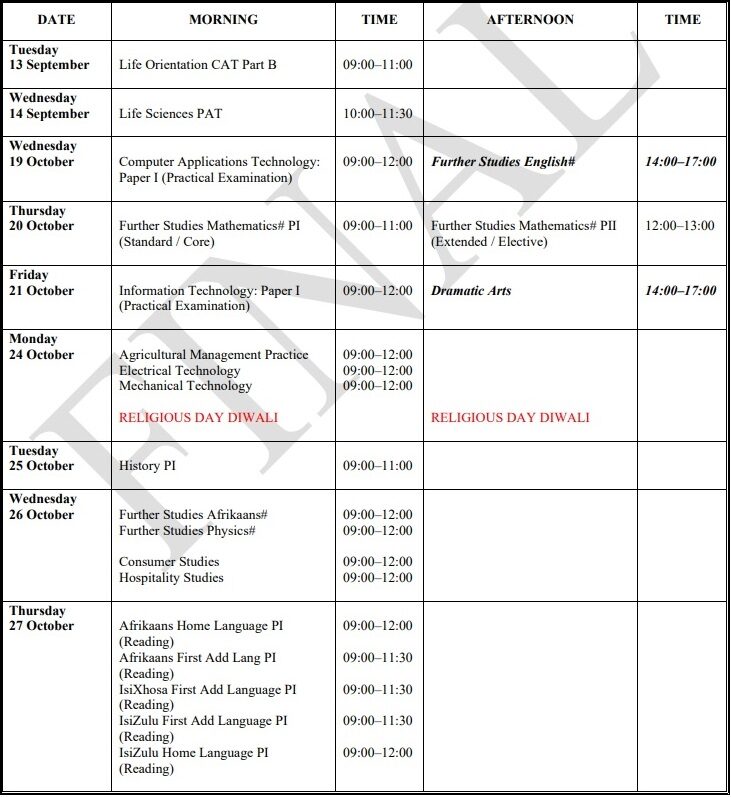
IEB Releases Final Matric Exam Timetable For 2022
Uncategorized

IEB Releases Final Matric Exam Timetable For 2022

THE Independent Examination Board (IEB) have released their final National Senior Certificate (NSC) examination timetable.

The IEB is a private assessment board that offers examination services to private or client schools. They are also accredited by Umalasi, the same quality assurance body that approves NSC examinations that normal public school learners in South Africa participate in.

IEB schools achieved a 98.39% pass rate in the 2021 NSC examinations.

This was slightly higher than the 2020 pass rate of 98.06%. Their matric class of 2021 consisted of 12 857 full-time and 968 part-time candidates.

Here’s The 2022 IEB Final Matric Timetable

Uncategorized

Curro eSports launches new South African gaming platform with Acer

INDEPENDENT school group Curro Holdings, in partnership with Acer for Education, has launched Curro’s own eSports gaming platform in South Africa.

Utilising help and expert guidance from Acer, Curro’s innovative new platform reassures parents with an extra layer of cyber security to ensure learners’ safety while playing online video game tournaments as part of the school group’s pioneering eSports programme.

Curro’s eSports programme has already registered more than 1,900 learners from across 38 of the group’s primary and 28 of the group’s high schools since its launch in 2020.

Until now, learners playing any of the tournaments, including Apex Legends and Minecraft Squad, as well as traditional eSports games like Rocket League, have not had a central space to view information. However, the new Acer platform allows teams to view their rankings but also makes it possible for coaches to manage players, coordinate tournaments and also allow communication between players as well as between players and coaches.

The tournaments are live-streamed via Twitch which means everyone gets to watch.

“We are amazed at how quickly our eSports programme has taken off. Our parents now understand that eSports is not just about playing video games as an extracurricular activity, but in fact, provides an entire world of opportunity for our learners, as an integrated part of our curriculum,” says Angela Schaerer, Digital Transformation Manager at Curro Holdings.

Schaerer says the new platform allows them to take their eSports offering to a whole new level of learning and upskill their learners and staff even more.

“For example, they can now shout cast (MC) games on the platform which is an extremely exciting opportunity, and we are already working closely with Acer to introduce a shout casting mentorship programme soon. We are planning to host our inter-Curro Cup tournament later this year, to determine the best eSport school in the group,” Schaerer says.

Recent research has identified numerous benefits to playing eSports and video games. These include improving the players’ ability to process and prioritise information, and enhancing their critical and creative thinking skills while quickening decision-making and reaction time without sacrificing accuracy.

Regular gaming also helps learners develop self-confidence and calmness, as well as acquire 21st-century skills like social awareness, collaboration, adaptability, persistence, and resourcefulness. These competencies could have ongoing future returns, helping learners secure valuable careers, especially in areas of math, science, and engineering.

Curro says it has been forging ahead with its eSports programme after witnessing the popularity of virtual sports during the Covid-19 lockdown when traditional sports were prohibited. Since then, the independent education provider has quickly fostered a name for itself in the global eSports community, having claimed victory in an International Minecraft match against a school in California in June 2021.

ITNEWS

Uncategorized

No wonder no one wants to be a teacher: world-first study looks at 65,000 news articles about Australian teachers

Remember when former Morrison government minister Stuart Robert lashed out at “dud” teachers? In March, the then acting education minister said the “bottom 10%” of teachers “can’t read and write” and blamed them for declining academic results.

This is more than just a sensational headline or politician trying to get attention.
My research argues the way teachers are talked about in the media has a flow-on effect to how people feel about becoming a teacher, and how current teachers see their place in the community.

So, when we talk about the shortage of teachers in Australia, we also need to look at media coverage of teachers in Australia.

My new book examines how teachers have been represented in the print media for the past 25 years.
When you look at the harsh criticism and blame placed on teachers, it’s no wonder we are not attracting enough new people to the profession and struggling to retain the ones we have.

My research
In a world-first study, I explored how school teachers have been portrayed in Australian print media from 1996 to 2020. I looked at more than 65,000 media articles from all 12 national and capital city daily newspapers, including all articles that mentioned teacher and/or teachers three times or more.

With an average of 50 articles per week for 25 years, and a total word count of more than 43 million, my analysis is one of the largest of its kind.

While a lot has been written about teachers in the media over the years, this is the first study to systematically analyse such a large number of articles, representing such a complete collection of stories about teachers in newspapers, published over such a long time.

So what did I find? A lot. But here are three key findings that are critical when it comes to the way we think and talk about teachers and their work.

We are fixated on ‘teacher quality’
First, my research charts the rise and rise of attention to “teacher quality”, especially between 2006 and 2019. This period covers the start of the Rudd-Gillard “education revolution”, which reframed education in Australia as all about “quality”. It ends with the start of COVID, when reporting on teachers and education temporarily concentrated on home schooling.

My analysis found the focus on “quality” was far more on teachers than, say, teaching approaches, schools, schooling, education systems or anything else.

Made with Flourish
Why is this an issue? It puts the emphasis on the purported deficiencies of individual teachers rather than on collective capacity to improve teaching.

It detracts from system quality – the systemic problems within our education system. “Teacher quality” is a way for politicians to place the blame elsewhere when they should be committing to addressing the root cause of these problems: inadequate and inequitable funding, excessive teacher workload, unreasonable administrative loads, or teachers being required to work out of their field of expertise.

Teachers’ work is made out to be simple (it’s not)

The second key thing I found is media reporting on teachers consistently talks about their work as simple and commonsense, as though all decisions made by teachers are between two options: a right one and a wrong one.

The phrase “teachers should” appears about 2,300 times in my database. Examples include, “teachers should be paid according to how their students succeed”, “teachers should not adopt a cookie-cutter approach to learning”, “teachers should arrive in classes prepared” and “teachers should not be spending time organising sausage sizzles”.

Research conducted in the 1990s, and still widely referred to by scholars, found teachers make roughly 1,500 decisions in the course of every school day.

Recent research, including some I’m currently doing with colleagues, suggests teachers’ work has greatly intensified and accelerated over the past 30 years. So it’s likely 1,500 decisions per school day is now a very conservative estimate.

These decisions include everything from “what texts will we focus on in English next term?” to “should I ditch what I’d planned for this lesson so we can keep having this conversation because the students are absorbed by it?”.

It also includes social decisions, such as “do I intervene right now and potentially escalate what’s going on at the back of the classroom or just keep a close eye on it for now?”.

Every single one of those decisions is complex. And yet, in media coverage, claims of what “all teachers” or “every teacher” can, should or could do come thick and fast.

Teaching is relentlessly difficult, and while not everyone needs to understand that – in the same way not everyone needs to understand exactly how to conduct brain surgery – we do need to pay some respect to the 300,000 or so Australian teachers who navigate the profession every day. Just because the complexity may not have been evident to us in our 13 years as school students doesn’t mean it wasn’t there.

Teacher-bashing is the norm
Finally, I found stories about teachers were disproportionately negative in their representations. I did find “good news” stories in my research but they were outnumbered by articles that focused on how teachers, collectively and individually, don’t measure up.

This included the linking of “crises” to “poor quality” teachers. Take, for example, former education minister Christopher Pyne’s comment that:

[…] the number one issue, in terms of the outcomes for students, is teacher quality, in fact [the OECD] said eight out of ten reasons why a student does well in Australia or badly is the classroom to which they are allocated. In other words, the teacher to whom they are allocated.

In other words, “teacher-bashing” is the norm when it comes to stories about teachers in the Australian news media.

The PR around teaching needs to change
As we consider what to do to improve teacher numbers in Australia, we need to think about the way we talk about teaching and teachers in the media.

If all people hear is that teachers are to “blame” for poor standards and they should be finding their demanding, complex jobs easy, this is hardly likely to encourage people into the profession. Nor does it give those already there the support and respect they need to stay.

THE CONVERSATION

Uncategorized

Winter school camp to promote careers in built environment sector – DPWI

THE Department of Public Works and Infrastructure is this week hosting the 8th annual Winter School Camp programme.

The purpose of the winter school is to promote careers within the built environment sector and create a solid foundation for a high pass rate in Mathematics and Physical Science. 

This aims to enable learner’s access into careers within the built environment, while prioritising the attendance of learners from disadvantaged communities and females.

“The camp forms part of the department’s mandate to transform the built environment sector by providing support to educators through enrichment programmes that help teachers become better Mathematical and Physical Science educators,” the Department of Public Works and Infrastructure said in a statement. 

The camp will have interactive exhibitions and expose the learners to career opportunities in the built environment sector while addressing the challenge of scarcity in educational resources that lead to poor performance in schools.

Since the programs’ inception in 2013, 42 schools have participated, while there are 22 schools currently enrolled this year, with 48 learners participating.

The prerequisites for learners to participate are:

-Each school needs to have an average of 40% of their Grade 10 – 12 scholars doing Mathematics and Physical Science and for Grade 9 – 12, and for

-learners to achieve a minimum of 60% for Mathematics and Physical Science.

Uncategorized

Young ed-tech founder equips learners with digital skills

IVOR PRICE  

INSPIRED by his grandparents, South Africa entrepreneur Shivad Singh founded Head Start Education, an online platform providing digital educational material for teachers and learners, when he was only 19.

Singh, who hails from KwaZulu-Natal, launched his business, formerly known as Presto, after graduating with a Bachelor of Commerce degree at the University of Cape Town. His aim is to equip learners and teachers with essential digital skills that will lead to an improvement in their overall skills development and employability.

Head Start Education serves as a gateway to Africa for educators to promote the advancement of education across the continent. The company is a reputable ed-tech provider, holding exclusive licenses for over 20 educational products world-wide. They supply these products to schools and large corporates that are then able to provide these services to their teachers, learners or customers.

“The focus for our business is to help learners leave high school with a quality education,” says Singh.

“The education sector in Africa and other developing countries continues to face serious challenges with poor quality of resources, irrelevant curriculums, poor learning outcomes and lack of infrastructure. These challenges have led to 1.2 million learners in South Africa entering Grade 1 with less than half of them completing high school.”

E-school platform on Head Start

Head Start has a “Netflix for Education” e-school platform that aggregates over 1 000 videos and affordable PDF content for their customers. The content is relevant to the school syllabus, and promotes financial education, entrepreneurship, coding, personal growth and emotional well-wellbeing.

Singh has received various forms of support to ensure the success of his business. Notably, he has received business skills training, mentorship and access to finance through his entrepreneurial journey with the SAB Foundation, one of the leading South African organisations in the social innovation space.

He started his journey with the foundation when he was selected for the University Seed fund. He was then announced as a winner at the SAB Foundation Social Innovation Awards and is now receiving support from the SAB Foundation Social Innovation Fund.

Through the support of my mentor provided by the SAB Foundation, we closed our first big deal,” he explains. “We also signed an agreement with an established financial institution and partnered with a leading school franchise in South Africa.”

According to Singh, the biggest highlight on his journey has been launching his Mobi Class education platform with the cellular provider, MTN.

With this support, he has provided educational content to over 300 000 learners. Originally Singh was running the business on his own, but this has grown and he now has five employees. His annual turnover has increased to almost R1 million per annum.

In 2017, Singh was recognised as a News24 Young Mandela of the Future, and received the “Leading South African Award” by One Young World. He is also the youngest member of South Africa’s Tai- Chi demo team.

Apart from running a global business, Singh still taps into his inner child and engages in digital social media platforms like TikTok. His passion and drive for entrepreneurship was inspired by his grandfather, Benny Singh.

“My grandparent’s life journeys are my inspiration,” shares Singh. “My grandfather lived in a one bedroom flat and couldn’t afford to go to university. However through sheer grit and determination, he made a success as an entrepreneur.”

Singh was further inspired by his great grandfather, who was the first South African Indian to pass high school in 1925, and the first person of colour to become principal of Sastri College in Durban. 

“I see myself as a combination of these two great men,” he said.

“My message to other entrepreneurs is to always be on the lookout for training and skills development opportunities,” added Singh. 

“It is vital that you have these tools in order to establish and grow a sustainable and successful business.”

Founded in 2010, the SAB Foundation provides grant funding for small, medium and micro-sized enterprises in order to contribute to the economic and social empowerment of historically disadvantaged persons through entrepreneurship development. More than R425 million to date has been invested in social innovation, disability empowerment and SMMEs.

Ventureburn 

Uncategorized

Limpopo TVET lecturer burnt to death following mob attack

WENDY MOTHATA

A TVET college lecturer in Lebowakgomo, Limpopo, was on Saturday attacked and burnt to death by unknown suspects while transporting goats.

The man was accused of stealing goats.

The 43-year-old college lecturer, Siphiwe Zondo, bought goats at Ga-Mphahlele village.

According to the police, Zondo was stopped and pulled outside of his vehicle by a rampaging mob, accusing him of stock theft.

The Limpopo police have since launched a manhunt for the suspects.

The police urged the public to come forward with any information relating to the murder of the TVET college lecturer.

Recently, four men were also burnt to death in Phalaborwa, Limpopo, after they were suspected of burglary.

Meanwhile, the Democratic Alliance (DA) in Limpopo has condemned the latest mob killing the college lecturer.

“The Democratic Alliance (DA) in Limpopo strongly condemns the latest mob killing in Lebowakgomo on Saturday. He was severely assaulted and burnt to death in his bakkie,” said DA Provincial Spokesperson on Transport and Community Safety, Katlego Suzan Phala.

Phala said that they are concerned about the sudden spike in mob justice killings in the province.

This year alone, 10 victims brutally fell to the hands of mob justice in the province.

“The DA has sympathy with frustrated communities who do not feel safe in their own homes and whose property are at risk, but we call on communities not to take the law into their hands. We do believe that lack of police visibility and the lack of police stations in rural villages contribute to incidents of mob justice in our province,” said Phala.

On 10 June 2022, the DA wrote to the Police Commissioner, Lt. Gen. Thembi Hadebe, to provide them with a report on mob justice acts in the province and the measures put in place to prevent such incidents, “we have yet to receive a response.”

“The DA hopes the newly appointed MEC for Community Safety and Transport, Polly Boshielo, will show
more interest, than her predecessor, in holding the police accountable to protect and serve the people
of Limpopo.”

INSIDE EDUCATION

Uncategorized

Classroom Management| Dealing with unruly behaviour among schoolchildren in a tumultuous world

CONRAD HUGHES|

COVID has left a lasting impact on education in a number of ways. Deficits in learning may never be fully redressed; backlogs, delays and more complexity in university admission will continue to be felt down the line; anxiety and depression are more prevalent.

But the pandemic has also given educators a chance to think about doing things differently. With the experience of lockdowns and social distancing, but also the opportunities offered to use technology more creatively, schools and universities can view the pandemic as a chance to recalibrate systems, processes and the whole philosophy of education.

Often experiences tell you not only what is present, but what is not present, and why whatever is missing is indispensable.

One of the core takeaways from COVID has been the centrality of well-being and human relations in learning. Through confinement and distancing, it became clear to students, teachers, parents and administrators that rapport and emotional connection, community and presence were all fundamental.

Learning is not a dry, technical exercise. It is an emotional, social phenomenon. This is something that psychologists have known for a long time.

Discipline

A number of articles are pointing out that serious disciplinary issues are arising in schools post-COVID. In the US, schools are reporting an increase in fights, vandalism and unruliness, causing teachers to quit. In South Africa, severe discipline problems have spiked post-COVID with cases of harassment, verbal abuse, physical attacks, intimidation and even stabbings.

Specialists are saying that there are more cases post-COVID than there were in the past.

I’m the head of a large K-12 school (from kindergarten to 12th grade). We have soldiered through COVID and it feels like we are coming through to the other side.

I’ve seen student anxiety, learning gaps and disciplinary issues arising in the way that young people respond to what has been a worldwide trauma. But whenever we look at discipline, certain universal principles come to the fore and should be considered.

Educational psychologists know that discipline issues are linked to the family context. Positive parental behaviour, daily routines (like having dinner every night as a family) and social support (listening, conversing, spending time together) have an enormously positive effect on students.

But not every student has the family backing needed to offer full emotional and psychological support.

Mentoring and one-to-one discussions

As a head of school, I’m a strong believer in establishing rapport with students on a one-to-one basis. Most schools are big places and it is easy for individuals to fall through the cracks. Every student should know that there is one trusted adult in the building and every teacher should be the coach of a given number of students. The smaller the group of students followed by a teacher, the better.

If every child has a chance to sit down with a teacher and talk about how things are going, it helps consolidate rapport and express any tensions that might be welling up. Every year I meet with my students and ask a few core questions. Teachers can do the same, taking on a coach position in these discussions, asking powerful questions such as:

How are you?
Tell me your story.
What would you like to talk about?
How are things in your life?

These questions allow students a chance to open up and express themselves. They also improve relationships between faculty and students over time. This becomes important because people are less likely to fall into antisocial behaviour when they are in the company of those they know and trust, particularly if those people are figures of authority.

A mentor programme built on rapport and meaningful growth conversations is a sure way to reduce tensions and promote well-being. This might not be enough to eradicate discipline problems altogether, but it means that students can be called to reason more quickly. There is already some social capital to work with to restore calm when that is needed. And the open door of conversation – with a known adult – is there as a pressure release, replacing violence.

Societal renewal

A school is a microcosm of the society around it. This does not mean we cannot change society through schools.

Rather than merely expressing the hardships of the adult world, schools are also sanctuaries for young people to learn and flourish in peace.

The teachers who put themselves on the front line every day for this vital public good deserve recognition and thanks.
With even more care given to building one-to-one relations, schools can help create a more peaceful world based on listening and appreciation of others.

(Conrad Hughes Campus and Secondary Principal at the International School of Geneva’s La Grande Boissière, Research Associate at the University of Geneva’s department of Education and Psychology, Université de Genève, Université de Genève)

THE CONVERSATION

Uncategorized

Science| South African Engineer Turns Protein-rich Caterpillars Into Savoury Biscuits and Chocolates

A start-up entrepreneur, hailing from South Africa, has changed the perception of considering caterpillars as a worm by turning them into a snack.

Though it sounds unbelievable, the African chemical engineer, Wendy Vesela, said she found the black caterpillar packed with protein and iron. While speaking to South Africa-based NTV, the engineer said she planned to turn the inchworm into flour that can be later utilised in preparing savoury biscuits, sweet chocolate protein bars, cereals or smoothies.

Not only this, but she claimed Caterpillars can also be used in pizzas as toppings after steaming them at high temperature.

While narrating the reason behind the “incredible” idea, Vesela said she found several domestic and international customers eagerly seeking to use caterpillars as a source of protein.

She also cited how edible insects and worms are gaining popularity in Western cultures.

Besides, the chemical engineer revealed she belongs to Limpopo Limpopo and added his community use mopane as a staple food, cooked in a sauce of onions and tomatoes. “Caterpillars are a healthier option of protein. And it’s not a worm. So people have just to get over that fear,” she told the local media outlet.

She said mopanes are environmentally friendly and require no extra space or water for their survival. He said it is generally found on mopane trees, which grow in hot and dry regions of southern Africa.

“It’s high in protein, in essential fats and minerals, especially iron. It has more iron than the most expensive piece of steak,” she said.

Further, Vesela said she had started a big venture nearly seven months ago and added the business is thriving well.

She said she would expand her business in the near future. The young South African chemical engineer said she is now hiring women from rural backgrounds in order to support them with money.

COPY SUPPLIED| Republicworld.com

Uncategorized

Morocco Absent from Ranking of Best Cities for Study Abroad

THE recent QS Best Student Cities 2023 ranking did not include any Moroccan city.

The ranking, issued by Quacquarelli Symonds (QS), lists the world’s best cities for studying abroad, taking into consideration numerous factors including desirability, affordability, and the opinions of current students.

This year’s ranking investigated 110 cities, 58 of which improved their positioning while 46 dropped in their global ranking.

In Africa, Cape Town topped the regional ranking with an overall score of 56.1 out of 100; the South African city ranked 78th worldwide.

Cairo and Johannesburg were the only other two African cities to feature on the list, with a respective overall score of roughly 50 out of 100 and a worldwide ranking of 94th and 97th.

For the Middle East region, the Emirati cities of Dubai and Abu Dhabi provided the best conditions for studying abroad, ranking 51st and 71st worldwide. Abu Dhabi tied with Daejeon, South Korea’s fifth-largest city.

Saudi Arabia’s Riyadh came 99th in the global ranking and third in the ME ahead of the Jordanian cities of Amman (113th) and Ibrid (139th).

As the Middle Eastern cities had to compete against each other for a leading position, the QS put them under the Asia region, placing them against South Korea’s capital.

Seoul notably aced the regional and global ranking as it has proven to be the second-best student city in the world in a tie with Munich, Germany.

The two cities scored 95.1 out of 100 in the QS ranking. Munich outshined the Korean capital this year in the student voice indicator which measures the student experience in a city.

Meanwhile, Seoul received a perfect score in the index measuring the number of “outstanding institutions” hosted by a city.

Still, London dominated the ranking for another year with “exceptional scores” for student mix at 94.9 and desirability at 94.9.

England’s capital also provides a “high concentration of world-class universities [which] also helped boost its position, achieving the world’s second-best score in the Rankings Indicator,” QS said.

Commenting on London’s performance as a student city, Ben Sowter, QS Senior VP, said the city “offers outstanding cultural, economic, and educational opportunities.”

He continued, “With two of the world’s ten best universities situated in the city, it remains a world-leading educational hub.”

But London’s increasingly high cost of living is raising concerns about whether the city would remain a favorable destination for students. This phenomenon extends to other major educational hubs.

“Worryingly, cities are broadly becoming less affordable for students by QS’ measures, with just under 90% declining in our Affordability metric,” Ben concluded.

MOROCCO WORLD NEWS