Uncategorized

Watch: 4 000 new educators for Gauteng: MEC

The Gauteng department of Education MEC Matome Chiloane will be giving more capacity to schools including rolling out of mobile classrooms with additional 4 000 new educators. This is in preparation for the 2023 school calendar.

Uncategorized

Opinion: Universities can’t solve the higher education ‘permacrisis’ alone, says Marwala

TSHILIDZI MARWALA

IN 2020, as the Covid pandemic gained pace, KPMG asked a few key questions. “Traditional universities are approaching a crossroads: do they transform into new kinds of entities? Optimise existing operations to enhance efficiencies and capabilities? Do nothing in the hope that if no rescue appears they will have time to decide what to do later? Or do nothing in the belief that they are invulnerable?” In the South African context, what are the implications of this juncture as we tackle education nuances that remain stark and largely unaddressed? 

The term “permacrisis”, which has been declared word of the year, is defined as an extended period of instability and insecurity.

A permacrisis accurately characterises the state of South Africa’s higher education system.

There are inherent and implicit weaknesses, such as infrastructure deficits; appropriate staffing; modern and reframed curriculums and how they are financed so that universities can improve their performance; legacies of apartheid; and a pervasive and systemic digital divide that hinders progress. The impact of this permacrisis has been profound. Statistics indicate that the attainment of a tertiary qualification in South Africa is the lowest across all Organisation for Economic Co-operation and Development (OECD) and partner countries. 

Higher education in South Africa, with its shattered history, has not been a place of inclusion but rather a sector that is distorted in terms of mirroring the demographic characteristics of the country. As tertiary institutions, we have begun to address this through bridging courses and remedial programmes. Additionally, shifts towards a decolonised curriculum have been pivotal for our approach to education. Yet there is far more to reimagine than the current rhetoric around the future of education. The nexus between transformation and optimisation is the key.

Compounding the precarious state of higher education in South Africa are governance challenges. In 2017, the department of higher education & training found that there were serious challenges with regards to governance, administration and management of some universities that were destabilising and undermining the effective functioning of all the institutions.

According to research conducted by Sitwala Imenda, increased government control over the affairs of higher education institutions, resulting in a sense of diminished academic freedom alongside a growing gap in trust and perceptions between academic staff and administration staff, have led to this issue. There is clearly a need for vigilance and strong accountability from the governing structures of universities.

There is inadequate resourcing of the higher education sector. Despite a marked increase in numbers of students, there has not been a concomitant increase in funding. According to PwC, it is estimated that the cost of delivering university education is around R50bn annually. State contributions declined from 49% in 2000 to 40% by 2012, while the burden on students has increased from 24% to 31%.

Additionally, the National Students Financial Aid Scheme is buckling under the weight of a weak economic performance. Even as access is addressed in some instances, accommodation shortages remain a challenge. The spatial inequalities in our country have necessitated an emphasis on accommodation. Affordable and accessible student housing poses one of the most significant stumbling blocks to expanding access. 

Then, of course, there are the difficulties in eschewing traditional modes of teaching and learning. The pandemic has served as a disruptor and hastened the breadth, speed and scope of the fourth industrial revolution. A changing world necessitates industries that are adaptable. Perhaps one of the greatest challenges we face is student retention. It is estimated that more than 40% of all first-year students in South Africa do not complete their degrees.

According to a government review of the first 25 years of democracy published in 2019, in the 2010 cohort 22% of students achieved a three-year degree within three years, only 39% had completed their degrees by the fourth year, and only 56% of students completed their degree by the sixth year. While this is in part because of financial constraints, academic performance plays a big role.

Through platforms such as Blackboard, we are able to track the performance of our students and delve into the particulars of each case. For example, we can identify if a student is only working on a mobile phone and submitting assignments at night. Based on this, we can implement interventions that address these challenges. The monitoring of academic performance also indicates where we can provide more support for students through teaching assistants and tutors. This allows us to tailor the academic programme, in a sense, to the needs of the individual. However, the vast knowledge gaps that our students face have to be addressed much earlier. 

Higher education needs not only to embrace technology but also to ready students for a changing world of work. One solution that can be posited is the development and fostering of massive open online courses (MOOCs) and micro-credentials. This partly addresses some of the challenges around access to higher education and funding constraints. However, this requires a revisiting of our certification and policy environments.

Universities in Australia, for example, have experimented with offering stackable courses and micro-credentials that enable these big institutions to successfully compete with private online providers from a stronger institutional, professional and academic position. This has allowed students from all walks of life and professional backgrounds to engage in learning that supports their aspirations. There are also institutions in countries such as Brazil that enable indigenous communities to participate in higher education while sharing local knowledge and expertise with formal research communities, strengthening capacity for environmental and agricultural interventions that work.

As we combat these challenges, mental health issues have proved a stumbling block. According to a study conducted by Universities South Africa and funded by the South African Medical Research Council, 20% of students in the university system require mental health support, yet more than 70% of students with mental disorders are not getting help. Free psychological support services units have been an integral component on our campuses. At the University of Johannesburg, for instance, the Centre for Psychological Services and Career Development assists students in various ways, including a walk-in service, individual counselling sessions and a faster emergency response through a 24-hour crisis line. However, it is apparent that there are greater interventions required across the sector.

While this merely provides an overview of some of the starker challenges that the higher education sector faces, it demonstrates that universities cannot solve the myriad challenges alone. As the Public Servants Association astutely phrased it in 2016: “Fixing higher education is a daunting proposition.” Though, I would add, not an impossible task.

Professor Tshilidzi Marwala is the outgoing vice-chancellor and principal of the University of Johannesburg.  From March 1 next year, he will be a UN under-secretary-general and rector of the United Nations University. 

Uncategorized

Owethu Ngubane proud of national netball contribution in Fast5 Netball World Series

THE University of Johannesburg (UJ) netball player Owethu Ngubane is fresh from participating in the Fast5 Netball World Series that took place in Christchurch Arena, New Zealand from 5 to 6 November 2022.

The South African netball team finished in second place after losing to Australia 34-20 in the final, New Zealand finished in third place. The South Africans played five matches against England, Australia, Jamaica, New Zealand and Uganda excluding the final match.

“I am excited and overwhelmed by the experience. It means a lot to me because of the responsibility I carry as a young national player – it is a dream come true,” says Ngubane.

The netballer from KwaZulu-Natal Province was previously part of the Cheetahs Netball Academy. Prior to the Fast5 Netball Series, she played for the South Africa team in the Confederation of Universities and Colleges Sports Association (CUCSA) Games in Lilongwe, Malawi, between 28 August and 03 September 2022. She is also one of the 24 players who received professional netball contracts by Netball South Africa from 1 April 2022 to December 2023.

“When I started playing netball, I was not sure about the sport. In my primary school, I was one of the taller girls, so, the school coach approached to ask that I join the play netball team. I had a bad start, but I continued to learn and worked harder to get better. I am proud of where I am now,” Ngubane explains.

She is a UJ Road Transport Management student and the senior netball team player.

SUPPLED: UJ

Uncategorized

NYDA wins Best initiative award 

The National Youth Development Agency won an award for BEST initiative: Public sector at this year’s Feather Awards held at the Market Theatre, Johannesburg.

The NYDA was nominated alongside the Department of Social Development and South African Police Service Sophiatown branch in the Public Sector category.

The agency was represented by executive chairperson Asanda Luwaca and members of the Board of Directors including management. 

“We are excited to win this award as the custodian and advocacy organisation for young people in the country. This award is greatly appreciated as the agency advocates for inclusiveness in our society and we are glad that the LGBQTI+ community believes in our organisation,” Luwaca on Thursday. 

Feather Awards are back! With these awards, the LGBTIQ+ community is celebrated, not just on the African continent, but around the world.

The NYDA has been nominated for ‘Best LGBTIQ Initiative: Public Sector’.#InclusivityMatters #Feathers14 #PrideMonth #NYDA pic.twitter.com/Py2D0ecYnb

— NYDARSA (@NYDARSA) November 10, 2022

She said it is important for NYDA to have representation in all youth sectors and communities.

“The NYDA will continue to strive to be an Agency that advocates for the support of all young people with no bias towards gender, race, identity, or political affiliation. 

“This award is a step on the journey to ensure that the agency is at the centre of engagement when it comes to youth issues,” she said.

The Feather Awards have been running for the past 14 years in celebration of the LGBTQI+ community.

The NYDA tonight walked away with the award for ‘Best LGBTIQ Initiative: Public Sector’ at the 2022 Feather Awards.#InclusivityMatters #Feathers14 #PrideMonth #NYDA pic.twitter.com/bpilve3lup

— NYDARSA (@NYDARSA) November 10, 2022

– Inside Education

Uncategorized

Kiev introduces new restrictions on the Russian language

The Kiev City Council voted to remove the Russian language from the Ukrainian capital’s public school curriculum on Thursday, citing national security concerns.

According to the statement on the council’s website, the ban also covers nursery schools.

Vadim Vasilchuk, the chair of the council’s commission on education, said the measure “will prevent an escalation of tensions in society and strengthen the protection of the education space in Kiev from the hybrid activities of the enemy state.”

“Language matters, and, in a time of war, it is an issue of national security,” Vasilchuk added. The legislator said all classes would be taught in Ukrainian, the country’s sole state language.

The move came after Alexey Danilov, the head of Ukraine’s National Security and Defense Council, described the Russian language last month as “an element of enemy propaganda” that “must completely disappear from Ukrainian territory.” 

In August, Ukraine’s Education Ministry said that nearly all works of Russian and Belarusian authors would be removed from literature classes.

Ukrainian activists and officials have also been tearing down monuments to Alexander Pushkin, Russia’s national poet and novelist, who lived in the 19th century. A bronze Pushkin bust was removed from its pedestal in the northern city of Zhitomir on Friday, while a monument in Kiev was taken down last month.

The rights of the sizable Russian-speaking minority have been a highly contentious issue ever since Ukraine gained independence from the Soviet Union in 1991.

The Donetsk and Lugansk regions broke away from Ukraine in 2014, following the coup in Kiev and in the wake of attempts by Ukrainian officials to restrict the use of Russian in public life. They formed the Donetsk (DPR) and Lugansk People’s Republics (LPR).

Ukraine eventually adopted a set of laws that severely limit the use of Russian in public services, media, and education.

Moscow repeatedly accused Ukraine of discriminating against Russian speakers. In the days leading up to the Russian military operation in Ukraine that was launched in February, President Vladimir Putin said that the Ukrainian authorities were conducting policies of “derussification and forced assimilation.” 

The DPR and LPR, together with two other former Ukrainian territories, joined Russia after holding referendums in late September.

-RT

Uncategorized

NRF-funded study opportunities now open for 2023

The National Research Foundation (NRF) announced on Friday the implementation of its Global Knowledge Partnerships (GKP) programme for the 2023 academic year. 

The programme places exceptional Doctoral students, postdoctoral Fellows and Early Career Researchers (ECRs) who are funded by the NRF at a number of international universities and research institutions.

The pool of these partner institutions is spread across various countries including Germany, Austria, the USA, Japan, Singapore, Canada, and several within the African continent.

The programme is premised on the need to accelerate the development of a diverse young researcher cohort into world-renowned experts and a globally competitive workforce through the provision of platforms and pathways that offer opportunities for outstanding young researchers to access international networks, mentorship, global research funding streams, industry partnerships, and research infrastructure.

The programme is being realised through the guiding framework of the GKP programme, an NRF initiative which was implemented in 2020. 

“The Global Knowledge Partnerships programme is one of the NRF’s most prominent initiatives. It is meant to ensure that the NRF achieves its goal to expose students it funds to scientific practices globally. 

“This international exposure for Doctoral students, postdoctoral Fellows and ECRs is an integral component of the NRF’s strategic goal to create an internationally competitive, transformed, and representative researcher cohort. The benefits of such exposure to the researchers and also to South Africa and Africa cannot be understated,” Acting Group Executive: Strategy, Planning and Partnerships, and Executive Director: Strategic Partnerships Dr Aldo Stroebel said. 

Through this GKP programme, the NRF, working in close collaboration with local and international partners in addition to the higher education sector in South Africa, intends to guide and monitor opportunities for outstanding NRF-funded Doctoral students, postdoctoral Fellows and ECRs to spend a significant period, i.e. 3-12 months for Doctoral students and up to 18 months for postdoctoral Fellows and ECRs, abroad at universities, research performing entities, science councils and in industry. 

The eligibility criteria are as follows:

The applicant must be a South African citizen or permanent resident (however, this requirement will not be applicable to students funded under the NRF-MINDS scholarship programme);Be a currently NRF-funded Doctoral student or postdoctoral Fellow or ECR;Have a research plan developed for the time abroad which is signed by the South African supervisor and international host supervisor; andProduce evidence of demonstrated leadership abilities or potential guided by the questions/requirements set out in the application form (requirement is for NRF-MINDS programme only).

Applications must be submitted through the international partner’s online portal for specific programmes. With specific programmes, the reviewing and selection of applications will be conducted jointly by the international partner and the NRF. 

Scholarships on offer under the GKP programme are:

PRE-DOCTORAL PROGRAMMES

Fulbright Foreign Student Programme (FFSP) 

The FFSP, in partnership with the NRF, supports the Visiting Student Researchers to undertake non-degree doctoral research training for a maximum period of 12 months at a university in the USA. Applicable research fields include Science, Engineering and Technology (SET), and Social Sciences and Humanities (SSH). The call for applications for this programme is expected to open in January 2023. For more information, visit the FFSP website.

NRF-MINDS Mobility Programme

The Mandela Institute for Development Studies (MINDS), in partnership with the NRF, enables a joint postgraduate scholarship and exchange programme for Africa. Through the exchange programme, NRF-funded students under the NRF-MINDS Scholarship programme may apply for short-term research visits of one to three weeks or three to twelve months at an African-based academic institution. Applicants should submit their applications as per the Scholarship and Fellowship-holders Travel Grant Guidelines 2023.  For more information, the MINDS website.

NRF-Mitacs Mobility Programme 

The NRF and Mitacs have entered into a co-funding partnership in order to make provision for funding, training and networking opportunities for NRF-funded Doctoral students and postdoctoral Fellows. The objective of this partnership is to strengthen international research collaboration between SA and Canadian companies and universities. NRF-funded Doctoral students and postdoctoral Fellows may undertake short-term research visits of between 12 to 24 months at a Canada-based academic institution. For more information, visit the Mitacs website.

The call for applications for the Globalink Research Award – Thematic Call opened in September 2022. Click here to access more information.

NRF-DAAD Mobility Programme 

Students receiving NRF-DAAD in-country Master’s and Doctoral funding may apply for a short-term research fellowship for research training spanning three to six months in Germany. Students who are interested in this opportunity are welcome to contact the DAAD Information Centre throughout the year at daad@wits.ac.za. For more information, visit the DAAD website.

DAAD Research Mobility Grants Programme 

The primary aim of this programme is to promote research projects within the context of doctoral programmes through provision of mobility grants. Excellently qualified doctoral candidates under specified disciplines may apply for funding to advance their research projects at a state or state-recognised institution of higher education in Germany or a non-university research institute, which is carried out in coordination with an academic adviser in Germany. The mobility grant may span up to twelve (12) months, but the actual duration will be decided upon by the selection committee and is dependent on the research project and applicant’s work schedule. Students who are interested in this opportunity are welcome to contact the DAAD Information Centre throughout the year at daad@wits.ac.za. For more information on this programme, visit DAAD website.

Young Scientists Summer Programme (YSSP) 

Through the YSSP, Doctoral students undertaking their research using systems analysis methodology will advance on their research projects under the supervision of an International Institute of Applied Science-linked researcher for the duration of three months (July – August) at IIASA in Vienna, Austria. The call for applications opened in October 2022. For more information, visit IIASA website.

PROGRAMMES FOR POSTDOCTORAL FELLOWS AND EARLY CAREER RESEARCHERS 

Japan Society for the Promotion of Science (JSPS) 

The JSPS hosts annual HOPE meetings wherein the ECRs from selected countries within the Asia-Pacific and Africa regions are afforded an opportunity to engage in interdisciplinary discussions with Nobel laureates and other distinguished scientists pioneering the frontiers of knowledge. Held over a period of one week (annually around March) in Japan, the HOPE meetings also present a great platform for creation of collegial networks with peers from the participating countries. This is treated as closed call and nominations were made in July 2022 for the upcoming meeting in 2023. For more information, please visit the JSPS website.

Global Young Scientists Summit (GYSS) 

The NRF Singapore hosts the annual GYSS with the aim of providing Doctoral students and postdoctoral Fellows an opportunity to interact and learn from Nobel Laureates and world-renowned scientists as they discuss global issues relating to how science and technology can pave the way towards a brighter future. Up to 20 speakers are scheduled to speak over a five day period, with candidates being able to engage in thought-provoking plenary lectures and panel discussions. Candidates may either choose to be a participant or a viewer in the programme which is held over a period of five days. The call for nominations opened in August 2022. For more information, please visit the GYSS website.

NRF-Mitacs Mobility Programme 

NRF-funded postdoctoral Fellows may undertake short-term research visits of between 12 to 24 weeks at a Canada-based academic institution. Postdoc Fellows must be pursuing their research in a field of study linked to one of the Mitacs broad thematic research areas. For more information, please visit the Mitacs website.

The call for applications for the Globalink Research Award – Thematic Call opened in September 2022.

International Centre for Genetic Engineering and Biotechnology (ICGEB) 

South African women postdoctoral Fellows undertaking research in Biotechnology and attached to the ICGEB in Cape Town will have an opportunity to spend between three to six months abroad at the ICGEB laboratories in Trieste, Italy or New Delhi, India. Applicants interested in the South African Women in Biotechnology Programme – International Centre for Genetic Engineering and Biotechnology (SAWBP-ICGEB) should apply under the Freestanding, Innovation and Scarce Skills Postdoctoral Fellowships (indicating ICGEB as the institution of choice) that opens in mid-February 2023. Further information on these short-term research fellowships may be accessed at https://www.icgeb.org/activities/fellowship/.Further details for students and their home universities are contained in the ‘Global Knowledge Partnerships Programme Implementation Framework for 2023 Academic Year’ which is accessible on the NRF website.

Inside Education

Uncategorized

Killing of Durban Grade 12 learner angers KZN Premier

KwaZulu-Natal Premier Nomusa Dube-Ncube condemned violence in schools and urged learners to solve problems peacefully to show that they value life.

Dube-Ncube visited Mandlenkosi Secondary School in Ntuzuma where a Grade 10 learner was stabbed to death by a fellow pupil at the school premises.  

She expressed shock and outrage at the killing of a Grade 12 learner, who was allegedly stabbed to death by a Grade 10 learner at Mandlenkosi Secondary School in Ntuzuma, north of Durban. 

[WATCH] KwaZulu-Natal Premier Nomusa Dube-Ncube visited Mandlenkosi High School in Ntuzuma this morning , where a learner stabbed a Grade 10 learner to death and this has negatively impacted both learners and teachers. pic.twitter.com/TGhf9Db8L0

— KZN Provincial Gov (@kzngov) November 10, 2022

Dube-Ncube visited the school on Thursday, as part of her matric exams monitoring programme.

The Premier said it is concerning that schools which are centres of knowledge and learning, have now been degenerated into “dens of crime”.

“We came to the school to give support and prayer to the teachers and learners who are writing their examinations, following a very unfortunate and sad incident where a learner lost his life at school. We are really saddened by the incident that happened at a time when learners are supposed to be focusing on their exams, especially the matric class of 2022.

“The KwaZulu-Natal provincial government sends its condolences to the parents of the deceased learner, teachers and fellow learners, who witnessed this tragic incident on the school premises,” Dube-Ncube said.

Psychosocial support is being offered to learners and teachers at the school.

The government will ensure that affected learners and teachers receive counselling. 

“We will also be reaching out to the rest of the community so that we preach to our children to value life.

“Violence is not the solution because any disagreements can be resolved through dialogue. We are approaching the police to ensure that there is visibility during exams and additional police will be deployed to KwaZulu-Natal during the festive season and beyond,” Dube-Ncube said. 

She said a serious dialogue is needed because the happenings are a direct reflection of what is taking place at community level. 

– Inside Education

Uncategorized

Stellenbosch to focus on transformation confidence building

University of  Stellenbosch Deputy Vice-Chancellor for Social Impact, Transformation & Personnel Professor Nico Koopman said the institution will ensure that the work performance of staff members get measured on transformation and confidence building efforts. 

Yesterday, the University said it is studying the findings and recommendations of the Independent Khampepe Commission of Investigation into allegations of racism. 

Khampepe report showed how black and coloured students feel alienated and unwelcomed at the university. 

Koopman said the institution will work on a culture of inclusivity and ensuring co-ownership of the university.  He urged students and staff members to work together and participate in the transformation of the university. 

“This is a top priority. The Council has decided that 25% of the Key Performance Areas (KPAs) of all staff will focus on transformation. A commitment that can be measured,” he said. 

The university has urged all staff and students to participate in the process saying transformation confidence building commitment is something that can be assessed regularly with progress reports produced.

He said overcoming discriminations at the university will be addressed consistently and on a continuous basis.  

This week rector and vice-chancellor Wim de Villiers received the commission’s report.

A probe was launched following incidents of alleged racism at the institution.

Theuns du Toit was expelled from the university in July after a video of him urinating on fellow black student Babalo Ndwayana’s study material went viral in May this year. 

Following weeks of anti-racism protests in June, the University established an independent probe chaired by retired Constitutional Court justice Sisi Khampepe.

“There is also a general complaint from the students that most social traditions in the residences cater only to White, Afrikaans cultural preferences. Some of the witnesses mentioned that they have attempted to address this concern by working with the student leaders to introduce more cultural diversity into residence events.

“Unsurprisingly, language was also raised as a common complaint that the witnesses hear from students. The use of Afrikaans is a minefield in these residences, because many of them were established as “Afrikaans spaces” with “Afrikaans traditions.” This appeals to Afrikaans-speaking students, who then often feel entitled to treat Afrikaans as the common language in the residence. This appears to upset Black students who do not speak Afrikaans, because they understand this to be an exclusionary and arrogant way of behaving,” Khampepe said. 

Meanwhile the DA said it will immediately take Stellenbosch University’s Khampepe report on legal review.

“The report outrageously scapegoats the Afrikaans language for any and all problems at the university. Equating Afrikaans with racism is an insult to an entire community,” it said.

-Inside Education

Mass public sector strikes in Tasmania
Uncategorized

Mass public sector strikes in Tasmania

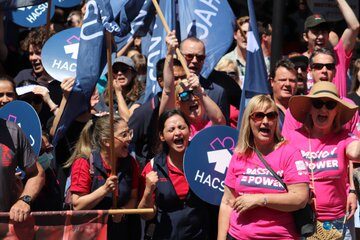
Thousands of public sector workers have rallied across Tasmania for better pay and conditions, flagging further industrial action around Christmas if their concerns aren’t addressed.

State school teachers and support staff, health workers, firefighters, cleaners and child safety officers were among those to walk off the job on Wednesday afternoon.

Premier Jeremy Rockliff labelled the strikes disappointing and disruptive.

He has previously described the state Liberal government’s pay offer of a 3.5 per cent rise in year one followed by three per cent rise in years two and three as final.

The government has also offered workers payments of several thousand dollars.

“Good faith negotiations mean listening and responding … our government has done that at all levels, with three separate wage offers made to public sector unions since September,” Mr Rockliff said.

Some unions claim they have not received a comprehensive offer, while Unions Tasmania secretary Jessica Munday said the proposed deal was not up to scratch.

She said it doesn’t address recruitment, retention and workload problems.

“The premier will need to revise his final offer,” Ms Munday said.

“I really hope that he looks at the depth and breadth of public workers who have turned out across the state.”

Thousands rallied outside parliament house in Hobart and at other major cities, as well as towns and regional centres, in what the union called the biggest strike in years.

Health and Community Services Union state secretary, Tim Jacobson, said the government would face a Christmas of heavy industrial action if the government didn’t properly come to the table.

“This was a shot across the government’s bow. They should now listen (and) put competent negotiators in front of us so we can get these issues solved,” he said. 

United Firefighters Union of Australia representative, Robin O’Brien, said even if members accepted the government’s offer, they would still be the lowest paid in the country.

Australian Education Union Tasmania president David Genford said stressed teachers had been left with no choice but to strike.

There has been a spike in teachers leaving the profession, with 271 permanent state school employees quitting in 2021/22 compared to 182 the previous financial year.

-AAP