Uncategorized

‘China Bookshelf’ project launched at University of the Western Cape, South Africa

THE “China Bookshelf” project was launched at the University of the Western Cape in South Africa on Nov. 3, 2022. Initiated by China Energy Investment Corporation Longyuan South Africa Renewables, it is the first project of its kind undertaken by a Chinese company in South Africa.

The project is based in the library of the Confucius Institute for Chinese Medicine in the main teaching building of the University of the Western Cape, where Longyuan South Africa Renewables built the bookshelves and provided a total of 360 books in different categories such as Chinese series, anti-epidemic documentaries, cultural development, literary works, technological innovation and Chinese language teaching.

The opening day was attended by representatives from the University of Johannesburg, Rhodes University and Stellenbosch University in South Africa, the University of Sussex in the UK and Zhejiang Normal University in China.

To fully showcase Chinese culture to South African university students, the site also introduced Chinese tea culture, Chinese medicine and other related knowledge through a combination of scenes and displays.

Umesh Bawa, Director of International Relations Office at the University of the Western Cape, and Zeng Liren, Chinese Co-Director of the Confucius Institute for Chinese Medicine, attended the opening ceremony and delivered speeches, in which they acknowledged the opportunity and platform provided by the project for students from both countries to exchange and learn, and highlighted Longyuan South Africa Renewabale’s sponsorship and support for the event and its positive contribution to China-South Africa friendship and cooperation.

SUPPLIED

Government must ensure quality inclusive education for children with disabilities:Ramaphosa
Uncategorized

Government must ensure quality inclusive education for children with disabilities:Ramaphosa

EFFORTS must be made to ensure quality inclusive education for children with disability, President Cyril Ramaphosa told delegates at the Summit on Economic Empowerment for Persons with Disabilities in Ekurhuleni on Thursday.

“We need to provide quality inclusive education for children with disabilities. This entails improving and strengthening reasonable
accommodation support measures for learners in both special and ordinary schools,” Ramaphosa said.

[EXHIBITION]: Economic Empowerment of and for Persons with a Disability

The theme for this year’s #DRAM2022 is “Empowering persons with disabilities through resourceful, sustainable and safe environments”.#LeaveNoOneBehind pic.twitter.com/FpNHu4B6pq

— Presidency | South Africa (@PresidencyZA) December 8, 2022

He urged stakeholders to ensure that children with disabilities in ordinary schools have accessible learning materials no matter where
the school is located.

[EXHIBITION]: Economic Empowerment of and for Persons with a Disability

The theme for this year’s #DRAM2022 is “Empowering persons with disabilities through resourceful, sustainable and safe environments”.#LeaveNoOneBehind pic.twitter.com/fHmR0lDDJq

— Presidency | South Africa (@PresidencyZA) December 8, 2022

The government has developed a process to review Education White Paper 6 on Inclusive Education towards developing full-service
schools and inclusive methods in mainstream schools.

Ramaphosa emphasised that all children, including children with disabilities, need to receive a quality education wherever they are
and whatever their circumstances.
“Let us work together to build an inclusive and transformative society where the needs of all are advanced with equal priority and equitable resourcing. Let us work to give practical meaning to the principle of ‘nothing about us, without us,” said Ramaphosa.

“Let us emerge from this summit not only with a clear sense of what needs to be done to empower persons with disabilities for economic and financial inclusion, but also with a renewed determination to make it happen.”

Ramaphosa directly asked Minister of Women, Youth and Persons with Disabilities Maite Nkoana-Mashabane to ensure that barriers
that impede the meaningful participation of persons with disabilities in all areas of public life are practically removed.
All areas in which persons with disabilities face discrimination through, for example, increasing job and training opportunities, promoting
inclusive education and ensuring access to health care services must urgently be removed.

These outcomes include the prohibition of discrimination on the basis of disability across the employment value chain, and that persons
with disabilities have equal access to just and favourable conditions of work.

He said role players can assist to enable persons with disabilities to access technical and vocational guidance programmes, placement
services and continuing training.

In an effort to actively promote employment opportunities and career advancement for persons with disabilities, appropriate policies
will be looked into which will include affirmative action programmes, incentives and other measures.

The President promised to mobilise collective resources in both public and private to promote opportunities for self-employment,
entrepreneurship and the development of cooperatives.

For its part, the government has introduced targeted programmes on economic empowerment that include a procurement
target of 7% for companies owned and run by persons with disabilities.

INSIDE EDUCATION

Uncategorized

53 Grade 12 Etwatwa pupils write rescheduled paper

WENDY MOTHATA

THE Gauteng Education MEC, Matome Chiloane is on Thursday visiting Etwatwa in Ekurhuleni to extend his well wishes to the 53 matriculants from Phandimfundo Secondary School for their rescheduled Economics examination paper.

This follows an incident where the matriculants were allegedly prevented from writing their Economics Paper 1 exam on November 1, 2022, due to false reports of service delivery protests in the area at the time.

Spokesperson Steve Mabona said the Department of Basic Education gave these learners a concession to write this paper on Thursday, December 8, 2022.

“The Department of Basic Education gave these learners a concession meaning that they can write this paper, which they could not write in the initial stages. So, the MEC will be wishing them well before they write their examination,” he said.

Rewrite opportunities have been granted in the following selected subjects:

Mathematics Paper 2: Mpumalanga Department of Education
Mathematical Literacy Paper 1: Eastern Cape Department of Education
Mathematical Literacy P2: Mpumalanga Department of Education, Eastern Cape Department of Education and North West Department of Education
Economics P1: Gauteng Department of Education
English First Additional Language Paper 1: Limpopo Department of Education and Western Cape Department of Education

According to the department, some of the reasons for the missed examinations include:

– Candidates who experienced technical glitches during the writing of Computer Applications Technology Paper 1 and Information.
– Technology Paper 1 or who, due to load shedding. could not complete the examination.
– 53 Economics P1 candidates from Phandimfundo Secondary Gauteng who missed the exam due to the principal’s actions.
– 1 127 candidates from seven schools in Witbank, Mpumalanga, who missed exams due to community protest actions.
– Two pregnant learners from the Western Cape and Limpopo, who were not allowed to write English P1.
– Three learners from the North West, who missed Maths Literacy Paper 2 due to flooding.
– Four learners from the Eastern Cape, who missed Maths Literacy P1 and P2 due to the principal’s actions.

Marking sessions will commence on 10 December and conclude on 22 December 2022. The department said that all PEDs are on track with their marking preparations.

Basic Education Director-General Hebert Mweli is today visiting various marking centres in Gauteng and engaging with markers. Marking of the #2022NSCExams has started.#MatricExams #MatricClassOf2022 pic.twitter.com/wlolsrlqx3

— Inside Education (@Inside_Edu) December 8, 2022

“Scripts are currently in storage. Scripts will be moved to marking centres from the 7/8 December 2022,” the Department of Basic Education said.

-INSIDE EDUCATION

Ramaphosa urges Science Forum to use science to fight poverty, restore human dignity 
Uncategorized

Ramaphosa urges Science Forum to use science to fight poverty, restore human dignity 

President Cyril Ramaphosa urged participants at the World Science Forum to explore ways to use science in restoring human dignity, reducing inequality and poverty. 

He delivered a keynote address at the opening session of the World Science Forum (WSF) in Cape Town on Tuesday. 

“Today more than ever, science is called upon to assist humanity in responding to the key challenges of our time, including disease, climate change and food insecurity,” Ramaphosa said. 

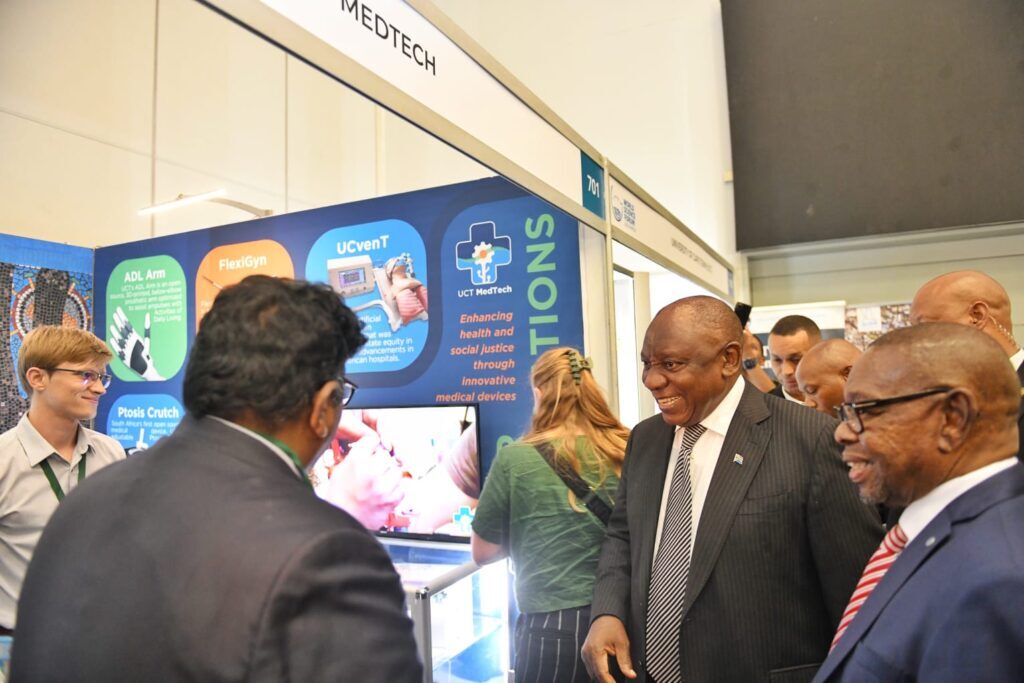
President Cyril Ramaphosaand Minister Dr Blade Nzimande meeting and greeting exhibitors at their various stalls as they entered Exhibition hall 2, World Science Forum opening session

Delegates must ensure that the Forum will not only be a platform for vibrant discussion, but will also lead to concrete actions harnessing science as an instrument for social justice, he added. 

The theme for the Forum is Science for Social Justice. He told delegates that inequality within and between countries is neither just nor sustainable.

For the event to be successful, he said it must inspire concerted global action for science to challenge and address inequality, injustice, poverty, environmental destruction and marginalisation.

“By hosting this Forum, South Africa is demonstrating its strong commitment to international cooperation in science. Science progresses when nations work together,” Ramaphosa said. 

It is the first World Science Forum taking place in Africa, it is hoped that it will contribute to advancing the African agenda for science, affirming the crucial contributions Africa has to make in enriching global science.

Access to significant collective resources, including cooperation instruments, which can be mobilised for investment in science for social justice.

He said there is a need for collective will and determination to ensure science makes a difference by informing policy that will create a more just and equal world.

Ramaphosa urged delegates to critically consider what role science should play in protecting and enhancing human dignity and in fighting poverty, unemployment and inequality.

Ramaphosa cited the inequality in access to vaccines during the COVID-19 pandemic as an example of a gross violation of human rights and contributed to further loss of life.

The global scientific community demonstrated the value of cooperation in responding with unprecedented urgency to produce COVID-19 vaccines.

Yet, the benefits of that extraordinary scientific work did not benefit all of humanity equally.

This experience, Ramaphosa said, has informed South Africa’s development of a national vaccine manufacturing programme, which includes a partnership with the World Health Organisation through hosting the mRNA technology transfer hub in Cape Town.

-INSIDE EDUCATION

Uncategorized

Ramaphosa opens World Science Forum

President Cyril Ramaphosa is delivering the keynote address at the opening session of the World Science Forum (WSF) in Cape Town.

The President’s participation in the World Science Forum will be a highlight of South Africa’s first hosting of this global forum under the auspices of the Department of Science and Innovation.

The theme for the forum, which will be held at the Cape Town International Convention Centre from 6 to 9 December 2022, is “Science for Social Justice”. 

The WSF takes place every two years and is among the most significant science gatherings worldwide, where scientists from all over the world engage on the role science should play in society.

South Africa’s hosting of the event itself creates significant economic activity in the host city of Cape Town, as well as industries countrywide that support such an occasion.

In hosting this forum, South Africa is looking to promote global debate that inspires action, provide support for African leadership in global science policy discussions, and to promote South Africa as a strategic partner for global science collaboration in response to societal challenges.

Established by the Hungarian Academy of Sciences, in collaboration with the United Nations’ Educational, Scientific and Cultural Organization (UNESCO), the gathering will see renowned thought leaders deliberate on various topics that include science for human dignity, science for climate justice, science diplomacy for multilateralism, and science for Africa and the World.

The event will be a platform for more than 900 leading scientists and decision-makers from politics and industry, representatives of civil society, and the media to express their views on new challenges facing science in the 21st century.

A series of pre-events has also been organised, including a Science Journalism Programme, discussions about the green hydrogen economy, an air-quality fun run in Sea Point and Khayelitsha, excursions to scientific facilities in and around Cape Town, a robotics boot camp for learners, a Women in Science film festival and a breakfast function with the international Square Kilometre Array Organisation.

The Opening Ceremony is taking place at the Cape Town International Convention Centre. 

-Inside Education 

Uncategorized

Section27 granted leave to appeal corporal punishment judgment involving two ‘violent’ teachers

WENDY MOTHATA

Section27, which represents the Centre for Child Law and two parents, was on Tuesday granted leave to appeal the corporal punishment judgment case involving the South African Council of Educators (SACE). 

The case concerns two ‘violent’ teachers who imposed corporal punishment on school learners. 

On Tuesday, Judge Dawie Fourie of the High Court of South Africa, Gauteng Division in Pretoria, granted  Section27’s application for leave to appeal.

Section27 spokesperson, Julia Chaskalson, said the two teachers who imposed corporal punishment on the learners received lenient sentences from SACE.

Chaskalson said Section27 wants the names of the two teachers to be struck off the roll of educators for 10 years.

 “Section27, on behalf of the Centre for Child Law and two parents, will now proceed to file papers at the Supreme Court of Appeal (SCA) in Bloemfontein. The children of the parents we represent were severely injured by teachers, who – despite pleading guilty to corporal punishment – received very lenient sentences from SACE. Both teachers were fined R15,000 but only paid R5,000 each because R10,000 of the fines were suspended. They also received another suspended sentence of having their names struck off the roll of educators for 10 years, which means that the teachers are still in classrooms unless they are found guilty of another offence,” said Chaskalson. 

“We would like the SCA to order SACE to review these sentences so that these violent teachers are no longer allowed to teach after being found guilty of corporal punishment.”

In August 2015, a teacher beat a 7-year-old with a PVC pipe, causing a head injury. The teacher then allegedly assaulted another pupil and left him with a bloody nose. 

In a separate incident, in February 2019, a teacher beat and slapped a 10-year-old pupil over the head, causing her ears to bleed. 

After being granted leave to appeal on Tuesday, Section27’s Faranaaz Veriava said: “Advancing to the Supreme Court of Appeal is an important step towards better accountability for teachers who employ corporal punishment in classrooms.

“Despite corporal punishment being illegal since 1996, SACE continues to allow teachers off the hook when they are found guilty of corporal punishment. We need a stronger institutional response to enforce the corporal punishment ban so that classrooms are safe from violence.”

INSIDE EDUCATION

Uncategorized

Grade 6 Winterveld learner drowns in swimming pool during school trip

GAUTENG Education MEC Matome Chiloane said on Monday he was deeply saddened by the death of a Grade 6 boy learner from Refalotse Primary School in Winterveld, Tshwane.

The learner passed away last Friday during a school trip.

“We are deeply saddened by the sudden passing of one of our learners. We extend our deepest condolences to the learner’s family and the school community at large,” said Chiloane.

According to the department of education, the Grade 6 learners, accompanied by teachers and some parents, travelled to a resort on Friday morning for a school trip.

Upon arrival, learners were assembled for a formal ceremony and proceeded to have lunch thereafter.

After lunch, the learners changed into their swimwear to go play at the swimming pools under the supervision of educators and parents.

It is reported that educators and parents were alerted by learners that another learner was unresponsive in one of the swimming pools.

“The educators are reported to have immediately removed the learner from the swimming pool and tried to resuscitate him while waiting for emergency services and police to respond accordingly,” the department of education said on Monday.

Unfortunately, the learner was certified dead by paramedics upon their arrival.

Police are investigating circumstances surrounding the incident.

Chiloane is expected to visit the school on Tuesday at 8am.

INSIDE EDUCATION

Uncategorized

Qualification for Varsity Football the goal for Madibaz

THE Madibaz football teams will have qualification for the Varsity Football tournaments squarely in their sights when the University Sport South Africa week takes place in Secunda in Mpumalanga.

They will be among a total of 40 men’s and women’s sides that will be chasing USSA glory from December 5 to 9 while also eyeing entry into the prestigious Varsity Football set-up for 2023.

Madibaz Sport football manager Mark Tommy expected plenty of challenges in the national varsity competition but felt that the men’s team would be motivated to make their mark on the back of their recent strong performances in the local leagues.

While the first team ended the 2021/22 SAB Regional League in third place, they are currently leading the 2022/23 log.

This augured well for coach Elrio van Heerden and his troops as they gunned for a spot in the top eight, according to Tommy.

“That will see them qualify for Varsity Football.”

Although he made their goals for the USSA tournament clear, Tommy acknowledged that it would be a tough passage for both the men and women.

“Varsity Football has been dominated by the inland universities as well as the University of Western Cape,” he said. “These are all institutions who have invested greatly in their football programmes.”

The Madibaz men will be up against the perennially strong Tshwane University of Technology outfit and also face stiff competition from the universities of Pretoria, North-West, Free State, Johannesburg and KwaZulu-Natal.

Tommy said women’s coach Niesie Daniels was buoyant about their prospects after several good performances in the provincial competitions.

They finished runners-up in the coastal group of the inaugural Sasol Provincial League after being promoted from the Regional League following the 2021 season.

But Tommy conceded that the USSAs would be “on a different level” because they would be competing against sides who played in the National First Division – including the University of Western Cape, who are currently lying in second, and top-five teams such as TUT, UJ and UP-Tuks.

The top eight men’s and top four women’s teams will qualify for next season’s Varsity Football tournament.

The Madibaz teams are ranked 11th (men) and 10th respectively for the USSA tournament.

SUPPLED

Uncategorized

Jendamark centre at Woodridge College to develop 4IR skills

INDUSTRIAL automation company Jendamark Automation has partnered with independent South African school Woodridge College to develop and equip the Woodridge Innovation and Technology Centre that is focused on readying pupils for a world transformed by the Fourth Industrial Revolution (4IR).

The newly opened centre features the latest 4IR technologies and will give pupils hands-on, practical experience in working with collaborative robots, coding and programming, three-dimensional printing and modelling, artificial intelligence, the Internet of Things, drone flying and more.

“Exposing pupils to this type of advanced and integrated technology, which is focused on the 4IR, will give them the skills and the competitive edge when entering university or joining the workforce,” says Woodridge College headmaster Derek Bradley.

The equipment and expertise provided by Jendamark would allow the centre to meet the goals the partners had jointly set. Real-life applications are a critical aspect when teaching children about a subject, he emphasised.

Further, while keeping a curriculum up to date with the rapid revolution of the working world was challenging, a focus on skills development was key to navigating change, says Woodridge deputy head for academics Dr Catherine Logie.

“If one has a curriculum which not only focuses on content but also on skills, then the content becomes a means to an end and pupils are able to adapt and learn as environments change. Having partners outside the fields of education gives teachers the opportunity to learn new things and adapt their lessons.

“A tech centre is not just about coding or robotics but is about having a space which is equipped differently from a standard classroom where pupils and teachers can explore parts of the curriculum. Already the Physical Sciences department is looking at how they can utilise the space and some of the equipment for expanding their practical work on motion. The new centre will generate renewed excitement around learning,” she said.

Additionally, it was exciting for the school to be leading this education revolution and expanding its digital programme offering, notes Woodridge Information Technology (IT) department head Nicholas Kock.

“In addition to our IT, computer-aided translation and computer literacy programmes that we currently offer in our existing computer labs, the new centre allows us to implement 4IR technologies and twenty-first-century skills,” he notes.

These skills included problem-solving, computational thinking, awareness of the social and ethical issues around technology as well as its responsible use.

“Our pupils are extremely fortunate that we have partnered with Jendamark, as this is an organisation that is using the latest technology in their production lines and in their research and development,” he added.

Meanwhile, Jendamark decided to partner with Woodridge College as they shared the view that learning should take place through practical experience, not just classroom theory, Jendamark operations director Siegfried Lokotsch says.

“We have a passion for education and have a long-term vision to provide relevant learning and ed-tech to pupils. While there is a rise in demand from parents for schools to offer robotics and programming, we also realised that they do not really understand what it is all about. Therefore, we are also trying to educate parents and children about the real-world relevance and possibilities of 4IR,” he highlights.

Additionally, if the Woodridge pilot proved to be a success, Jendamark hoped to replicate the model in the future.

Further, in addition to providing on-going technology support and regular equipment upgrades, Jendamark will facilitate tours of its manufacturing plant where it builds and exports high-tech automotive component assembly systems.

Here, pupils will see the real-world, industrial applications of what they are learning in action and be inspired to explore possible career options, such as engineering or software development.

Jendamark’s ODIN technology team will collaborate on the curriculum offered to ensure that it remains relevant to the needs of industry, Lokotsch says.

The initiative is in line with the strategic plan for the school which was commissioned some 18 months ago, says Woodridge Trust chairperson Andrea Puggia.

“Two key strategic goals that emerged from this plan were the need to provide a relevant curriculum that produces innovative problem solvers, and to ensure Woodridge has the infrastructure to meet the strategic needs of the school.

“This project embodies both goals and it is most gratifying to see the strategic plan being integrated into the fabric of the school,” she says. 

Engineering News

Uncategorized

African scholars and their impact need to be more visible

“Agroecological intensification; reducing chemical inputs while building soil health and microorganisms; fostering diversification, alongside social and political transformations needed to guarantee equity in food systems, must be ramped up urgently to create resilient food systems that can withstand climate change, conflicts and other shocks.”

This is according to Dr Susan Chomba, a Kenyan social scientist, who is the director of Vital Landscapes for Africa at the World Resources Institute. During an interview with University World News, Chomba shared her experience at the recent COP27, where she was a presenter on pathways to resilient agricultural and food systems in Africa.

UWN:What is your main field of expertise and how did your work in climate change begin?

SC: My main field of expertise is forestry and agriculture, and how these two interact with each other, shaped by people, and then having positive or negative outcomes for people, nature and climate. It requires systems thinking to connect the dots.

I began my work, on climate change specifically, back in 2007 as a researcher at the World Agroforestry Centre in Nairobi, where I was tasked with synthesising and providing evidence to the African Group of Negotiators on the forest and land use sectors’ role in mitigation and adaptation.

UWN:What is the focus of your work at the World Resources Institute and how is it relevant to climate action?

SC: My work focuses on food systems transformation, landscape restoration, nature protection and the securing rights of indigenous groups and local communities. I also oversee our work on water.

There is an inherent link between food systems, nature and climate in Africa because a big percentage of productivity increase in agriculture comes from expanding into natural ecosystems, and this increases our carbon dioxide emissions, while leading to biodiversity loss.

Consequently, the more we degrade our natural capital base, the more our food systems become vulnerable to climatic shocks.

Looking into the future, we need to think about building resilient food systems in Africa. This will involve a lot of modelling and scientific research that helps us to factor in changes such as climatic shocks and demographics, while taking advantage of our local knowledge systems and the diversity of indigenous African foods (vegetables, legumes, fruits, cereals and root crops) that are resilient to droughts, rich in nutrients.

We risk losing this diversity of crops because of the current industrial models that prioritise, breed and promote a few crops.

Some of the greenhouse gases that cause global warming come from food systems – the way we produce, transport, process, package and consume food. We can’t solve the climate crisis without addressing emissions in the food systems, and that’s a major part of our work.

While greenhouse gas emissions from Africa remain relatively low, there is more urgency to adapt and make our food systems more resilient to climatic shocks. It is crucial to also think about the scenario of feeding a rapidly growing population that is projected to double by 2050, and what that means for emissions.

Rather than wait until Africa’s emissions skyrocket, we are looking at innovations that help us to transition our food systems so that we do not have huge levels of emissions like we have in the rest of the world. This form of leapfrogging is important and is only possible with contextualised solutions.

UWN:As a climate scientist and researcher, against the backdrop of COP27, what are some of ways of building sustainable agriculture and food systems in Africa?

SC: During this COP, I have been providing a few key transformation pathways for food systems in Africa that can really help us move forward. One, we need agroecological intensification in our production systems. The High-Level Panel of Experts (HLPE) produced a comprehensive report in 2019 laying out 13 principles for transforming our food systems.

If we can work towards those while paying attention to contextual variabilities and applicability of those principles, we would make tremendous progress. In line with this, we need to restore degraded lands to enable sustainable production. At least 60% of the land used for agricultural production is degraded on the continent and that is why initiatives such as the African Forest Landscape Restoration Initiative (AFR100) are needed.

In our effort to restore these landscapes, we must resist the urge to only count trees and the number of hectares regreened, but look at how restoration impacts food security. You can have negative or positive impacts on food security, depending on how you restore landscapes.

The second pathway is to invest heavily in reducing food loss and food waste on the continent. At least a third of the food produced globally is wasted and this extends to our region where we have millions of people starving. This is unconscionable.

We have constantly evolving solutions for food loss and food waste, but the scaling requires financing, policy and partnerships. Through our circular food systems project in Rwanda, for example, we have seen endless innovation by private sector and small and medium enterprises to address food loss and waste that can be scaled.

The third area we need to focus on is dietary shifts. There are many campaigns to reduce meat and milk consumption because they have a huge carbon footprint in the Global North.

We have an opportunity in Africa to have a different discussion about our dietary shifts and, in this case, we need to focus on the diversity of crops that will help us close the malnutrition gap, lower the diseases burden that comes from consumption of unhealthy foods and create value and market for our local foods. We need to promote a diversity of foods that are indigenous, resilient to climate change, nutritious and require less production inputs.

The last one is on trade. Policies such as the African Continental Free Trade Agreement that was enacted in 2021 offer a window of opportunity to shorten our value chains. It also increases inter-African trade.

This will help us reduce our carbon footprint and reduce reliance on imports that are susceptible to shocks that are outside our control – for example, the war in Ukraine – and divert our foreign exchange to food that we can clearly produce.

That trade must also benefit smallholder farmers and the trickle-down economics has not been effective at achieving that without proactive measures that enable farmers to aggregate, collectively negotiate better prices and market access.

UWN:What role are universities and research centres playing in climate innovation, especially the transition to clean energy?

SC: Research and innovation are fundamental to ensuring that the African continent transitions to clean energy, both for domestic and for industrial use, and growth.

For instance, we need clean cooking options to help rural women who use biomass for cooking, which has negative impacts on their health and negative environmental impacts.

Universities and research institutions have a role to play in innovating around clean energy on the continent – whether it’s geothermal, solar, wind, or other renewable forms of energy.

Some of the key issues affecting our research and academic institutions include the lack of access to sustainable funding that can help them invest in long-term research, innovation and experimentation.

There are many conditions in our countries that must be shifted to allow researchers to establish their research careers and to prevent the continent from brain drain, whereby most of its brilliant scientists migrate to the developed world.

UWN:How has COP27 been helping to empower universities and researchers to increase their impact on climate action?

SC: We saw a proliferation of scientific evidence being presented in different pavilions and, obviously, the very solid evidence that is used to inform the COP negotiations, which is produced by the Intergovernmental Panel on Climate Change (IPCC) reports both on adaptation and mitigation.

Research is crucial for any discussions around the COP because we need to ensure that the options we are putting forward to climate change negotiators for both mitigation and adaptation are based on solid evidence.

There is work to be done on the COPs to ensure that whatever is being discussed in the pavilions is synthesised and presented on the negotiation table because, unfortunately, the two processes seem to be running parallel at the moment.

Being an African scientist and researcher, I was very conscious of the under-representation of African researchers, scientists and academics, even in a COP that was held on African soil.

We need to see more visibility of African scholars and how their science is being used to inform transformation pathways for the continent.

It is also important that we look into the number of African academic institutions that are accredited to be part of the COP process and to ensure that they have the resources to be able to attend. For example, this last COP has been extremely expensive, especially on accommodation, and this can lock out scholars in the Global South from participating.

UWN:What was different during COP27 compared to previous gatherings? What would make COP27 be considered a success?

SC: COP27 was happening on African soil, so issues that are pertinent to the continent have been at the forefront at this conference and that is amazing. We have had discussions and sessions on loss and damage, adaptation and food systems.

A successful COP27 must recognise the issues affecting one of the most vulnerable regions in the world – in other words, Africa – and one that contributes the least to emissions (less than 4% of total greenhouse gas emissions) and yet is heavily impacted by climate change.

It is important to recognise those issues and ensure that they are not left in Egypt, but that they proceed towards COP28.

We must not lose focus on the urgency of loss and damage and increasing adaptation finance, even as we know mitigation is a priority for the Global North. Above all, we must see action.

We have to ask the hard questions on what institutional changes are needed so the funds reach affected communities at the speed and scale required to help them adapt to climate change.

University World News