Uncategorized

Classroom Management | Futureproofing our children through play

SCIENTIFIC research over the past 30 years has shown that the most important period of human development is from birth to eight years old.

In the first few years of a child’s life, more than one million neural connections are formed each second, a pace that will never be repeated.

Proper early childhood development (ECD) stimulates brain growth; sparks creative thinking; improves communication, vocabulary and language. This is according to the United Nations Children’s Fund (UNICEF) research that also shows that early childhood development promotes impulse control and emotion regulation.

Although learning takes place throughout life, the pace of learning in early childhood will never be equalled again.  To maximise this pace of learning, the independent education provider, Curro Holdings has implemented the Curiosity Approach programme across four of its nursery schools.

The Curiosity Approach considers the crucial component of early childhood learning – free and uninterrupted play. An early childhood education setting should be a place where children discover a love for learning through a variety of play experiences.

The programme stems from the UK and has grown to become a world-wide education solution. Its methodology encompasses the latest global trends in ECD, where it has proven to be more successful than traditional teaching methods currently being followed by most ECD centres.

Locally, the programme was first implemented in 2019 by Curro Rosen Castle which is now the only official Curiosity Approach School in South Africa. To date, three more schools have joined this programme – Curro Fourways, Curro Chartwell and Curro Bryanston.

According to Sally Langerman, Operational Head at Rosen Castle, the Group adopted this approach because of its exceptional global results in developing children holistically.  “All children deserve a  learning environment where play is recognised as important, where nature is weaved throughout the learning process, where learning also takes place outdoors with the use of all senses and where the focus of the school is on the individual child,” she adds.

“We have seen dramatic results in many areas. Our environment is much calmer with all the bright colours and restricting furniture being removed. It’s unbelievable how this immediately calms the classroom environment. Children don’t run around in the space, they lose that edge, and instead become more intentionally engaged in the environment and the learning process,” says Langerman.

The Curiosity Approach is based on four pillars:

Uninterrupted free play;Changing traditional school settings to a more natural, comfortable and engaging environment that has the child at its centre;Reducing visual over-stimulation and instead increasing multi-sensory learning utilising and incorporating nature throughout the day;Ensuring children maximize every day of their early years – it’s precious. It should not be spent full of adult directed routines.

Langerman says Curro’s Grade R teachers are thrilled with the quality of learners who are coming through to them and have commented very favourably on their readiness to learn.

The Lego Foundation reports that 94% of businesses say they expect people to learn new skills on the job, and the skills they most want to see are critical thinking, problem-solving, active learning, resilience, stress tolerance, creativity, and flexibility. These skills are closely linked to the five super skills that children develop naturally when they learn through play, which makes it a no-brainer when considering ECD options for your child. 

Uncategorized

North West Education provides school-based training to address bullying and drug use

STAFF REPORTER |

THE North West Department of Education has on Tuesday conducted training for the senior school management across the province with the aim of fighting the scourge of bullying and use of drugs in school.

The department held training with principals, deputy principals, head of Departments and school safety officers.

“In an effort to fight back the scourge of bullying and drugs in schools, the North West Department of Education has conducted an intensive training of arming the Senior School Management across the province,” said the provincial education spokesperson Elias Malindi.

Malindi said that the training covered the drug situation in the North West and the effects of drugs.

“The training covers the drug situation in the North West schools, definition of drugs, signs and symptoms of drug usage, effects of drugs in the school environment, legal aspect of drugs testing and training, drug testing practicals and stakeholder analysis,” he said.

The department said the National School Safety Framework training has been added since it is the umbrella under which all school safety programs fall.

“This tool kit covers school safety in a holistic manner and is approved by the Department of Basic Education as a guide for school safety in all South African schools,” said Malindi.

The MEC for Education in the North West province, Mmaphefo Matsemela emphasised that the school management team should be equipped to detect bullying and drugs usage in schools.

“Since bullying is a major issue in our schools, there is a need to equip schools on how to deal with the scourge. Participants were equipped on the definition of bullying, different types of bullying, how to deal with bullying, possible anti-bullying activities, bullying action plan and possible stakeholders,” said Matsemela.  

The MEC said positive discipline and classroom management was also offered in the training.

“One method of curbing violence in the schools is to deal with corporal punishment in the schools. Positive discipline and classroom management is also offered in this training as a means of replacing corporal punishment and encourages schools to take back the authority in the classroom in order to take the school a place of safety, teaching, and learning”, said MEC Matsemela.

“This training in essence covered school safety in total and there is a monitoring programme which will be adhered to by schools for implementation processes,” said Malindi.

-Inside Education

Uncategorized

 Makgofe High School in Limpopo closed following ‘unusual behaviour’

STAFF REPORTER |

THE management of Makgofe High School outside Seshego, Polokwane released their learners on Thursday after many learners were found collapsing due to some unusual occurrence.

According to a learner who’s doing grade 8 at the school, she said that one of their classmate collapsed and started crying out loud.

“A we were seating in class; the teacher was busy. Suddenly there was noise at the back, when I looked back one of my classmate collapsed on the floor. She was creaming out loud and also shaking,” said the student.

She further added that the teacher requested all the learners to go outside of the class.

The school called some of the parents to come and fetch their children while some learners and teachers were told to leave the premises.

The Limpopo Department of Education said that they are looking in to the matter.

The Spokesperson for the department Tidimalo Chuene said that the school reported that 40 learners from various grades displayed “strange behaviour.”

“The school reported that the learners’ behaviour did not resemble any physical illness.  As the department, we still don’t know what caused their fainting or why they fainted. We don’t want to speculate but we are concerned,” Chuene said.

The Spokesperson said the education department will work together with psychosocial experts to assist.

“We will bring the psychosocial experts to assist with the situation, so that teaching and learning can resume,” said Chuene.

Inside Education

Uncategorized

KZN school admissions for the year 2023 opens

STAFF REPORTER |

THE KwaZulu-Natal Department of Education has announced that the applications for the 2023 academic year is currently underway.

The applications opened on the 1st of Match and it will close on the 30th of September 2022.

The Education Department has urged guardians and parents to register their children on time to avoid late registration in January 2023.

“Applications for the 2023 academic year are currently underway from the 1st of March to the 30th of September 202 Apply early to ensure a smooth start to your child’s academic year,” the department said.

The department said parents and guardians must avoid late applications as it hinders the children’s learning.

The provincial MEC for Education, Kwazi Mshengu said, “as the Department of Education in KwaZulu-Natal, we urge parents to heed this call of early registration of learners.”

He further added that registering children on time will give educators ample time to sharpen the learners’ future.

“This will assist the system, especially our educators to have ample time to sharpen our learners and secure a bright future for them as well as the nation,” said Mshengu.

The department urged parents to enroll learners for entry into grades 1 to 8.

The department encouraged parents and guardians to apply for a minimum of three schools in order to make sure that they secure space for their children.

The department further encouraged guardians and parents to follow up on the progress of the applications three months after submitting.

-Inside Education

Uncategorized

Education MEC calls for independent panel to investigate racism allegations at KZN school

KWAZULU-NATAL Education MEC Kwazi Mshengu has promised to appoint an independent panel by Friday that will help deal with racism allegations that have surfaced again at Grosvenor Girls’ High School in Durban.

Last week the classes were disrupted at the school following the alleged racism allegations.

The learners are accusing the teachers of calling them monkeys and other derogatory terms.

The MEC visited the school on Tuesday to speak with learners, the school governing body and the school management.

He has instructed the department’s head of department to appoint the panel.
In 2019 the school was also marred by the same allegations of racism and the MEC said the panel will appoint will help in resolving the issue once and for all.
He acknowledged that the department made a mistake of not appointing an independent panel when the issues of racism surfaced in 2019.

He encouraged students to give their personal accounts to the panel.

“When findings and recommendations are made before us we will act without fear. It is better to get an independent panel,” said Mshengu.

Further, the MEC explained that the department wants to deal with these issues expeditiously and added that he has advised that the panel be given clear time frames with deadlines.

Members of the Economic Freedom Fighters (EFF) tried to disrupt Tuesday’s meeting and the MEC said it was unfortunate that the party wanted to take the opportunity while the department is trying to work on the issue.

“We will deal with anyone involved in these allegations of racism and maladministration. We are not going to succumb to the pressure from the EFF and cut corners because ultimately if we do that, we will not serve justice to the learners,” he added.

The independent panel will be given 21 days to finish its investigations and the MEC pleaded with learners to allow teaching and learning to continue during that time.

“Learners must be in class so that they don’t lose time in terms of teaching and learning,” he stressed.

-Engineering News

Uncategorized

CLASSROOM CORNER| E-learning technology made available to more than 2 000 learners

A South African-developed e-learning education system has been made available to more than 2 000 pupils in the Eastern Cape, Limpopo, KwaZulu-Natal, the Free State and Gauteng – many of them underprivileged.

The system, which was developed by education technology (ed-tech) business Odin Education – a division of South African technology company Jendamark Automation – comprises a locked digital tablet that can only be used for educational purposes, curriculum-aligned content which is personalised for each user, and full-time online support.

The technology uses behavioural data to learn which educational content pupils are enjoying most and then pushes more of it to them.

The aim of the system is to supplement in-person schooling. Each device is loaded with mobile data, educational apps and learning platforms, and is tailored to each pupil’s subject choices. It then gathers information from its user’s interactions and serves them more of the academic and extramural content in which they are interested.

The e-learning system, which is being distributed privately through corporate social investment (CSI) initiatives, will next be provided to learners in the Western Cape.

The most recent recipients of the system were 215 Grade 12 pupils at Gqeberha’s Woolhope Secondary School, in the Eastern Cape, who received their digital devices towards the end of January. The donation was sponsored by couplings supplier SJM Flex, financial company DG Capital and technology developer Rockwell Automation.

“If this is used effectively, every pupil who has one will benefit,” Woolhope Secondary School principal AJ Jaram said at the handover event last month.

He said Odin Education’s ed-tech system would help equip pupils for the Fourth Industrial Revolution, which was changing the way we lived and worked.

Woolhope Secondary School student leader Beyonce Jacobs, who had the opportunity to trial the Odin Education system with fellow students last year, claimed it had helped deliver a 100% pass rate for her Grade 11 class – despite the disruptions caused by Covid-19.

“It’s quite stressful, not coming to school every day and knowing that there are trials and final exams coming up. The Odin Education system will take a bit of the pressure off because our textbooks are on it, plus it also has many more ways to explore and learn,” she explained.

Woolhope Secondary School learner Sinovuyo George added that the system represented a significant leap forward from the WhatsApp chat forums they had previously used for learning during lockdown.

“This is better, because there are videos explaining the entire lesson, among other learning resources,” she said.

SJM Flex human resources manager Rajes Padayachie – a Woolhope Secondary School alumna – said many of the company employees’ children attended the school.

“Our social responsibility initiatives are aimed at the empowerment of both our employees and the broader community. We believe that enriching the lives and minds of young people is investing in a self-reliant, dynamic and independent generation,” she said.

Padayachie said the company would explore ways to donate additional devices to learners.

For Rockwell Automation, one of the standout features of the Odin Education system was that it was designed in such a way that pupils could not use mobile data for social media or applications other than e-learning.

“Therefore, we are able to monitor the real value of the programme to learners,” said Rockwell Automation industry account manager Devendree Ankiah.

The opportunity to provide access to educational resources and being able to choose the beneficiary school for the donation of the devices were attractive aspects to the company.

“We have invested heavily in [science, technology, engineering and mathematics] education. To collaborate with a company focused on education is something that speaks to our hearts,” she said.

“Education is where our future opportunities lie, and we regard education as the backbone of any promising career. Being able to support this cause by way of technological investment is a great way for DG Capital to assist in shaping the lives of our future leaders,” added DG Capital director David Edwards.

Odin Education head Ajit Gopalakrishnan noted that CSI was key to getting more digital devices rolled out countrywide.

“It’s a [CSI] programme that has a quantifiable impact and can be tailored to any company’s regional footprint, while also delivering real-time [return on investment] impact reports and [broad-based black economic empowerment] points in return,” he concluded.

-Engineering News

Uncategorized

SCIENCE CORNER | Coding initiative to train 10K learners without computers

CODING skills development initiative Coding 4 Youth has set a target to train 10 000 young people in coding, in February and March, through the Unplugged Coding project.

Coding 4 Youth is a Leva Foundation project run in partnership with the Nelson Mandela University. The aim of the project is to reach 10 000 local learners by the end of March, using three coding apps: Rangers, Boats and Tanks.

Each month, the Leva Foundation, a social upliftment organisation, partners with a registered non-profit organisation to focus on specific initiatives, enabling it to serve communities in all stages of life.

The organisation empowers teachers in disadvantaged communities with various “Unplugged Coding” tools to teach learners coding skills, without the use of computers. The coding games available in Tanks, Rangers and Boats apps have already been used to reach thousands of learners directly, while hundreds of schools have received the coding kits, according to Leva Foundation.

The approach is to use physical activities such as games, and pen-and-paper exercises to introduce learners to coding, instead of computers.

The initiative offers coding kits which interact with the Boats (Grade R to 3) and Tanks (Grade 4 and higher) coding apps, to impart skills to the young learners using tangible tokens and image recognition.

Tanks has 35 levels, whereby players need to get the tank to the destination in each level. The tank can only be moved when the player uses the physical puzzle pieces they are given to build the code. Once the code has been pieced together, learners use the smartphone’s camera to upload a picture and move the tank.

Going offline and teaching coding through hands-on games and learning activities is gaining momentum, with industry insiders saying unplugged coding can be just as effective as online learning, when the right approach is taken.

Professor Jean Greyling, HOD of the Department of Computing Sciences at Nelson Mandela University, describes the Unplugged Coding project as a “low-tech solution” for the skills needed in a “high-tech” digital economy.

“The 10 000 target will be reached as a team effort, with teachers, NGO workers and ‘coding evangelists’ presenting workshops which are held at schools, in libraries or in communities where NGOs operate. This is truly a solution from Africa for Africa,” explains Greyling.

“Our project makes use of customised tokens (puzzle pieces), image recognition and standard smartphones to introduce learners to coding concepts. We also develop offline lessons which interact with our apps to introduce not only coding and algorithms, but also digital design, computational thinking and digital citizenship to the lessons.”

The initiative is sponsored by AWS in Communities, a corporate social responsibility initiative by Amazon to help thousands of students worldwide gain access to science, technology, engineering, the arts and mathematics education opportunities in fun and imaginative ways.

The Rangers and Boats apps were developed by Byron Batteson, a computing sciences honours student at Nelson Mandela University, in 2017.

The project is now endorsed by the university as an important engagement project, winning various local, national and global accolades, including a plenary invite to Unesco’s Mobile Learning Week in Paris. Last year, it was a top winner in the Falling Walls awards, organised from Berlin, Germany.

The Unplugged Coding seeks to reach learners beyond the borders of SA, with other African countries being reached through partnerships in Botswana, Tanzania, Kenya, Uganda, Nigeria, Ghana and Burkina Faso.

It will culminate in various physical and virtual coding tournaments towards the end of March.

“For me what makes the Rangers and Boats apps so exciting is that it is not only genuinely fun and easy to learn, but that it bypasses the need for expensive technology in Africa,” says Ryan le Roux, CEO of Leva Foundation.

“The project happens within the context of the fourth industrial revolution and the desperate shortage of software developers in most of the world. The sharp move to more online activities because of COVID 19 has resulted in an even higher need for programmers and the learning experience is accessible and attractive to both learners and educators.”

-ITWeb

Uncategorized

SPORTS CORNER | Nine West African Sports Stars Taking a Stand for Equality, Ending Poverty, and More

FOR many children across Africa, playing sports on the big stage is a childhood dream — scoring the winning goal in a major tournament; throwing that last-minute 3-pointer to clinch the victory at the NBA playoff finals; testing their skills alongside the finest players in the world and rubbing shoulders with other sport icons.

For some, sport is the hope of an exit plan from the communities in which they grew up.

Sports also have a unique power to unite divided groups of people. Just one powerful and symbolic example came in South Africa in the early 90s, amid great tension over the appointment of Nelson Mandela as the country’s first Black president.

Yet, after the South African National Rugby team clinched the World Cup at home in 1995, the crowd filled mostly with white South Africans quickly forgot their animosity. Both white and Black South Africans started chanting with excitement “Nelson! Nelson! Nelson!” across Johannesburg’s Ellis Park Stadium. This moment in time will always be remembered as one of, as the New York Times puts it, the “ultimate examples of sport’s power to heal”.

Sports also help to promote human development. And according to Makhtar Diop, the current International Finance Corporation’s Managing Director and Executive Vice President, “reviving school sports in elementary schools — particularly in the most impoverished areas where children do not have access to sports infrastructure or physical education programs — is an investment for life.”

Many sport stars, on finding success, are returning to their roots and contributing to the economic growth and development of the communities they came from, via poverty alleviation schemes, supporting charitable causes, or investing in facilities to encourage more children to participate in sports. Like Nelson Mandela once said, “Sport has the power to change the world…Sport can create hope where once there was only despair.”

We’ve put together a (non-exhaustive) list of some of West Africa’s biggest sport stars, who are using their platforms to help make a positive impact, transform lives, and uplift their communities.

1. Didier Drogba

Drogba’s name continues to echo in the minds of global football fans three years after the former captain and all-time highest goal scorer for Côte d’Ivoire retired from playing football.

Aside from his prowess on the football pitch, Drogba is also known for his philanthropic work in his home country.

In 2005, during the country’s civil unrest and just moments after Côte d’Ivoire qualified for the 2006 World Cup, Drogba leveraged his global reputation and used his voice to call on his country to end the conflict.

“From the north, south, centre, and west, we proved today that all Ivorians can coexist and play together with a shared aim — to qualify for the World Cup,” Drogba said, in a speech in front of a TV crew gathered with the players in the dressing room of the stadium. “We promised you that the celebrations would unite the people — today we beg you on our knees.”

“The one country in Africa with so many riches must not descend into war,” he continued. “Please lay down your weapons and hold elections.”

Described by the BBC as “one of football’s most extraordinary tales”, change did follow in the weeks and months following Drogba’s speech — which continued to be played on TV sets across the country — and a ceasefire was signed.

Since then, Drogba’s humanitarian activities through the Didier Drogba Foundation, have earned him a quite stunning list of awards and recognitions — including an honorary degree from a university in his home town, Abidjan. 

He was appointed as a Goodwill Ambassador for the United Nations Development Programme in 2007; in 2020, received the UEFA President’s Award, which recognises both professional excellence and exemplary personal qualities; and in October 2021, he became a Goodwill Ambassador for Sports and Health with the World Health Organisation (WHO). Meanwhile in 2009, he also donated £3 million from an endorsement with Pepsi to build a hospital in Abidjan. A champion in every sense of the word.

2. Sadio Mané

Mané, the player of the tournament of the just concluded Africa Cup of Nations (AFCON), is one player who doesn’t shy away from giving back to his hometown. In June 2021, the one-time African Footballer of the Year donated almost $700,000 to help fund the construction of a hospital in his home of Bambali in Senegal. The hospital will reportedly become the first in the village, which is about 400 kilometers outside Senegal’s capital city Dakar.

He’d previously, in 2019, also donated close to $350,000 to build a new secondary school in Bambali, and in 2018, gifted 300 Liverpool shirts to locals there to wear during the UEFA Champions League final. Amid the COVID-19 outbreak, Mané also donated £41,000 to health authorities in Senegal. Without a doubt, despite his success, Mané hasn’t forgotten his roots and the community that raised him.

3. Antonio Rüdiger

The German-born Sierra Leonean, Antonio Rüdiger, is a one-time winner of Europe’s most prestigious soccer accolade — the UEFA Champions League (UCL) — with Chelsea football club. Just last month, the Chelsea FC centre-back launched his charitable foundation for education in his home country of Sierra Leone.

Rüdiger pledged $40,000 to the foundation, as well as auctioning off his signed Chelsea shirt, to help improve the life and access to quality education of the people in his local community. According to him: “This foundation means a lot to me, but I don’t want it to be a one-man show, I want everyone to admire it, especially the younger generation.” He is a player much loved back home in Sierra Leone.

4. Masai Ujiri

Ujiri is a Nigerian professional basketball executive, former player, and the current vice-chairman and president of Canada-based Toronto Raptors Basketball Club.

Back in 2003 and inspired by the impact basketball has had in his own life, Ujiri co-founded the nonprofit Giants of Africa, aiming to use basketball as a way to encourage young children across Africa to dream big. In September 2021, Ujiri and the foundation announced a commitment to build 100 basketball courts across Africa over the next 10 years, including in Nigeria, Kenya, Tanzania, Côte d’Ivoire, and Burkina Faso.

“Sports are one of the best ways that we can help our young people achieve their goals and I look forward to hearing the stories of the thousands of young people who will be able to utlise these courts to help make their communities stronger over the next 10 years and beyond,” Ujiri said.

5 & 6. The Ogwumike Sisters

Next on the list are the Nigerian-American Ogwumike sisters, Nneka and Chiney. Both sisters currently play as forwards for the Los Angeles Sparks professional basketball team, while Nneka also currently serves as president of the Women’s National Basketball Association (WNBA) players’ union.

In 2014, just a few weeks after the abduction of the Chibok schoolgirls — which sparked the #BringBackOurGirls movement — the Ogwumike sisters challenged girls’ basketball teams to intensify their support for the work UNICEF is doing in Nigeria to protect and promote the rights of women and girls.

The Ogwumike sisters partnered with the U.S. Fund for UNICEF’s Girls’ Education Project, with the aim of helping millions of girls better access quality education — with a focus on Northern Nigeria — through getting more children in school, developing scholarships for female teachers, and creating safe spaces for girls.

In a 2019 charity visit to Queens College, in Lagos, Chiney Ogwumike said that “there is more to basketball than having the regular skills set,” further emphasising the need for young children to be focused on their dreams, in a society where it can be hard to do so.

And in 2020, Nneka Ogwumike led WNBA players in advocating for reduced gender pay gaps in the sport. The 8-year collective bargaining agreement for WNBA players will increase the salary cap for women in the sport, as well as creating a variety of career and quality of life benefits for WNBA players — including childcare stipends and full salary during maternity leave.

7. Kamaru Usman

Kamarudeen “Kamaru” Usman is a Nigerian-American professional mixed martial artist and the current UFC Welterweight Champion. In June 2021, during a visit to his home country Nigeria, the UFC champ decided to collaborate with the Lagos Food Bank Initiative to donate and personally share food items to about 1,000 underserved kids in Lagos.

“Being born in a place like Nigeria helped mould me into the man I am today,” he reportedly said at the event.

With it’s 12,000-strong volunteer network, the Lagos Food Bank Initiative, the first indigenous food bank in Nigeria, has been able to reach 1.6 million people in more than 130 communities in Nigeria. You can read more about their work here.

8. Wilfried Zaha

Dazet Wilfried Armel Zaha is a professional footballer for Premier League club Crystal Palace and the Côte d’Ivoire’s national team. The English-Ivorian national uses his Zaha Foundation, spearheaded by him and his family, to help rebuild inner-city areas so young people can better engage in social activities in a secure, accessible environment. 

According to the foundation, this is a “passion” of Zaha’s, “who himself grew up silently developing his craft with his friends on the streets and in park areas.” Zaha has also spoken about how he was left homeless at the age of six while growing up in London, where he moved at age four with his family.

Through his foundation, Zaha also funds an orphanage run by his sister back home and donates 10% of his earnings to these good causes.

9. Anthony Joshua

Anthony Oluwafemi Olaseni Joshua OBE, 32, is a British-Nigerian professional boxer. The 2012 London Olympics gold medallist and two-time former unified World Heavyweight Champion is a strong believer in giving back. On multiple occasions, he’s worked to support the Forever Hope Foundation, a nonprofit that partners with children’s charities and organisations on fundraising.

In 2017, for example, Joshua and the Forever Hope Foundation raised £10,000 to support Great Ormond Street Children’s Hospital in the UK. Alongside this, as highlighted by the foundation, he’s also worked to help raise money for anti-gang crime charities, donated money to help support the rehabilitation of offenders, and donated numerous items for charity auctions — such as a pair of signed boxing gloves.

-Global Citizen

Uncategorized

Nzimande Publishes A Technical Report On the Critical Skills List of the Department of Home Affairs

HIGHER Education, Science and Innovation Minister, Dr Blade Nzimande, has published a technical report on the Critical Skills List of the Department of Home Affairs.

Higher Education, Science and Innovation Minister, Dr Blade Nzimande, has published a technical report on the Critical Skills List of the Department of Home Affairs.

The Critical Skills List technical report provides details of all the processes undertaken in the development of the Critical Skills List, and the actual list gazetted by Home Affairs Minister, Dr Aaron Motsoaledi, on 2 February 2022.

The report follows a Memorandum of Agreement signed by the Higher Education and Training and Home Affairs Departments in January 2020 to facilitate the development of the Critical Skills List.

In terms of the MOA, the Department of Higher Education and Training was mandated to undertake research and produce the technical report which includes the methodology and consultation processes involved in the evidence-based Critical Skills List. The department handed the list to the Department of Home Affairs for consideration.

Nzimande said the Department of Higher Education and Training undertook the research and produced the technical report, titled “Finalisation of the Critical Skills List”, through a major research programme on Labour Market Intelligence.

The Minister said that South Africans live in a globalised economy, where countries often source workers from all over the world to fill gaps in their local economies, and it is therefore, “not surprising that many countries, especially Western countries, regularly compile and publish lists of occupational shortages”.

“The Migration Advisory Committee in the UK publishes a Skilled Occupation List, which is used by immigration authorities to grant special skills visas for potential immigrants. The Australian government also publishes a Skilled Occupation List regularly to draw skilled people into the country. 

“Similarly, Canada regularly publishes a list of Occupations of Demand, which it uses to apply its skilled worker visa. In South Africa, the Critical Skills List forms the basis to offer suitably skilled foreign nationals a Critical Skills visa in occupational areas where there is a dire domestic shortage,” Nzimande said.

Nzimande explained that the development of the new list required extensive collaboration between Higher Education and Training, through the Labour Market Intelligence partnership programme, Home Affairs, a host of other government departments, and representatives from business, labour, community and the broader public.

The technical report can be accessed on the department’s Labour Market Intelligence website: https://lmi-research.org.za and the Department of Higher Education and Training website: https://www.dhet.gov.za

Shock drop in school test marks in South Africa
Uncategorized

Shock drop in school test marks in South Africa

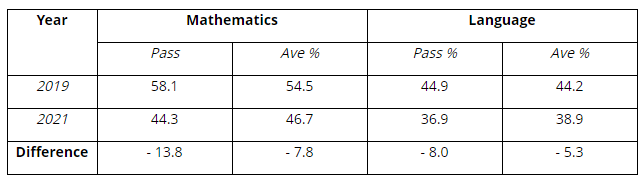
THE Western Cape Education Department has published its latest systemic test results, showing that the COVID-19 pandemic has had a significant impact on learning and teaching in the country.

While schools have now returned to full-time attendance, the test results conducted in the Western Cape in October 2021 provide the clearest, internationally benchmarked and independent analysis of learning losses suffered by the learners in the province, said provincial minister of education Debbie Schäfer.

“While we are the only province to conduct such tests, it is an indication of what the effects of this pandemic are on learners across South Africa. Unfortunately, the results are dire.

“The 2021 results are seen in comparison to tests conducted in 2019, as testing could not take place in 2020. While we had previously made great progress with a steady increase in performance in years preceding 2020, these gains have unfortunately been reversed as a result of the pandemic.”

The results are as follows:

Grade 3 

Grade 6 

Grade 9 

Overall, learners have fallen up to 70% of a school year behind previous cohorts in language, and up to 106% of a year behind in mathematics. The greatest learning losses can be seen in the foundation phase, Schäfer said.

“We have always maintained that the loss of contact (face-to-face) teaching time would affect our youngest learners the most as they do not have the same self-discipline, maturity or structure that our older learners would have to cope with rotating timetables and learning at home.

“The WCED is studying these results and accompanying diagnostics with a focus on updating its learning recovery plans to address these losses.”

The department said it already has a number of programmes underway to improve literacy and numeracy, which we are looking at expanding.

“Most importantly, the extent of learning loss needs to be determined at the classroom level by the teacher. The diagnostics emanating from the systemic testing will be presented as a useful aid to direct the teacher in planning learning programmes for the learners in specific skills and core competencies for each of the grades and subject areas.

“Ultimately, the most important way to claw back these losses is to ensure that every child is at school every day, that teaching and learning time is maximised, and that every effort is made to promote a learning culture beyond the school. Our administrative data from Temporary Revised Education Plans (TREPs) show that between closures and rotating timetables, 155 school days were lost in 2020 and 2021 in our province.”

Schäfer further warned that further disruptions will only exacerbate the existing losses.

– BusinessTech