Uncategorized

Kiev introduces new restrictions on the Russian language

The Kiev City Council voted to remove the Russian language from the Ukrainian capital’s public school curriculum on Thursday, citing national security concerns.

According to the statement on the council’s website, the ban also covers nursery schools.

Vadim Vasilchuk, the chair of the council’s commission on education, said the measure “will prevent an escalation of tensions in society and strengthen the protection of the education space in Kiev from the hybrid activities of the enemy state.”

“Language matters, and, in a time of war, it is an issue of national security,” Vasilchuk added. The legislator said all classes would be taught in Ukrainian, the country’s sole state language.

The move came after Alexey Danilov, the head of Ukraine’s National Security and Defense Council, described the Russian language last month as “an element of enemy propaganda” that “must completely disappear from Ukrainian territory.” 

In August, Ukraine’s Education Ministry said that nearly all works of Russian and Belarusian authors would be removed from literature classes.

Ukrainian activists and officials have also been tearing down monuments to Alexander Pushkin, Russia’s national poet and novelist, who lived in the 19th century. A bronze Pushkin bust was removed from its pedestal in the northern city of Zhitomir on Friday, while a monument in Kiev was taken down last month.

The rights of the sizable Russian-speaking minority have been a highly contentious issue ever since Ukraine gained independence from the Soviet Union in 1991.

The Donetsk and Lugansk regions broke away from Ukraine in 2014, following the coup in Kiev and in the wake of attempts by Ukrainian officials to restrict the use of Russian in public life. They formed the Donetsk (DPR) and Lugansk People’s Republics (LPR).

Ukraine eventually adopted a set of laws that severely limit the use of Russian in public services, media, and education.

Moscow repeatedly accused Ukraine of discriminating against Russian speakers. In the days leading up to the Russian military operation in Ukraine that was launched in February, President Vladimir Putin said that the Ukrainian authorities were conducting policies of “derussification and forced assimilation.” 

The DPR and LPR, together with two other former Ukrainian territories, joined Russia after holding referendums in late September.

-RT

Uncategorized

NRF-funded study opportunities now open for 2023

The National Research Foundation (NRF) announced on Friday the implementation of its Global Knowledge Partnerships (GKP) programme for the 2023 academic year. 

The programme places exceptional Doctoral students, postdoctoral Fellows and Early Career Researchers (ECRs) who are funded by the NRF at a number of international universities and research institutions.

The pool of these partner institutions is spread across various countries including Germany, Austria, the USA, Japan, Singapore, Canada, and several within the African continent.

The programme is premised on the need to accelerate the development of a diverse young researcher cohort into world-renowned experts and a globally competitive workforce through the provision of platforms and pathways that offer opportunities for outstanding young researchers to access international networks, mentorship, global research funding streams, industry partnerships, and research infrastructure.

The programme is being realised through the guiding framework of the GKP programme, an NRF initiative which was implemented in 2020. 

“The Global Knowledge Partnerships programme is one of the NRF’s most prominent initiatives. It is meant to ensure that the NRF achieves its goal to expose students it funds to scientific practices globally. 

“This international exposure for Doctoral students, postdoctoral Fellows and ECRs is an integral component of the NRF’s strategic goal to create an internationally competitive, transformed, and representative researcher cohort. The benefits of such exposure to the researchers and also to South Africa and Africa cannot be understated,” Acting Group Executive: Strategy, Planning and Partnerships, and Executive Director: Strategic Partnerships Dr Aldo Stroebel said. 

Through this GKP programme, the NRF, working in close collaboration with local and international partners in addition to the higher education sector in South Africa, intends to guide and monitor opportunities for outstanding NRF-funded Doctoral students, postdoctoral Fellows and ECRs to spend a significant period, i.e. 3-12 months for Doctoral students and up to 18 months for postdoctoral Fellows and ECRs, abroad at universities, research performing entities, science councils and in industry. 

The eligibility criteria are as follows:

The applicant must be a South African citizen or permanent resident (however, this requirement will not be applicable to students funded under the NRF-MINDS scholarship programme);Be a currently NRF-funded Doctoral student or postdoctoral Fellow or ECR;Have a research plan developed for the time abroad which is signed by the South African supervisor and international host supervisor; andProduce evidence of demonstrated leadership abilities or potential guided by the questions/requirements set out in the application form (requirement is for NRF-MINDS programme only).

Applications must be submitted through the international partner’s online portal for specific programmes. With specific programmes, the reviewing and selection of applications will be conducted jointly by the international partner and the NRF. 

Scholarships on offer under the GKP programme are:

PRE-DOCTORAL PROGRAMMES

Fulbright Foreign Student Programme (FFSP) 

The FFSP, in partnership with the NRF, supports the Visiting Student Researchers to undertake non-degree doctoral research training for a maximum period of 12 months at a university in the USA. Applicable research fields include Science, Engineering and Technology (SET), and Social Sciences and Humanities (SSH). The call for applications for this programme is expected to open in January 2023. For more information, visit the FFSP website.

NRF-MINDS Mobility Programme

The Mandela Institute for Development Studies (MINDS), in partnership with the NRF, enables a joint postgraduate scholarship and exchange programme for Africa. Through the exchange programme, NRF-funded students under the NRF-MINDS Scholarship programme may apply for short-term research visits of one to three weeks or three to twelve months at an African-based academic institution. Applicants should submit their applications as per the Scholarship and Fellowship-holders Travel Grant Guidelines 2023.  For more information, the MINDS website.

NRF-Mitacs Mobility Programme 

The NRF and Mitacs have entered into a co-funding partnership in order to make provision for funding, training and networking opportunities for NRF-funded Doctoral students and postdoctoral Fellows. The objective of this partnership is to strengthen international research collaboration between SA and Canadian companies and universities. NRF-funded Doctoral students and postdoctoral Fellows may undertake short-term research visits of between 12 to 24 months at a Canada-based academic institution. For more information, visit the Mitacs website.

The call for applications for the Globalink Research Award – Thematic Call opened in September 2022. Click here to access more information.

NRF-DAAD Mobility Programme 

Students receiving NRF-DAAD in-country Master’s and Doctoral funding may apply for a short-term research fellowship for research training spanning three to six months in Germany. Students who are interested in this opportunity are welcome to contact the DAAD Information Centre throughout the year at daad@wits.ac.za. For more information, visit the DAAD website.

DAAD Research Mobility Grants Programme 

The primary aim of this programme is to promote research projects within the context of doctoral programmes through provision of mobility grants. Excellently qualified doctoral candidates under specified disciplines may apply for funding to advance their research projects at a state or state-recognised institution of higher education in Germany or a non-university research institute, which is carried out in coordination with an academic adviser in Germany. The mobility grant may span up to twelve (12) months, but the actual duration will be decided upon by the selection committee and is dependent on the research project and applicant’s work schedule. Students who are interested in this opportunity are welcome to contact the DAAD Information Centre throughout the year at daad@wits.ac.za. For more information on this programme, visit DAAD website.

Young Scientists Summer Programme (YSSP) 

Through the YSSP, Doctoral students undertaking their research using systems analysis methodology will advance on their research projects under the supervision of an International Institute of Applied Science-linked researcher for the duration of three months (July – August) at IIASA in Vienna, Austria. The call for applications opened in October 2022. For more information, visit IIASA website.

PROGRAMMES FOR POSTDOCTORAL FELLOWS AND EARLY CAREER RESEARCHERS 

Japan Society for the Promotion of Science (JSPS) 

The JSPS hosts annual HOPE meetings wherein the ECRs from selected countries within the Asia-Pacific and Africa regions are afforded an opportunity to engage in interdisciplinary discussions with Nobel laureates and other distinguished scientists pioneering the frontiers of knowledge. Held over a period of one week (annually around March) in Japan, the HOPE meetings also present a great platform for creation of collegial networks with peers from the participating countries. This is treated as closed call and nominations were made in July 2022 for the upcoming meeting in 2023. For more information, please visit the JSPS website.

Global Young Scientists Summit (GYSS) 

The NRF Singapore hosts the annual GYSS with the aim of providing Doctoral students and postdoctoral Fellows an opportunity to interact and learn from Nobel Laureates and world-renowned scientists as they discuss global issues relating to how science and technology can pave the way towards a brighter future. Up to 20 speakers are scheduled to speak over a five day period, with candidates being able to engage in thought-provoking plenary lectures and panel discussions. Candidates may either choose to be a participant or a viewer in the programme which is held over a period of five days. The call for nominations opened in August 2022. For more information, please visit the GYSS website.

NRF-Mitacs Mobility Programme 

NRF-funded postdoctoral Fellows may undertake short-term research visits of between 12 to 24 weeks at a Canada-based academic institution. Postdoc Fellows must be pursuing their research in a field of study linked to one of the Mitacs broad thematic research areas. For more information, please visit the Mitacs website.

The call for applications for the Globalink Research Award – Thematic Call opened in September 2022.

International Centre for Genetic Engineering and Biotechnology (ICGEB) 

South African women postdoctoral Fellows undertaking research in Biotechnology and attached to the ICGEB in Cape Town will have an opportunity to spend between three to six months abroad at the ICGEB laboratories in Trieste, Italy or New Delhi, India. Applicants interested in the South African Women in Biotechnology Programme – International Centre for Genetic Engineering and Biotechnology (SAWBP-ICGEB) should apply under the Freestanding, Innovation and Scarce Skills Postdoctoral Fellowships (indicating ICGEB as the institution of choice) that opens in mid-February 2023. Further information on these short-term research fellowships may be accessed at https://www.icgeb.org/activities/fellowship/.Further details for students and their home universities are contained in the ‘Global Knowledge Partnerships Programme Implementation Framework for 2023 Academic Year’ which is accessible on the NRF website.

Inside Education

Uncategorized

Killing of Durban Grade 12 learner angers KZN Premier

KwaZulu-Natal Premier Nomusa Dube-Ncube condemned violence in schools and urged learners to solve problems peacefully to show that they value life.

Dube-Ncube visited Mandlenkosi Secondary School in Ntuzuma where a Grade 10 learner was stabbed to death by a fellow pupil at the school premises.  

She expressed shock and outrage at the killing of a Grade 12 learner, who was allegedly stabbed to death by a Grade 10 learner at Mandlenkosi Secondary School in Ntuzuma, north of Durban. 

[WATCH] KwaZulu-Natal Premier Nomusa Dube-Ncube visited Mandlenkosi High School in Ntuzuma this morning , where a learner stabbed a Grade 10 learner to death and this has negatively impacted both learners and teachers. pic.twitter.com/TGhf9Db8L0

— KZN Provincial Gov (@kzngov) November 10, 2022

Dube-Ncube visited the school on Thursday, as part of her matric exams monitoring programme.

The Premier said it is concerning that schools which are centres of knowledge and learning, have now been degenerated into “dens of crime”.

“We came to the school to give support and prayer to the teachers and learners who are writing their examinations, following a very unfortunate and sad incident where a learner lost his life at school. We are really saddened by the incident that happened at a time when learners are supposed to be focusing on their exams, especially the matric class of 2022.

“The KwaZulu-Natal provincial government sends its condolences to the parents of the deceased learner, teachers and fellow learners, who witnessed this tragic incident on the school premises,” Dube-Ncube said.

Psychosocial support is being offered to learners and teachers at the school.

The government will ensure that affected learners and teachers receive counselling. 

“We will also be reaching out to the rest of the community so that we preach to our children to value life.

“Violence is not the solution because any disagreements can be resolved through dialogue. We are approaching the police to ensure that there is visibility during exams and additional police will be deployed to KwaZulu-Natal during the festive season and beyond,” Dube-Ncube said. 

She said a serious dialogue is needed because the happenings are a direct reflection of what is taking place at community level. 

– Inside Education

Uncategorized

Stellenbosch to focus on transformation confidence building

University of  Stellenbosch Deputy Vice-Chancellor for Social Impact, Transformation & Personnel Professor Nico Koopman said the institution will ensure that the work performance of staff members get measured on transformation and confidence building efforts. 

Yesterday, the University said it is studying the findings and recommendations of the Independent Khampepe Commission of Investigation into allegations of racism. 

Khampepe report showed how black and coloured students feel alienated and unwelcomed at the university. 

Koopman said the institution will work on a culture of inclusivity and ensuring co-ownership of the university.  He urged students and staff members to work together and participate in the transformation of the university. 

“This is a top priority. The Council has decided that 25% of the Key Performance Areas (KPAs) of all staff will focus on transformation. A commitment that can be measured,” he said. 

The university has urged all staff and students to participate in the process saying transformation confidence building commitment is something that can be assessed regularly with progress reports produced.

He said overcoming discriminations at the university will be addressed consistently and on a continuous basis.  

This week rector and vice-chancellor Wim de Villiers received the commission’s report.

A probe was launched following incidents of alleged racism at the institution.

Theuns du Toit was expelled from the university in July after a video of him urinating on fellow black student Babalo Ndwayana’s study material went viral in May this year. 

Following weeks of anti-racism protests in June, the University established an independent probe chaired by retired Constitutional Court justice Sisi Khampepe.

“There is also a general complaint from the students that most social traditions in the residences cater only to White, Afrikaans cultural preferences. Some of the witnesses mentioned that they have attempted to address this concern by working with the student leaders to introduce more cultural diversity into residence events.

“Unsurprisingly, language was also raised as a common complaint that the witnesses hear from students. The use of Afrikaans is a minefield in these residences, because many of them were established as “Afrikaans spaces” with “Afrikaans traditions.” This appeals to Afrikaans-speaking students, who then often feel entitled to treat Afrikaans as the common language in the residence. This appears to upset Black students who do not speak Afrikaans, because they understand this to be an exclusionary and arrogant way of behaving,” Khampepe said. 

Meanwhile the DA said it will immediately take Stellenbosch University’s Khampepe report on legal review.

“The report outrageously scapegoats the Afrikaans language for any and all problems at the university. Equating Afrikaans with racism is an insult to an entire community,” it said.

-Inside Education

Mass public sector strikes in Tasmania
Uncategorized

Mass public sector strikes in Tasmania

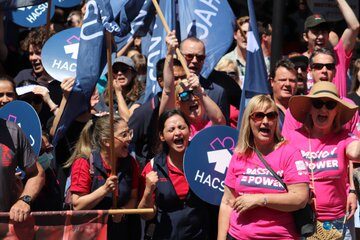
Thousands of public sector workers have rallied across Tasmania for better pay and conditions, flagging further industrial action around Christmas if their concerns aren’t addressed.

State school teachers and support staff, health workers, firefighters, cleaners and child safety officers were among those to walk off the job on Wednesday afternoon.

Premier Jeremy Rockliff labelled the strikes disappointing and disruptive.

He has previously described the state Liberal government’s pay offer of a 3.5 per cent rise in year one followed by three per cent rise in years two and three as final.

The government has also offered workers payments of several thousand dollars.

“Good faith negotiations mean listening and responding … our government has done that at all levels, with three separate wage offers made to public sector unions since September,” Mr Rockliff said.

Some unions claim they have not received a comprehensive offer, while Unions Tasmania secretary Jessica Munday said the proposed deal was not up to scratch.

She said it doesn’t address recruitment, retention and workload problems.

“The premier will need to revise his final offer,” Ms Munday said.

“I really hope that he looks at the depth and breadth of public workers who have turned out across the state.”

Thousands rallied outside parliament house in Hobart and at other major cities, as well as towns and regional centres, in what the union called the biggest strike in years.

Health and Community Services Union state secretary, Tim Jacobson, said the government would face a Christmas of heavy industrial action if the government didn’t properly come to the table.

“This was a shot across the government’s bow. They should now listen (and) put competent negotiators in front of us so we can get these issues solved,” he said. 

United Firefighters Union of Australia representative, Robin O’Brien, said even if members accepted the government’s offer, they would still be the lowest paid in the country.

Australian Education Union Tasmania president David Genford said stressed teachers had been left with no choice but to strike.

There has been a spike in teachers leaving the profession, with 271 permanent state school employees quitting in 2021/22 compared to 182 the previous financial year.

-AAP

Uncategorized

Eskom launches crowdsourcing digital platform

Power utility Eskom said on Wednesday it has received an overwhelming response over the past few months to its call for highly skilled power generation personnel to come forward to assist in the operational recovery and rebuilding of skills inside the organisation.

“Eskom is proud to announce the launch of its crowdsourcing digital platform. A future-fit invitation to electricity industry experts to support Eskom’s turnaround.

“A digital platform and governance mechanism have been designed and implemented to reap the full benefits of the diversity of skills across the country through the crowdsourcing of these skills into the business,” it said in a statement.

Crowdsourcing differs from recruitment in that it is triggered by specific technical challenges, is not linked to a permanent position, and it targets a talent pool that consists of highly skilled and experienced persons.

The crowdsourcing digital platform developed by Eskom, was launched on Wednesday and is accessible from any mobile device via the Eskom website. The platform aims to simplify the crowdsourcing process by enabling highly skilled and experienced persons to submit their details directly to the crowdsourcing database.

To date, the database includes 238 individuals, of which 153 have been shortlisted as potentially active, skilled, and willing candidates.

Eskom said approximately 25 individuals have been selected for the first phase of the crowdsourcing intake: These individuals will commence work between November and December 2022. Additional recruitment will take place as and when required by the business, to meet specific technical needs.

To the process and to ensure sustainability and to maximise the impact of these skills, each crowdsourced individual is required to transfer skills to the permanent Eskom team that they will work with.

Members of the public were encouraged to access the platform and submit details for consideration if the following criteria are met:

You are a highly skilled electricity generation expert or technical professional (e.g. engineer, power plant operator/controller, artisan, technician)You have more than 10 years of related experienceYou are able and willing to support EskomYou are willing to transfer your skills and expertise
Eskom looks forward to collaborating with South Africans to address the current electricity supply challenges facing the country.

Inside Education

Uncategorized

New discovery in Italy could ‘rewrite history’

Historians may have to review the history of the relationship between the Etruscan civilization and the Roman Empire, after Italy’s Culture Ministry on Tuesday announced the discovery of several dozen bronze statues believed to be over 2,000 years old in an ancient Tuscan thermal spring, reports rt.com.

Massimo Osanna, the ministry’s director of museums, hailed the discovery as one of the most significant ever in the Mediterranean region. He explained that the bronze figurines – which depict humans, gods, and individual body parts – were found perfectly preserved thanks to them being covered in mud. Alongside the statues, archeologists also reportedly found some 5,000 gold, silver, and bronze coins.

According to Jacopo Tabolli, who coordinated the dig for the University for Foreigners in Siena, the discovery sheds new light on the Etruscan civilization and the expansion of the Roman Empire between the 1st and 2nd centuries BC.

“While there were social and civil wars being fought outside the sanctuary … inside the sanctuary, the great elite Etruscan and Roman families prayed together in a context of peace surrounded by conflict,” Tabolli said, noting that the discovered statues bear both Etruscan and Latin inscriptions.

“This possibility to rewrite the relationship and dialectic between the Etruscans and Romans is an exceptional opportunity,” he proclaimed, as cited by the Associated Press.

Monument to Russian empress set for demolition

To showcase the significance of this discovery, Italy’s Culture Ministry has announced the construction of a new museum in the area to house the newly-found antiquities.

The Etruscan civilization was one of several civilizations inhabiting the Italian peninsula before the rise of the Roman Empire. It is believed to have been developed by the people of the Etruria region as early as 900 BC. The Etruscan states shared a common language and culture and covered the territory of what is now Tuscany, western Umbria, and northern Lazio.

The Etruscan civilization was later assimilated into the Roman Empire. Historians believe the process began in the late 4th century BC as wars broke out between the Romans and Etruscans. The Roman Empire fully incorporated all of the Etruscan territories in 27 BC.

RT

Uncategorized

Chiloane calls for punitive measures against unroadworthy scholar transport operators

PHUTI MOSOMANE

SCHOOLS are not doing enough to monitor and report unroadworthy scholar transport vehicles to authorities, Gauteng Education MEC Matome Chiloane said in an exclusive interview with Inside Education on Monday.

“In just one day, we took off the road through a special operation 61 unroadworthy learner transport vehicles including buses carrying pupils. This is just in one area in the Western corridor,” Chiloane.

“Schools must report unroadworthy vehicles transporting learners immediately. Do not wait for an incident. I asked a principal in one school to explain as to why given that at one point a vehicle got stuck, and kids got to school late because the transport was not roadworthy- and still no one reported the vehicle.”

Two weeks ago, a bus overturned, leaving two pupils dead in Wedela, Carletonville.

At least 63 other pupils were injured in the crash.

A Grade 8 boy and a Grade 10 girl from Wedela Technical High School lost their lives.

“We will have an engagement with all stakeholders. Apart from having policy, there has to be monitoring of compliance. We are having challenges because of lack of monitoring on compliance including on contracts,” Chiloane added.

He said there was a need to move away from allowing just anyone who has a car to transport learners without following any process.

“If you have a car, and learners- you are done. You are transporting kids to the school. We can’t work like that. This makes it difficult to ensure safety of the transport, and schools on the other hand need to know who is transporting learners.”

Chiloane said that in a short period of time, his department was able to replace unroadworthy vehicles on provincial roads.

He said more monitoring teams will be deployed across the province in a short period of time.

He said the department has since sent a communication to all schools for more proactiveness on the matter.

Visit www.insideeducation.co.za for more on the conversation with Gauteng MEC of Education regarding his vision and plans.

INSIDE EDUCATION

Uncategorized

Basic Education Department’s readiness for new subjects questioned by Parliament

THE Department of Basic Education (DBE) wants to ensure that learners are well placed to take advantage of the opportunities that will be created during the Fourth Industrial Revolution (4IR).

The DBE believes this will be accomplished through the introduction of new school subjects. This is to improve the curriculum and prepare learners for the future world of work.

Ocean and marine engineering, aerospace engineering, coding and robotics and entrepreneurship are just a few subjects that the department will introduce which could widen the employment and study options learners have once they leave school.

While these plans are considered a step in the right direction, many stakeholders have questions whether the introduction of these subjects will be practical. These questions remain, as many schools in South Africa lack the resources and facilities needed to teach learners specialised subjects.

The DBE was questioned in this regard in Parliament. The Minister of Basic Education was asked what will be done to capacitate schools with the necessary human resources and infrastructure to enable them to offer the additional subjects to their learners.

The department undertook a consultation period, which allowed stakeholders to make recommendations to the DBE. These consultations revealed three areas which will need attention for the successful introduction of the new school subjects.

These areas are

The provision of human resourcesFunding of Technical Schools, Focus Schools And Schools Of Skills Review of Subject Combinations, and Content Review of Technical Mathematics and Sciences

The DBE acknowledged that development and provision of human resources is critical for the implementation of the new school subjects and the Three Stream Model. However, for proper human resource planning, the department will finalise core inputs which will be the basis for their plans.

These core inputs include determining the targeted number of learners per subject, curriculum structure and number of schools that will offer these subjects. The department will also finalise the norms for the provisioning of posts and finalise the qualifications and standards. 

STAFF REPORTER| Skillsportal

Uncategorized

Help Lwazi Cedrick Ngcungama achieve his sports jersey design dream

Lwazi Cedrick Ngcungama (29) from Gcilima, is a self-taught graphic designer who focuses on sports design.
He went to Phathwa High School and is currently in Johannesburg seeking greener pastures.

Lwazi said he’s been designing football jerseys for years and posting them on social media. Recently the South African Football Association (SAFA) and its jersey technical sponsor, Lecoq Sportif created a rare opportunity for members of the public to design a jersey for South Africa’s national teams.

“The winning jersey will be first used for the upcoming FIFA Women’s World Cup 2023 to be held in Australia next July. Currently I’m a top five finalist in the competition.”

He is asking South Coasters to vote for him, the voting will close on November 8.

To vote, go to lecoqsportif.co.za, click on sports, then on voting now open, choose design 3 and fill in the form and submit. Or you can use the voting link: http://bit.ly/3DztZZF

“I am the only one from the KZN South Coast left in the competition, I would appreciate every vote so I can bring this one home and achieve one of my ultimate dreams, to design a jersey for our national team that will be worn by all South Africans.”

Earlier this year he designed golf day shirts for the 1996 Bafana Bafana Legends.

STAFF REPORTER