Uncategorized

Gauteng education on the right track: Chiloane 

PHUTI MOSOMANE

GAUTENG Education MEC Matome Chiloane said the 84.4% overall performance in the 2022 matric results showed that the Gauteng education system is on the right track. 

Chiloane congratulated Gauteng’s matric class of 2022 for achieving an outstanding pass rate of 84.4%. A 1.7% increase from 2021.

This achievement is a 1.7% improvement from the 2021 matric results of 82.8% and puts Gauteng as the second top performing province in South Africa.

More schools in Gauteng have achieved a 100% pass rate. In 2021 131 schools managed to ace the exams with a 100% pass rate, the figure has risen to 149 schools for the 2022 matric exams.  

Similarly, more schools achieved a pass rate of above 95% in 2022 than in the previous year. In 2022 a total of 290 schools achieved above 95%, compared to 265 in 2021.The province has achieved bachelor entry pass rate of 43.4%.

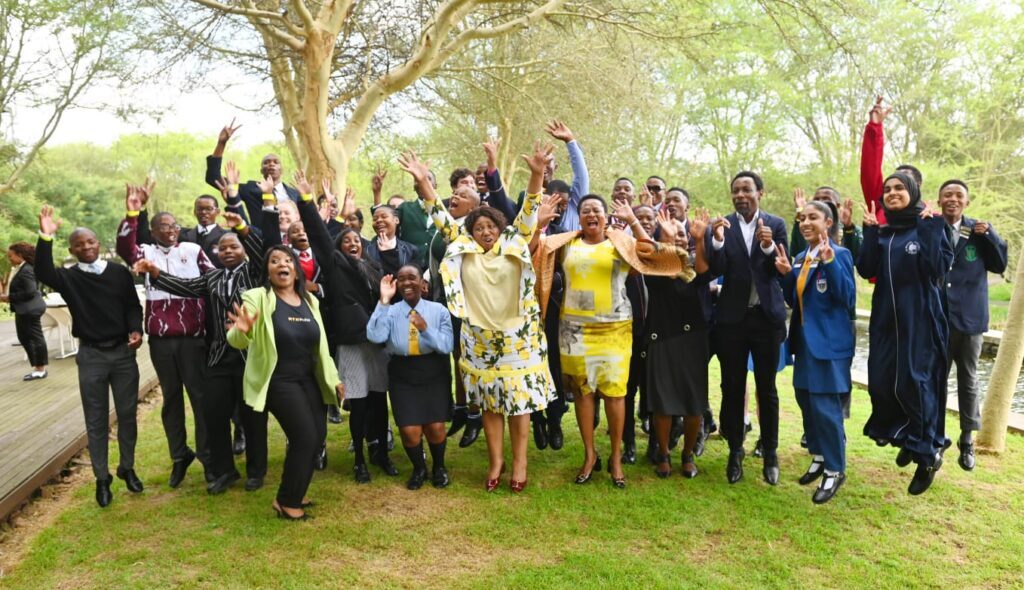
“This goes to show how dedication, resilience, and hard work in 2022 proved to be the elements of success for Gauteng’s Class of 2022, who achieved an outstanding pass rate of 84.4%,” he told top achievers in Soshanguve East Secondary School on Friday.

Gauteng is the second best performing province below the Free State province.

Chiloane said the class of 2022 navigated two years of disrupted schooling in 2020 and 2021 brought by COVID-19, and an overloaded curriculum programme in the run-up to their Grade 12 examinations.

“Equipped with the mindset to accomplish improved performance, the class of 2022 set off on a purposeful course to identify achievable goals. utilise available tailored resources provided through school, district and provincial learner support initiatives and maximise the additional structured time allocated through interventions and all other support,” he said.

He said the 2022 matric outcomes were a result of “dedicated collective support of parents and school communities and entrusted efforts by teachers, social administrators and managers, district and provincial officials contributing to rendering the class of 2022 exam ready”.

Five Gauteng Districts performed above 80%, with four districts being part of the Top 10 Performing Districts in the country, having achieved pass rates of more than 85% each:

Johannesburg West  89.74%  (+3.14%)  [3rd Place nationally]

Tshwane South   89.96%  (-0.34%)   [4th Place nationally]

Gauteng North   87.71%  (+7.51%)  [5th Place nationally]

Johannesburg North   86.19%  (+1.29%)  [10th Place nationally] 

Ekurhuleni South  85.69%  (-0.61%)

Sedibeng East   85.24%  (+3.84%)

Johannesburg East   84.21%  (+0.81%)

Gauteng East 83.58%  (+6.08%)

Tshwane North  83.46%  (+0.26%)

Ekurhuleni North  82.93%  (+0.73%)

Johannesburg South 82.80%  (+4.5%)

Gauteng West  82.10%  (+2.8%)

Johannesburg Central  82.03%  (+1.23%)

Tshwane West  81.98%  (-0.32%)

Sedibeng West  81.68%  (+2.58%)

Equally, Chiloane said the department must also attend schools that consistently perform below par.  About 53 public and independent schools achieved less than 65% compared to 69 public and independent schools in 2021. 

“In the next few days, the Gauteng Department of Education will meet with the School Management Teams of all public schools that performed below 65% and begin a process to address this poor performance,” Chiloane assured Premier Panyza Lesufi who also attended the ceremony.  

The Department will meet the public schools that performed below 65% to put into place interventions to improve the performance of these schools. This will include a review of management and teaching personnel. A rapid school evaluation will be undertaken, and an academic improvement plan designed and implemented.

“We will support all matriculants that have failed by providing a multi-faceted Second Chance Programme in 2023 to assist supplementary exam and part-time candidates, amended Senior Certificate candidates and progressed learners who need to complete their National Senior Certificate.

He said the department will assist them in the subjects they have failed to ensure that they completed the requirements for passing. Moreover, he said learners that require psycho-social support are also urged to engage their schools or the Department. 

“As we celebrate the Class of 2022 with much pride and excitement, it is only fitting and a privilege to recognise that our successes are due to our collective commitment to Growing Gauteng Together as learners, teachers, school staff, parents and all basic education sector stakeholders. In this regard, I reiterate our commitment to pursue a quality and inclusive basic education system for all young people of our province,” said MEC Chiloane.

Lesufi said the 2022 matric results belong to the teachers. He said it was critical for Gauteng to deliberately focus on developing skills for the new economy as “learners are the future gold requiring necessary support”.

“I can stand here and say we have turned the corner,” Lesufi said.

INSIDE EDUCATION
Uncategorized

Class of 2022 deserves respect for rising above Covid-19 and loadshedding – Ramaphosa

PRESIDENT Cyril Ramaphosa has congratulated the Matric Class of 2022 for outstanding individual and collective performances in the face of challenges arising from two years of the COVID-19 pandemic.

The Department of Basic Education (DBE) announced the National Senior Certificate (NSC) matric results on Thursday evening.
 
Ramaphosa said the matric results announced by Basic Education Minister Angie Motshekga highlighted numerous advances in the basic education system, including an overall pass rate of 80.1 percent.

“The Class of 2022 deserves the congratulations and respect of the nation for rising above the challenges of COVID-19, loadshedding and a period of unrest,” said Ramaphosa.
 
“We must all work together to build a society where learners are not measured only by their resilience in testing times but where they can fulfil their potential in conducive conditions.”

Ramaphosa added: “As much as we celebrate individual achievement, the Class of 2022 also constitutes a pass for our education system; it vindicates the extensive and unwavering investment we have made in education during nearly 30 years of freedom.”
 
“We owe the achievements of 2022 to the diligence of learners alongside the commitment and support of teachers, who also endured the challenges of the year, as well as education officials.”

INSIDE EDUCATION

Uncategorized

My child isn’t happy with their final exam results. How can I support them?

NICOLETTE V. ROMAN

EVERY January, the day arrives that South Africans know can decide their fates: the “matric” exam results are announced. In 2022, 753,964 full-time and 167,915 part-time candidates registered to write the secondary school exit exam – the largest cohort ever. They’ll receive the results on 20 January 2023.

Many probably feel ambivalent about this massive moment in their educational journey. On the one hand, there is the feeling of completeness because the school years are done. On the other, there is a basket of emotions: stress, anxiety and excitement at the prospect of the unknown. Matrics (or Grade 12s) and their parents know that the National Senior Certificate, issued when matric is successfully completed, is a ticket to the future.

The results dictate whether you qualify to apply to a tertiary institution or not; this a big deal in a society that sees university qualifications as the ideal (or only) path to wealth, image and fame. University qualifications are also viewed as superior to vocational training.

So, those who don’t achieve the required matric marks will not be able to attend university. It can shatter dreams and cause huge disappointment, along with feelings of failure, hopelessness and helplessness. The way a parent or caregiver responds in this situation is extremely important.

As a researcher specialising in parent-child relationships, here’s my advice for guiding children through what can be a tough, scary and disappointing time.

Positive support

There are four key things your children need to hear if they are disappointed and feeling like a failure:

Getting up after a fall is important

Success is relative: everyone is different and has different abilities

There are many ways to achieve success other than getting a university degree

As a parent you believe your child is capable of doing anything.

This kind of positive, loving support is critical. The research I’ve conducted with various colleagues shows that parents are important in adolescents’ decision-making, life goals and aspirations. They also play a key role in shaping teens’ psychological wellbeing, as well as modelling both healthy and risky behaviours.

Negative parenting practices like rejection, neglect, psychological control, pressure to perform, overprotectiveness and indulgent parenting are associated with difficulty in making good decisions. Children may panic about making decisions, become indecisive – especially about career choices – or make risky decisions.

It is normal for parents to be disappointed that their child’s results were not as expected. However, as a start, take a deep breath and realise that your child is struggling to come to terms with their results, too, and may believe they are a failure. This is not the time to scold and berate them about not achieving.

Remember, the Grade 12 year that’s just passed has, by and large, been about achieving success and feeling the pressure to perform. This situation just amplifies their stress and anxiety.

Taking a deep breath allows for calmness in your approach to supporting your child. A more positive approach, which includes being responsive, supportive, approachable, encouraging and understanding, would be very helpful as a start to diffusing a very emotional situation for your child.

Room to talk and plan

Allow your child to talk about how they’re feeling about the outcome, without interrupting. It would be a good idea to find out if your child has thoughts about the way forward. This could be the first of a few paced conversations over a few weeks. This will allow for some perspective and give your child the chance to think things through. That helps them to develop feelings of ownership in decision-making as well as boosting their confidence and competence. This is important for the satisfaction of psychological needs to achieve psychological wellbeing.

If they haven’t thought about what comes next, you could consider exploring the options together, building a plan B and C since plan A was not achieved. For instance, your child could request re-marks for subjects where they expected to perform better. Or they could enrol for the Department of Basic Education’s Second Chance Programme.

Monitor your child and their wellbeing in this time. You may feel that you need to draw in others, such as a counsellor, psychologist or social worker, or a teacher or friend your child is close to, to help map out the next steps, providing options or just as an additional support for you and your child.
(Nicolette V Roman, University of the Western Cape)

THE CONVERSATION

Uncategorized

Matric Results: Free State province leads the Class of 2022 at 88.5% – Motshekga

PHUTI MOSOMANE

THE Free State is once again the leading province at 88.5%, an increase of 2.8% from 2021, according to Basic Education Minister Angie Motshekga, who announced matric results for the year 2022 on Thursday night.

Gauteng achieved at 84.4%, an increase of 1.6% from 2021.

KwaZulu-Natal, the best improved province, achieved 83.0%, an increase of 6.2% from 2021, while the third best improved province record went to the Eastern Cape, with an achievement of 77.3%, an increase of 4.2% from 2021.

“We should state that none of the provinces performed below the 70% pass rate; and none had a decline when their 2022 results are compared with those of the previous year. Five provinces performed above the 70% pass rate; and four provinces performed above the 80% pass rate,” said Motshekga.

“The provinces with the highest improvements in their performances are KwaZulu-Natal with 6.2%; Limpopo with 5.3%; and the Eastern Cape with 4.2%.  Again, the great work done in these three most rural provinces, must be applauded.”

Motshekga also praised the class of 2022 for producing a pass rate of 80.1% despite challenges with the COVID-19 pandemic and load shedding. 

The pass rate is now up by 3.7 percentage points.

“The Matric Class of 2022 must be commended for maintaining this trend despite the astronomical challenges they faced – challenges related to the COVID-19 pandemic, ESKOM’s loadshedding, and the sporadic service delivery protests,” said Motshekga.

“The 2022 NSC overall pass rate has reached the 80.1%, (compared with 76.4% in 2021) – an improvement of 3.7% from the pass rate achieved by the Class of 2021.  This, represents a record of five hundred and eighty thousand, five hundred and fifty five (580 555) candidates, who passed the 2022 NSC examinations – an improvement of 7.9% passes by number, achieved by the Class of 2021.”

She said the number of bachelor passes has increased 8.9 percentage points, and also diploma passes. 

She said Gauteng and KwaZulu-Natal contributed the most bachelor passes.

“We must state that KwaZulu-Natal and Gauteng contributed the most Bachelor passes, with sixty-nine thousand, eight hundred and forty-nine (69 849) – an increase of 12.9% from 2021; and fifty-eight thousand, one hundred and nineteen (58 119) – an increase of 4.1% from 2021, respectively.” 

“When combined, KZN and Gauteng contributed one hundred and twenty-seven thousand, nine hundred and sixty-eight (127 968) Bachelor passes – an improvement of 8.7% from 2021, and 45.9% of the overall Bachelor passes nationally,” said Motshekga.

She said it was remarkable to note that the Eastern Cape, KwaZulu-Natal and Limpopo – the three most rural provinces in the country, produced a combined total of 137 701 Bachelor passes, which is equivalent to 63.0% of the total Bachelor passes; and an improvement of 13.5% from the 2021 total Bachelor passes. 

“In addition, these three most rural provinces, produced one hundred and seventeen thousand, four hundred and fifty one (117 451) passes with distinction, which is equivalent to 53.7% of the total passes with distinction; – an improvement of 13.1% from the 2021,” said Motshekga.

“It is also noteworthy that the Eastern Cape, KwaZulu-Natal and Limpopo were also able to produce a combined total ninety-five thousand, three hundred and ninety-three (95 393) Diploma passes; which is equivalent to 49.3% of the total Diploma passes nationally; and an improvement of 8.3% from the 2021 total passes with Diploma.  Therefore, this kind of consistent and improved performance by our three most rural provinces, dispels the myth that quality education, is a character of urban provinces.” 

INSIDE EDUCATION

2022 Matric Learners: Motshekga applauds “Top Dogs” for making it against all odds
Uncategorized

2022 Matric Learners: Motshekga applauds “Top Dogs” for making it against all odds

PHUTI MOSOMANE

BASIC Education Minister Angie Motshekga has congratulated the Matric Class of 2022, saying they were an affirmation of an education system that was not broken but on the rise.

Motshekga said last year’s matrics had to deal with COVID-19 interruptions since 2020, and also had to deal with Eskom’s load shedding, floods and community protests.

The minister was speaking at a special breakfast she hosted for the top achievers and their parents in Randburg, Johannesburg on Thursday.

“You are true affirmation of a system that is not broken but rising. An embodiment of true ambassadors of public schooling,” Motshekga said.

She praised learners for showing perseverance, dedication and, above all, hard work.

“We thank learners for putting in the hours and avoiding the well-beaten path to failure by being slack. We thank the teachers for recognising the spark of greatness in these learners and lighting a fire under. Success beckons success! Go forth and conquer,” said Motshekga.

“To tower over your peers is no fluke, an accident of history, but it is a triumph reserved for those whose greatness is yet to be experienced.”

Motshekga said under the current socio-economic challenges in South Africa, last year’s top achievers gave their parents and guardians hope to end generational poverty in their families. 

“I am impressed that this generation never gave up. You carry our hopes as a nation that tomorrow will be better,” Motshekga added. 

Department of Basic Education Director-General Mathanzima Mweli said learners “remained the light in the midst of loadshedding”.

“Today we are celebrating the ‘Top Dogs’ of the Class of 2022,” Mweli said. 

Mweli thanked parents and guardians for working with schools in ensuring that social ills do not interfere with education of their children. 

During the post-breakfast briefing, Inside Education spoke to some of the top achievers.

Here is what they had to say|

Brotas Nkomo, from DD Mabuza Comprehensive School, in Mpumalanga, said despite the impact of loadshedding he had to ensure that he carefully developed a plan to study more using natural light. 

“I am very happy about this recognition. I was taken by surprise but I am thankful to everyone who made it possible,” said Nkomo. 

Kanetso Lekhisa, from the Commtech Comprehensive School in Bloemfontein in the Free State, thanked Motshekga and his teachers for paving the way for him to be acknowledged with the top achievers’ award.

Mountainview Secondary School learner, Nikita Govender, from Verulam in Durban, KwaZulu-Natal, said: “I am excited to be here. It’s a once in a lifetime experience and I am grateful for my all my hard work.”

Another top achiever, Simone Anna-Mart Louw, from Bloemhof Girls High school in the Western Cape, thanked her teachers for making it possible to be honoured. 

Gwiba Nokenge, who hails from Toli High School in deep rural Lusikisiki, Eastern Cape, says he was planning to study Mechatronics Engineering degree at the University of Cape Town. 

His mother, Khuliswa Nonkenge, said she never thought her son will be honoured as a top achiever given the challenges he and other pupils encountered in the rural areas of the Eastern Cape. 

“I am really happy to see my child being honoured. As you know, our villages are struggling to get much support but I am happy to the department, and the teachers,” Nonkenge said.

Meanwhile, MTN Plus Manager Miriam Mathebula congratulated matriculants and said they have demonstrated that anything is possible. “You have defeated disruptions brought by the COVID-19,” said Mathebula.

Tebogo Maenetja, the Chief Human Resources Officer, urged top achievers to explore careers in technology innovations.

“MTN is currently recruiting for the jobs with skills that we have not yet developed,” said Maenetja.

INSIDE EDUCATION 

Uncategorized

Mental health and wellbeing of ethnic minority teachers 

THIS report set out to understand how the wellbeing of ethnic minority educators compared with the wider population. 

This report – made possible with the generous support of Wesleyan – set out to understand how the wellbeing of ethnic minority educators compared with the wider population. The research comprised of three focus groups, which were conducted by YouGov using its panel of education professionals. These included 26 teachers, middle leaders and senior leaders who identified as having ethnic minority backgrounds.

The results confirm many of the drivers of stress in the teaching profession, irrespective of race, including volume of workload, workplace culture and Ofsted pressures. The findings also clearly illustrate the differential experiences of Black and Brown and other ethnic minority teachers and leaders in schools across the country, including barriers to progression, tokenism and microaggressions.

Developed with insights from the BAMEed Network and Black Teachers Connect, the report explores the main drivers of stress among ethnic minority teachers, their experiences in the workplace and what needs to happen for real cultural change to take place.

In section two, we have set out to amplify the voices of research participants and to allow them to tell their story in their own way.

The Chartered College of Teaching and Education Support will hold an event on Thursday 2nd March with Professor Dame Alison Peacock and charity CEO, Sinéad Mc Brearty to discuss their latest research into the wellbeing of ethnic minority teachers. Participants will also have an opportunity to participate in a live discussion.

Sinéad Mc Brearty, Chief Executive of Education Support says:

“Racism has no place in schools or colleges. We all have a responsibility to understand how racism is experienced by colleagues, and to improve the system for everyone. 

Discrimination serves only to demoralise and ultimately drive good teachers out of the workforce.  This serves no-one, least of all children and young people. These findings point the way to simple, inexpensive strategies for improvement.”

We have summarised our key findings of the report below. You can download a full copy of our report here.

Stress is a normalised part of being a teacher, regardless of ethnicity

“If I say I am stressed, I get told to leave school at 4pm – but still produce all the data analysis by 9am the next morning.”
Middle leader

Teachers from an ethnic minority background have to deal with the stress of teaching, plus the additional impact of racist and racialised experiences.

“I’ve purposely been singled out as the token Black teacher when visitors have been in school.”
Middle leader

Ethnic minority teachers call for much wider equality, diversity and inclusion (EDI) training to create more inclusive cultures.

“I was told that I was supporting extremism – when simply we were visiting a Mosque to learn more about the religion for RE.”
Middle leader

Line management experiences are variable but getting it right can help with stress management.

“One of my AHT [Assistant Headteacher] colleagues often tells me I need to think more carefully how I portray myself … as a Brown man. Sometimes I feel I have to work harder than colleagues to prove myself …. and actually similarly other ethnic minorities”
Senior leader

Sector Response

Dr Patrick Roach, NASUWT General Secretary, said:

“The experiences of being overworked and undervalued are unfortunately common across the teaching profession, regardless of ethnicity. However, it is clear from this report and from what our Black members tell us that being from a minority ethnic background adds an additional layer of racist and racialist experiences in the workplace which are further undermining teachers’ dignity and morale.

“Black teachers commonly face additional barriers to pay and career progression, as well as overt and covert racism and discrimination in their daily working lives.

“For example, our most recent data from members indicates that 59% of Asian teachers and 53% of Black teachers who were expecting to move up the pay scale in 2020/21 as a result of their performance review did so in the academic year 2020/21, compared to 73% of White teachers.

“Our data indicates lower satisfaction levels among teachers from black backgrounds. While four in ten of White teachers described themselves as satisfied or very satisfied about their job, this dropped to 34% of Asian teachers and 33% of black teachers.

“The Government could take immediate action to tackle racialised pay gaps and discrimination in the workplace by strengthening regulation, but they have refused to do so.

“This failure to act is exacerbating the serious problems with the recruitment and retention of Black teachers in the profession and undermining the basic entitlement of all workers to be treated with respect and dignity.

“We are continuing our fight for racial justice for Black teachers and will be holding our Black Teachers’ Consultation Conference this coming weekend at which these and other issues affecting Black teachers’ working lives will be discussed.”

Methodology

This research study had three main aims:

Provide insight into the issues and challenges experienced by ethnic minority teachers at work and how these may impact on their mental health and wellbeing

Explore how stress impacts the mental health and wellbeing of ethnic minority teachers

Recommend the resources most needed by education organisations which would benefit the mental health and wellbeing of ethnic minority teachers at work

The research comprised three online focus groups, which were conducted by YouGov using its panel of education professionals. Three focus groups explored:

Perceptions of their teaching career

Current challenges to the profession

Specific challenges for teachers from ethnic minority backgrounds

How this impacts on their mental health and wellbeing

How best they could be supported

The specific topic of stress experienced at work was also investigated, with reference to the overall findings in the Teacher Wellbeing Index (2022). Each focus group comprised teachers working at different levels in schools.

The first group involved classroom teachers, the second group was middle leaders and the final group was senior leaders. All participants worked in primary or secondary schools (with learners aged 4-18) in different parts of England, and the majority worked in the state-funded education sector.

The focus groups were held online using YouGov’s text-based platform where the participants typed in their responses to the questions asked and discussed their experiences with each via text messages.

Many of these messages have been included in this report, so that the reader can see the teachers’ views. The focus groups were conducted by two moderators from YouGov, one of whom was from a mixed-race background and one who was white. All focus groups were held in March 2022, lasted approximately 1.5 hours, and were observed by Education Support.

FENEWS

Uncategorized

SA, Turkey deepen science and innovation ties

SOUTH Africa and Turkey have signed a memorandum of understanding (MOU), agreeing to advance cooperation in science and innovation.

This is according to a Department of Science and Innovation statement.

The MOU was signed by minister of higher education, science and innovation, Dr Blade Nzimande, and Turkey’s foreign affairs minister, Mevlüt Çavuşoğlu.

According to the statement, the signed MOU will see deepening of the cooperation relations between the two countries.

Both SA and Turkey recognise the importance of science and technology in the development of their respective national economies, and the ability of science, technology, and innovation (STI) to improve the standard of living of communities.

Nzimande believes the partnership will be beneficial to both countries, particularly in the areas of joint research, capacity building and in advancement of scholarly cooperation in areas of STI.

“The partnership will promote inter-institutional cooperation, exchange of scientists, researchers, technical experts, scholars, joint research, as well as the exchange of science, innovation, and technological policy information in advancing science diplomacy between the two countries.”

SA and Turkey have maintained strategic bilateral political, economic and cultural relations since 1991, says the statement, adding that the bilateral trade between the two countries has seen a gradual growth over recent years.

During the period April to November 2022, South African exports to Turkey increased by approximately 18%.

ITWeb

Uncategorized

IEB matric class records 98.42% pass rate

PHUTI MOSOMANE

THE Independent Examinations Board’s (IEB) 2022 matric class has achieved a 98.42% pass rate, a slight improvement on 2021’s pass rate of 98.39%. 

About 12 580 full-time and 945 part-time candidates from 232 examination centres writing in 262 venues across Southern Africa wrote the IEB’s National Senior Certificate (NSC) examinations in October and November 2022. 

This is fewer than the 12 857 full-time candidates and 968 part-time candidates in 2021.

“The performance of the 2022 cohort of students has been outstanding. There is enough credible research on the impact of Covid-19 on the educational aspects of children to provide insight into where we are at, in coming out of the pandemic almost three years later. It is fair to say that it is the 2022 cohort of learners that were hardest hit by the impact of the pandemic when it broke in 2020 in their grade 10 year,” said IEB Chief Executive Officer Anne Oberholzer.  

“Various strategies have been employed to try and mitigate these – moving teaching online, pen and paper distance education, catch-up programs, weekend school lessons and so on – some more successful than others.”

Oberholzer said 89.32% of the cohort achieved entry to degree studies, compared to 89.2% in 2021.

While 7.52% qualified for entry to diploma studies, compared to 7.82% in 2021, and 1.57% achieved entry for study at the Higher Certificate level, compared to 1.37% in 2021.

“While the class of 2022 has seen how previous Grade 12 classes of 2020 and 2021 managed to adapt to a new reality, this was the class that missed out the most in their Grade 10 and Grade 11 years which are fundamentally important to success in their grade 12 performance,” Oberholzer said. 

The closing date for the application for remarking is Tuesday 31 January 2023.

The results from re-marking will be released on Wednesday 1 March 2023.

Applications for the learners who qualify to enrol for the May/June examinations will be open from 1 March to 15 March 2023.

“External quality assurance processes provide assurance to society that standards of demand in examinations are consistent over time and that one cohort of learners is not unfairly advantaged or disadvantaged. The quality assurance processes also ensure that the conduct of the examinations is carried out with integrity at every step.”

“The examination process is complex, and its oversight is not only extensive, but requires people who are knowledgeable and experienced in the theory and practical aspects of examination conduct,” said Oberholzer.

On Thursday, Basic Education Minister Angie Motshekga will announce the 2022 matric results approved by the quality assurer Umalusi earlier this week.

INSIDE EDUCATION 

Uncategorized

Curro’s IEB matriculants score top marks

CURRO says it is delighted that its Matric Class of 2022 has recorded an exceptional 98.63% pass rate for the 2022 academic year.

It said the achievement is based on the performance of its 1893 learners who wrote the Independent Examinations Board (IEB) exams last year.

Among the triumphant achievers are nine learners who each bagged a spot on the IEB’s Outstanding Achiever’s list. 

Learners who made it onto this prestigious IEB list have all achieved within the top 5% in 6 or more subjects and scored a rating level of 7 in Life Orientation.

Among the learners are Isabella Campbell from Heron Bridge College who obtained 9 distinctions, Natasha Honey from Curro Hazeldean who achieved 8 distinctions and Mohamed Ismail Salejee from Heritage House who also obtained 8 distinctions as well as a 99% for Mathematics.

In addition, 12 other Curro learners received recognition as part of the IEB’s Commendable Achievements, meaning they’ve achieved within the top 5% in 5 subjects and scored a rating level of 7 in Life Orientation.

A world of opportunity at their feet

The majority of Curro’s learners (67%) achieved a minimum of a C-average and 190 learners achieved an A average. Curro’s talented learners can now access some of the best tertiary education available to pursue their dreams and build bright futures.

Curro’s academic faculty is incredibly proud of its learners’ results.

“We commend our learners who have proven their talent and acumen to produce remarkable results.  It has been wonderful to watch our learners grab every opportunity to learn, grow and succeed in the classroom. The sheer calibre of these learners is evident in their results, and these qualities will stand them in good stead as they take on new challenges as leaders of tomorrow,” says Cobus Loubser, Curro Holdings CEO.

“We are extremely proud of our entire Class of 2022 and wish them all the best,” concludes Loubser.

Staff Reporter

Uncategorized

Race for Free State ANC chairperson position heats up

PHUTI MOSOMANE

THE race to lead the African National Congress (ANC) in the Free State appears to be too close to call after four different leaders representing various lobby groups lock horns to lead the province. 

The Interim Provincial Committee (IPC) convenor Mxolisi Dukwana, Free State Premier Sisi Ntombela, former Maluti-a-Phofung mayor Vusi Tshabalala, and the former Free State ANC deputy chairperson Thabo Manyoni are currently in the running in the four-horse race.

The Free State province has been in disarray for a number of years and without a chairperson since the departure of former ANC Secretary-General Ace Magashule, while attempts to unite the warring factions, including interventions by senior party leaders, have failed.

Following endless delays characterised by infighting and court cases, the ANC in the Free State announced this week that it was all systems go after meetings with several senior party leaders, including ANC Deputy President Paul Mashatile and ANC Secretary-General Fikile Mbalula.

The long-awaited ANC Free State conference is set to kick off on Friday at the Imvelo Safari Lodge in Mangaung, Free State.

Free State ANC Interim Provincial Committee coordinator Paseka Nompondo said this week that more than 75% of branches are ready to hold the provincial conference on Friday. 

“The verification report confirmed that the branches that qualified after their Branch General Meetings (BGMs) were 242, which is about 75% of branches. This means that the Free State has surpassed 70% threshold to hold a Conference,” said Nompondo.

Both Fezile Dabi and Thabo Mofutsanyana regions are expected to hold their regional conferences after the provincial conference this weekend. 

“The outcome of the verification report puts Fezile Dabi and Thabo Mofutsanyana regions above 70% threshold. In the light of that report, the Interim Provincial Committee resolved that the two regions were ready to convene their conferences. Xhariep will be the last region to hold its conference,” said Nompondo.  

ANC Free State IPC spokesperson Oupa Khoabane said 242 branches have already been verified and were now ready to be part of the conference on Friday. 

“We have 242 branches which have qualified to be part of the conference,” he said. 

In an interview with Inside Politics, ANC Women’s League’s former General-Secretary, Meokgo Matuba, called on party members to rally around a woman in order to promote policy gender parity. 

Ntombela, a former Deputy President of the ANC Women’s League, is the only female candidate contesting for the position of ANC chairperson in the Free State.

“I am uncompromising on the issues of advancing women at the forefront of implementing ANC policies because it is always women at the forefront of ensuring delivery of service to the people,” Matuba said in a wide-ranging interview with Inside Politics on Monday. 

“The poor and the unemployed look to the women in the communities to provide. This is an opportunity for members of the ANC in the Free State to support and entrust women with the opportunity to lead. Where women are given an opportunity, they have shown maturity in leadership.  I am particularly biased towards women leadership, and confident that our people will benefit,” she said. 

Ntombela’s Spokesperson, Sello Peterson, said the time for a female ANC chairperson was now. 

“So far majority of branches have made their decisions. And she [Premier Sisi Ntombela] is leading. I don’t know if there is any other contestant, but as far as I know, Premier Sisi Ntombela will be elected chairperson this coming weekend,” said Peterson.

“She is working hard to ensure that jobs are created, turning around the economy and improving service delivery. Since assuming a role of Premier, she has attended to each and every service delivery issue on the spot.”

Another ANC regional leader who preferred not to be named said Ntombela’s campaign has gained momentum in the province and the number of members supporting her were increasing, especially in the province’s biggest region, Thabo Mofutsanyana.

Ntombela is the sixth Premier of the Free State.

She previously served as the Free State MEC for Cooperative Governance and Traditional Affairs and Human Settlements, and the Free State MEC for Social Development.

In March 2018, she was selected by the ANC to succeed Magashule as Premier of the Free State.

She took office on 27 March 2018, and became the fourth female Premier of the province.

She was then elected Treasurer of the Free State ANC branch in May 2018.

By late night on Sunday, there was still last-minutes lobbying taking place, with each group logged in “zoom meetings”. 

The conference is sitting on Friday with the IPC facing court litigation against the regional conference of Lejweleputswa region. 

“The committee is concerned on the continued trend of referring organisational matters to the courts despite much effort done to resolve internal disputes satisfactorily. The court documents have been referred to our lawyers to prepare replying affidavits. The IPC has decided to defend the matter,” said Khoabane.   

On Monday, Mbalula, together with ANC NEC member David Mahlobo visited Mangaung to meet ANC structures including the interim provincial committee, including Councilors representing the party on the metro.   

INSIDE POLITICS