Uncategorized

Nzimande’s claims of sabotage an “internal matter”, says DHET spokesperson

EDWIN NAIDU

THE spokesperson for the Minister of Higher Education, Science and Innovation, Ishmael Mnisi, declined to comment on a Sunday report highlighting tension over media coverage of the minister.

According to the report, the minister, Blade Nzimande, expressed his frustration with what he sees as attempts to undermine him in the media.

Nzimande complained about being overshadowed by his second-in-command, Deputy Minister Buti Manamela, Director-General Nkosinathi Sishi, deputy director Lucky Masuku, and Mnisi himself when it comes to coverage in the media.

“Our view is that it remains an internal matter,” Mnisi told Inside Politics when asked about the reports.

An audio recording of the exchange was made public on social media, where the Minister can be heard asking whether someone was against him.

“Why? Is there someone with an issue against me in the department? I am never covered by the DHET wall. Never, yet I am the department’s chief spokesperson for both the Department of Science and Technology and the Department of Higher Education. Now I want an explanation here today as to why that is the case,” the minister said.

Nzimande can be heard telling his team that he felt let down by them, and it was creating tension between him and Manamela and Sishi, as this was not the first time it had happened.

Angering him further was the “embarrassing” lack of coverage of him when launching the country’s second computer laboratory.

“Here I am, the chief spokesperson of the department. Now I am not in competition, DG. We should never in the future have any functions competing with the minister’s functions, even with the deputy minister,” he said.

“I said when I start speaking, please go to the DHET wall right at the same time, and who is captured speaking is the DG. I do not have a problem with the DG being covered. But what the wall is doing is interchanging between the DG and the deputy minister. I was not covered on Friday, by the way,“ Nzimande said.

The Minister said it was not the first time he had been overlooked concerning coverage on the department’s wall.

“In many instances, I am speaking there, and the wall is covering the deputy minister. In essence, what the communication team is doing is deliberately causing tension between myself and the deputy minister by doing so,” he said, according to the recording.

On Sunday, Nzimande’s media team issued an advisory, saying that Nzimande will officially open the University of the Western Cape (UWC) Education Faculty precinct and the Unibell Student Accommodation on Monday.

INSIDE EDUCATION

Uncategorized

More than R5bn funds paid to students who didn’t qualify for NSFAS

PHUTI MOSOMANE

THE Special Investigating Unit (SIU) has uncovered evidence suggesting that over R5 billion of the National Student Financial Aid Scheme (NSFAS) funds may have been disbursed to students who were not eligible for financial assistance.

During a recent briefing to the Parliament’s Standing Committee on Public Accounts (SCOPA), SIU head Andy Mothibi provided details on how this money had been used to illegally fund students who did not meet the criteria for financial aid.

Preliminary investigations have revealed that approximately 40,000 students across 76 institutions of higher education were awarded financial assistance from the National Student Financial Aid Scheme (NSFAS), despite having a household income that exceeded the maximum threshold of R350,000.

The SIU has the authority to initiate legal action in the High Court or a Special Tribunal, on its behalf, to remedy any wrongdoing uncovered during its investigations involving corruption, fraud, or maladministration.

In accordance with the Special Investigating Units and Special Tribunals Act 74 of 1996, any evidence of criminal activity discovered by the SIU will be referred to the National Prosecuting Authority (NPA) for further action.

During a briefing to the Parliament’s Standing Committee on Public Accounts, officials from the Department of Higher Education and NSFAS provided updates on their investigations into the National Skills Fund and NSFAS. 

Higher Education DG Dr Nkosinathi Sishi noted that NSFAS is supporting 26 public universities, 50 colleges, and 9 community education training programs (excluding SETAS).

Sishi revealed that the funding allocated to working-class students has increased significantly from R21 billion in 2018 to R47 billion in the current term. 

He also said that the number of students funded by NSFAS has increased from 586,000 in 2018 to 770,000 in 2021, with 80% of university students now receiving NSFAS funding to ensure access to higher education.

NSFAS Chairperson Ernest Khosa praised the transparency of the SIU’s investigations and expressed his satisfaction that the figures presented were in line with expectations.

He noted that the identification of fraudulent beneficiaries and exposure of mafias in student accommodations could help improve the execution of NSFAS’s mandate.

NSFAS CEO Andile Nongogo reported that the institution had received 37 fraud cases during the current financial period, with 14 cases having been finalized, 7 still in progress, and 16 not yet reviewed due to capacity constraints. 

While the amount of illegitimate payments reported by NSFAS differed slightly from the SIU’s findings, Nongogo stated that the organization was fully committed to cooperating with the SIU’s investigations.

Members of the committee expressed concern about the recovery of the more than R5 billion in illegitimate payments made by NSFAS and questioned how the institution plans to address the issue.

INSIDE EDUCATION

Walking in the footsteps of giants, Manamela challenges teacher graduates to aim higher than those who walked before them
Uncategorized

Walking in the footsteps of giants, Manamela challenges teacher graduates to aim higher than those who walked before them

EDWIN NAIDU

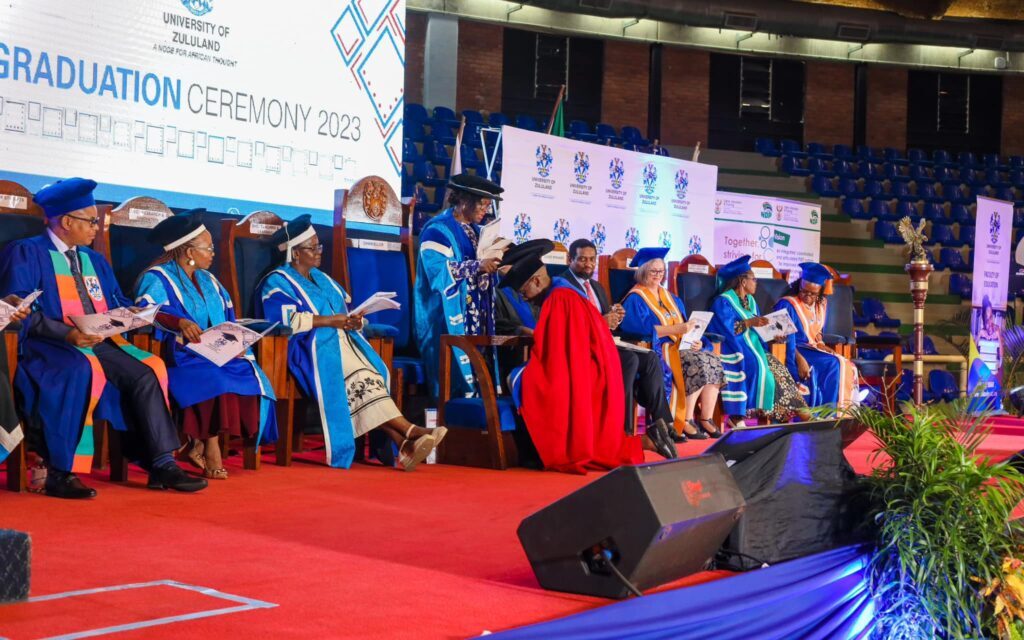
PAYING tribute to great teachers, including his aunts, encouraging graduates to walk in the footsteps of giants before them, Buti Manamela, the Deputy Minister of Higher Education, Science and Innovation, also threw down the gauntlet to new teaching graduates at the University of Zululand on Tuesday afternoon.

“Teaching is one of the most important professions our country needs. We have a group of young people who will become an army in our classrooms nationwide,” he said during his keynote address at UNIZULU’s Faculty of Education in Kwadlangezwa.

Addressing students at the only comprehensive tertiary educational institution north of the Tugela River on Tuesday, Manamela noted that not all teachers were good ambassadors for their profession; some have committed crimes worse than society can comprehend.

“A few amongst those who practice this profession do go to school under the influence of alcohol; others have sexual relations with the school kids; some even use violence to instil discipline; some do not even bother to ensure that they do their best, or even beyond the call of duty; to teach the kids to the best of their abilities,” he added.

But his message to graduates was crystal clear.

“I want you to be a better type of teacher. The one who understands the children that they teach, their weaknesses and their strengths, what their family background is and who their parents are (if they have any), whether they do have a meal before they come to schools, are being bullied at home or at school which may affect their studies, can they hear or see, and if not is there a way in which we can help them so that this does not affect their studies, you need to contribute into revolutionising teaching.”

The Deputy Minister urged graduates to study further and explore ways of improving education delivery through technology.

“Can we find a better way to deliver lessons in a much more exciting and fun way? Is there a way we can think of education beyond the classroom?”

Mindful of the changing world in which social media platforms like Twitter and TikTok dominate, Manamela said teaching must keep up with the times.

“You are the generation that needs to think beyond the box and get children excited about mathematics, history, languages, science, art and technology. They say in China, using algorithms, some social media is used for learning and teaching beyond the classroom,” Manamela added.

Paying tribute to Nokutela Dube, the founder of Ohlange High School in Inanda, and wife of the first President of the African National Congress, John Dube, Manamela described her as a woman who made education fashionable.

But he urged students not only to emulate her but do better than her.

“Founding a school today may be one of the simplest acts one can achieve. But in 1901, being black and a woman was no small hurdle. But with dedication and commitment, she pushed ahead with her dream of educating the black child,” he told students.

Manamela reminded students of the many great South African leaders who emerged from UNIZULU.

The illustrious list includes Dr Nkosazana Dlamini-Zuma, Judge Sisi Khampepe, Sibongile Khumalo, Dr Mosibudi Mangena, Dr Hlengiwe Mkhize, Judge Mogoeng Mogoeng, and current Minister of Higher Education, Dr Bonginkosi Blade Nzimande.

“However, I do not urge you to be like them. They walked these corridors in the toughest and thickest of our time in history. The adversity that confronted them, the legislated hate that was meted against them, and the narrow path that lay ahead beyond the gates of this university is what shaped them. I urge you to do better than them,” he said.

Acknowledging that the post-school education system has inherent structural problems, Manamela said, however, it is one of the best in the continent and can stand head and shoulder with the best in the world.

“When you leave here, remember that every school in the province should have an educator from here; every court a legal fundi of your Almer Mater, every clinic a nurse, every mine an engineer, every covered inch of this country where there are graduates, you now have the honour of wearing the badge: I went to oNgoye and I graduated,” he said.

Deputy Minister of Higher Education, Science and Innovation, Mr Buti Manamela arrived at the University Of Zululand Graduation Ceremony being held for the Education Faculty. PHOTO: DHET

According to the Deputy Minister, credit for the success of the UNIZULU graduates belonged to the educators who helped shape them.

“Today, because of the investment of all the teachers in your life, you have crossed the first box of education at a higher level. I was not inspired only by the teachers in school, but the teachers at home played even greater role. Both my aunts and my uncle were trained teachers. Not only were my aunts teachers, but they were both principals.”

“They also went on to study further beyond their teacher diplomas. They are heroes in our family but also in their communities. The teaching profession remains one of the most important and valuable. The extent of the impact and reach that teachers have in society is immense,” he added.

Again, referencing social media, Manamela said TikTok would not only be used for showcasing dancing and singing, important as these are, but should also promote robotics, 3D printing, technological literacy and many other things that will help children evolve into sophisticated beings.

He urged graduates to be the generation responsible for redefining learning and teaching.

Not missing an opportunity to extol the benefits of Technical and vocational education and training (TVET) colleges, Manamela said that during a visit to an institution, he spoke to one of the teachers in the electrical workshop who have been with the college for many years.

“He took me through the various stations he uses to train his students. One of these was the solar installation and maintenance station. He told me this was not part of the curriculum, but the challenges out there have imposed this curriculum on us. So every Saturday, he teaches his electrical students how to run solar energy as a business. In the first week, only two students attended because it was voluntary. Only when these two students started making money did the rest become interested.

“That’s the kind of innovation that I am talking about. I want to take this opportunity to urge you to go and
teach at TVET Colleges too. This is one of the growing sectors that need better qualified instructors who understand and respect the trade,” he added.

Concluding his address, Manamela told the new crop of teachers that they must consider working in rural areas, those villages, those outskirts where no one goes, “but where lives and souls also need to be saved”.

“We need a million Nokutela who will brave the unjust laws, the hurdles placed before them, the desire to be self-serving and the urge to use what we have just for our benefit.”

“History does not remember those who danced in their limelight. History reflects those who lit candles for others to see their way. Go out there and make history and a better country.”

The graduations were in full swing at the University of Zululand. PHOTO: DHET

INSIDE EDUCATION

Uncategorized

KZN Education MEC urged to be transparent about NSNP tender after 5,400 schools were left without food

PHUTI MOSOMANE

DUE to tender irregularities, most of the 5,400 schools in KwaZulu-Natal (KZN), which are beneficiaries of the National School Nutrition Programme (NSNP), were without food this week, causing hundreds of thousands of learners to go hungry upon returning from their Easter Holidays.

The Department of Education in KZN awarded a single individual a multi-million rand tender to supply food to schools across the province.

The scandal has put the department’s planning under the spotlight, and the MEC of education, Mbali Frazer, has promised to address the issues as soon as possible.

However, the details about who was awarded the tender remain undisclosed.

There are concerns that tenders are often awarded through corruption and irregularities, and the ActionSA KwaZulu-Natal Provincial Chairperson, Zwakele Mncwango, has called for transparency on how the tender was awarded.

The restoration of the NSNP is expected to take place by the close of business on Tuesday, but there are allegations of political interference delaying the service.

“While the Department of Education and its MEC, Ms Mbali Frazer, have been tight lipped regarding the matter and whom was awarded the Tender, it is a concern that the Department saw it fit to divert from a system that has been working without hiccups for a number of years, and introduce one that has unfortunately collapsed before it could take off,” said Mcwango.

“Should the matter not be resolved by the end of this month, we will immediately take action steps and write to the Public Protector and request a full investigation into the matter and reveal what led to the Department of Education to come to the decision to strip other suppliers of their duties and award it to a single individual, and uncover how many people applies for the Tender, what were its specifications and did the individuals met t required specifications.”

There are allegations of “possible political interference delaying the service,” according to the DA KZN spokesperson on Education, Dr Imran Keeka.

“MEC Frazer has also cited illegal business fora for fuelling tensions and delaying deliveries. This, on top of what she confirmed, was a logistics problem involving the new bulk supplier of food for learners as part of the NSNP,” said Keeka. 

INSIDE EDUCATION

Uncategorized

School sports wins with City Lodge Hotels

SOUTH Africans are sports mad and this passion for a variety of sporting codes starts early. School sports teams are where we first feel the thrill of the match, develop our competitive spirit, camaraderie, and that unstoppable desire to put our physical and mental best towards a shared goal.

Whether we’re in the grandstands watching a live match or cheering on our team in a neighbourhood pub or around the braai, sports is a national pastime. City Lodge Hotel Group has long been a favourite with school sports teams on tour and has now partnered with SuperSport Schools to host school sports teams at its hotels around the country.

SuperSport Schools records and live streams school sports on television and on its app, allowing supportive parents and other interested parties to watch live from anywhere, on demand, at any time, and at no cost to the viewer. They are passionate about growing school sports and shining a spotlight on our young athletes.

Town Lodges and Road Lodges are favourites with travelling school sports teams, coaches and families as they are budget-friendly, offer all three meals in their restaurants, and most have swimming pools with decks and gardens for outdoor relaxation.

Courtyard Hotels and City Lodge Hotels are equally well equipped to host teams and supporters looking for more upmarket accommodation when on the road, and are often located near a Town Lodge or Road Lodge, making hosting groups with different accommodation needs even easier.

The Group as a whole is geared up to host sports teams and cater to the needs of these athletic guests, taking care of towels and laundry arrangements, special snacks and drinks, and providing an extra corner in our hotels to store bulky sporting kits and gear.

Gerhard Steyn, general manager at SuperSport Schools, says: “SuperSport Schools’ primary objective is to broadcast school sports events nationwide in South Africa. Given the extensive presence of City Lodge Hotel Group throughout the country, we are delighted to partner with them to offer schools sports teams a suitable place to prepare for and recover after their games.”

Lindiwe Sangweni-Siddo, chief operating officer at City Lodge Hotel Group, adds, “After the pandemic it was wonderful to see school sports teams on tour once again. Sports plays an important role in childhood development as well as identifying which athletes will go on to represent their schools, provinces and country.

We at City Lodge Hotel Group are delighted to enter into this partnership with SuperSport Schools to further promote healthy sporting activities among our youngsters. We have 56 hotels across South Africa in major and secondary cities, as well as in Windhoek, Namibia; Gaborone, Botswana; and Maputo, Mozambique, which means there will most likely be one of our hotels near your next match or game.”

SUPPLIED

Uncategorized

AI in the classroom and how it may change education and jobs

ELLA CANDAGE

YOU may or may not be familiar with the term artificial intelligence, or AI. If not, then you could be familiar with the very popular AI system called ChatGPT. ChatGPT was launched in November of 2022. The program allows users to compose emails and essays in a manner that sounds as if a real human composed it.

This is a big reason why the program caught on like wildfire among college students. The program will complete essays and assignments for you.

ChatGPT seems to be the first wave of artificial intelligence rebuilding the foundation of academics, because a lot of things that students normally do themselves can now be assisted or done by AI. The increasing awareness of this program among students has started to instill panic in some instructors, but others have begun the process of embracing where the trend is headed instead.

ChatGPT and other AI programs have unknowingly put academics at a crossroads where they can try to ban the use altogether or they can choose to adapt the AI into their curriculum. 

As artificial intelligence has become more of a hot topic in the world, especially in educational areas, people are starting to discuss and collaborate on it more.

As its popularity progresses, people seek to understand where it is headed and what it means for not only the future of education but also the future of the workforce, specifically entry-level jobs. The reason artificial intelligence systems like ChatGPT have become such a hot topic is because we have to acknowledge that they may be better at performing certain jobs and tasks than we could ever be. 

If we look into specialized areas such as computer programming and coding, an artificial intelligence program is less likely to have errors and the project would be completed probably hours before a human would finish the task.

It is a frightening thing to face, but also one that we are still unsure of. Oded Netzer, a business school professor at Columbia, believes that artificial intelligence will actually help coders instead of replace them. So artificial intelligence could actually be a supportive addition instead, filling in the gaps so that workers may execute their work more accurately and quicker. 

The University of Maine has recently been holding a series of artificial intelligence events where anyone interested can become more informed on the budding topic of artificial intelligence in school and workplaces. On April 6, there was a presentation called “The Future of Work: How Generative AI May Change Professions and Tasks Ranging from Law, Journalism, Software Programmer, Videographer, Medicine, and More.”

Led by the main presenters, Peter Schilling and Jon Ippolito, the presentation lasted an hour and was informative on the future of AI in classrooms and jobs. In attendance were professors from a widespread variety of departments at UMaine such as forestry, chemical engineering, journalism, computer science and more. Each department had a different experience and viewpoint on the way artificial intelligence may change their education curriculum and how it may affect students entering the workforce. 

Not all opinions were negative, with some professors seeing programs like ChatGPT as a way to supplement learning if used properly. Others, like those in computer science, had interesting perspectives on how it could possibly be more difficult to get an entry-level job in the field should artificial intelligence start doing the base-level work. 

Another interesting perspective was that fields like English and journalism may not be as affected by artificial intelligence because jobs in that field involve things that may just require human personality and human sense. This is because there is an Achilles’ heel with artificial intelligence, and that is that it lacks true sense that only a human can have. AI can also be risky in healthcare, rather than an asset, if the program is not made 100% to be completely unbiased.

For example, there was a system used to identify malignant skin lesions by a dermatology department in healthcare and the system started to incorrectly identify malignant lesions based on the presence of a ruler.

Medical images of a cancerous lesion will include a ruler in the image for scale and the program had started to falsely identify the ruler as an indicator of cancer. It shows how easily fallible and dangerous the system could be if not done and supervised properly. 

MaineCampus

Uncategorized

Stellenbosch University head in “no confidence vote” over second nepotism claim

EDWIN NAIDU

EMBATTLED rector and vice-chancellor of Stellenbosch University, Professor Wim de Villers, faces a vote of no confidence following damaging reports over his leadership.

De Villiers, has twice been accused of nepotism in recent weeks, in addition to Stellenbosch University being in hot water over its language policy. According to the South African Human Rights Commission, the university had violated the rights of Afrikaans-speaking students.

Council met on Monday to discuss the steps to be taken against De Villiers, who was accused for a second time of nepotism over the placement of a relative in alleged breach of the university’s admission policies.

De Villiers has maintained he had done nothing wrong, however, according to a statement by acting council chairperson Nicky Newton-King, the vice-chancellor had admitted there had been a second admission of a relative under the Rector’s Discretionary Placement (RDP).

However, she noted that there was little documentation on the principles and procedures that guided discretionary placements over the years, adding that De Villiers and the registrar had attempted to improve this by setting guidelines. 

“SU also has a nepotism policy which is administered by the Human Resources Department (not Student Administration) and has been understood by the Rector to apply to the placement of staff and procurement matters and not to admissions (including the RDPs) which fall within the Registrar’s ambit,” Newton-King said.

After the first instance of nepotism had emerged, the second incident came after an applicant with better matric marks did not get accepted to the same course the vice-chancellor’s wife nephew had been accepted on.

A statement released by the university said they had followed a clearly defined admissions policy, with guidelines on discretionary placements implemented since 2018.

But this approach was currently being reviewed “to address any possible shortcomings”.

INSIDE EDUCATION

Uncategorized

Newly discovered frog species Blommersia dupreezi named after North-West Professor

ANGELINE MAROKOANE

PROFESSOR Louis du Preez, professor of zoology at the Potchefstroom Campus of the North-West University (NWU), was honoured by having a newly discovered Malagasy frog species named after him.

The honour was bestowed by a group of German scientists from the University of Braunschweig, Landesmuseum in Darmstadt, and the Zoological Museum in München, in recognition of Professor du Preez’s substantial contributions to understanding the flatworm parasites of Malagasy anurans.

This lineage of frog species represents the most evolutionarily divergent species of Blommersia known to date.

It means within the genus Blommersia, this new species branch off early and is in fact an old species.

Although it is still regarded as Blommersia, it differs quite a lot from all other species in the genus.

The new species is now formally named and described as Blommersia dupreezi.

“I am grateful to be recognised for the work I did in Madagascar by having a vertebrate animal named after me. This is a huge honour and I am humbled by the gesture,” he says.

Professor du Preez is a renowned National Research Foundation B-rated scientist and is affiliated to the Unit of Environmental Sciences and Development at the NWU.

His role as leader of the African Amphibian Conservation Research Group is highly regarded in scientific circles.

The group’s research focuses on the conservation and well-being of amphibians.

Professor du Preez research focuses on amphibians and their parasites. He has authored seven books – including The Field Guide to Frogs of Southern Africa – as well as 168 peer-reviewed scientific papers.

His contribution to the knowledge field doesn’t stop there, as he, along with Vincent Carruthers, created a smartphone app about the frogs of Southern Africa, which is truly commendable.

Professor du Preez says the best aspect of his work is training and inspiring young scientists. “Seeing their knowledge develop and finding their niche areas is incredibly rewarding for me.”

His job presents a variety of challenges, including the need for travel to remote locations.

He adds that when one is passionate about their work, it can become difficult to separate your career and personal life.

“My family has been remarkably supportive of my work – they’ve joined me in research and turned family trips into learning opportunities. It is thanks to them that I have been able to spend long hours in pursuit of my dreams while still having their support,” he adds.

Professor du Preez encourages aspiring researchers to remember to stay passionate about their work and focus on making positive contributions to the scientific world, rather than striving for personal achievements.

“We all have a duty to improve conditions and increase the chance of survival for every species on Earth – including the frogs, who were one of the first land-dwelling animals and are now among the most threatened vertebrates on our planet,” he adds.

INSIDE EDUCATION

Uncategorized

UCT alumni social enterprise aims to disrupt arts education in schools

AK Arts & Leadership Academy (AKALA) is on a mission to disrupt the arts education landscape in the country by expanding access to arts education and combating arts teacher unemployment.

Inspired by the radical leadership of fallen apartheid activist Ashley Kriel, AKALA is a non-profit company (NPC) founded by University of Cape Town (UCT) alumni. 

Through human-centred approaches and co-creation with stakeholders, AKALA aims to advocate for the integration of the arts across all spaces of learning and design, implement arts education programmes, and capacitate the professional development of arts education students and graduates.

This as a way of mitigating the crisis faced by South Africa’s arts education system, which is beset with a looming shortage of qualified arts teachers, a declining status of arts education, and limited employment opportunities for newly graduated specialist art teachers.

AKALA recently held its first event, The Co-Creation Station, where stakeholders in arts education discussed and co-created the organisation’s mission, vision, and values using design thinking.

This workshop gave rise to AKALA’s Big Audacious Goal Statement, which serves as a reminder to always co-create with those who stand to benefit from the organisation’s work.

Baseline research conducted by AKALA revealed that only two in 10 schools in the Western Cape offer specialist art education subjects, with 42 out of 50 teachers who teach art subjects not suitably skilled or qualified. Moreover, there is a looming arts teacher shortage, with half of the country’s current working teaching force set to retire by 2030.
 
“Our aim is to make people competitive in the global workplace by nurturing future skills through advocacy and practice.”

The NPC’s long-term goal is to establish the pilot AKALA Art Centre, a combined school registered with the Provincial Education Department, offering specialist art education for grades R to 12, and specialist vocational art education for the Further Education and Training Phase.

The 2022 Durban floods were the most catastrophic yet recorded in KwaZulu-Natal.

INSIDE EDUCATION

Uncategorized

Student wins trip to Harvard Business School with ground-breaking project

STAFF REPORTER

HONORIS United Universities and Regent Business School are proud to announce that one of their students, Boitumelo Nkatlo, has returned from a trip to Harvard Business School which he won following the entrepreneurship skills he demonstrated in his ground-breaking project, BNAqua Solutions.

He joined global leaders in entrepreneurship as they gathered at the prestigious Harvard Business School’s Africa Business Conference, held in Boston, USA, from 24 to 25 March 2023.

Regent Business School is a proud member of the Honoris United Universities network, the first pan-African private higher education network committed to preparing and educating the next generation of African leaders and professionals to make a regional impact in a globalised world.

As the Platinum Sponsor of this conference, Honoris United Universities believes in the power of entrepreneurship and innovation for the prosperity of the African continent and its communities.

This belief is manifested through various partnerships with international organizations and institutions that work towards uplifting and encouraging young entrepreneurs in Africa.

Boitumelo Nkatlo’s winning invention, BNAqua Solutions, is a testament to this belief. It is an inventive solution that addresses the water scarcity issues faced by communities in South Africa. His invention, which is fully recognised and licensed in his name, treats acid mine drainage water and transforms it into safe drinking water, using waste metallic materials.

As the winner of this prestigious competition, Boitumelo Nkatlo attended the Harvard Business School’s Africa Business Conference from 24 to 25 March 2023 in Boston, USA, where he was afforded access to a host of activities specifically for students including a campus tour, introductions to the Harvard faculty, an MBA open house, and a networking lunch.

His excitement and gratitude for this once in a lifetime opportunity were evident, “I am truly grateful to Honoris United Universities and Regent Business School for enabling me to attend the Harvard Business School’s Africa Business Conference in Boston, USA., where I made valuable contacts within the African continent. Some noteworthy interactions were with the chairman of OCP Group, a fertilizing manufacturer based in Morocco, Mostafa Terrab; a Ghanaian entrepreneur, Fred Swaniker and the chairman of Standard Bank South Africa, Nonkululeko Nyembezi. The break-out sessions which I attended covered some incredibly relevant topics, and I particularly enjoyed the sessions
focusing on Africa’s creative economy and financial inclusion. A highlight was a private meeting with
Prof. Anywhere Siko who is a Berol Corporation Fellow and assistant professor in the Accounting and
Management unit at Harvard. This trip could lead to other life-changing opportunities.”

Dr. Ahmed Shaikh, Managing Director of Regent Business School, added, “As an institution that places a high value on innovation and entrepreneurship, we are proud to have played a role in Boitumelo’s success. His dedication to finding sustainable and affordable solutions to address the issue of clean water access is inspiring, and we are confident that he will continue to make a significant impact in the future.”

This recognition is a testament to the hard work, dedication, and innovation of Boitumelo Nkatlo and the Regent Business School. It also highlights the commitment of Honoris United Universities to empower and encourage young entrepreneurs in Africa.

Honoris United Universities and Regent Business School wish Boitumelo Nkatlo well with his future endeavours and remain committed to continued support for the next generation of African entrepreneurs.

INSIDE EDUCATION