Uncategorized

Student wins trip to Harvard Business School with ground-breaking project

STAFF REPORTER

HONORIS United Universities and Regent Business School are proud to announce that one of their students, Boitumelo Nkatlo, has returned from a trip to Harvard Business School which he won following the entrepreneurship skills he demonstrated in his ground-breaking project, BNAqua Solutions.

He joined global leaders in entrepreneurship as they gathered at the prestigious Harvard Business School’s Africa Business Conference, held in Boston, USA, from 24 to 25 March 2023.

Regent Business School is a proud member of the Honoris United Universities network, the first pan-African private higher education network committed to preparing and educating the next generation of African leaders and professionals to make a regional impact in a globalised world.

As the Platinum Sponsor of this conference, Honoris United Universities believes in the power of entrepreneurship and innovation for the prosperity of the African continent and its communities.

This belief is manifested through various partnerships with international organizations and institutions that work towards uplifting and encouraging young entrepreneurs in Africa.

Boitumelo Nkatlo’s winning invention, BNAqua Solutions, is a testament to this belief. It is an inventive solution that addresses the water scarcity issues faced by communities in South Africa. His invention, which is fully recognised and licensed in his name, treats acid mine drainage water and transforms it into safe drinking water, using waste metallic materials.

As the winner of this prestigious competition, Boitumelo Nkatlo attended the Harvard Business School’s Africa Business Conference from 24 to 25 March 2023 in Boston, USA, where he was afforded access to a host of activities specifically for students including a campus tour, introductions to the Harvard faculty, an MBA open house, and a networking lunch.

His excitement and gratitude for this once in a lifetime opportunity were evident, “I am truly grateful to Honoris United Universities and Regent Business School for enabling me to attend the Harvard Business School’s Africa Business Conference in Boston, USA., where I made valuable contacts within the African continent. Some noteworthy interactions were with the chairman of OCP Group, a fertilizing manufacturer based in Morocco, Mostafa Terrab; a Ghanaian entrepreneur, Fred Swaniker and the chairman of Standard Bank South Africa, Nonkululeko Nyembezi. The break-out sessions which I attended covered some incredibly relevant topics, and I particularly enjoyed the sessions
focusing on Africa’s creative economy and financial inclusion. A highlight was a private meeting with
Prof. Anywhere Siko who is a Berol Corporation Fellow and assistant professor in the Accounting and
Management unit at Harvard. This trip could lead to other life-changing opportunities.”

Dr. Ahmed Shaikh, Managing Director of Regent Business School, added, “As an institution that places a high value on innovation and entrepreneurship, we are proud to have played a role in Boitumelo’s success. His dedication to finding sustainable and affordable solutions to address the issue of clean water access is inspiring, and we are confident that he will continue to make a significant impact in the future.”

This recognition is a testament to the hard work, dedication, and innovation of Boitumelo Nkatlo and the Regent Business School. It also highlights the commitment of Honoris United Universities to empower and encourage young entrepreneurs in Africa.

Honoris United Universities and Regent Business School wish Boitumelo Nkatlo well with his future endeavours and remain committed to continued support for the next generation of African entrepreneurs.

INSIDE EDUCATION
Uncategorized

New study shows flooding in KZN province has doubled in the last century

STAFF REPORTER

THE disastrous flood that hit Durban in April 2022 was the most catastrophic natural disaster yet recorded in KwaZulu-Natal (KZN) in collective terms of lives lost, homes and infrastructure damaged or destroyed and economic impact.

This is according to a new study by researchers from the University of the Witwatersrand in Johannesburg, South Africa, and the University of Brighton, UK, published in the South African Geographical Journal.

Professor Stefan Grab from Wits University and his colleague, Professor David Nash constructed a geographical history of flooding disasters in KZN by sifting through thousands of archived articles held in old newspapers, colonial and government records, early missionary records, and meteorological records which became available from the 1850s onwards.

They define extreme flooding events, where major rivers were overflowing their banks, together with one or more
significant consequences, such as the loss of human life, livestock, agricultural fields and crops, and infrastructure such as buildings, roads and bridges.

The study, which reconstructed the history of floods in KZN since the 1840s, confirmed a widely-held – yet anecdotal view – that the April 2022 floods were likely the most catastrophic natural disaster yet recorded in KZN and that flooding events have doubled over the last century or more.

“Right after the floods, many commentators like the media, some scientists and others were quick to report that the floods were the most severe ever recorded. Our aim was to place the floods into perspective and see if this and other statements related to the disaster were factually correct by building a historic geographic account of past floods and associated extreme rainfall events for the province of KZN and particularly the greater Durban region,” says Grab, lead author of the study.

“When you look at a natural disaster you need to look at it in context. Whether the April 2022 floods were the ‘worst in living memory’ is debatable, as a flooding event in September 1987 affected a larger geographic area of KZN and destroyed more homes than the 2022 event,” says Grab.

Similarly, a catastrophic flooding event in Durban, 1856 – also in April – produced a greater quantity of rainfall
over a three-day period than last year’s floods.

In April 2022, the KZN coastal zone, including the greater Durban area and South Coast, received more than 300mm of rain in 24 hours. This led to calamitous flooding, with 459 people losing their lives and 88 people still missing by the end of May 2022. Over 4000 homes were destroyed, 40 000 people left homeless, and 45 000 people were temporarily left unemployed.

The cost of infrastructure and business losses amounted to an estimated US$2 billion.

In April 1856, 303mm of rain fell in Durban over 24 hours, and a record of 691mm over a three-day period from April 14 to 16.

INSIDE EDUCATION

Uncategorized

‘Silent crisis’ at schools in South Africa – education department responds

THE Department of Basic Education has dismissed reports that South Africa’s education system is deteriorating, saying that “the facts” point to improvements against all “relevant” metrics of education system performance.

The department was responding to several reports published by the Centre for Development and Enterprise (CDE) in March, in which the group painted a shocking state of affairs in education in South Africa.

Among many notable points made by the reports, the group spoke of a ‘silent crisis’ in local schools, showing that South Africa has one of the worst-performing education systems in the world.

Broadly, the CDE highlighted the following:

– South Africa is the single biggest learning underperformer relative to GDP per capita among low and middle-income countries.

– After a year of school, more than 50% of Grade 1 learners don’t know all the letters in the alphabet. 78% of Grade 4 learners could not read for meaning in any language.

– Out of 39 participating countries, South Africa’s Grade 9 learners – on a test designed for Grade 8s – placed 38th (second last) in mathematics proficiency and last place (39th) in science proficiency.

– Covid-19 lockdowns devastated learning in South Africa (as elsewhere). Experts believe the average 10-year-old knows less than the average 9-year-old before the pandemic.

– many teachers lack the capabilities to teach better, with the proficiency levels of South African teachers (41%) rank far below that of their peers in Kenya (95%) and Zimbabwe (87%). 79% of Grade 6 maths teachers in the country scored below 60% on a Grade 6 maths test.

– South Africa has the highest teacher absenteeism rate of all SADC countries, which stood at 10% in 2017.

– A report by the National Education Evaluation and Development Unit (NEEDU), released in 2015, assessing rural literacy found extensive union involvement in corrupt teacher hiring and promotion processes.

– Despite findings of criminality, no government official implicated in the 2014-2015′ jobs for cash’ scandals has been prosecuted or suspended.

On Thursday (13 April), the department said it had “noted” the reports but broadly dismissed them as a one-sided, inflammatory, political analysis.

Further, it said that work currently being done by the department had already caught up to many of the points raised, adding that the CDE missed an opportunity to give readers an update on the developments within the sector.

“The sector was not invited to respond or at least to provide information on work being done to address the challenges raised in the reports. This means the reports are one-sided and overtaken, in some parts, by work done up to now,” it said.

“Any underlying value in the CDE’s analysis and recommendations on education policy is unfortunately undermined by the strong politically charged stance taken.”

The DBE said that calling president Cyril Ramaphosa a “weak president” and seeking the resignation of DBE minister Angie Motshekga made the publishing of the reports a political move, while terminology, such as likening the corruption within the system to state capture, emphasised this.

“The appropriation of the language of ‘state capture’ into the education space is unfortunate and inappropriate, given that “state capture” has a particular reference to a serious problem our country has experienced, and applying it inappropriately empties it of its value,” it said.

The department also said that much of the CDE reports were based on data published by the department, so it took issue with the group calling it a ‘silent crisis’ when work was clearly being done.

Progress made

While not addressing each point raised by the CDE, the department did speak to some of the sore points and the progress being made.

On the issue of corruption, it said that the department cooperated fully with police investigations of possible criminality and has drafted reforms to school appointment processes which are now contained in the draft Basic Education Laws Amendment (BELA) Bill.

It offered no comment on the poor performance of learners and teachers, but said that the country has seen increased participation in the country, with essentially universal school attendance for 7 to 15-year-olds.

“Early learning opportunities have been rapidly expanding in recent years: Only 40% of 5-year-olds attended an educational institution in 2002, compared to nearly 90% in 2021,” it said.

It added that the average performance of South African learners has been amongst the fastest improving in the world, according to all three independent international assessments of learning.

“These quality advances have supported consistent improvements in the outcomes of the National Senior Certificate examinations. The percentage of all youths who complete the National Senior Certificate has increased from less than 40% in the early 2000s to over 60%.

“The number of bachelor passes – those qualifying for university entrance – has tripled since 2008. More than 60% of these bachelor passes now come from no-fee schools, which serve children in more vulnerable and rural contexts,” it said.

“The authors of the CDE reports are obviously aware of the record of clear progress in the sector because they do not actually say there has been a decline in the performance of the system. In fact, the reports do acknowledge that South Africa’s performance on all independent international assessments of learning quality improved since the early 2000s.”

However, this acknowledgement is in the proverbial “fine print” of the reports, the department said, which makes the negative tone “unsurprising”.

The department said that the CDE reports raise valid points – such as the impact of Covid-19 – but that it “opted for an inflammatory tone, one-sided negative analysis, and a politically charged stance, ultimately missing an opportunity to contribute to a shared agenda for improving education in the future”.

Business Tech

Uncategorized

Logistical challenges cause school nutrition delays in KZN

PHUTI MOSOMANE

THE KwaZulu-Natal Education MEC, Mbali Frazer, has acknowledged that glitches in the food delivery system to some schools resulted in thousands of pupils starting the first day back at school with empty stomachs.

Fraser expressed regret over the situation and was shocked to discover logistical challenges on the part of the main service provider.

Upon receiving the report on Wednesday, Frazer instructed the top management of the Department to promptly engage with the affected districts and stakeholders to identify the root causes of the challenges and determine their extent.

“This unfortunate situation currently faced by schools, communities and service providers is deeply regretted. The Department and the affected service provider have been working around the clock to resolve these challenges,” she said. 

There are 5,400 schools which are beneficiaries of the National School Nutrition Programme (NSNP) in the province.

INSIDE EDUCATION 

No need for a new deadline on pit toilets, Equal Education tells Limpopo education 
Uncategorized

No need for a new deadline on pit toilets, Equal Education tells Limpopo education 

PHUTI MOSOMANE

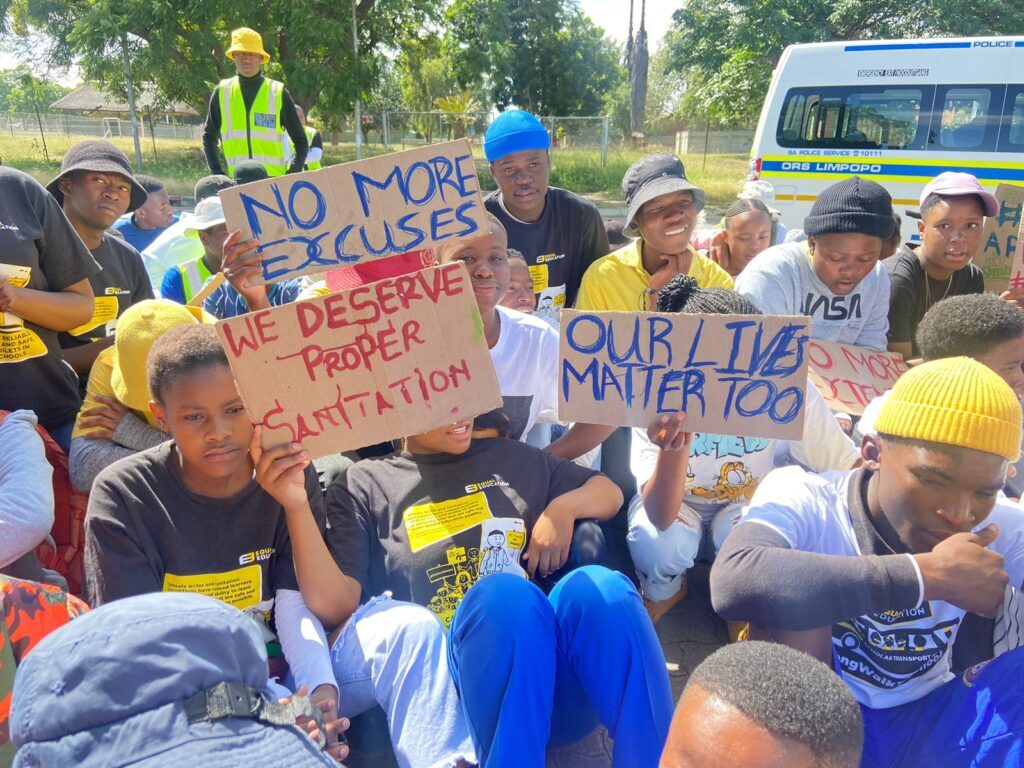
LEARNERS from various schools in Limpopo marched to the Limpopo Department of Education demanding urgent actions on eradication of pit toilets in public schools. 

Hundreds of learners from affected schools told the department that they’ve had enough of failed promises to bring dignity to schools through the eradication pit toilets. 

Equal Education Limpopo Organiser, Tiny Lebelo, told Inside Education that while they will wait for the department to respond, it is no longer about the setting a new deadline but rather delivering urgent interventions in priority one schools.

“We are eagerly awaiting a response from the department on Friday as they promised. We are hoping the Limpopo Education will address our demands but also give us a timeline of how they will address the missed deadline. I think it’s no longer about them setting another deadline now but rather acting on the missed deadline ensuring that all priority 1 schools have adequate sanitation,” Lebelo said. 

“It’s important that the LDOE fixes sanitation backlogs in rural schools because these are schools that have been built by the communities and are in need of dire upgrades. We look forward to actually seeing construction occurring at all priority 1 schools to safeguard the dignity of learners in far remote and neglected areas of our country.” 

Lebelo said learners “cannot wait any longer for sanitation improvements which are,in the main, human rights issue. Today, we have highlight the plight of these learners in a manner that shows the urgency of the delivery”. 

Meanwhile, the provincial department of education head of Infrastructure Isaac Malatji accepted the Memorandum from learners on behalf of the department and the provincial government. 

Spokesperson for the department, Mike Maringa, said the department made a commitment to respond by Friday.

“No comments at this stage as we are still looking at the memorandum and engaging with Various units of the department to see how best to respond to the issues,” Maringa told Inside Education.

Learners in Limpopo protest against pit toilets. PHOTO: SUPPLIED

Priority one schools are schools with illegal plain pit toilets as their only form of sanitation.

Plain pit toilets were completely banned from schools by the Minimum Uniform Norms and Standards for Public School Infrastructure (the school infrastructure law) in 2013 and had to be removed and replaced by 2016.

It has been 10 years since the introduction of the school infrastructure law, and all of the sanitation delivery deadlines (2016 and 2020) have been missed.

In 2017, EE visited 18 schools in Ga-Mashashane in Limpopo’s Capricorn district to determine whether these schools had access to water supply and safe toilets in line with the school infrastructure law. 

The results of this investigation are detailed in the report, “Dikolo tša go hloka seriti.” The initial visits were prompted by an outcry from Equalisers (EE high school learner members) about the terrible sanitation conditions at their schools. 

“Our findings confirmed learners’ reports about unsafe sanitation conditions at school. We found, among other things, that learners in most of the schools used plain pit toilets as the only sanitation option available, while others were exposed to dangerous or broken enviro-loos and ventilated improved pit toilets,” the reports said. 

In February 2020, EE and the Equal Education Law Centre (EELC) revisited 15 of the 18 schools to check progress in access to safe water and toilet facilities in Limpopo schools. 

The visits were also motivated by the involvement as amicus curiae (friend of the court) in the Michael Komape court case, where the Polokwane High Court ordered the LDoE and the national department of basic education (DBE) to develop a reasonable plan for replacing all pit toilets in Limpopo schools (the structural order). 

Using the information gathered during the 2020 school visits, Equal Education submitted a supplementary affidavit to the court in which it argued that both the national and Limpopo education departments had failed to fulfill their constitutional duty to provide safe infrastructure for learners in Limpopo. 

The data gathered on the hygiene and safety conditions that shape the learning experiences of learners at these schools was documented in the second report, “Tšhedimošo mo dikolong tša go hloka seriti.”

In March 2023, 15 schools were visited by Equal Education to monitor the progress of sanitation delivery after the release of two reports highlighting their struggles. 

“We found the sanitation conditions in some schools unchanged, while others had gotten worse. It is clear that the LDoE continues to be slow in addressing sanitation backlogs and fulfilling its moral and legal responsibilities to learners,” organisers said. 

Learners at Tutwana Primary, Seipone Secondary, and Kgolokgotla Secondary schools are still using illegal plain pit toilets as their only form of sanitation.

The advocacy group said these structures are especially dangerous and inappropriate for younger children at Tutwana Primary School. The use of these illegal structures persists in schools despite several tragic cases of young children losing their lives.

According to the LDoE’s latest progress report, 52 schools categorised under priority one—schools with only inappropriate toilets like plain pits—are still in the planning and design phases of development. 

However, based on the department’s revised implementation plan submitted to the High Court in 2021,  these schools should have received sanitation upgrades by the end of March 2023. 

On Tuesday, protesters said it was urgent that the Limpopo department of education DoE provide schools with adequate, proper, and safe toilet facilities to meet the necessary hygiene and safety standards for a conducive learning environment.

“As long as these illegal pit toilets exist in schools, children’s rights will continue to be violated. We cannot and will not sit back while the LDoE continuously fails to meet the deadlines for school sanitation upgrades. #FixOurSchools #SeritiMoDikolong!” Lebelo said. 

Learners in Limpopo protest against pit toilets. PHOTO: SUPPLIED

INSIDE EDUCATION 

Uncategorized

Five appear in court for University of Fort Hare murders 

PHUTI MOSOMANE

FIVE men have appeared in the Alice Magistrates Court on Tuesday for a number of charges, including murder and attempted murder of employees at the University of Fort Hare.

Three of the five suspects involved in the University of Fort Hare shootings had links with the institution. 

Police said one worked with the fleet manager, the other is a former Student Representative Council (SRC) member, and another was brought back to work at the university after retiring.

One of the suspects allegedly ordered a hit on the University of Fort Hare’s fleet manager Petrus Roets last year. 

Two of the accused are from KwaZulu-Natal. 

Police top brass led by Minister Bheki Cele and National police commissioner, General Fannie Masemola visited Alice in the Eastern Cape following a breakthrough in the police investigations into cases of murder and attempted murder at the Fort Hare university. 

The five men facing murder and attempted murder charges will remain in custody until the 4th of May for a formal bail application. 

Fort Hare vice-chancellor Prof Buhlungu said he was pleased that President Cyril Ramaphosa prioritised the cases as he promised.

“I am pleased that today we are seeing breakthrough in this case. I think the President for sending police top brass as he promised. We will not rest until those who aided and abet corruption are brought to book,” he said on Tuesday. 

On the 6th January, Buhlungu’s protector Mboneli Vesele was gunned down outside his official residence. 

Since then, a high level national police task force and intervention teams were deployed to find his killers and also resolve the remaining murder cases linked to corruption in the varsity.

The team reported directly to the national police commissioner.

INSIDE EDUCATION 

Uncategorized

Africa Development Bank visited Angola to see the country’s progress in STEM Education

CHINEDU OKAFOR

THE National Bank of Angola’s Governor, José de Lima Massano, met with the executive directors and discussed the country’s achievements in changing financial regulatory systems and processes as well as stabilizing the exchange rate. The visit took place between March 6 and 10.

The Chamber of Commerce, BFA (Bank of Fomento Angola), Standard Bank, Industrial Association of Angola, the association of agro-livestock producers, Angola Development Bank, and the Association of the Bank in Angola hosted a meeting where the directors also met private sector players in the agricultural sector.

They met with the team from the bank’s local office and listened to presentations on the macroeconomic and fiscal situation of the nation as well as the activities of the Bank there.

The delegation was led by Gerard Bussier, the executive director for Mauritius, who discussed the significance of the Bank’s support for the field of science and technology education.

The directors observed the effects of the transformational education project firsthand while on a visit to CAZENGA Secondary School number 3114 in Luanda.

Over 800 students have received scholarships as a result of the project, including 610 scholarships for girls studying science, technology, engineering, and mathematics (STEM). Additionally, the project has funded state-of-the-art biology, physics, and chemistry laboratories for the school.

The directors’ attendance at the groundbreaking ceremony for the planned Science and Technology Park of Luanda, which the Bank will finance as part of the Science and Technology Development Project, was another highlight of their trip.

The Ministry of Higher Education, Science, Technology, and Innovation (MESCTI) is in charge of carrying out the Project for the Development of Science and Technology (PDCT).

The ceremony, which highlighted the stages of construction and its effects on Angolan society, was presided over by Maria do Rosário Bragança, Minister of Higher Education, Science, Technology, and Innovation of Angola.

The park’s construction is anticipated to take 30 months.

Business Insider: Africa

Uncategorized

A new review into how teachers are educated should acknowledge they learn throughout their careers (not just at the start)

BERYL EXLEY

THERE has been a constant stream of reviews into teacher education in Australia. The most recent was finalised in February 2022. Led by former federal education department secretary Lisa Paul, the review recommended an “ambitious reform agenda” to attract “high quality” students and ensure teacher education was “evidence-based and practical”.

The Paul review recommended “strengthening the link” between performance and funding of teaching degrees.

The expert panel was, in part, borne out of the Paul review as well as national concerns about teacher shortages. A key issue raised at a federal government roundtable on teacher shortages in August 2022 was the need to “ensure graduating teachers are better prepared for the classroom”.

What does the 2023 discussion paper say?

The discussion paper seeks advice on four key areas:

how to strengthen undergraduate and postgraduate “initial teacher education” programs to deliver “confident, effective, classroom-ready graduates”

linking the funding of graduate outcomes with the funding for higher education providers

improving professional experience placements in teaching degrees

helping more mid-career entrants into postgraduate teaching degrees.

Each section of the discussion paper is relatively comprehensive, with useful case studies and a set of discussion questions.

However, the four areas are considered in isolation from one another and without due regard for how they interrelate. Also missing from the review is an appreciation of how initial teacher education degrees are one part of a teacher’s professional learning journey.

All the elements of reform are placed at risk when the sum of the parts don’t equal a whole.

We need a reality check

There is significant ongoing concern about teacher shortages and the number of graduates from teaching degrees. As Scott said on Thursday, “teaching is a tough job and it is increasingly demanding”. Education Minister Jason Clare has also highlighted the need to “increase [course] completion rates and deliver more classroom-ready graduates”.

At the same time, the Paul review found graduate teachers felt underprepared to teach reading, support diverse learners, manage challenging behaviour, work in regional settings, and engage with parents/carers. It’s important to remember these are all exceedingly complex aspects of classroom teaching – even for seasoned teachers and accomplished school leaders.

We need to have realistic expectations about what initial study can provide to graduate teachers. It can teach fundamental theories and provide professional experience, but teachers will need to keep adapting their skills and expanding their knowledge once they are in the classroom.

What works in one context with one set of participants may be less effective in another context because of another set of underlying factors.

This is why tailored induction programs and ongoing mentorship every time an early career teacher starts at a new school is crucial.

Unfortunately, workplace induction programs are usually only offered to teachers in full-time permanent jobs, and rarely to the army of graduate teachers who change schools on a regular basis because they are working as temporary or contract staff.

Entry requirements should not shut out aspiring teachers

The discussion paper focuses on increasing the numbers of First Nations students, as well as those from regional and remote communities, and low socio-economic backgrounds who become teachers – and rightly so. These groups of people are underrepresented in teaching degrees and each hold great potential to make significant contributions to the profession and to the lives of children and the community.

We need to be realistic about the number of prerequisites for education degrees.

The Australian Institute for Teaching and School Leadership develops accreditation standards for teacher education programs. State-based regulators, such as the Queensland College of Teachers, can also add their own requirements.

Meeting all these components add extra burdens to aspiring teachers, and there is no evidence to suggest additional entry requirements directly impact graduate teaching quality. For example, in Queensland, aspiring teachers must have successfully completed Year 12 English, mathematics and science before they can start a primary teacher education degree.

This is an issue given the primary teacher workforce is predominantly female, yet boys outnumber girls in Year 12 physics and advanced maths. This means many aspiring teachers need to do an extra science course before they start their primary teacher education degree.

What about linking funding to performance?

The discussion paper canvasses linking government funding for teaching degrees to a set of performance measures such as higher education providers’ capacity to attract high quality candidates from a range of backgrounds, retain those students until graduation, student satisfaction and their employment outcomes.

It suggests publicly reporting data about these measures and providing financial incentives.

We need to be very careful about any changes here and any unintended consequences such as disincentivising higher education providers from offering teacher education degrees.

Given there is a worldwide shortage of teachers, now is not the time to suggest a punitive response to matters of quality in initial teacher education, or to provide a multi-tier funding structure. Rather, we need more understanding of the funding and resources required to support preservice teachers to be the best they can be before they enter the classroom.

(Beryl Exley, Professor, Griffith Institute for Educational Research, Griffith University, Griffith University)

THE CONVERSATION

Uncategorized

Departments of Sports, Basic Education aim to build talent at grassroots level

STAFF REPORTER

THE Department of Sport Arts and Culture (DSAC) and the Department of Basic Education (DBE) have partnered in spearheading the National School Sports Championships since its inception in 2012.

The National School Sport Championships (NSSC) which is the bedrock of sport development, remains the premier event in the South Africa school sport calendar. Ministers of both Departments entered into an agreement endorsing that schools were the incubators for sport development and talent identification.

The National School Sport Championships remains the natural stimulant of the rollout of the school sport league programme where children are provided with access to participate in an organized sport programme that has a product born out of the institutional and legislative frameworks as endorsed at the 2011 Sports Indaba.

School sport operational structures were established in March 2012 at National and Provincial levels with the objective of coordinating and rolling out of the schools’ sport program. 

The primary aim of the school sport programme is to ensure that each one of South Africa’s schools (i.e.) primary and high schools, are afforded an opportunity to participate in at least one sporting code.

The programme further seeks to address all the barriers of entry that are currently inhibiting broad based participation in school sport through the provision of the requisite support material, personnel, and competition opportunities.

This time around and as part of this programme, the high Schools National School Sports Championships with primary focus on Athletics will be taking place at Germiston Athletics Stadium from 02 – 05 April 2023 placing focus on the following: Junior (ASA U/20), Youth (ASA U/18), Sub-Youth (ASA U/16), Primary Youth and L.S.E.N. = Learners with Special Educational Needs – (DEAF & MID).

Learners will also be participating in the following activities (i.e.) Long Jump, Triple Jump, High Jump, Pole Vault, Shot Put, Discus, Javelin, Hammer throw and track and field competing in 100m – 3000m, Relays and hurdles.

INSIDE EDUCATION

Uncategorized

Musical chairs: UWC is looking for a new VC, UJ’s Professor Saurab Sinha heads to New Zealand

EDWIN NAIDU

THE right-hand man of former University of Johannesburg (UJ) vice-chancellor, Professor Tshilidzi Marwala, has quit for an overseas posting in one of New Zealand’s prestigious institutions.

Deputy Vice-Chancellor: Research and Internationalisation at the University of Johannesburg Professor Saurab Sinha will join the 150-year-old University of Canterbury on 1 July.

Marwala, his former boss, joined the United Nations University in Tokyo on 1 March.

Respected academic and author Sinha said in a post on social media that it was an immense privilege serving the UJ over the last decade. Sinha, supported by the U.S. Fulbright program is currently undertaking a research sabbatical at Princeton University.

The University of Canterbury is led since 2019 by Professor Cheryl de la Rey, who was the first – and only – woman vice-chancellor of the University of Pretoria in a century between 2009 and 2018.

Sinha contested the vice-chancellor post at UJ against Professor Letlhokwa George Mpedi, the former Deputy Vice-Chancellor: Academic, UJ, who succeeded Marwala on 1 March.

He becomes the second top executive to leave UJ. Professor Debra Meyer, Executive Dean: Faculty of Science, who also stood against Mpedi, left on 31 March to join the Sol Plaatje University as Deputy Vice-Chancellor: Teaching and Learning.

“Since joining UJ, she has played a vital role in driving the faculty’s strategy to support the University’s objectives. Prof Meyer, we wish you only the very best in your new role and future endeavours,” said Mpedi in a message to staff.

Sinha said: “With the UJ Community and partners, locally and abroad, UJ has continued to grow from strength to strength; the symbiosis of culture, people and strategy is setup for continued research, innovation and internationalisation excellence.”

Sinha, whose latest book, on 6G technology, has just been published, will remain a Visiting Professor at UJ.

Currently in Princeton on a fellowship, Sinha, said: “I’m looking forward to the next journey of learning, change, and contribution. Reporting to the Vice-Chancellor and Principal, University of Canterbury (UC), New Zealand, I’ll provide leadership to UC Engineering (Engineering, Forestry, Mathematics and Statistics, Product Design). I look forward to being part of the senior leadership team, UC and Christchurch/Canterbury Community.”

In 2023, UC celebrates 150 years – a significant milestone – furthering engagement with people for
education, research and impact.

With my departure, there is an exciting opportunity for the next leader – to serve as UJ’s Deputy Vice-Chancellor: Research and Internationalisation,” he said.

Candidates can Apply: http://jobs.uj.ac.za

The University of the Western Cape is also looking for a new vice-chancellor following the announcement by incumbent Professor Tyrone Pretorius, who also worked under Prof De la Rey when she was at the University of Pretoria, announced he was leaving.

Professor Pretorius is an alumnus of the University of the Western Cape (UWC) and was appointed as the seventh Rector and Vice-Chancellor of the institution in 2015. Researcher Professor José Frantz is currently acting vice-chancellor.

INSIDE EDUCATION