World-class Hospitality And Organisation Offered At 2023 Sashoc Nationals
Uncategorized

World-class Hospitality And Organisation Offered At 2023 Sashoc Nationals

STAFF REPORTER

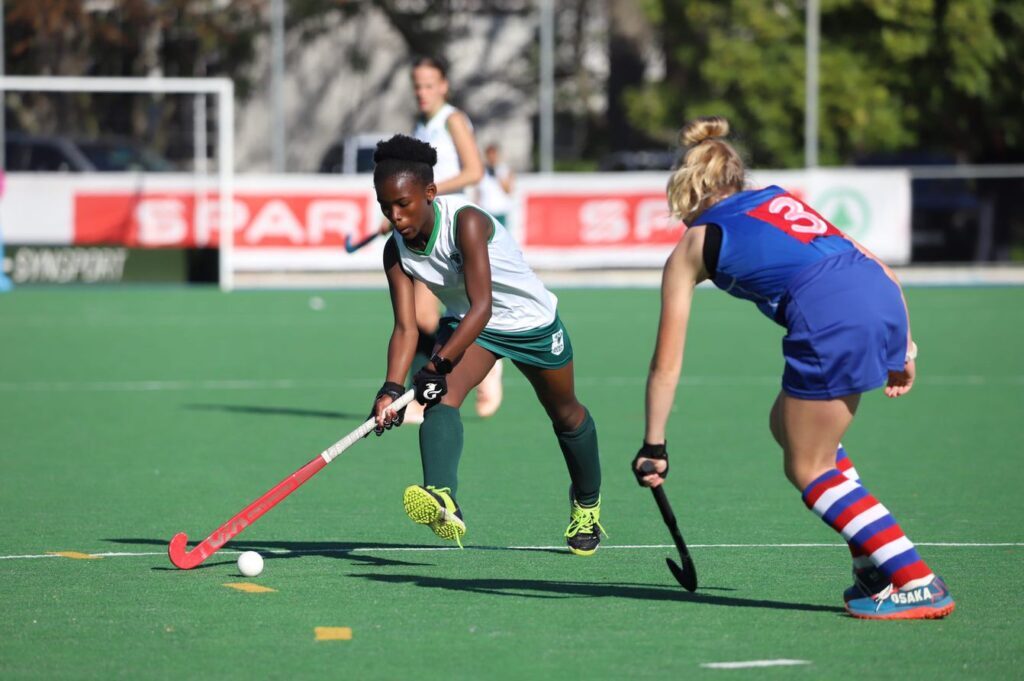
WITH world-class facilities and quality organisation awaiting them later this year, the country’s rising young stars can expect a memorable experience when they compete for top honours in various age groups at the SA Schools Hockey Association (SASHOC) National tournaments to be hosted by Southern Free State Hockey between 25 June and 12 July 2023.

Once again, the SASHOC Nationals 18-day hockey festival is expected to deliver superb performances from the best schools players across the nation, who will turn out for their provincial teams.

By building a solid platform over the years – through district and provincial events – SASHOC has ensured the top-flight inter-provincial tournaments will not only offer a strength versus strength format, but will also give young hockey players valuable experience both on and off the field with the host province and sponsors ensuring the best awaits them in terms of organisation and hospitality.

An affiliate member of the South African Hockey Association (SAHA), the South African Schools Hockey Association (SASHOC) is a regulatory board which promotes, upholds, supports, controls and maintains rules for all schoolgirls and schoolboys playing hockey in South Africa. Laying the foundation in hockey development at schools level in South Africa and ensuring that there is opportunity to maintain the growth of the game, will ensure that Hockey will continue to grow from strength to strength. SASHOC also firmly believes that transformation plays an important role in our organization achieving its goals.

Along with the hard-working local organising committee, SASHOC started the planning and logistical process for this year’s Nationals in December 2022, ensuring organisers were given sufficient time to put quality events together across the board.

The hosts are also providing superb facilities, boosting the experience offered to the participating players and teams.

The main field to be used will be the Kovsies Astro university ground, where the A-section games will be played. The B-section matches will be played at Grey College and Eunice High School for Girls. 

“We are looking forward to welcoming team officials, players, parents and all other hockey lovers to Bloemfontein,” said Louise van der Merwe, the head of the LOC.

“We invite everyone to come and experience and appreciate schools hockey at the highest level and true Free State hospitality.”

The SASHOC Nationals will be backed by multiple valuable partners – including sponsors Sportsmans Warehouse (retail partner), Grays Hockey (ball and umpire shirt supplier), Trompie Sport (sports facilities partner), and renowned brands SPAR and iKhokha – ensuring the players receive the support they need throughout the tournaments in all age groups.

“We truly appreciate the tremendous backing we have received from all our partners and sponsors, who all make a huge difference in ensuring this event is as successful as has come to be expected from our premier schools hockey event of the season,” said SASHOC chairman Wendell Domingo.

“With more than 118,000 players registering to compete in schools hockey last year it is clear that the sport is growing in popularity in terms of participation and youth development and we are eager to see the latest generation of young stars in action.

“The SASHOC team and the LOC are doing an incredible job in the build-up to ensure this is a world-class event in terms of organisation and hospitality, and we are grateful for their continued efforts.”

With organisers having extended their agreement with SuperSport Schools, the SASHOC Nationals will also have significant reach.

Family members and friends of players, as well as hockey fans around South Africa, will again be able to watch live, with matches in all age groups being broadcast on television and on the SuperSport Schools app.

INSIDE EDUCATION
University Corner renamed after illustrious writer Es’kia Mphahlele
Uncategorized

University Corner renamed after illustrious writer Es’kia Mphahlele

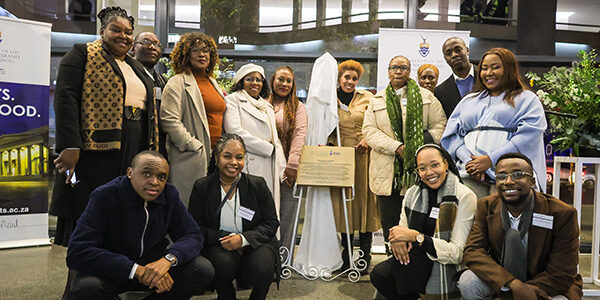
Wits University has officially renamed University Corner after renowned writer and activist Es’kia Mphahlele as part of its continuing transformation plan.

The University Corner, located on the corner of Jorissen and Bertha street, was officially renamed on 01 June 2023.

The renaming of the popular building which houses the Wits Centre for Journalism, the Wits Centre for Diversity Studies and the Wits Art Museum to name a few, is a fitting tribute to Mphahlele, the first black Full Professor at Wits.

He spent nearly 70 years of his life in a career spanning education, journalism, creative writing, and the leadership of institutions for the promotion of literature and the arts.

He was an icon who contributed enormously to the Wits community. Through his body of creative work, his far-reaching education work, and cultural activism, Mphahlele was a major force in shaping modern African Literature.

Before unveiling the golden plaque to guests and members of Mphahele’s family, Wits Vice-Chancellor and Principal Professor Zeblon Vilakazi, said that renaming the building serves as a vital physical connection between the Wits Campus and Braamfontein.

“The university recognizes the importance of community engagement in forging new knowledge. Es’kia Mphahlele’s work was instrumental in breaking the bounds of traditional knowledge creation and fostering a more inclusive approach to scholarship,” said Vilakazi.

“Let us not forget that Professor Es’kia Mphahlele was not only a visionary in education but also a leading African writer, whose talents were dedicated to the development of African writing on this continent and its diaspora. His contributions to literature were so remarkable that he was nominated for the Nobel Prize for Literature not once but twice,” said Vilakazi.

“Today, as we confer his name upon this building, we pay homage to Professor Es’kia Mphahlele’s massive contribution to African letters. This small gesture of recognition is a testament to his enduring legacy and a reminder to future generations of scholars that his work continues to inspire and guide us.”

The Mphahlele family representative, Gontse Moropa, thanked the institution for renaming the building after her uncle.

“As a family, we are very happy that you are honouring my granduncle. It shows that his legacy still continues.”

The Students’ Representative Council’s acting President, Kabelo Phungwayo, said that Es’kia Mphahlele’s struggle for his educational career is an inspiration to most students.

Phungwayo said it is an inspiration to honour someone who fought for his own education and thereafter fought for the education of others.

“We consider Es’kia as a revolutionary scholar, who inspires our African epistemology of humanism and who is the Dean of African letters. Such a figure, being recognised in this institution, means a lot to the SRC,” said Phungwayo.

INSIDE EDUCATION

Uncategorized

Foetal alcohol syndrome: facial modelling study explores technology to aid diagnosis

Tinashe Ernest Muzvidzwa Mutsavangwa, Berhhard Egger and Felix Atuhaire

FOETAL alcohol syndrome is a lifelong condition caused by exposing an unborn baby to alcohol. It’s a pattern of mental, physical and behavioural symptoms seen in some people whose mothers consumed alcohol during pregnancy.

Not all prenatal alcohol exposure results in the syndrome; it is the most severe form of a range of effects called foetal alcohol spectrum disorders.

South Africa has the highest reported rates of foetal alcohol spectrum disorders in the world: 111.1 per 1,000 population. The disorders may affect seven million people in the country. The number could be higher because of under-diagnosis.

Foetal alcohol syndrome can’t be reversed. But confirmed diagnosis can have benefits. It can lead to early intervention and therapy (physical, occupational, and speech, among others), and a better understanding from parents and teachers. Diagnosis can also ensure that adults are eligible for social services support.

Clinicians use a range of methods to diagnose foetal alcohol syndrome, including assessing abnormal growth and brain function. A key part of the process is looking at the individual’s facial features. Typical features are small eye openings, a thin upper lip, and a smooth area between the nose and upper lip.

But visual examination of the facial features can be subjective and often depends on the clinician’s experience and expertise. Another challenge arises in low-resource settings when there aren’t many doctors specially trained to do this.

A more objective and standard way to detect foetal alcohol syndrome early would therefore be useful.

One method that’s being used to aid diagnosis is three-dimensional (3D) surfaces produced by devices that scan the face. The technology is costly and complex. Two-dimensional (2D) images are easier to get – it can be done with a digital camera or smartphone – but are not accurate enough for diagnosis.

Our study sought to explore whether it was possible to use normal 2D face images to approximate 3D surfaces of the face. We showed that it was. Our method involved using 3D models that can change their shape based on a variety of real human faces, combined with 3D facial analysis technology.

We argue in our paper that our findings show the technology can improve early detection, intervention and treatment for people affected by foetal alcohol syndrome, particularly in low-resource settings.

We hope to contribute to the global effort to prevent and manage the lifelong consequences of the syndrome and disorders.

How it would work
We constructed a flexible 3D model that can alter its shape based on a variety of real human faces. The changes are guided by statistical patterns learned from a dataset of high-quality 3D scans from 98 individuals. This international open-source dataset was carefully curated to represent different demographic groups.

We didn’t have access to image data of individuals affected by foetal alcohol syndrome. We therefore used 2D and 3D images of individuals without this condition to develop and validate our approach. We nevertheless reasoned that our method should work equally well for any scenario where the model and the test subjects are closely matched.

We then set out to develop and validate a machine learning algorithm for predicting 3D faces of unseen subjects, from their 2D face images only, using our 3D model.

This was a pioneering step in our research, where we aimed to create a “smart” tool that could bring flat images to life in three dimensions. The results of the study were encouraging.

Our 3D-from-2D prediction algorithm performed well in three ways: capturing facial variations representing unique features summarising information of faces from 2D images.

Since we had actual 3D face scans to use for comparison, we were able to calculate the average difference between these scans and the face shapes predicted by our model. This allowed us to measure the error in our fitting, which we found to be in line with other studies.

We particularly focused on specific regions of the face: the eyes, midface, upper lip, and philtrum (the groove between the nose and the top lip). These regions provide crucial information for clinicians when examining the facial markers of foetal alcohol syndrome.We could accurately predict these facial regions, and concluded from this that our method could form the foundation of an image-based diagnostic tool for foetal alcohol syndrome.

Our study also showed that the quality of our predictions was independent of skin tone. This is a crucial finding. Certain 3D scanning technologies have been known to struggle with accurately capturing darker skin tones. This issue is being addressed. Nevertheless, our findings gave us confidence that there was additional potential for use of our approach in diverse populations.

Challenges
We did identify some limitations. Access to 3D data of individuals with foetal alcohol syndrome remains a challenge. Future research could focus on reducing reconstruction errors to acceptable clinical standards by collecting and analysing larger datasets, including data from underrepresented populations.

Mutsvangwa is Associate Professor of Biomedical Engineering, University of Cape Town. Egger is Professor for Cognitive Computer Vision, Friedrich-Alexander-Universität Erlangen-Nürnberg and Atuhaire is a Lecturer, Mbarara University of Science and Technology.

This article was first published in The Conversation.

Uncategorized

Chinese Ambassador and Motshekga in an initiative to “Warm Children’s Hearts.”

STAFF REPORTER

THE Ambassador of the People’s Republic of China to South Africa, Chen Xiaodong and the Minister of Basic Education, Angie Motshekga, have launched the “Warm Children’s Heart” Initiative to enhance quality learning and teaching in randomly selected schools in various provinces.

The schools included Bonwelong and Tshepisong Primary Schools in the Gauteng Province, Mokwasele Primary School in the Limpopo Province and Pefferville Primary School in the Eastern Cape Province. The programme was launched by the Department of Basic Education (DBE), in partnership with the Embassy of the People’s Republic of China in South Africa, at Bonwelong Primary School on 29 May 2023. Gauteng MEC for Education, Matome Chiloane, attended the launch ceremony.

The “Warm Children’s Heart” Initiative was established by Professor Peng Liyaun, the wife of Chinese President Xi Jinping, in partnership with the Organisation of African First Ladies (OAFLAD) to show care and support to children globally. It was specifically initiated to provide care for African children, embodying the deep compassion and dedication that China and South Africa share for the well-being
of the youth.

According to Professor Peng Liyaun, the programme underscores China’s commitment to supporting education and nurturing the potential of children on the African Continent. Through the programme, the Embassy intends to provide school bags, soccer balls, basketballs, water bottles, stationery, and other items valued at R200,000 to learners in the four identified schools.

“This year marks the 25th anniversary of the establishment of diplomatic relations between South Africa and China. Under the joint leadership of successive leaders of our two countries, especially President Xi Jinping and President Ramaphosa, our cooperation in various areas of education reached fruitful results, which brought tangible benefits to the two countries. In recent years, under the guidance of Professor Peng Liyuan, the Chinese side donated many batches of school and COVID-19 response supplies to South African children. We will continue to promote our exchanges and cooperation in basic education, enhance friendship, promote people-to-people contact, and join hands to build a high-level China-South Africa community with a shared future.”

Motshekga said that the partnership between South Africa and China in primary education has significantly contributed to improving the quality of education in South Africa.

Motshekga said that during the COVID-19 pandemic, China contributed essential supplies such as water tanks, masks, and thermometers to support the reopening of schools. Additionally, China has supported the National Teaching Awards, providing study visits for outstanding teachers and principals.

“In the spirit of solidarity, the Chinese Government donated funds to assist in the recovery from the devastating floods in KwaZulu-Natal. These acts of kindness and support have exemplified the depth of our partnership. The “Warm Children’s Heart” Initiative represents another milestone in our shared journey to provide a brighter future for our children. Let us continue to work hand in hand,
building bridges of knowledge and understanding between our two nations,” said Motshekga.

INSIDE EDUCATION

Hearings on BELA Bill in eight provinces completed
Uncategorized

Hearings on BELA Bill in eight provinces completed

STAFF REPORTER

THE Portfolio Committee on Basic Education has concluded successful public hearings on the Basic Education Laws Amendment (BELA) Bill in eight provinces.

Public hearings took place in the Northern Cape Province last weekend.

The DBE said it was satisfied with the process thus far, as public hearings have been conducted in an organised and peaceful manner.

Those who supported the Bill said that it would improve the quality of the education system, particularly for those from disadvantaged households, through the proposal for the inclusion of Heads of Departments in determining language and admission policies at schools. They added that Clause 37 of the Bill, requiring home-schooled children to be registered, is necessary as it allows the Department to account for every child in the system whilst ensuring uniformity and access.

Those opposing the Bill said that it would undermine the constitutional right of parents to make decisions on behalf of their children. They further argued that the Bill primarily intends to take power away from School Governing Bodies (SBGs) to determine language and admission policies, undermining mother-tongue education.

They added that home-schooling is currently available to low-income families, but the new proposals that require independent accessors and continuous assessments will have profound cost implications. There was, however, a general agreement that alcohol sales be banned from schools as it could encourage further substance abuse within communities.

Other changes to the Bill include: making grade R compulsory as opposed to Grade 1, which is currently the case, and criminalising parents who do not ensure that their children attend school, with fines or jail time for up to 12 months.

In addition, it would also compel parents to supply specified documentation when applying; hold SGBs accountable for disclosures of financial interests, including those related to their spouses and family members; prohibit educators from conducting business with the state; and abolish corporal punishment.

INSIDE EDUCATION

Uncategorized

Estimated R40bn a year needed to clear school backlogs

STAFF REPORTER

The magnitude of addressing the infrastructure backlogs at schools throughout the country requires an annual investment of about R40 billion, according to the Department of Basic Education Head of Infrastructure, David van der Westhuijzen.

This is significantly more than the funding allocated through the Education Infrastructure Grant and necessitates a Blended Finance Model.

The significant challenges are overcrowding in schools, inadequate sanitation, inadequate water supply, inadequate energy supply and a lack of maintenance.

The Department of Basic Education has briefed the Portfolio Committee on Basic Education on the status of infrastructure in SA schools.

An overview of the progress made in eradicating critical infrastructure backlogs since 1996 was provided by Acting Director-General Dr Granville Whittle, along with van der Westhuijzen and Director Solly Mafoko,

The presentation, led by Van der Westhuijzen, estimated that in 1996 there were about 1,000 schools made entirely of inappropriate materials. In 2011, there were initially 510 schools on the infrastructure eradication programme (this number decreased to 332). Of the 332 schools made entirely of inappropriate materials, 330 have been replaced. The remaining two replacement schools are scheduled for completion in 2023/24.

Furthermore, Van der Westhuijzen said that in 1996, a total of 8,823 schools with no water supply were reported. In 2011, there were initially 1,117 schools on the programme (this number increased to 1,306).

However, of the 1,306 water supply projects, 1,292 have been completed. The remaining 14 water supply projects are scheduled for completion in 2023/24.

In 1996, 15,263 schools with no electricity supply were recorded. In 2011, there were initially 902 schools on the programme (this number decreased to 373).  All 373 electricity supply projects have been completed.

In 1996, there were 3,265 schools with no toilets, but by 2011, there were initially 701 schools on the programme; however, this number went up to 1,087). All the 1,087 sanitation projects have been completed. It is estimated that there were about 9,600 schools dependent on basic pit toilets in 1996.

In 2018, there were initially 3,898 schools on the programme (this number decreased to 3,395). Of the 3,395 sanitation projects, 2,728 have been completed. The remaining 667 sanitation projects are scheduled for completion in 2023/24.

The Department developed a 10-point strategy to address these challenges due to implementation.

Bongiwe Mbinqo-Gigaba, Portfolio Committee Chairperson, raised questions about the measures that have been put in place to curb corruption, to which the DBE responded that the assets and financial status of DBE officials are declared annually.

In addition, no direct contractors are appointed and implementing agents are used to select service providers after awarded tenders.

A suggestion arising from the discussion was to explore a Blended Finance Model to fast-track infrastructure efficiency via donors and partners, as in the Western Cape and Gauteng Provinces, through collaboration schools.

INSIDE EDUCATION

Uncategorized

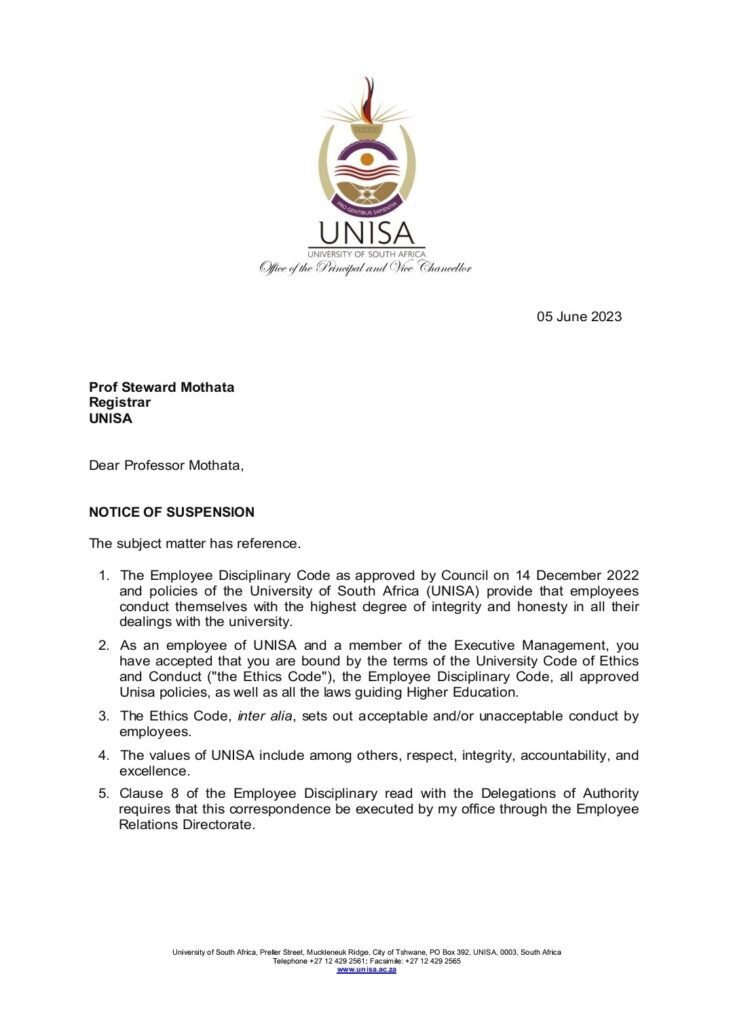
Suspended Unisa Registrar hits back over “spurious claims.”

PHUTI MOSOMANE

SUSPENDED University of South Africa (Unisa), Registrar Professor Steward Mothata has hit back over the “unlawful” reasons behind his suspension.

Mothata was placed on a precautionary suspension a week ago for the reasons outlined in a confidential letter to him.

However, his lawyer, Modidima Mannya, Mothata, described the actions by Unisa as an:” abuse of power”, adding that Vice-Chancellor Professor Lenka Bula does not have any powers whatsoever to suspend him.

The Registrar claims he is being victimised over acts of alleged sexual misconduct levelled against him by a staff member 13 months ago. The details of these were lodged with Unisa Council, but no action has been taken.

“The power to suspend and take any disciplinary action vests in the Council of the university. For this reason alone, the suspension is unlawful as a matter of law.”

In the legal response, Mothata said Council appointed an external advisory firm PWC to investigate allegations of sexual misconduct against him. However, the preliminary report of the investigation confirms that the complaint is void of any truth and points to gross misconduct on the part of Prof Lenka Bula.

“The report specifically indicates the non-cooperation of Prof Lenka Bula. It is clear that the suspension is retaliation for the fact that the purported sexual misconduct complaint has been found to lack merit and exposes the participation of Prof Lenka Bula in the abuse of sexual misconduct.”

In another twist, in February 2021, Prof Mothata said in the lawyer's letter that he had reported to Council the misconduct of Prof Lenka Bula concerning the renovations at the Vice Chancellor’s house. These allegations were not investigated and subsequently were investigated by the Independent Assessor, who made damning findings against Prof Lenka Bula.

On 28th May 2023, Prof Mothata reported to Council what is unlawful conduct on the part of Prof Lenka Bula in making a payment of R500 000 (five hundred thousand rands) to Ms More, the claimed complainant in a sexual harassment complaint against Prof Mothata.

Prof Mothata accepted the findings of the Independent Assessor.

But Unisa has noted with concern the spurious allegations attributed to Prof Mothata, in which he is said to have told some media that he is being targeted for telling “the truth” and that the suspension letter is “vague.”

“We want to put it on record that the university needed to put Prof Mothata on precautionary suspension owing to his conduct which is in breach of the Unisa’s University Code of Ethics and Conduct and the Employee Disciplinary Code.”

“It is the university’s view that the suspension is necessary for the continued functioning and

governance of the University. The university believes that due processes were followed, which informed the decision to place the Registrar on suspension.”

Meanwhile, according to City Press at the weekend, the Unisa council has asked Higher Education Minister Blade Nzimande not to disband them but to appoint an additional three members to assist them in performing their duties.

The newspaper said that the council pleaded with Nzimande, following an explosive 309-page report by Themba Mosia, after investigating allegations that the council was ineffective and maladministration claims against principal and vice-chancellor Professor Puleng LenkaBula. 

Mosia recommended to Nzimande that the council be disbanded, LenkaBula sacked, and an administrator appointed for Unisa.

Nzimande is studying the report.

INSIDE EDUCATION

Uncategorized

Fight against corruption takes shape at Fort Hare

STAFF REPORTER

THE University of Fort Hare (UFH) has welcomed a breakthrough in the fight against corruption spearheaded by the institution and South African law enforcement agencies to uproot deep-seated corruption and criminal networks that have bled the institution dry for several decades.

The National Prosecuting Authority’s Asset Forfeiture Unit announced it obtained a provisional restraint order against the property of Walter Qusheka, as well as five other defendants, including Qusheka’s wife. Qusheka is the Director of Garden to Floors, a company that traded under the name of Qush with the University.

The current value of the assets under restraint is R14.3 million, and Judge N Jali granted the restraint order against the property. Qush had a contract with the University, which expired at the end of its determined period in 2015.

But a former UFH Contracts Manager, Thobile George, had no lawful authority to contract on behalf of the University and renewed the contract on a month-to-month basis, resulting in a loss of R19.2 million for the University.

Evidence in possession of the University and provided to law enforcement agencies showed that George received kick-back payments of R4 million. Qush paid funds into an account where George sat as a company director after he illegally extended the contract. The original contract with Qush was signed in 2011. The NPA’s Asset Forfeiture Unit has indicated in a statement that George, Walter and Vuyokazi Qusheka, Yolisa Songca, Lungelwa Finwana, and Yandiswa Sonamzi face criminal charges of fraud and corruption, and their matter was postponed until 4 August for a trial date.

However, at the weekend, in a matter related to academic fraud, it emerged that the University of Fort Hare convocation believes the Special Investigation Unit (SIU) does not have the necessary skills, knowledge, and expertise to investigate allegations at the institution.

The convocation instead wants the Department of Higher Education, Science and Innovation to appoint a ministerial team to probe the alleged degree scam at the 107-year-old institution.

It is currently scrutinising four tenders involving cleaning and gardening services, the leasing of student accommodation tender, the appointment of a service provider for the maintenance and repair of air conditioning systems, and collusion between officials of UFH and service providers, in which such officials held direct or indirect interests.

Convocation president advocate Andile Mini, at a press briefing in East London on Friday, said he has written to Higher Education Science and Innovation Blade Nzimande, requesting him to launch an independent investigation into the academic scam.

INSIDE EDUCATION

Uncategorized

Sefako Makgatho University workers to strike for salary increment

PHUTI MOSOMANE

THE Academic and Professional Staff Association (APSA) general secretary professor Boitumelo Senokoane says the union is preparing its members at Sefako Makgatho Health Sciences University to embark on a strike action on Thursday.

The union decided to embark on a strike action for wage increases after they were granted a certificate of non-resolution following a declaration of dispute that came after 3 months of wage negotiations and mediation by the CCMA failed to resolve the wage dispute.

“The employer is intransigent, unwilling to move from their initial offer of 5.7%. Our members mandated us to demand 7%, based on the assessment of the rising cost of living. Inflation remains elevated above 7% in the past few months, and the South African Reserve Bank has forecasted an average 6,2% inflation rate for 2023. Given the elevated risks of inflation, the annualised average forecast by SARB may be an under-forecast,” Senokoane said.

Senokoane said based on the average inflation forecast of 7,2%, a 5,7% offered by Sefako Makgatho University management will amount to a wage decline of 1,5% in real terms.

“APSA opposes this real decline, hence we insist on a 7% increase. The offer by the University will diminish the buying power of our workers in the context of inflation,” he said, adding that as per SMU strike policy, the employer has been given 48 hours’ notice and the protest action will be on Thursday.

INSIDE POLITICS

Unisa confirms suspension of Registrar
Uncategorized

Unisa confirms suspension of Registrar

STAFF REPORTER

THE University of South Africa (Unisa) has confirmed that the Registrar, Professor Steward Mothata, has been placed on precautionary suspension without providing reasons for the decision.

“The issues leading to the suspension have been outlined to him in a confidential letter shared directly with him and only him. Please note that this is a matter between Professor Mothata and the university, and the standing practice in the university is not to discuss such matters in the public domain, including through the media. There are existing internal platforms for addressing such matters, which all employees are fully conversant with,” said Unisa spokesperson Tommy Huma.

He added that Unisa has noted with concern the spurious allegations attributed to Prof Mothata, in which he is said to have told some media that he is being targeted for telling “the truth” and that the suspension letter is “vague.”

“We want to put it on record that it was necessary for the university to put Prof Mothata on precautionary suspension owing to his conduct which is in breach of the Unisa’s University Code of Ethics and Conduct and the Employee Disciplinary Code.”

Huma said it is the university’s view that the suspension is necessary for the continued functioning and governance of the University. “The university is of the view that due processes were followed, which informed the decision to place the Registrar on suspension.”

The university also noted rumours in the public domain that Council is no longer quorate and cannot hold meetings. The university has obtained a legal opinion stating that Council does quorate and should continue with its business.

The university also reassures its community and other stakeholders that the business of the University is continuing as usual, i.e., teaching and learning, research and innovation and engaged scholarship.

Staff are encouraged to continue going the extra mile in promoting the academic project and providing support services to students.

INSIDE EDUCATION