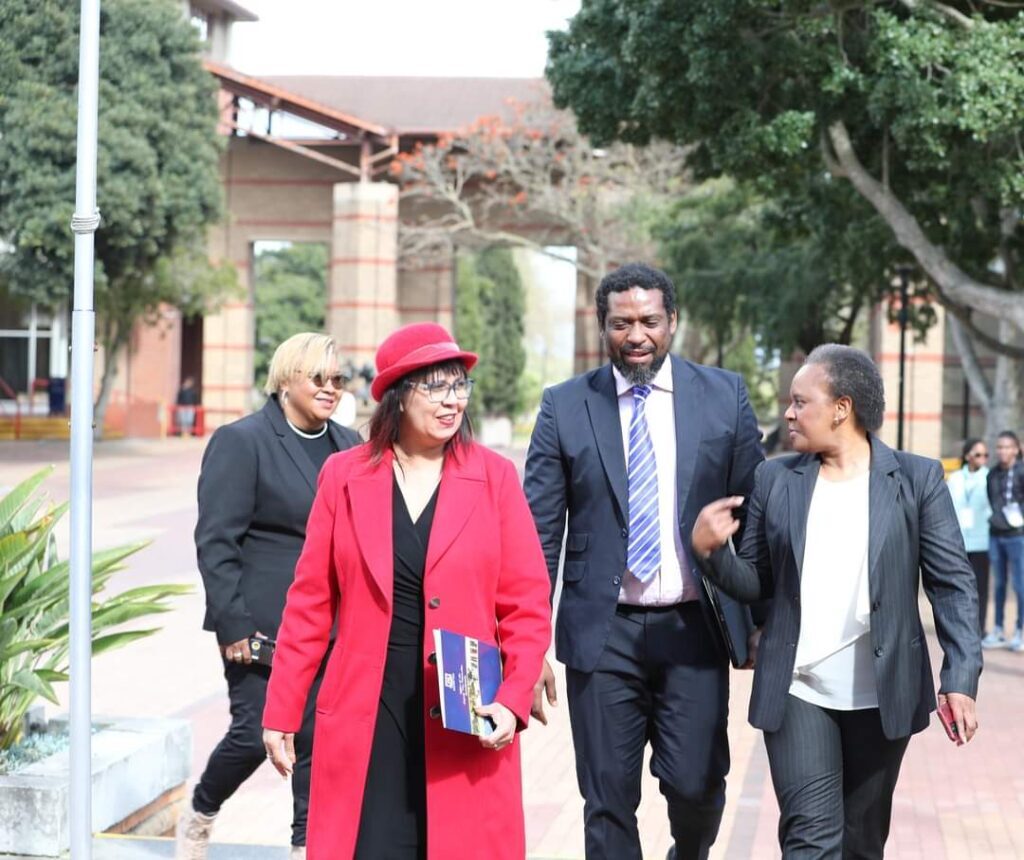
Pendulum Swings Back to Universities, says Manamela
Uncategorized

Pendulum Swings Back to Universities, says Manamela

Johnathan Paoli

Deputy Minister of Higher Education, Science and Innovation, Buti Manamela, praised the recent think thank gathering regarding a perspective, aimed towards the future, specifically centering around the role of universities.

“The world is facing four major transformations- and they are all occurring at once. They are economic, including the dramatic decarbonisation of industry; technological, due to the merging of the digital and physical worlds and embedding of AI; geopolitical, driven by the shift from a unipolar to multipolar environment; and social, as citizens cope with massive changes and sometimes conflicting values,” deputy minister Manamela said.

Manamela was attending the EDHE Lekgotla and Studentpreneurs Indaba 2023, held at the University of the Western Cape on Monday.

In opening remarks to the Indaba, the deputy minister addressed the need to keep up with changes in relation to technology, social medial and the world at large.

Praising the role of universities in not only updating current scholastic frameworks but more importantly facilitating new technologies and opportunities for employment.

This follows on a recent shift away from universities towards a concentration upon TVET colleges, and what some have felt to be a neglect of the potential of new technologies and forms of entrepreneurship emanating from university level knowledge production.

“The heart of the EDHE programme is the task of helping us to find ways of making better use of the knowledge that our universities produce so that we can produce policy and institutional mechanisms that will extricate the economically marginalised sections our society such as young people, women, and rural communities from the trap of poverty, unemployment, and inequality,” Manamela said.

The deputy minister said that these discussion and pooling of intellectual and other forms of knowledge resources remains in line with the facilitation of a conducive platform for the sharing of good practices and emerging initiatives in university entrepreneurship.

INSIDE POLITICS

Uncategorized

BELA passes constitutional muster, says chief legal adviser

Staff Reporter

Despite concern over its controversial intentions, there were no problems with the constitutionality of specific provisions of the Basic Education Laws Amendment (BELA) Bill, according to the government’s chief legal advisor.

Advocate Zuraya Adhikarie, the Chief Legal Adviser for the government’s Constitutional and Legal Services Office, said it received a request from the committee to advise on the legislative procedure following provincial public hearings and the constitutionality of specific provisions of the BELA Bill.

Last week, Adhikarie told the Portfolio Committee on Basic Education that clauses 4 and 5 of the Basic Education Laws Amendment (BELA) Bill did not traverse or deal with the principle of separation of power.

Adhikarie said the two clauses clarified the responsibilities and autonomy of the three-tier partnership initially envisaged by the Schools Act and were verified as correct in the judgments pronounced on the issues of admissions and language policy at schools.
She said their office received a request from the committee to advise on the legislative procedure following provincial public hearings and the constitutionality of certain provisions of the BELA Bill.

She said that, concerning meetings of the committee they had attended, the BELA Bill was still pursuing the correct legal process, in line with sections 29 and 76 of the Constitution.

“The motion of desirability taken on the bill after clause-by-clause deliberations points to the fact that the committee desires to proceed with the bill. The committee must proceed with the bill and adopt a report on it, and the bill itself, and refer these to the National Assembly in line with the relevant rules of Parliament,” she said.

Concerning the first part of the legal question, the committees considering Bills must consider a motion of desirability regarding NA rule 286(4)(i). The motion must be proposed after due deliberation. In other words, based on the Bill’s contents and the Committee’s deliberations, the Committee must decide whether it wants to proceed with the Bill. If the Committee adopts the motion, it must proceed to deliberate on the details of the legislation.

The committee was told that the motion of desirability taken on the Bill after the clause-by-clause deliberation points to the fact that the Committee desires to proceed. Hence, the Committee must proceed with the Bill adopt a report on the Bill and the Bill itself and refer these to the National Assembly in line with the relevant Rules of Parliament.

INSIDE EDUCATION

Uncategorized

UKZN leads the charge against Gender-Based Violence

Staff Reporter

The University of KwaZulu-Natal (UKZN) has announced key strategic interventions expected to bring about significant change in the fight against Sexual and Gender-Based Violence (SGVB).

The University is appointing a central strategic coordinator for SGBV response, has established a specialised SGBV Investigations Unit and plans to roll out an innovative Social Justice Educational Module, which will be compulsory for all students.

The announcement was made at a recent GBV Awareness Panel Discussion held on the UKZN Howard College Campus.

Executive Director for Corporate Relations at UKZN, Normah Zondo said the SGBV response official will be central in shaping and implementing the University’s comprehensive approach, focusing on enforcing accountability measures, enhancing preventive systems, and bolstering existing support and response mechanisms.

“This appointment is critical in instituting a zero-tolerance policy on SGBV across all university campuses. The coordinator will also oversee the revision of existing SGBV-related policies and manage systems for the monitoring, evaluating, and tracking of reported cases,” said Zondo.

The newly established SGBV Investigations Unit will prioritise maintaining the confidentiality of cases and ensuring the prevention of secondary victimisation for victims of SGBV. Ms Zinhle Dlamini from the University’s Risk Management Services spoke on the operations of the unit and support systems available to students.

The UKZN Gender-Based Violence Committee Chairperson, Dr Janine Hicks spoke on the Committee’s efforts to respond to GBV against students in Higher Education. 

“The University has been working hard to ensure that students are heard and that our GBV policies at UKZN align with the government’s response. We are delighted to have this institutional response to GBV!”

One of the speakers on the panel, Advocate Mzo Rusi, who heads the Sexual Offences and Community Affairs (SOCA) unit of the National Prosecuting Authority in KZN, explained the motivation for the establishment of the SOCA unit and Thuthuzela Care Centres, which prioritises on sexual offence matters. 

He provided information on the services at these centres and advised on the many essential measures and protocols for reporting a GBV case.

Chairperson of the UKZN ‘Men of Virtue’ project, Sanele Zuma, said that as much as men are perpetrators, some are also victims of GBV. He highlighted some of the work ‘Men of Virtue’ are doing to bring them on board as partners in the GBV response, which includes dialogues and psychoeducation on topics such as consent.

The panel responded to questions from the audience, many of whom opened up about their own personal experiences with GBV and the poor service or lack of response they’d received from the authorities placed to protect and support them.

INSIDE EDUCATION

Uncategorized

DG expresses concern over mathematics performance

Staff Reporter

Basic Education Director-General, Mathanzima Mweli, this week, concluded the Western Cape and Free State leg of his national Reading Literacy engagements.

DG Mweli, together with his team of senior managers from the DBE, convened the engagements with district and provincial officials, primary and high school principals. The engagements, which took place from 28 August 2023 to 01 September 2023, commenced in George, Cape Town and proceeded to Bethlehem, Bloemfontein and lastly, Kroonstad to capacitate officials on the effective implementation of reading strategies and to increase support for the Class of 2023 to improve learning outcomes.

Mweli encouraged officials from both provinces to implement effective strategies, to strengthen learner support programmes for all grades, to lead to an education and training system of the highest quality through significantly improved learning outcomes as the National Development plan enjoins us to do.

“The Mathematics results in our country are very concerning and principals should ensure that teachers provide adequate support to struggling learners, in Mathematics and Languages in particular.”

In his presentation, Seliki Tlhabane, Chief Director for Mathematics, Science and Technology and Curriculum Enhancement Programmes, stated that Mathematics is not performing well, therefore the Basic Education Sector requires resources to improve learning outcomes of the subject: For too long our performance in Mathematics has been very low, both in the General Education and Training (GET), as well as Further Education and Training (FET) Bands.

He also emphasized that the Curriculum is structured in such a way that it is accessible to all learners, for instance there is low order content (Cognitive levels 1&2), Medium order content (Cognitive level 3), and High order content (Cognitive level 4).

All teachers should be able to teach learners well to at least do very well in Cognitive levels 1 and 2. 

He also emphasized the need for extensive monitoring by School Principals and School Management Teams.

The National and Provincial Education Departments will provide additional support to schools to ensure that struggling learners are given adequate resources and support through various intervention programmes.

In her presentation on leading basic school functionality from the front, Agnes Rasesemola, former principal of Sunrise View Secondary School in the North West Province, in sharing her journey as a School Principal concluded her presentation by making the following observations: “Control is an illusion; We need to focus on influence rather than control”; “Let us be Selfless: Serving is Leadership”; “Let us be the Thermostat of Positive School Culture”; Let us be accountable to our Teachers”; “Let us be the Cheerleaders and Praise our staff”; “The cow does not give milk, you have to milk it”

INSIDE EDUCATION

Uncategorized

TVET College reforms must reduce university-centric funding focus – Nzimande

Edwin Naidu

TVET college curriculum reform has the potential to contribute in various ways to improve the employability, productivity and success rates of TVET college graduates.

To be successful in bringing these changes, there is a need for change in the management strategies to prepare for current and future TVET curriculum challenges, said Dr Blade Nzimande, the Minister of Higher Education, Science and Innovation, at the TVET Curriculum Transformation and Innovation Summit in Midrand last week.

“This summit brings together more substantial industry involvement in the TVET curriculum review process needed to enhance stakeholders in the TVET sector under one roof, aiming to collectively address and elevate the challenges of curriculum transformation and innovation within the sector. The Summit also brings together the key stakeholders to respond to the need to adjust and reposition TVET curricula in light of new technological developments,” said Nzimande.

He said it was critical for more substantial industry involvement in the TVET curriculum review process to enhance responsiveness to industry needs and requirements.

“Furthermore, we need to develop leadership programmes to help leaders within the TVET sector to bring about the necessary curriculum change,” he added.

Another important consideration is the deliberate decision to relook at the funding model of colleges to fulfil their mandate of expanding student numbers, meeting the need for adequate resources, and delivering the quality of teaching needed to develop South Africa’s skills workforce.

“We know by now that our funding model for our institution is skewed towards university or university-centric. This has to change if we are to create the jobs we need in our economy,” he added.

Reflecting on the progress towards shaping a sustainable TVET sector, the Minister said the National Development Plan commits to growing technical and vocational training with specific emphasis on its size and shape, differentiation, articulation, efficiency and functional effectiveness in response to the broader national development challenges.

Currently, South Africa is producing, on average 20 000 qualified artisans annually.

He said the goal remains to ensure that the number increases significantly to meet the National Development Plan (NDP) target to produce 30 000 qualified artisans annually by 2030.

“We have expanded our Centres of Specialisation to thirty-four (34) Centres at twenty-seven (27) TVET Colleges to enhance workplace-linked training of artisans and related occupations, with a further investment of R68 million in sixteen (16) of our Colleges who now have thirty-three (33) Trade Test Centres,” he added.
So far, these trade test centres have tested over 600 apprentices, of which over 500 have qualified as artisans.

Currently, twenty-six (26) of colleges are engaged in entrepreneurial training through Entrepreneurship Hubs with plans to, through the Department of Science and Innovation (DSI), introduce innovation hubs in TVET colleges.

To date, the Department has opened up 14 954 TVET placement opportunities to the value of R726 Million and committed to achieving a target of 20,000 placements of TVET graduates as per the President’s commitment at this year’s State of the Nation Address.

“We have subsidised our colleges to meet their developmental goals, and we also provided TVET college students with financial support through the National Student Financial Aid Scheme (NSFAS),” he said.

INSIDE EDUCATION

Uncategorized

DBE and President host Presidential Young Men and Boys Indaba at Maponya Mall

Staff Reporter

President Cyril Ramaphosa delivered the keynote address during the Presidential Young Men and Boys Indaba that took place at the Maponya Mall in Soweto last week.

The Department of Basic Education collaborated with Primestars and SterKinekor for the screening of the “What about the Boys?” film and subsequent dialogue for young men and boys to become part of South Africa’s journey towards a society free from Gender-Based Violence (GBV).

DBE’s Director for Social Cohesion and Equity in Education, Likho Bottoman, explained that, “the young men’s dialogue was an open and honest conversation about what contributes to violence against women and girls, discussing patriarchal attitudes and practices for toxic masculinity to be challenged, as well as the influence of culture and media depictions of men and women to ensure that men and boys are not left behind, but become part of the solution. It is an intentional effort of the sector to create safe spaces for boys to confront their own vulnerabilities”.

During his address, President Ramaphosa said that, “there is a crisis in society; that crisis is violence against women and girls; violence that men perpetrate. Because it is men who are responsible for this scourge, men need to be part of bringing it to an end. We are encouraged that we have with us today young men from different parts of our country who have stood up and said yes, we want to be part of bringing about change. There must be an open and honest conversation about what contributes to violence against women and girls. We need to talk about patriarchal attitudes and practices. We need to challenge toxic masculinity, which is the idea that being a man means one must dominate and demean women. We must talk about the influence of culture and media depictions of men and women”.

President Ramaphosa referred to the pressure faced by SA men within families, in relationships, with friends, at school and in peer groups due to social ills and other challenges. 

Many young men may not have positive role models due to absent fathers, whilst others face pressure to become sexually active when they are not ready to, or to engage in unsafe sex practices, leading to teenage pregnancies, the spread of HIV and sexually transmitted infections. 

“We need to talk about sexuality in general, about stigma, bullying and even violence against gay or gender non-conforming young men. This is a problem in many of our communities.”

Basic Education Minister, Angie Motshekga and Basic Education Deputy Minister, Dr Reginah Mhaule, also voiced their gratitude towards the initiative. 

“The programme focuses on reimagining and reinvent masculinities in sensitive, kind, respectful, accountable, expressive and nurturing ways. It is about working with young men and boys through theatres of learning to influence how they view themselves and the kinds of men that they grow into”.

The event was attended by Primestars Managing Director Martin Sweet, Gauteng Premier Mr Panyaza Lesufi, Gauteng MEC for Education, Matome Chiloane, Junior Mayor of the City of Johannesburg, Arabile Maphiri and representatives of civil society and business in collaboration towards raising a nation of good men.

More engagements of this nature are intended to take place in provinces towards developmental and integrated gender empowerment social programming for young men and boys.

INSIDE EDUCATION

Uncategorized

Chiloane launches Phahama School of Specialisation focusing on Mining

INSIDE EDUCATION REPORTER

Gauteng Education MEC Matome Chiloane on Thursday launched Phahama Maths, Science & ICT School of Specialisation with a focus on Mining.

The school was launched in Mohlakeng, Randfontein and the Gauteng Department of Education said it is moving beyond the normal status quo of our Public Ordinary Schools. 

“We are launching schools that will be a beacon in our communities and produce learners who are highly skilled, ready to work, ready to continue to Institutions of Higher learning or start their own businesses. 

“We are doing our best to prepare learners for the jobs of the future, jobs that may not exist currently, and we are achieving this through Schools of Specialisation,” Chiloane said.

He said the department is pushing for learners to have skills that are linked to the economy in the proximity of their school.

The school, Phahama Maths, Science & ICT School of Specialisation with a focus on Mining is in the Western Economic Corridor, where the industries focus on mining, archaeology, logistics, tourism and manufacturing.

Chiloane said the learners at the school have already proven their diligence in resolving challenges in the mining sector by developing a number of innovative solutions. 

As early as Grade 9, learners have invented a Network Time Protocol Server which enables GPS signals and accurate time to be accessed while underground. 

Learners have also developed an app which detects whether miners have their safety helmets on or not, have created models of machinery that can advance the process of mining, and have displayed a deep understanding of the operations within the sector.

“As the Department, we are thrilled by this display of knowledge and insight of a sector which was previously not taught in the basic education curriculum. We anticipate the advanced educational outcomes we will achieve through Schools of Specialisation and look forward to launching many more such schools across the province,” Chiloane added.

INSIDE EDUCATION 

Uncategorized

DA Unveils Its Alternative to NSFAS Funding Model

Johnathan Paoli

The DA Shadow Minister of Higher Education, Chantel King, revealed the party’s alternative student funding model on Thursday in an attempt to solve problems associated with the National Student Financial Aid Scheme (NSFAS) as well as providing an update on the Private Protector’s investigation of the NSFAS direct payment contracts.

King said that the current higher education funding model is not only highly unsustainable considering declining levels of economic growth, a shrinking tax base and poor fiscal management; but that the problem seems to be exacerbated by the centralised NSFAS operations model and ICT interface differences between institutions and the scheme.

This inevitably detrimentally affects payments and students being unable to register on time for the new academic year.

King said that the proposed funding model will be a tiered system for loans and grants, with a primary focus on providing substantial financial support to students from low-income households.

The shadow minister said the differentiated loan scheme will be based on income bands which will be regularly evaluated and updated and would give students access to a variety of government loans with favourable repayment conditions.

The loans would be converted to bursaries based on academic performance to incentivise a better throughput rate at institutions.

“This system provides a funding solution for the ‘missing middle’ who can afford to pay a portion of their expenses without excluding poorer students,” King said.

Kind said with more funds available, budgets for accommodation allowances could be broadened and blanket accommodation caps replaced with individualised accommodation funding.

The party is also preparing the conduction of an updated national survey on the state of higher education in the country, which will include an investigation into projected student accommodation demands in order to affect the policy approach and ensure affordable and quality accommodation for students.

Kind set out the proposed path of the PP’s investigation into possible transgressions of tender processes and policies, including a secondary focus on the four specific companies that had dubiously secured contracts, namely Coinvest Africa, Ezaga Holdings, Norraco Corporation and Tenet Technology.

In addition, the party called on the bid evaluation committee (BEC) to account on every part of the process including the actions of suspended NSFAS CEO Andile Nongogo as well as a possible questioning of Minister of Higher Education, Dr Blade Nzimande.

This follows on an escalation throughout the year of logistical and sustainability problems with the national funding scheme, as well as reports of corruption and maladministration in relation to the direct payment of student allowances.

INSIDE EDUCATION