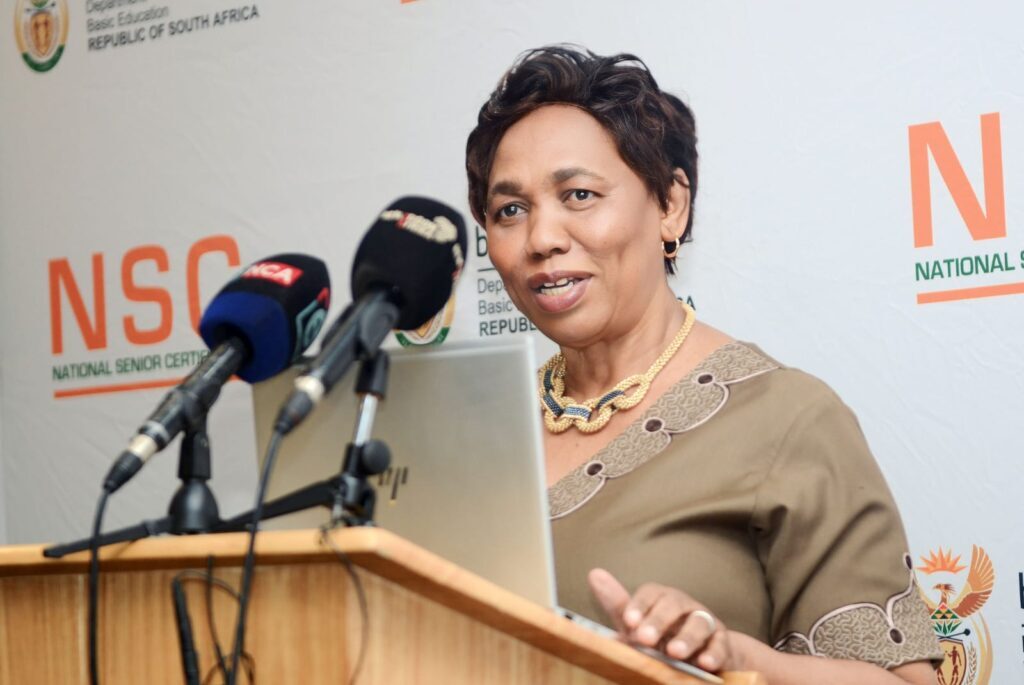
DBE ropes in State Security Agency to ensure there are no matric exam paper leaks – Motshekga
Uncategorized

DBE ropes in State Security Agency to ensure there are no matric exam paper leaks – Motshekga

Phuti Mosomane

Basic Education Minister Angie Motshekga said on Sunday the department has enhanced security measures to prevent paper leaks in all nine provinces as Grade 12s prepare to start writing their 2023 exams from Monday.

Briefing the media in Tshwane ahead of the exams Motshekga said the State Security Agency (SSA) has also audited all security enhancement processes. 

“Provincial Education Departments (PEDs) must follow standard operating procedures training storage point managers in security protocols. Moreover, specific collection times for question papers by chief invigilators have been established to deter early access. Each PED has its own irregularity committee to anticipate and mitigate the crisis,” she said. 

Motshekga also said all PEDs and schools have devised contingency plans, including backup generators to mitigate challenges of load shedding that has been brought to Stage 2 from Sunday.

Minister of Basic Education Angie Motshekga. Picture: Eddie Mtsweni

The Computer Applications Technology (CAT) and Information Technology (IT) Paper 1 examinations were conducted this week without power issues, with isolated incidents, she said, adding that the affected candidates were isolated and managed. 

If there were power interruptions Motshekga said the DBE will offer a backup paper if needed.

“In South African Sign Language Home Language (SASL HL), candidates’ laptops will be fully charged before each examination commences, and backup power supply measures have been put in place”.

Over 717 377 candidates have registered to participate in the final examinations across 6,898 centres nationwide. 

Motshekga said the figures are not mere statistics; they embody the aspirations, dreams, and relentless efforts of Grade 12 learners.

“They stand as a testament to the resilience of our students and the continuous dedication of the Department of Basic Education in providing them with a platform to succeed.

“When we compare this year’s figures to 2022, we observe a gradual decrease in the number of candidates, 34,626 candidates, and this could be attributed to the fact that more candidates complete their qualifications on time,” she said.

Basic Education Director-General Mathanzima Mweli. Picture: Eddie Mtsweni

There has been an increase in the number of part-time learners from 168 631 in 2022 to 181 143 in 2023 (an increase of 12 512).

A total of 207 question papers, 72 500 invigilators and 52 500 markers will drive the examinations process.

The quality assurance body Umalusi has approved all question papers to be administered in the 2023 Examinations and given the nod to the exams.

Motshekga will on Monday monitor the first day of the 2023 matric examinations in Ekurhuleni, Gauteng and will be joined by Gauteng Education MEC Matome Chiloane.

During the media briefing today, I shared some of the tips I’ve given to the matric candidates as they prepare to write their exams.

We wish the matric class of 2023 well. #NSC2023@DBE_SA @ElijahMhlanga @dbetvnews pic.twitter.com/16V2uUUteT

— Hubert Mathanzima Mweli (@HubertMweli) October 29, 2023

INSIDE EDUCATION 

Uncategorized

A Western Cape Teacher has reached the finals of the 2023 Global Teacher Prize

Johnathan Paoli

A Life Sciences teacher at Protea Heights Academy in Brackenfell, Western Cape, Dr Mariette Wheeler, has been selected as a Top 10 finalist for the prestigious 2023 Global Teacher Prize.

Wheeler was selected from over 7 000 nominations and applications from 130 countries around the world.

The Western Cape Education department (WCED) congratulated Wheeler and said her dedication to education and making a difference in the lives of her learners has put her where she is.

Wheeler said that she appreciated all the support and considered it an honour to represent Protea Heights Academy, the WCED and the country at the awards ceremony in Paris on 8 November.

“Teachers matter and teachers do so much for the youth of our country, not just in igniting curiosity but also in being there for our learners,” Wheeler said.

WC Education MEC David Maynier congratulated Wheeler on her award and said candidates for the Global Teacher Prize were judged on a rigorous set of criteria to identify an exceptional teacher who has made an outstanding contribution to the profession of teaching.

“To have a Western Cape teacher in the Top 10 is a real testament to the quality of teaching taking place in our province,” Maynier said.

The Global Teacher Prize is an annual $1 million award by the global educational charity, Varkey Foundation, to a teacher who has made an outstanding contribution to the profession.

The Prize, which has been referred to by some as the Nobel Prize for teaching highlights and celebrates the profession while giving greater recognition to the work of teachers all over the world.

Nominations of teachers who meet specific criteria are open to the worldwide public, with judging being done by the Global Teacher Prize Academy, consisting of head teachers, education experts, commentators, journalists, public officials, tech entrepreneurs, company directors, and scientists from around the world.

This follows on from the National Teachers’ Awards which was held at the Hatfield Christian Church in Thaba Tshwane, Pretoria earlier this month.

INSIDE EDUCATION

Uncategorized

The EFF Student Command threatens to open a criminal case over NSFAS

Lerato Mbhiza

The EFF Student Command (EFFSC) President Sihle Lonzi has threatened to open a fraud and corruption case against NSFAS and called for people who were involved in the stealing of the money to be arrested.

“We want to see all those involved in this to be arrested not only to be removed in position but to put on Orange overall.”

Lonzi was speaking at EFF’s Winnie Madikizela Mandela’s House on Thursday a day after NSFAS fired its CEO Andile Nongogo, fingered by the SIU for fraud and irregularities in the awarding of R47 billion contracts to direct payment service providers.

He questions the NSFAS board’s decision in allowing those accused of malfeasance to explain themselves instead of taking action against them for theft.

He also questioned why the contracts of the implicated service providers were not terminated with immediate effect.

“Why are the contracts being terminated in the future and not now?”

Lonzi said the EFF is happy the students’ demonstrations have paid off and the contracts of the service providers have been terminated, while pointing out that the EFFSC has won 16 university SRC leadership positions.

“This shows that we have a majority, and sends a strong message to the ANC that we will remove you from the union building in next year’s general elections”.

Nongogo was fired and the four contractors he appointed to disburse student funding are being terminated after a report by legal firm Werkmans Attorneys and advocate Thembeka Ngcukaitobi, found that not only did he play a role in handpicking the companies, but he had direct links with some of the companies from his previous job as CEO of the Services Sector Education and Training Authority (Services Seta).

The report also found that Nongogo appointed Dr George Chirwa, who has links with eZaga Holdings and its subsidiary eZaga Remit; Africawide Consulting, and Africawide Foundation as technical advisor.

eZaga and Tenet Technology have denied the allegations made against them, claiming to not have received the full report in which these were made.

INSIDE EDUCATION

The Gauteng Department of Education gives the green light for the Matric Exams
Uncategorized

The Gauteng Department of Education gives the green light for the Matric Exams

Lerato Mbhiza

The Gauteng Department of Education (GDE) is ready to start with the National Senior Certificate examinations from 30 October to 5 December, with CAT and IT rewrites taking place on 6 December.

This was confirmed by Gauteng Education MEC Matome Chiloane, who highlighted some of the initiatives the department has taken to ensure learners’ preparedness for the exams.

Chiloane was speaking at a ceremony at Ponelopele Oracle Secondary School in Johannesburg on Monday, where he outlined the province’s readiness for the exams and also gave an update on the status of the 2024 online admission for Grades 1 and 8.

“We have done a lot to ensure that we support our matriculants this year,” Chiloane said. “We continued with our Secondary School Improvement Programmes, mainly targeting schools that are struggling, Section 68B [the non-exclusion of learners from schools], as well as our township schools.”

Chiloane warned NSC candidates to not be disruptive during exams because those found breaking the rules will be removed immediately from the examination centres and banned from continuing with the exams.

GDE spokesperson Steve Mabona said the focus for this year’s exams is on credibility, integrity, efficiency and ensuring there are no technical irregularities.

He reiterated Chiloane’s warning that candidates found cheating will be barred from writing future examinations.

Mabona said 191,181 candidates have registered to write the examinations. Of these, 132 561 are full-time candidates and 58,620 are part-time repeat candidates.

There are a total of 1,015 examination centres, which include 738 public centres, 277 independent centres, and 93 centres for part-time/repeater candidates. A total of 16 new centres have been activated and registered with the department.

Mabona said candidates were helped by participating in the Secondary School Improvement Programme (SSIP) from September to October this year. Candidates were taken to SSIP residential camps for 12 weeks, where they were extensively coached on different subjects.

During training, special attention was paid to checking learners’ IDs to eliminate imposters.

Students will not be allowed to take cell phones into the exam centres, and the GDE has said that wristwatches will also not be allowed to eliminate all possible means by which learners could access and/or share information digitally and online while writing their examinations.

High-level security mechanisms remain in place and have been augmented to mitigate any leaks of question papers, including strict adherence to norm times when collecting and returning examination material before and after every exam.

The department has appointed service providers to augment security for the duration of the examinations, including armed escorts, response units, and CCTV cameras.

Regarding possible load-shedding, Mabona said exam centres that did not have generators would procure or rent generators to avoid any disruptions that may result from power cuts.

“The Department has also leased generators to ensure that backup power is available during load-shedding to allow for key processes such as marking and capturing to proceed,” Mabona said.

INSIDE EDUCATION

Uncategorized

Nongogo fired as Usaf orders a probe on Nsfas’ staff possible collusion in eEzaga scandal

Johnathan Paoli

THE Universities South Africa (Usaf) – a membership organisation representing the country’s public universities – has requested an investigation of Nsfas staff members to determine possible involvement in the awarding of contracts for the direct payment system.

Usaf CEO Phethiwe Matutu said the Usaf Board was watching with interest, the outcome of the processes concerning Nsfas CEO Andile Nongogo and the disciplinary enquiry pertaining to staff involved in wrongdoing.

The funding scheme board on Tuesday confirmed Nongogo’s immediate dismissal, following his submissions regarding his conduct.

Calls for the probe into staff collusion in awarding of the tender comes after the scrapping of the controversial eZaga payment system, together with Coinvest, Tenet Technologies and Norraco Corporation, by the Nsfas board last week.

The board found a conflict of interest in the appointment of some of the services providers who received the funding scheme’s direct payment system tender.

Last week the Nsfas board briefed the media in Pretoria on the system and allegations made against Nongogo.

Nongogo was placed on a leave of absence earlier this year, following the Nsfas board’s investigation into the allegations made against him, with board chairperson Ernest Khosa confirming that Nongogo actively participated in the presentations to the bidding committee.

In addition to Nongogo’s investigation and a probe into possible employee involvement, Matutu said that Nsfas supply chain management also needed to be reviewed.

Matutu said the membership organisation was supportive of the decision taken by the Nsfas board to look at the issues and to accept the recommendations of the report, which was investigating these four service providers.

“We categorically equate the success of Nsfas to the success of the entire post-school education and training sector, given the reported wide reach of the scheme to 1,1 million students in 2023. It is therefore imperative that NSFAS restores the administration of student processes to normality,” Matutu concluded.

Tenet Technologies has expressed its intention at possible legal action against the state, with CEO Ryan Passmore saying that they had not been informed of any damning allegations or cancellation by the scheme board.

“We are not aware of any damning findings, and neither have we been accused of any wrongdoing. We are not aware of anything other than the media reports of a cancellation. We will, however, challenge any cancellation that is unlawful and without cause,” Passmore said.

INSIDE EDUCATION

Uncategorized

Enrol early to avoid disappointment for your child

Staff Reporter

With the deadline fast approaching to enrol Grade 1 or Grade 8 scholars into schools in Gauteng for the 2024 academic year, there is help for parents who might need more support with the online application process.

Mohlago Ndebele, Service Team Lead at SPARK Schools, offers suggestions and tips to guide parents and guardians through the process.

“You cannot delay your application until the end of the year to secure a spot for your child in the school of your choice. Gauteng has hundreds of thousands of parents applying for schools, especially for Grade 1. The application process might feel daunting, but if parents and guardians do a little homework and preparation, the process should go much smoother,” she says.

Application tips and suggestions:
Visit the school website: Set some time aside to go through the school of your choice application process to understand what you will need to ensure your application is successful. Look at the documents required and ensure you have them all. If you need clarification on the documents, call the school’s enrollment team to assist you with the list of documents. Most schools require the following documents: birth certificate of the child, proof of parent’s residence, immunisation card (Grade 1), latest report card, and parent or guardian ID.
Pay attention to the details: Check before proceeding with the application; for example, ensure that you choose the correct grade and add the proper age to the application. It’s well worth reading the form carefully and double-checking when you are done.
Don’t assume anything: Submit the required documents and pay to ensure the space is secured. Also, having a sibling at the school does not provide automatic enrolment for a younger child. You still have to apply for a position; do not delay the application, or you might have to find a new school for the younger sibling.
Follow up: Once you’ve applied, call the school or their enrolment office to check progress. Checking your application is essential to know if anything is missing or any issues might delay your application.
Visit the school: If your application is complete, visit the school. This is a great way to learn about the school values and the environment your child will learn from. You can also ensure that the school fits your child correctly.

“The application process might seem intimidating. However, it doesn’t need to be. With these easy steps, your child will be enrolled in no time,” says Ndebele.

INSIDE EDUCATION

Uncategorized

SADTU hosts a workshop for school principals on sexual offences law

Staff Reporter

The South African Democratic Teachers’ Union (SADTU) will hold a training workshop for school principals from special needs schools to focus particularly on the recent legislative amendments regarding sexual offences – Criminal Law (Sexual Offences and Related Matters) Amendment Act of 2021 which came into operation on 31 July 2022.

This legislation has, among others, amended the National Register of Sex Offenders by broadening its scope to not only protect children and mentally disabled persons but all vulnerable groups. It extends the list of persons entitled to submit applications to the Registrar of the National Register of Sex Offenders.

Further, it regulates the reporting duty of persons aware that sexual offences have been committed against vulnerable persons.

This training will occur a week after the South African Council for Educators (SACE) presented its 2022/23 Annual Report before the Parliamentary Education Portfolio Committee on 18 October.

The Report stated that SACE received 734 professional misconduct allegations against educators. Of these, 163 were related to sexual harassment of a learner (failure to report rape, rape of a learner, impregnating of a learner).

One hundred principals from all nine provinces are expected to attend this training, which aligns with the Union’s 2030 Vision, which is focused on creating a learning nation and servicing union members.

This workshop targets principals because they are the main drivers of change in schools so that they can steer their schools in the right direction. It is envisioned that they will use the information for their schools and cascade it to others through Professional Learning Communities.

The training session will also include presentations on mental health and other communicable diseases and leadership.

INSIDE EDUCATION

Uncategorized

Teaching teenagers to navigate online spaces safely

Staff Reporter

In a world where we are increasingly living in the digital space, teaching young people how to manage their digital lives safely and responsibly is imperative.
 
As the world observes Cybersecurity Awareness Month this October, Shaun Fuchs, founder and CEO of Centennial Schools, points out that while the internet has opened a whole new world of possibilities for young people, they must be taught about cybersecurity and given the tools to keep themselves safe online.
 
Centennial Schools is highly invested in digitally-led education, with cyber security central to its teaching. “Given that almost 70% of South Africans regularly frequent the digital, the opportunities for students are vast. However, it can also be dangerous without essential tech-safety education,” Fuchs says.
 
“Gen Z is the most digitally literate generation on the planet. They live on their mobile phones. Using multiple online applications and platforms comes naturally to them. By modelling healthy tech habits and communication skills, we are helping them establish online boundaries, including communicating with people effectively online,” he says.
 
“We are in the middle of the 5 th  industrial revolution, which means that almost everything we do has an online presence. This means we must teach our children to be vigilant and smart about their digital interactions. This includes password safety, determining the authenticity of an online profile, limiting the amount of information they reveal online, distinguishing between real and fake sites, and mitigating
cyberbullying and scam-based situations,” he says.
 
Kreaan Singh, co-founder of CoinEd, who has partnered with Centennial Schools to provide blockchain and cryptocurrency training for students, says there are three essential rules for students to follow;

Be careful about the information that you share with people and online. Criminals will use this information to manipulate you to gain access to your personal information, including your cryptocurrency holdings. 

Always do your research. Be wary of opportunities that sound too good to be true. A simple internet search will often be the difference between falling victim to a scam and avoiding one. 

If your teenagers use Cryptocurrency or interact with any payment processes online, they need to understand how to secure their funds. Use unique, strong passwords if you are holding your investments on cryptocurrency exchanges. “By making sure our children are digitally literate and digitally safe, we are giving them the tools they need to succeed in life and work,” Fuchs says.

INSIDE EDUCATION

Uncategorized

Public health graduates can alleviate the burden on the healthcare system

Staff Reporter

The world faces a healthcare workforce crisis, and the available number of health workers does not meet the demand for accessible medical care.

The current number of health practitioners, both globally and locally, needs to be revised to tackle the burden of disease. 

South Africa’s health system is overburdened, which significantly impacts the nation’s health, resulting in poor national health outcomes, poor standards of service delivery, long patient waiting times and high rates of healthcare worker burnout. 

However, the dire situation can be significantly alleviated with the recognition of the important supporting – but overlooked – role that public health graduates can play, says Dr Jackie Witthuhn, Programme Manager: Public Health at IIE MSA, a brand of The Independent Institute of Education, SA’s leading private higher education provider.

“The role that undergraduate public health graduates, especially non-clinical staff, can play in the healthcare system is often overlooked. However, their skills can make a huge difference to increase public health capacity, freeing up medical staff to focus on patients while also focusing on primary interventions,” she says.
 
Undergraduate public health qualifications differ from medical or healthcare degrees, focusing mainly on disease detection, surveillance and prevention. The field or discipline aims to reach populations and communities and detect and prevent health problems before they start, rather than waiting to work with people once they are sick. Therefore, the public health approach is based on a preventative health model rather than a curative health model, explains Dr Witthuhn.

“There are many reasons for the health workforce crisis which need to be explored, including the Covid pandemic, which highlighted the structural weaknesses in our healthcare system, including neglecting primary care and prevention.  Other reasons for the healthcare workforce crisis include poor workforce planning and a lack of proper planning, including task shifting, which is an approach to help address the shortage of healthcare workers by reallocating available and skilled resources.

“The burden of chronic diseases, including cardiovascular disease, obesity and diabetes, which are increasing at alarming rates, increases the pressure on the healthcare system. Primary prevention can largely prevent these diseases, an approach that emphasises the need for a preventative public health focus and approach. The significant role undergraduate public health graduates can play in this regard is often underestimated.”

South Africa can ensure a proactive approach by utilising existing public health resources more effectively and focusing on non-clinical Public Health graduates. 

The question of how to provide an adequate health workforce is a pertinent one. A clear strategy is necessary and can include, among others:
 A more integrated approach to the planning and allocating of health workers and task shifting to use non-clinical public health graduates.
 Higher education institutions and health services work together to achieve distributed training and develop norms and standards.
 A more competent mix of staff per level of care to take stock of the available workforce, their training and skills.
 Government and industry recognise qualified staff such as public health undergraduate students who can be responsible for delivering a defined package of essential health interventions aligned to their skills and based on their qualification’s core discipline.

“We have the resources, but we need to start creating a system that can make optimal use of all of them,” says Dr Witthuhn. 

“Future health workforce plans should focus on utilising existing healthcare resources and infrastructure considering South Africa’s developmental status. All of the conditions that can make change possible are already in place. Investing in the supporting role of public health graduates and focusing on primary prevention can greatly address the current healthcare workforce shortage to deliver significant health and economic dividends.”

INSIDE EDUCATION

We are the CHAMPIONS
Uncategorized

We are the CHAMPIONS

STAFF REPORTER

Clapham High School and Jabulile Secondary School have been crowned Gauteng Schools Football Champions.

The inaugural Gauteng Schools Football Champions League has crowned its first set of champions, with Clapham High School winning the boys competition and Jabulile Secondary School for the girls.

The culmination of five rounds of games that were played on a bi-weekly basis which began in July 2023, the league concluded at Kagiso Sports Complex in Krugersdorp on Tuesday, 20 September.

Both the winning teams, Clapham High School (Tshwane) and Jabulile Secondary School (Orange Farm), performed exceptionally well throughout the competition, having maintained first position from the beginning to the end to attain first place gold status as well as earn the R100 000 grand prize, with R50 000 going to each school.

The prestigious Clapham school, renowned for producing elite young football players, emerged as the male victors with a total of 17 points accumulated. They were followed by Bhukulani Senior Secondary School (Zondi, Soweto) as runners up with 14 and the SAFA Sport School of Excellence (Germiston, Ekurhuleni) and Rosina Sedibane School of Specialisation (Laudium, Tshwane) came in joint third place with 13 points each.

Jabulile came out on top of the girls teams with 19 points, while, Kwadedangendlale Secondary School (Zola, Soweto) managed a second place finish with 16 followed by the Curro Academy (Soshanguve), rounding out the top three with 15 points.

Clapham’s Kgaogelo Monyane was named male player of the tournament, while Neo Mafisa from Curro Academy was pronounced as both female player of the tournament as well as top female goal scorer.

The first-of-its-kind league format for School Sports in the country, the tournament featured 16 teams (8 male teams, 8 female teams) of the best-performing schools in football from the School Sports Wednesday league programme in Gauteng.

Implemented by the Gauteng Department of Sport, Arts, Culture and Recreation together with the Department of Education and supported by SAFA Gauteng, the programme has helped advance and expose top developing talent from Gauteng schools.

INSIDE EDUCATION