Uncategorized

Opinion: Unisa management was correct to interdict the Minister

Mametlwe Sebei

Last night, UNISA management approached Gauteng division of the high court for an interdict to stop the Minister of Higher Education and Training Blade Nzimande from placing it under the administration pursuant to the notice he issued to that effect.

The court correctly find that the Minister’s actions amount to breach of the court which effectively sanction the Minister to act until such time that the appointment of Prof Themba Mosia, as an independent administrator, and the findings of his assessment report have been determined in the two judicial review applications of the University Council and the VC, respectively.

The appointment of Mosia remains irregular at many levels, and his findings highly flawed. They cannot be the last word on the state of the university. 

His conflict of interests and the dishonest manner in which he abused his status clearly to advance an agenda of the faction aligned with the corrupt interests in the university compromised what otherwise would have been a very constructive process to take the university forward.

If the Minister is sincerely interested in dealing with the real problems at UNISA he needs to assist the process of convening the university stakeholders- workers, academics, and students-amongst others to reflect on the state of the university, including some of the problems the reports correctly point out to, and how the turn-around strategy can be developed and implemented.

The fact that university was awarded the top performing company in the University Sector by the publication Top 500 again indicates the direction of the university. Although these awards do not embrace every facet of the university and in many ways conceals other serious problems

including major issues around university administrative and ICT systems, student support, and governance issues, they are reliable in so far as they look into financial performance.

The finances are no secondary matter. Universities are in crises not due to lack of commitment to the academic and research project on the part of its key stakeholders, academics, workers and students. 

They crises emanate from their subversion by profiteering interests and their enablers who turns universities into sites of capital accumulation through tenders, outsourcing and commercialisation of university at all levels. 

Financial managements are therefore significant indicators of the management’s commitments to enables these interests or to reign on them in defence of the teaching and learning mission.

On the other hand, it is vital again to reiterate that it is problematic that the Minister endorses Mosia’s findings in favour of tendering model of procurement of basic equipment like laptops. 

The decision of the UNISA management to terminate this tender and to procure laptops in open market has saved UNISA over R400 million. 

On the hand, Bojanala District Municipality under Blade and Mnisi’s party has spend R2 million on two laptops. This should put the matters into perspective.

Workers and student movements should step forward.

This court decision calls for the movements of workers, academics and students to step forward with a clear programme to defend UNISA from this brazen attempt at hijack of the university. 

They should fight to eliminate every form of outsourcing including canteens and others which were remained after the heroic #OutsourcingMustFall movement that led to insourcing of security, cleaning and other services at the university. 

They should step forward to fight mediocrity and mismanagement of the university, and for a genuine transformation of the university into a public institution capable of offering quality, accessible public higher education for all, for socially engaged scholarship and research that meaningfully contribute to the upliftment of working-class communities and humanity in general.

Mametlwe Sebei, lecturer: Dept of Jurisprudence at Unisa College of Law.
Uncategorized

Two more children die from food poisoning 

Lerato Mbhiza

Two children from the West Rand have passed away after allegedly eating poisonous food they bought from a taxi rank on Wednesday night.

The incident comes days after two four-year-old-children in Naledi in Soweto died allegedly after eating biscuits from a foreign-owned spaza shop. 

Provincial police commissioner Elias Mawela said that police investigations were underway to determine the cause of death.

“Two children bought some food. Unfortunately, we’ve lost those two children. The other three who were treated and discharged, they’re going to help us to look for the people who sold the food to them.” 

The latest incident of children being killed after allegedly consuming food bought from spaza shops is unfortunately not the first .

In 2021 two siblings from Mpumalanga died after sharing a packet of noodles bought from a spaza shop. Thato Makofane (9) and her brother, Keamoketswe (13), died within a short period of each other. Their death certificates stated that the cause of death was still under investigation.

The Gauteng Health Department’s outbreak response team took to the streets of Soweto trying to increase health awareness following the recent food poisoning incident in Naledi township.

The Department’s Motalatale Modiba stated they also sensitised the community on what to do when they are present with food poisoning symptoms, such as cramping, nausea, vomiting or diarrhea. 

“When people present these symptoms, it’s important that they go to the nearest health facility for further management.”

Modiba said the team spent Wednesday in Naledi and surrounding areas engaging locals and conducting health education about food. 

“The health education also covers spaza shops in the area and includes checking compliance in terms of the Foodstuffs, Cosmetics And Disinfectants Act and food labeling regulations.”

Health MEC Nomantu Nkomo-Ralehoko has called on all spheres of government to work together to enforce compliance with the relevant laws.

“The department is urging the public to visit their nearest health facilities when they present with symptoms such as: vomiting, sudden chest pains, body ache/weakness, fever or foam in the mouth. 

“The outbreak response team comprising of, Environmental Health Practitioners (health inspectors) from the municipality and the province, Ward-Based Outreach Teams, Communicable Disease Control specialists, Surveillance Officer, Infection Control and Health Promoters will continue to conduct awareness campaigns in Naledi and surrounding areas on Thursday and Friday,” she said.

Johannesburg Council Speaker Colleen Makhubele has called for calm following threats against foreign spaza shop owners by the Naledi community.

INSIDE POLITICS

Uncategorized

Gauteng Education MEC Devastated by the tragic death of two Gr 1 learners

Johnathan Paoli

Gauteng Education MEC Matome Chiloane devastated by the tragic death of two Grade 1 learners from Naledi, Soweto.

MEC Chiloane expressed his condolences on Tuesday, saying he was devastated by the recent death of two Grade 1 learners from Kgauhelo Primary and Karabo Primary schools in Naledi, Soweto after allegedly eating biscuits and juice purchased from a spaza shop.

Two other Grade 1 learners from Ikemeleng Primary school are currently in a critical condition and are receiving medical care at Chris Hani Baragwanath Academic Hospital after allegedly eating snacks from the same spaza shop as well.

“This incident serves as a grave reminder to parents and guardians to exercise utmost caution when it comes to the safety and well-being of our learners,” Chiloane said.

Gauteng Police spokesperson Dimakatso Nevhuhulwi said the community members had issued threats to loot and burn the spaza shop. However, the police stopped the angry community members and warned that such actions could jeopardise evidence.

Nevhuhulwi said an investigation into the cause of death is currently ongoing.

The shop has since been shut down by the police and members of the community with other spaza shops operated by foreigners also being closed in parts of the township.

Operation Dudula leader Ntonto Kente said the shutdown of foreign-owned spaza shops which started on Tuesday would continue in an effort to prevent the poisoning and killing of South African children.

“The whole of this week will be dedicated to shutting down these businesses. We can’t let our children die and do nothing,” Kente said.

The Gauteng Department of Education called for the community’s support and understanding during the investigation, saying that parents need to remain vigilant when it comes to safeguarding the well-being of their children.

INSIDE EDUCATION

Uncategorized

Springbok Women beat their Kenyan counterparts in a historic Test match

Inside Education Reporter

This was the first-ever international rugby match at UWC, mere days after the Operation Room, as the UWC Sports Stadium is affectionately known among the locals, hosted a Cape football derby when Cape Town City took on Cape Town Spurs in the DStv Diski Challenge. 

It was a proud moment for UWC alumna Babalwa Latsha. 

The two events are a testament to the goal of the University’s Department of Sport Administration to make a massive contribution to South African sport in the broader scheme of things as part of UWC’s community engagement strategy. 
Few years ago, UWC spent millions of rands to revamp its sports facilities to be at world standards to host matches of this magnitude.

A hattrick by Veroeshka Grain, playing in the number 14 jumper just like former UWC Varsity Cup star Kurt-Lee Arendse did for the Springbok Men in the Rugby World Cup, was the standout performance for the wearers of the green and gold.

The game was still in the balance at halftime when the Boks led 24-12, but a resurgent second-half effort from South Africa meant they eventually won comfortably by 77-12.

The home team, led by UWC alumna Babalwa Latsha, started like a house on fire and enjoyed a healthy 17-0 lead after 16 minutes after Grain, Sinazo Mcatshulwa (lock) and prop Yonela Ngixingolo all crossed the whitewash. 

The Lionesses from Kenya, however, refused to back down and scored back-to-back tries through Diana Kemunto (flanker) and Stellah Wafula (left wing), while flyhalf Ann Goretti converted Kemunto’s try to bring the scores to 19-12.

A try after a rolling maul from a lineout by Bok-hooker Roseline Botes gave interim head coach Louis Koen’s side some breathing space as they went into the halftime break, leading 24-12.

Although the heavens opened sporadically in the first half, which made handling the wet ball tricky at times, the try-scoring floodgates opened after halftime. The Boks dominated the Lionesses during this period and eventually ran in 9 unanswered tries in the second half.

The forwards, expertly led by Latsha with her barnstorming runs, were physically far superior to the Kenyans and laid the perfect platform from which Libbie Janse van Rensburg (flyhalf) could send her speedsters away. The Bulls Daisies playmaker impressed with her distribution and game management and had a hand in most of the Boks’ tries.

Latsha was ably supported up front by Sinazo Mcatshula, her lock partner and fellow UWC alumna Danelle Lochner, and flankers Nompumulelo Mathe and Catha Jacobs, while the backline had a field day. Reserve lock Vainah Ubisi’s impact in the second half was so impressive that the powerful front ranker earned herself the player of the match award despite her not starting the game.

“This was a typical test match – it was physical and hard, and we had to chip away at Kenya,” said Koen. “I said to the players that we cannot expect a wall to fall with one blow, but it will fall if you chip away repeatedly, and that is how it panned out. I think the good work of our assistant coaches, Laurian Johannes-Haupt and Franzel September, over the last couple of weeks, is really showing now, as well as the impact of our conditioning and wrestling sessions.”

The Springbok Women will play a training match against the San Clemente Rhinos on Tuesday, and following that match at False Bay Rugby Club, they will face an array of international stars when they take on the Barbarians at Athlone Stadium on Saturday.

INSIDE EDUCATION

Uncategorized

Samsung’s Solve for Tomorrow enters the home stretch as finalists develop their prototypes

Inside Education Reporter

The ten finalist schools in Samsung’s Solve for Tomorrow competition are in a race against time to complete their solutions in the third phase of the nationwide challenge.

The current phase involves creating prototypes to solve the various societal challenges the learners identified in their respective communities. This leg of the competition is running until the end of September 2023.

The learners were prepared for this phase through purposeful Design Thinking workshops held in their regions in May 2023. At these workshops, they were taught invaluable skills on how to approach best and get the most out of their work, think critically, speak and act like designers, and a cognitive and structured process for human-centred, creative problem-solving. They were also encouraged to focus on building strong teams and training on conducting research that could help transform their ideas from mere concepts to workable solutions that would address the identified issues within their communities.

The finalist schools, who hail from the provinces of Gauteng, Mpumalanga, Free State, KwaZulu-Natal and Limpopo, now have just over a month until the end of September to work on and complete their prototypes. They will then present to a panel of judges on the 3rd of October as they vie for the top prize.

The different groups of learners are coming up with exciting and varied solutions for their communities that include an ambitious plan for better roads using sustainable materials, basic needs during load-shedding, alternative solutions for water and electricity, and clean water, to name a few.

Grade 11 learner from Mbilwi Secondary School in Venda, Limpopo, Igoline Coelho, shared how her team is determined to blow the opponents out of the water. “Our team has been ready from the get-go to put in the hours and hard work needed to get us over the finish line. Ours is a very simple solution but with the potential for a high impact. The problem affects everyone and we are happy to make a contribution with our solution. We hope it can catch on and be used by many other communities. We are a very competitive team and are determined to win the competition.”

The finalist team from Acornhoek in Mpumalanga, Maphuthaditshaba Secondary School, believes they will be delivering the best solution that will help their community. “Our solution will help households and small enterprises, so it will also have an impact on the local economy. We are going to do our best to win, especially because we are the only representative of our province in the competition,” said team member Keabetswe Malaza (Grade 10). 

Amahle Skhosana (Grade 11) from Adams College in Amanzimtoti, KwaZulu-Natal, said they’ve worked hard as a unit up to this point in the competition and discovered that they work well together. “Using science, technology, engineering and maths to solve our community’s problem has excited the entire team because of all the learning opportunities it presents. We are going to do our best to win to make everyone proud, but more importantly, to solve the problem.”

Sbongile Zulu, a Grade 10 learner from Buhlebemfundo Secondary School in Tsakane (Gauteng) said her team feels ready to conquer after all the great insights and useful tips they learned from the Samsung mentors allocated to each school. 

“We are determined to do well in this competition because if we win, the prize is double – we get to solve a problem in our community and also get an awesome prize for our school. There is more than enough motivation.”

The Solve for Tomorrow competition officially launched in South Africa in January this year, and is Samsung’s Contribution to youth empowerment and skills development in the information communication technology sector to help advance the country’s Fourth Industrial Revolution (4IR) agenda. It was designed to increase interest and proficiency in Science, Technology, Engineering and Maths (STEM) among grade 10 and 11 learners from underserved communities.

“As the learners enter this critical stage of the competition, we are getting excited and looking forward to seeing all the solutions they come up with. This bodes well for the future of our country as the youngsters are killing the proverbial two birds with one stone by learning and also improving or solving problems in their communities,” said Hlubi Shivanda, Director for Business Operations, Innovation and Corporate Affairs at Samsung.

The winning school will get a prize of R100 000 worth of STEM equipment for their school, while second and third positions will get R50 000 and R30 000 worth of STEM equipment for their schools respectively. In addition to the main prizes, each of the learners in the top three teams will be rewarded with a Samsung device.

INSIDE EDUCATION

Uncategorized

From Russia, with Love…South African students in finals of the International Financial Security Olympiad

Inside Education Correspondent

A delegation of South African students from various universities, led by Advocate Nomazotsho Memani, is in Sochi, Russia for the International Financial Security Olympiad.

Russian Alumni coordinated the program in conjunction with various universities.

Memeni said, via WhatsApp, that the group left South Africa on 29 September and has reached the final stages of the competition. 

“Seven South Africans who have passed the first round of trials will participate in the final stage on 2 to 6 October 2023, at the ‘Sirius’ federal territory in Sochi, Russia. 

The South African participants are Bubulumko Baai, Karabo Masenyadiloana, Thokozani Simelane, Thabo Lehlohonolo, Malale Kasango, Mamello Mofokeng, Snazo Mona and Zandile June-Rose Ngcobo.

The Olympiad is hosted by Rosfinmonitoring, Russian Ministry of Education, the Ministry of Science and Higher Education and RUDN University,” she said. 

In a statement, the head of the International Olympiad on Financial Security project, Vice-rector for Student in Affairs in Russia, MJ Katsarsky, said South Africa is taking part in the event for the second time. 

“The peoples’ Friendship University of Russia named after Patrice Lumumba (RUDN University) has the honour to express our compliments and inform that according to the results of the qualifying stage of the International Olympiad on Financial Security (hereinafter -Olympiad) the 8 finalists from South Africa, will go through the final stage.

“The purpose of the Olympiad is to show modern trends to the talented young people in the sphere of financial security, directions of development of science and technology in this area, to allow determining their future path”.

More than 12 500 students took part in the Olympiad in total and about 2 000 of them are foreigners”. 

Katsarskysaid due to the growing interest in the International Financial Security Olympiad among a number of states, the geography of participating countries was expanded in 2023, with countries such as Algeria, Cuba, Iran, Namibia,, Pakistan,, Venezuela, and Vietnam having joined BRICS. 

INSIDE EDUCATION

Good wishes from Inside Education for the class of 2023 
Uncategorized

Good wishes from Inside Education for the class of 2023 

Inside Education Reporter

Inside Education, which, in association with the Department of Basic Education, has published a compilation of study notes to assist matric learners, wishes the class of 2023 well in the matric examinations. 

“Matric is the stepping stone to success, and we hope that our special supplement will help learners give their studies a final boost,” says Matuma Letsoalo, Managing Director of Inside Education. 

Credibility of matric exams paramount.

Letsoalo adds that the publication is pleased to partner with the DBE to help improve learners’ outcomes. 

“Year-on-year, the national results have shown improvement, and we want to contribute to this upward trajectory,” adds Letsoalo. 

INSIDE EDUCATION

Uncategorized

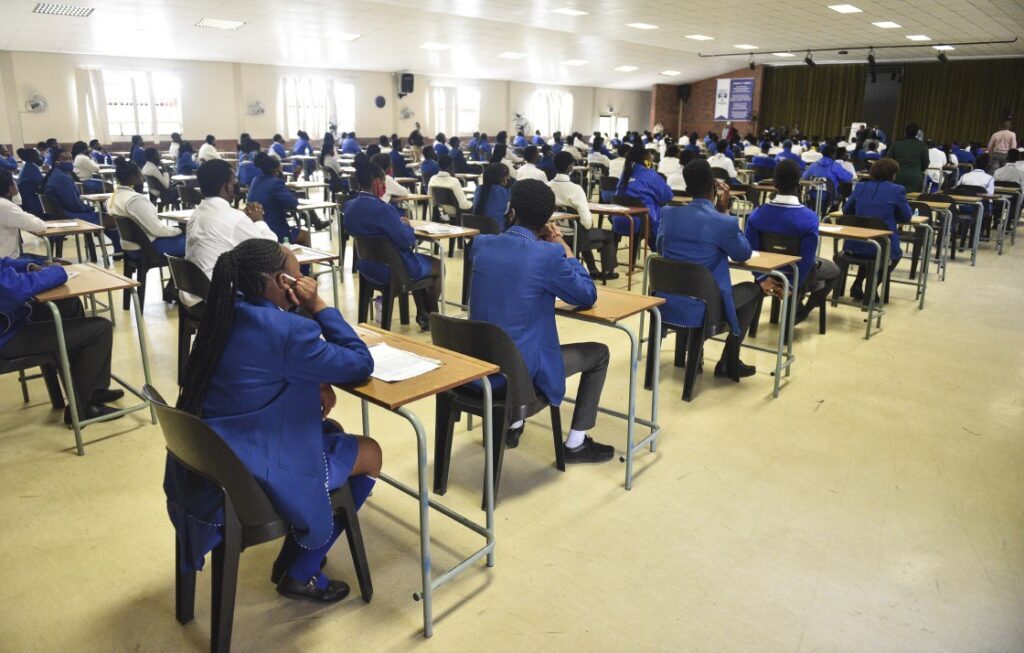
Matric pupils at North West school gear up for examinations

Kenneth Mokgatlhe

Matric pupils at Phakedi High School in Mokgola Village near Zeerust are confident about their readiness for their final examinations due in October. 

Despite the lack of learning resources such as a library or computer laboratory, learners in this school say they are using everything at their disposal to pass their examinations.

Phakedi High School is a rural school in the North West Province where pupils have to walk more than 2 kilometres from their different homes to get to the place of learning. 

Omphile Mothoagae is no exception. The 17-year-old majoring in Geography, Life Sciences, and Agriculture stays with her unemployed mother, a single parent who is confident about her readiness for matric exams.

“I believe the year was so short, but I am ready. We have been holding study camps at the school, and we will have the last one before the commencement of examinations,” said Mothoagae.

According to Mothoagae, the Foondamate helped prepare her for the upcoming final examinations because she could download all previous question papers using the tool,  which enabled her to study effectively. 

“I do not know what I would have done without this app; it is useful for children like us from the rural schools which do not have libraries or computers.”

Foondamate is an artificial intelligence robot study tool on WhatsApp that supports matric learners with their studying materials and emotional and psychological support.

Mothoagae’s school, Phakedi High, had 104 learners in its class of 2022, and 86 managed to pass. The rural school produced 33 Bachelors, 23 Diplomas and 31 Higher Certificates. 

Umalusi, the quality assurance body, appeared before the portfolio committee on education in parliament this week to present a preliminary report on the state of preparedness.

Umalusi’s Mary-Louise Madalane told the lawmakers that 855,607 matric candidates registered as of August 31, 723 877 were full-time learners.

And 18-year-old Tshepang Moremongwe is one of those full-time learners studying mathematics and physical science at a rural school in the North West.

Moremongwe said the revision papers were helping him where he needed help understanding what he was taught in class.

“Teachers are currently assisting us through revision, which does help me. We are using old question papers to revise, and we can ask questions where we do not understand,” Moremongwe said.

Moremongwe, who wants to be a teacher, stays with his grandmother and says he struggles to obtain other study material as he always needs money to buy data.

“Data is expensive, and I cannot do much with R5 data. We depend on my grandmother’s social grant, which is not enough to buy enough data or visit the library in Zeerust,” he added.

INSIDE EDUCATION