Uncategorized

Partnerships drive the Plastic Changemakers programme

Inside Education Correspondent

THE Plastic Changemakers programme, which aims to teach primary-school children on the environmental impacts of plastic pollution, was recently launched in Cape Town by the Breteau Foundation. 

The Breteau Foundation aims to inspire and empower over 1 million primary school children around the world to act against plastic pollution in their homes and communities. 

Mona Ewees Mkumatela, regional development manager for the Breteau Foundation in South Africa, says the programme has already seen significant take-up from education practitioners, community organisations and NPOs. 

“Since we launched the programme in October, we have had extremely positive feedback from our partners across sectors,” she says. “This is very encouraging for us. We rely heavily on others to help us in our quest to reach one million children across the world and turn them into ambassadors for change in the plastics pollution space.”

Bruce Probyn, Chairman of the Western Cape Education Council, says engaging today’s learners requires a shift away from traditional teaching methods. 

“We need to think differently about the way we interest and excite pupils,” he says. “The days of ‘chalk and talk’ are fading. They’re being replaced by a need for innovative, engaging approaches.”

Probyn’s long-term vision for the programme is optimistic. 

“I envision that if the Plastic Changemakers programme becomes deeply embedded over time, it could lead to litter-free schools, which, in turn, would influence the surrounding communities.”

Probyn highlights the importance of a clear plan, well-thought-out steps, and consistent support. 

“We collaborate with foundation phase colleagues who are actively engaged in approximately 18 schools, where multidisciplinary teaching is being implemented,” he says. “In this context, the Plastic Changemakers programme has a unique and valuable role to fulfil.”

The programme has also raised interest among local community organisations, including the Bonteheuwel Training Skills Squad (BTS). 

Zaironesa Karriem, the driving force behind BTS, says, “It’s not just about training and life skills; it’s about cultivating a sense of exploration, adventure, and fun.”

BTS serves three high schools and 14 primary schools in Bonteheuwel and aims to engage all these institutions in the initiative.

“Our motivation is rooted in the desire to reshape the perspectives of young individuals. We aim to provide our learners with a practical understanding of how what is often perceived as waste and pollution can, in fact, hold the potential for creating sustainable opportunities,” says Karriem. 

“By exposing learners to initiatives like the Plastic Changemakers programme, BTS aims to instil seeds of change, nurturing values that the children can carry with them into the world as responsible ambassadors.”

Karriem says the programme engages children in a relatable and tactile way.

“It’s about bridging the gap between classroom theory and real-world practice, ensuring that every child’s inherent creativity finds expression. It’s also about building confidence and nurturing skills that, with ongoing support, will evolve into positive action.”

Jocelyn Anderson, Sustainable Schools Programme Manager at environmental education organisation, Nature Connect, says the Plastic Changemakers programme is the perfect addition to Nature Connect’s online library of quality, curriculum-aligned resources to support teaching and learning in schools.

“What sets it apart is its ability to engage youth actively in environmental action,” she adds. “It provides students with opportunities to take real steps towards caring for the environment, instilling in them a sense of agency and empowerment.

“It cultivates a sense of agency in both teachers and learners, motivating them to actively participate in nature conservation efforts.”

Anderson says her hope is to include the Plastic Changemakers programme in teacher training workshops, events, and immersive education experiences. 

“Specifically, we are looking at incorporating the programme into our initiatives designed to raise awareness about plastic pollution, such as our beach clean-ups and in-school lessons. 

“We will also be adding the programme materials to our online resource library for teachers to access.”

For more information visit https://breteaufoundation.org/

INSIDE EDUCATION

Uncategorized

Gauteng Education Department official survives shooting incident

Lerato Mbhiza

A Gauteng Education Department official was shot at while driving along the Chris Hani Road and Golden Highway intersection on Thursday afternoon and spokesperson Steve Mabona said the official from the Johannesburg south district – who oversees learning and training support material – survived the “unfortunate” shooting incident.

“According to information at our disposal, the male official from our Johannesburg south district, overseeing learning and teaching support material, was in his vehicle at the Chris Hani Road and Golden Highway intersection when he was suddenly shot by an unidentified assailant.

“Immediate medical attention was provided, and we are relieved to report that the official is currently in a stable condition and receiving medical attention at a local facility.

“We extend our heartfelt wishes for the speedy recovery of our colleague and assure the family that we will provide the necessary support during this challenging time,” Mabona said.

Gauteng Education MEC Matome Chiloane said that while the motive is unknown, it is worrisome that an official can be targeted and shot at in that manner. 

“We wish to call upon law enforcement agencies to bring the perpetrators to book. Anyone who might have information regarding this incident is encouraged to share the same with the police. We wish our employee a speedy recovery”. 

INSIDE EDUCATION

Uncategorized

Nzimande slams the scourge of GBV at the launch of NSFAS 2024 application season

Primrose Lerato Mbhiza

At the official announcement of the NSFAS bursary application season for the academic year 2024, Minister of Higher Education Dr Blade Nzimande took the time to highlight and condemn the disturbing trend of Gender-Based Violence that he said was a scourge afflicting not only in society but also plagued institutions of higher learning as well.

“I have convened this media briefing to announce the official opening of the National Student Financial Aid Scheme bursary application season for the academic year 2024. 

“However before I provide further details on the 2024 application season, I would like to raise concerns and necessary for both the government and the post school education and training sector to intensify campaigns to confront and defeat the scourge of gender based violence in our institutions the issue of Gender Based Violence in our society and at our post school education and training institutions. 

“In the past weeks we have seen video footage of a university student stabbing his wife at a private student residence in Belhar, Cape Town. This kind of barbaric behaviour by males against women must be condemned and perpetrators must face the full might of the law. 

“We cannot continue like this in our society where as many as 38% of murders are committed against women, often by their intimate partners. 

“As part of dealing with gender-based violence in our institutions, I launched  the Transforming MENtalities Initiative, which is a multistakeholder partnership within the PSET, with a particular focus on mobilising men in our sector to be part of championing a world free of gender biases, stereotypes, violence and discrimination. 

“I urge all institutions working with Higher Health (which oversees wellness at higher education institutions) to continue to collectively implement programmes towards addressing the challenges of sexual and gender based violence within the PSET (Post School Education and Training) system,” Nzimande said.

The Minister also said he welcomed the arrests that have been made at the University of Fort Hare for the killings that have taken place there including a most recent incident where a student was stabbed to death allegedly over a missing laptop.

Two bodyguards of Fort Hare Vice-Chancellor Sakhela Buhlungu were killed in separate incidents this year in what has been alleged were assassination attempts of the VC.

“We had indicated to Minister Cele that indeed no stone must be left unturned in going to the reasons for the killings at Fort Hare. Without prejudging the situation, as Minister, I am however deeply concerned about the latest arrest of someone inside the Vice-Chancellors office and ostensibly responsible for the security in the institution.

“This may point to the fact that the problems at UFH may be deeper than meets the eye. I will be further engaging with Council on the latest developments, particularly given the fact that complaints have been raised with me about alleged illegal surveillance of Council and staff members”.

Nzimande said he wanted to remind all South Africans that the mandate of the National Student Financial Aid Scheme (NSFAS) was to provide financial assistance to deserving beneficiaries who qualify for access to post-school education.

As a scheme, NSFAS represents one of the most progressive efforts by the government to systematically break the legacies of intergenerational social inequality in access to and outcomes of post school education and training, Nzimande said. 

“This is particularly important if we consider the structural and social constraint to accessing education that was imposed by centuries of colonial and apartheid rule. 

“There is no doubt that this government has made a decisive contribution towards a break with these reproductive legacies of the past. 

“Since 1991, NSFAS funding has grown from disbursing R21.4 million to almost 48 billion to fund children of the working class and the poor seeking to further their studies in public universities and TVET colleges. 

“This is a clear indication that the government has prioritised student funding and broadening of access to those sections of our communities who had no access to post school education and training in the past. 

“The other notable milestone for the scheme has been the integration of all public universities and TVET colleges to the student-centred model wherein students apply directly to NSFAS for funding. 

“In this current financial year, NSFAS is  funding 1,6 million students. This follows an unprecedented surge in the number of applications received by the scheme.

“The entity has been working tirelessly to ensure that it improves on its processes for applications and ensuring quick turnaround times on funding decisions in preparation for the 2024 funding year. 

“You would agree with me, that in order for NSFAS to successfully implement the funding of 2024, there needs to be closure of the 2023 funding cycle.  This includes the finalisation of all the appeals and payment of all outstanding allowances for the academic year 2023. 

“NSFAS committed that all appeals and the payment of outstanding allowance will be finalised this year. For all those  students who did not get successful funding outcomes for the 2023 academic year, they are all encouraged to apply for 2024 funding.

“Let me also indicate that the proposed 2024 funding policy is almost complete, and will be issued by the end of November, to allow stakeholders to prepare for the 2024 academic year. 

“The funding policy will cover the eligibility criteria and student allowances”.

INSIDE EDUCATION 

Covid-19 was not only a pandemic but it also had a devastating impact on education – Ramaphosa
Uncategorized

Covid-19 was not only a pandemic but it also had a devastating impact on education – Ramaphosa

Lerato Mbhiza

President Cyril Ramaphosa said while some learners adapted swiftly to online learning during the two years of the Covid-19 pandemic, others, particularly those from poorer communities experienced greater challenges.

Ramaphosa was addressing the 10th Education International African regional conference at the Sandton Convention Center on Tuesday where he spoke about the devastating impact the pandemic had on South Africa, saying as we navigated the turbulent waters, the world was confronted with political upheavals and conflicts.

“We saw how rural communities and students with disabilities were disproportionately affected. With schooling disrupted, inequalities in education were exacerbated”. 

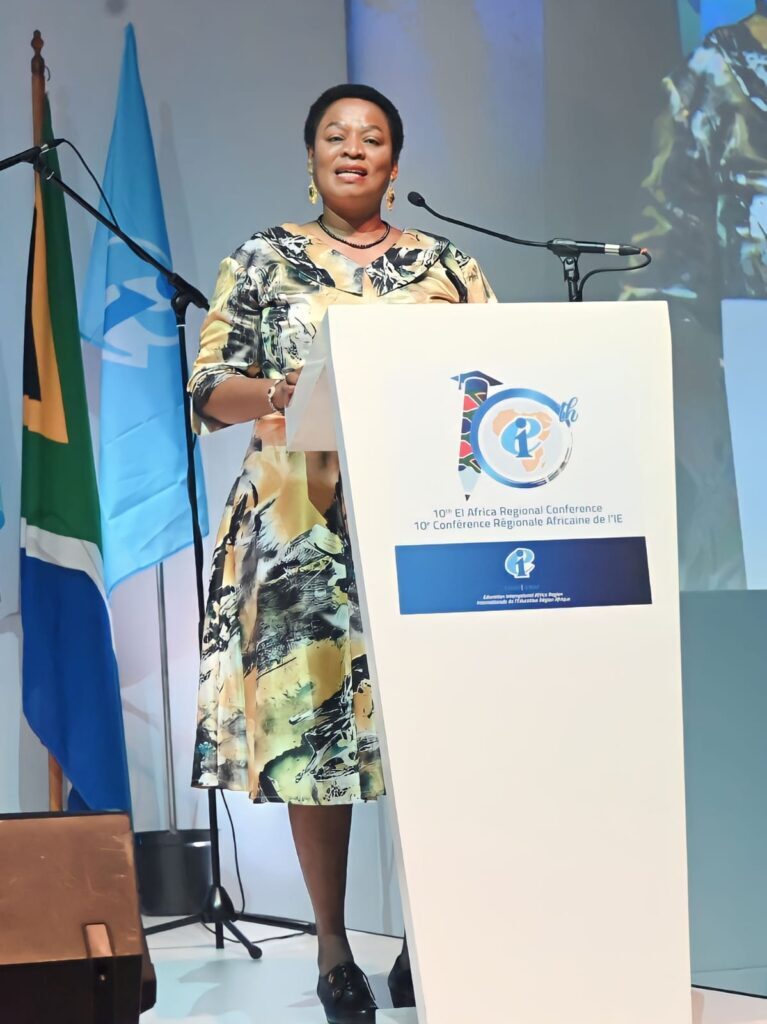
Basic Education Deputy Minister Reginah Mhaule. Picture: Eddie Mtsweni

Ramaphosa added that Covid-19 and the lockdowns which resulted in schools, businesses and other public enterprises being forced to shut down,  further strained social fabric, affecting the livelihoods of countless individuals and denying many children their fundamental right to education. 

On the other hand, the pandemic hastened digital transformation and altered patterns of work and education. 

“It forced us to confront and appreciate the essential nature of health care, revealing both the robustness and fragility of our societies in the face of hardship”. 

Ramaphosa also added that the education system needs to be decolonised as education has become increasingly important in the world.  

“The discussions at this conference, focusing on tackling racism, decolonising education and promoting democracy, human rights and trade union rights, could not be more timely”‘. 

“The project of decolonising education in Africa is not just a matter of academic interest. It is a pressing need,” said Ramaphosa. 

Ramaphosa told delegates that they need to challenge colonial theories and practices to build resilient education systems that are centered on African perspectives and experiences. 

“This requires a shift away from a Eurocentric worldview to embrace a more diverse and inclusive perspective. We must acknowledge and value the knowledge systems of all peoples and integrate them into our curricula and knowledge selection processes ” said Ramaphosa. The responsibility to nurture and defend the right to education extends to all parts of society”.

INSIDE EDUCATION

Uncategorized

Flourishing in the Age of AI the major theme at the 2023 WISE Summit in Doha

Edwin Naidu

Several high-profile speakers will arrive in Doha, Qatar, next week for the 2023 WISE Summit, the global platform for innovation in education established by the Qatar Foundation meeting this year under the pertinent theme “Creative Fluency: Human Flourishing in the Age of AI”.

The packed line-up for the 11th WISE Summit includes Rawaa Augé, Presenter, Al Jazeera, Jeffrey Sachs, University Professor and Director of the Center for Sustainable Development, Columbia University, Sayasat Nurbek, Minister of Science and Higher Education, Kazakhstan, Hayfa Al Abdulla, Innovation Director, Qatar Foundation, and Jason Czyz, Co-President, Institute of International Education.

Scheduled for 28-29 November 2023 at the Qatar National Convention Centre (QNCC) in Doha, WISE 11 promises a unique blend of insights and interactions. However, it is the emergence of Artificial Intelligence challenges to the traditional view of creativity, raising important questions about education’s future. The Summit will encourage the WISE community to explore topics like computational literacy, personalized learning, AI-integrated teaching approaches, and equity issues in emerging educational technologies worldwide.

Of particular interest to teachers around the world, a panel will also discuss Classrooms of the Future: Will AI Necessitate a Fundamental Rethink of Teaching and Learning? In addition, panels will consider Charting the Future of Education: Roadmap for AI Integration in the Classroom as well as AI and Digital Sovereignty.

With AI dominating debate in the tertiary education sector, many believe it can revolutionize education, including access and inclusion for underserved youth. However, the ethical considerations of AI, and the potential it has to contribute to discrimination, inequality, and
exclusion must not be overlooked – and will be the basis of one of the panel discussions.

Stavros N. Yiannouka, CEO of WISE, said WISE 11 is a dedicated space where the intersection of human creativity and artificial intelligence will be thoroughly examined.

“We’re bringing together leading experts, educators, and innovators from around the world to work hand-in-hand, ensuring that our approach to AI in education centers around the betterment of human lives.”

A spokesperson from Qatar Foundation added, “The WISE Summit remains a beacon for innovation and intellectual discourse in education. This year’s theme aligns perfectly with Qatar Foundation’s mission to cultivate a culture of lifelong learning and creativity. We are honoured to host this pivotal event that resonates with our vision of empowering individuals to adapt and excel in a dynamically evolving world.”

The authors of WISE Research will also present their latest reports addressing critical education issues around the globe, and propose action-oriented recommendations and policy guidance for stakeholders in the education industry.

Throughout its time, WISE has contributed to the creation of a vibrant community with more than 50,000 members across 140 countries, engagement of over 3,000 international attendees in 2019, participation of over 2,000 in-person delegates and 11,000+ online participants in the 2021

Edition, and expanding the reach of WISE to cities such as Tunis, Beijing, Madrid, Accra, New York City, Paris, and Medellin since 2016.

Global leaders, such as Michelle Obama, Julia Gillard, and Gordon Brown, have addressed platforms at WISE.

This year’s theme, currently the subject of raging debate globally, explores the intricate connection between humans and the evolving AI landscape. It envisions a future where AI supports rather than competes with human potential. “Human Flourishing” aims for more than coexistence; it seeks to promote well-being while preserving essential human qualities.

In the realm of education, this theme encourages stakeholders to thoughtfully integrate AI to enhance learning, stimulate creativity, and prepare the next generation for a future closely intertwined with AI.

This 11th edition brings together educators, tech pioneers, AI ethicists, and students for collaborative discussions and diverse sessions, featuring high-level local and international stakeholders.

WISE 11 stands as a lighthouse in the evolving AI-education landscape. The summit will address pivotal topics, including:
● Scaling for Equity and Access
● Envisioning the Classrooms of the Future
● Aligning Higher Education with an AI-Driven Job Market
● Building Ethical AI Systems
● Preserving AI and Digital Sovereignty.

WISE is set to welcome an audience of around 1,200 delegates attending throughout the day, with up to 2,200 participants expected for the opening and closing sessions.

Inside Education is a media partner at WISE 2023 and will be reporting on proceedings.

INSIDE EDUCATION

Watch: Tackling the state of security in Gauteng schools
Uncategorized

Watch: Tackling the state of security in Gauteng schools

Reporter Johnathan Paoli and Multimedia reporter Kgalalelo Setlhare

The Matthew Goniwe School of Leadership and Governance has partnered with the Gauteng department of education in a campaign to address learner suicides in the province’s schools.

On the 11th of November, the Gauteng department of education held a School Safety Indaba in Ekurhuleni, as part of its Quality Learning and Teaching Campaign also known as the QLTC.

The QLTC was launched in 2008 to promote the treatment of education as a societal issue, which is subject to environmental, legislative and cultural influences.

This year, as part of its social support focus, the campaign examined the safety of learners at Gauteng schools following alarming statistics on learner and teacher deaths, particularly those that were by suicide.

Speaking at the School Safety Indaba, Gauteng education MEC Matome Chiloane addressed the safety status of the province’s schools, highlighting the interventions that had been implemented at schools across Gauteng.

Gauteng education MEC Matome Chiloane. Pictures: Eddie Mtsweni

As part of its various measures to address the prevalence of learner deaths, the department has partnered up with various organisations such as:

the Matthew Goniwe School of Leadership & Governance,

the South African Depression and Anxiety group and

the National Association of Child and Youth Care Workers in order to address the psychological challenges affecting learners and teachers.

CEO of the Matthew Goniwe School of Leadership and Governance Sibusiso Mahlangu highlighted the findings of an environmental report on the state of school safety, which found fundamental deficiencies in capacity building, community-based advocacy as well as infrastructural upgrades to monitor schools.

As a solution, MGSLG in collaboration with the Gauteng department of education has designed a three-year programme to capacitate schools and promote safety in order to create centres of excellence with strong community links, quality learning and teaching, and effective management. In so doing, MGSLG aims to help combat the root causes of crime and violence and advance social cohesion.

The School Safety Indaba is part of the Safe Schools Campaign, a commitment under the Operation Kgutla Molao – Restore Order Campaig. Pictures: Eddie Mtsweni

The education department has already started with other safety measures such as the placement of an additional 120 social workers to assist with learner risk assessments.

INSIDE EDUCATION

Uncategorized

Ramaphosa to open the 10th African Regional Education International Conference in Joburg

Lerato Mbhiza

President Cyril Ramaphosa will on Tuesday address the opening of the Education International 10th Africa Regional (EIRAF) Conference in Sandton, Johannesburg – a global teacher and education workers labour federation with more than 32 million members.

Education International affiliates in South Africa are the South African Democratic Teachers’ Union, the National Professional Teachers’ Organisation of South Africa, the National Teachers’ Union, the Professional Educators Union and the Suid-Afrikaanse Onderwysersunie.

Hosted by South African Education International member organisations, next week’s conference is themed “Standing Together for Resilient Education Systems in Times of Crisis.”

The conference started on Sunday, 19 November and ends on Thursday, 23 November 2023.

In line with the principle of rotation, the Regional Conference is being held in Zone 6 (Southern Africa) with sub-themes: “Guaranteeing Quality Public Education for All During and Beyond Crises” as well as “Rebuilding our Profession and our Education Systems”

Spokesperson for the Presidency, Vincent Magwenya said the conference seeks to formulate strategies for equitable, inclusive, and high-quality public education; addressing challenges such as the COVID-19 pandemic, Ebola, HIV/AIDS, conflict, and climate change.

“Taking place every four years, EIRAF serves as a platform for reports, policy adoption, and future program approval in accordance with its Constitution. It offers member organisations a vital opportunity for substantive discussions on trade unions, education, the future of education, and other critical regional issues” said Magwenya.

Conference delegates include representatives from global unions and partner organisations.

Some of the discussion during the conference will focus on crucial topics such as making Early Childhood Education for all a reality in Africa, creating safe and healthy schools and education institutions, evidence-based social and policy dialogue, and defending and promoting academic freedom and professional autonomy in Africa.

INSIDE EDUCATION

Uncategorized

Mastering the exams through controlling your study habits

Inside Education Reporter

Exams can be daunting, stress-inducing, and downright nerve-wracking, according to Dr Hestie Byles is Manager: Academic Advising at the University of Pretoria.

The mere thought of those looming exam papers can send shivers down the spines of even the most confident students.

However, amidst the anxiety, she says it’s crucial for students under pressure to remember that success in exams is not solely determined by innate abilities (“I have good study techniques”) or external factors (“This is a difficult module” or “This lecturer’s standards are too high”). It’s about approach, mindset, and ability to focus on what you can control.

In today’s fast-paced academic world, the pressure to excel can be paralysing, and many students become fixated on the uncontrollable elements of exams, such as the difficulty of the questions or the expectations of teachers and parents.

This fixation on external factors can lead to feelings of helplessness and despair. However, there is a better way to approach exams – one that empowers students to take control of their own success.

The key to coping with exams is to shift the focus away from what you cannot control and redirect it towards what you can. Here are some strategies to help students do just that:

Preparation:

It all begins with how you prepare for your exams. You can control your study habits, the resources you use, and the time you allocate for studying. Create a study schedule that suits your learning style and stick to it.

Organise your study materials and your study space, seek help from lecturers, advisors, tutors, or peers if needed, and actively engage in the learning process. Remember, preparation is the foundation of success.

Mindset:

Your mindset plays a significant role in how you cope with exams. Cultivate a growth mindset, which believes in the power of effort and resilience.

Understand that setbacks and failures are opportunities for growth and improvement. Anyone can get better at anything if they are willing to put in the work. By focusing on your ability to learn and adapt, you can approach exams with a sense of confidence and determination.

Stress Management:

Stress is a natural response to exams. It’s part of what makes us human, but how you manage it is within your control. Practice stress-reduction techniques such as deep breathing, meditation or exercise. Create a conducive study environment that minimises distractions.

Switch OFF your cell phone while studying; I have proven to myself (many times over) that multi-tasking, especially if a phone is involved, does not work! Taking breaks and getting enough sleep are also crucial for managing stress and maintaining focus, and both are within your control too.

Perspective:

Shift your perspective from a narrow focus on grades to a broader view of education as a journey of personal growth and knowledge-acquisition to empower yourself to be the best version of whatever career-person it is that you see yourself as.

While grades are important, they do not define your worth or your potential. If they did, many of our great heroes of the past would have been deemed pretty worthless (case in point, Einstein and more). By valuing the learning process itself, you can reduce the anxiety associated with exams.

Adaptability:

Exams can be unpredictable, but your ability to adapt to changing circumstances is within your control. I remember coming to university as a first-year student, thinking I had it all figured out, only to realise that we cover a term’s worth of schoolwork in one week!

The only way I survived was by being open to different methods of learning and problem-solving. I often found that you have to use different study methods for different subjects. If you encounter a challenging question or unexpected format, stay calm, breathe, and then apply the knowledge and skills you have developed throughout your studies and by incorporating different study methods.

In the grand scheme of the educational journey, exams are just one part of the process. Focusing on what can be controlled – preparation, mindset, stress management, perspective and adaptability – will not only help students cope with exams, but also empower you to thrive in your academic career and reach your finish line.

Above all, students must remember you have the power to shape your exam experience, and ultimately your success. By taking charge of what you can control, you can approach exams with confidence, resilience and the certainty that you are capable of achieving your goals and mastering your exams and your academic life.

INSIDE EDUCATION

Uncategorized

Study shows surge in funding for universities, but stark inequality remains

Inside Education Correspondent

A study commissioned by Inyathelo, the South African Institute for Advancement, has revealed a significant increase in philanthropic funding for South African universities.

However, the research also exposes deep-seated disparities in funding distribution that continue to plague the higher education sector.

South African universities saw a remarkable increase in philanthropic income in 2020, valued at R2.31 billion, nearly double 2019 funding. When Sector Education and Training Authority (SETA) income is also included (funding from skills development and training organisations), the total reached R2.66 billion.

Now in its eighth edition since it was launched in 2013, the Annual Survey of Philanthropy in Higher Education (ASPIHE) provides comprehensive data and analysis on philanthropic support to South African universities.

To ensure continuity with previous research, the latest study is based on philanthropic funding during 2020, a year marked by the global Covid-19 pandemic. It sheds light on the challenges faced by universities in South Africa at that time, as well as the resilience they showed in navigating the crisis.

This upward trend in giving highlights the commitment of donors in addressing pressing pandemic issues such as emergency relief, medical research and digital technology support, says Professor Beverley Thaver, Professor in Higher Education Studies, University of the Western Cape, and lead researcher, ASPIHE.

Key findings from the ASPIHE 2020 report include:

More donors: Some 11 244 donors contributed to 10 institutions in 2020, compared with 4 355 donors in 2013.

Parity in giving: The proportion of income from international donors, 50%, was matched by South African sources. This suggests robust levels of civic responsibility by South Africans, says Professor Thaver.

Shift in allocation: Unlike previous years, where student funding received the bulk of philanthropic support, the pandemic caused a significant shift. Some 40% of funds were directed to infrastructure, such as vaccination stations, and less than 30% to student funding.

Greater staff investment: The 10 participating universities employed 178 full-time and part-time staff in fundraising, development and alumni relations by 31 December 2020. This was just below 2019 and 2018 figures, and an increase from the total of 136 staff in the 2013 sample.

“The numbers suggest that the more an institution spends on attracting philanthropic income, the higher the income amount. That is, the more fundraising, alumni relations and associated support staff an institution has, the higher its philanthropic income.

“Nonetheless, the higher the income received, the greater the cost. Three institutions had expenditure ratios ranging from 18% to 40%, way above the international benchmark of between 8% and 12%.”

South African universities are divided into three types: traditional universities which offer theoretically-oriented university degrees; universities of technology which offer vocational-oriented diplomas and degrees; and comprehensive universities which offer a combination of both types of qualification.

Shift in SETA strategy: Non-traditional universities have generally been more successful at attracting SETA funding. The top earners of SETA income in 2020, however, were traditional universities, a reversal from the previous year. This suggests traditional institutions increasingly target SETAs for funding

Skewed income distribution: Traditional universities received a disproportionate share of philanthropic income. In 2020, traditional universities accounted for 99% of total donor income, leaving non-traditional institutions with just 1%.

“The stark inequality in the donor income totals between traditional and non-traditional universities has been persistent and the gap is growing. Previous reports have pointed to deep and complex historical, political, and structural factors that continue to disadvantage most institutions that are not classified as traditional by the South African Department of Higher Education,” says Professor Thaver.

The 10 universities that participated in the latest research were the Durban University of Technology (DUT); Tshwane University of Technology (TUT); University of Cape Town (UCT); University of the Free State (UFS); University of Johannesburg (UJ); University of KwaZulu-Natal (UKZN); University of Pretoria (UP); Stellenbosch University (SU); University of the Western Cape (UWC); and University of the Witwatersrand (Wits).

INSIDE EDUCATION

Uncategorized

Reflections on teaching mathematics in South Africa

Inside Education Correspondent

Teaching mathematics in South Africa, like in many other countries, is a complex and multifaceted challenge, according to Yeshvira Brijlall, the Department Head (Acting) for Maths & Sciences at the University of KwaZulu Natal.

Speaking during a maths symposium at UKZN, Brijlall said the effectiveness of mathematics education is crucial not only for individual academic success but also for the overall development of the country.

“South Africa faces significant socio-economic disparities, and this is reflected in the education system. Many students come from disadvantaged backgrounds with limited access to resources, which can impact their learning experiences. At my school, we have learners from Grade R (pre-school) all the way to Grade 12 (Matric).

“Many of these learners’ stem from affluent backgrounds with a few learners coming in from the nearby informal settlements. Even though my school is relatively well-resourced, the learners are not all equal when they leave the school premises resulting in them still having unequal opportunities,” she said.

Brijlall said the learners have parents/caregivers who may not be able to offer these children support and guidance when it comes to homework and re-enforcement of skills.

As a result, these learners are often left behind as teachers check activities and move on with the syllabus in the interests of time constraints. Their school ran intervention programmes for at risk learners.

Citing language of instruction as a crucial factor, she said South Africa has multiple official languages (12 languages – inclusive of Sign Language), and the choice of language in which mathematics is taught can affect students’ understanding.

“It’s important to consider language barriers and ensure that students have a strong foundation in the language used for teaching.”

Remedial classes, literacy and numeracy programmes can increase understanding of the subject.

However, Brijlall noted that the quality of mathematics education depends heavily on the competence and commitment of teachers.

“Continuous professional development is essential to keep educators updated with the latest teaching methods and technologies. Additionally, addressing the shortage of qualified mathematics teachers remains a priority.”

INSIDE EDUCATION