We are the CHAMPIONS
Uncategorized

We are the CHAMPIONS

STAFF REPORTER

Clapham High School and Jabulile Secondary School have been crowned Gauteng Schools Football Champions.

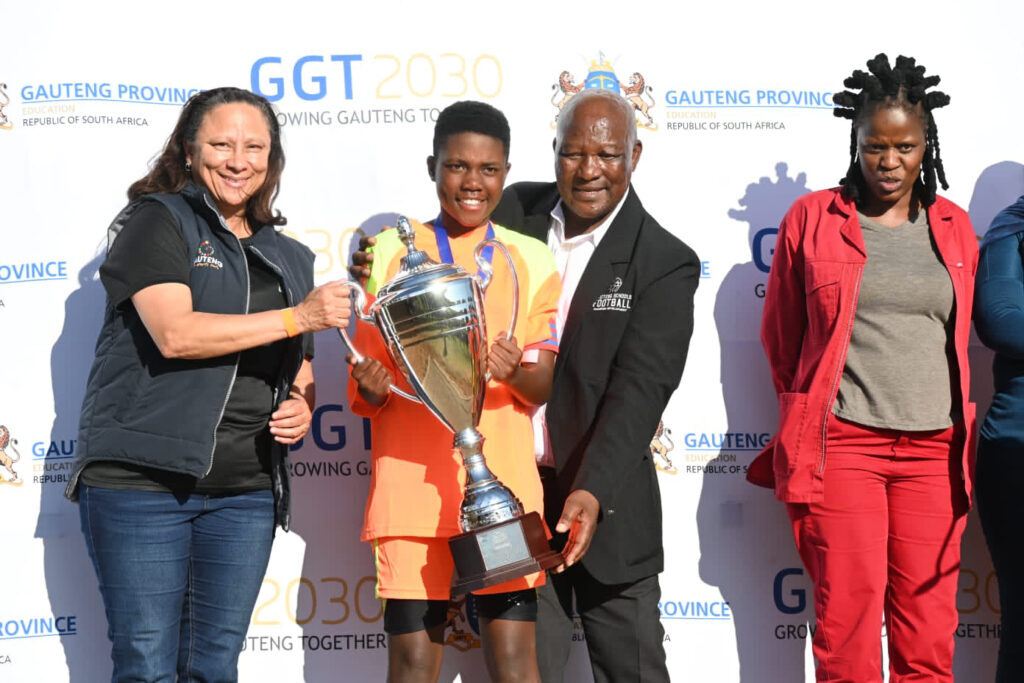
The inaugural Gauteng Schools Football Champions League has crowned its first set of champions, with Clapham High School winning the boys competition and Jabulile Secondary School for the girls.

The culmination of five rounds of games that were played on a bi-weekly basis which began in July 2023, the league concluded at Kagiso Sports Complex in Krugersdorp on Tuesday, 20 September.

Both the winning teams, Clapham High School (Tshwane) and Jabulile Secondary School (Orange Farm), performed exceptionally well throughout the competition, having maintained first position from the beginning to the end to attain first place gold status as well as earn the R100 000 grand prize, with R50 000 going to each school.

The prestigious Clapham school, renowned for producing elite young football players, emerged as the male victors with a total of 17 points accumulated. They were followed by Bhukulani Senior Secondary School (Zondi, Soweto) as runners up with 14 and the SAFA Sport School of Excellence (Germiston, Ekurhuleni) and Rosina Sedibane School of Specialisation (Laudium, Tshwane) came in joint third place with 13 points each.

Jabulile came out on top of the girls teams with 19 points, while, Kwadedangendlale Secondary School (Zola, Soweto) managed a second place finish with 16 followed by the Curro Academy (Soshanguve), rounding out the top three with 15 points.

Clapham’s Kgaogelo Monyane was named male player of the tournament, while Neo Mafisa from Curro Academy was pronounced as both female player of the tournament as well as top female goal scorer.

The first-of-its-kind league format for School Sports in the country, the tournament featured 16 teams (8 male teams, 8 female teams) of the best-performing schools in football from the School Sports Wednesday league programme in Gauteng.

Implemented by the Gauteng Department of Sport, Arts, Culture and Recreation together with the Department of Education and supported by SAFA Gauteng, the programme has helped advance and expose top developing talent from Gauteng schools.

INSIDE EDUCATION

Uncategorized

Learners in remote areas set sights on success despite big challenges

MOKGADI MOGY MASHAKO AND LUCAS LEDWABA

Matric learner Sidney Ramantshwana and his peers are almost always exhausted by the time they get to school. Their long walk to the classroom covers a distance of approximately 14km which they complete in about two hours.

In the afternoon after a long day of learning they have to walk the same distance back home. Still, some of those who are heading households are expected to perform house chores such as fetching water, sometimes collecting firewood and preparing meals for younger siblings.

Ramantshwana, a Grade 12 learner at Hanyani High School in Sagole Tshipise in Limpopo, said the long walk to the school impacts on their ability to concentrate in the classroom.

“We are tired, always. And this place can get very hot sometimes,” he said, adding that he’s still determined to achieve his goal of passing matric and going on to study law.

Ramatshwana’s school is located in a remote rural area with very little access to modern amenities such as the internet and experiences poor network connectivity. This unfortunately is the lived reality of scores of rural-based learners across SA.

As hundreds of thousands of matric learners countrywide prepare to sit for their final year National Senior Certificate (NSC) exams on Monday, 30 October, rural-based learners like Sophie Sefala, face even greater challenges.

For Sefala and many learners like her, preparing for the NSC exams, which are set in uniform standard regardless of learners’ location, is a high mountain to climb given the unique challenges they face.

A 2015 United Nations Millennium Development Goals Report 2015 report estimated that roughly 2.8 billion people worldwide lack access to modern energy services and more than 1 billion did not have access to electricity.

“For the most part this grave development burden falls on rural areas, where a lack of access to modern energy services negatively affects productivity, educational attainment and even health and ultimately exacerbates the poverty trap.”

The constant power outages resulting from loadshedding have escalated the challenges faced by rural-based learners. “Not having electricity makes it difficult to study for an exam and makes it harder to get enough sleep,” said Mahlatse Ledwaba, a Grade 12 learner at Mmatshipi Secondary School in Utjane village in Mashashane, Limpopo.

“Sometimes when loadshedding occurs there’s no access to the internet and it is impossible for a learner like me to research or communicate with people about school work. It’s a challenge,” she said.

University of Western Cape’s Professor Rouaan Maarman who specialises in poverty and education noted while responding to the 2022 matric results earlier this year that “it seems as if the cycle of poverty is intensified by electricity blackouts and every layer of disadvantage contributes to a more challenging school performance in the poorer school communities”.

A 2020 study by Amnesty International titled Broken and Unequal – The State of Education in South Africa, concluded that the country “has one of the most unequal school systems in the world, with the widest gap between the test scores of the top 20% of schools and the rest.”

Ledwaba, 17, said in addition to the long walk to school, the lack of access to libraries is a major concern. The nearest library to her village is 30km away in Polokwane.

The fact that many families in rural areas like Mashashane rely on social grants for their sustenance means such trips to town are out of their reach due to financial constraints.

Sophie Sefala, 18, is often forced to study by candle light due to power outages in her village of Ga-Mothapo, where she lives with her parents, her sister and her little child.

“Studying requires adequate light for extreme concentration and memorisation. Using candles while studying is difficult as it can run out at any time,” she said.

“Another problem is when we have to bathe with cold water in the morning, this causes many of us to catch colds and lose school days,” she said.

Praise Motebejane, an 18-year-old matric learner, epitomises the spirit of learners at his rural-based school in Ga-Ramogale, a settlement situated about 25 km east of Polokwane in Limpopo. Situated a mere 8 kilometres from the University of Limpopo in Mankweng, this school, much like others in the vastly rural province, wrestles with the unique challenges of rural education.

Schools in villages such as Ramogale lack basic services such as water and sanitation, to larger concerns such as inconsistent electricity supply and limited access to modern technology.

Understanding these challenges, Motebejane’s school, Gerson Ntjie Secondary, has had to be innovative by extending the school day – allowing matric learners to stay and study until 8 pm. This strategy aims to shield them from distractions at home.

“It’s demanding but mastering the balance is key. I want to go to aviation school and at this point unfortunately my parents won’t be able to take me. This doesn’t mean I will give up on the dream though,” Motebejane said.

However staying up late in schools is not always possible for many learners due to challenges that persist outside of the schools.

This was highlighted by an incident earlier this year when matric learners studying at night at the Georgetown High School in Pietermaritzburg in KwaZulu-Natal were attacked and robbed.

Zanele Modise, the Head of Organizing at Equal Education said vulnerabilities of rural students were exacerbated by the outbreak of Covid-19 and loadshedding.

Modise said walking long distances to school means learners get to school very tired and unable to concentrate in class.

“At times most of them haven’t had a meal, but also they wake up very early to walk dangerous terrains. We have had testimonials of learners who have been assaulted and one can imagine how traumatic that is,” said Modise.

Motebejane on the other hand, contends that academic pressures weigh heavily on him, especially after his grades recently slipped below his Grade 11 standards.

“For the final exams I have chosen to focus on the challenging subjects first and have found an invaluable app stocked with past papers for revision. Fortunately I am able to access the app on my phone, but sadly not all my peers have phones,” he said.

Gerson Ntjie Secondary School maintains its reputation as one of the consistently best-performing schools, with average matric pass results of 85% each year.

The wider challenges of rural schools in South Africa haven’t gone unnoticed. As highlighted by Professors Pierre du Plessis and Raj Mestry in the South African Journal of Education, which confirmed that progress in the rural education sector post-democracy remains slow.

As part of their recommendations they stressed that “the government must meet the challenges that rural schools face and must be actively involved in upgrading and developing rural schools”.

The National Framework for Rural Education: Enhancing access, equity and quality in rural schools by the Department of Basic Education (DBE) proposes that rural education provisioning capitalises on resources available in rural communities.

The DBE notes that “provision of quality education in rural schools requires not only targeted fiscal investments, but also civic agency.”

It further suggests that “the DBE must collaborate with rural communities to mobilise resources (including socio-cultural, agricultural and natural resources, as well as indigenous knowledge systems).”

The rural education policy, which was adopted in 2022 as a national framework, proposed the establishment of a Rural Education Advisory Committee, including stakeholders and experts, to advise on policy implementation, fund rural education programs, and monitor the impact of these policies on rural education.

Phuti Ragophala, a retired school principal better known as “techno-gran”, acknowledged the determination required by rural learners to succeed.

“Learners from rural schools have much potential and talent. They just need support and encouragement to move forward,” she said.

Ragophala operates a coding program called Tangible Africa for rural learners in Sekuruwe that doesn’t require electricity, signal, or wifi, providing valuable skills to Grade 12 learners. She is also a recipient of the President’s Silver Award of the Order of Baobab this year for her contribution in education and promoting technological advancement to teachers and learners.

“What remains a challenge for learners, especially from rural areas, is the lack of gadgets and wifi connectivity. I believe that challenges are there to sharpen us and, to the matriculants I trust they will work hard and overcome come what may,” Ragophala said. – Mukurukuru Media

Uncategorized

Nsfas CEO’s job on the line as board terminates contracts of all direct payment service providers 

Lerato Mbhiza 

The board of the National Student Financial Aid Scheme (Nsfas) has decided to terminate the contracts of all its four direct payment providers tasked to pay grants and allowances to students after a damning Werkmans Attorneys report found irregularities in the tenders awarded to the companies.

However, Nesfas said it will ensure that the move doesn’t affect the payment of the grants to students.

The board’s chairman Ernest Khosa said they would also be writing to the Nsfas CEO Andile Nongogo and ask him to justify why his contract should not be terminated.

The scheme’s board chairperson, Ernest Khosa, briefed the media in Tshwane on Wednesday, where he said the board had accepted the recommendations of the interim report and resolved to implement them.

Khoza said Nsfas will adhere to the findings and the recommendations made by Werksmans Attorneys and Advocate Tembeka Ngcukaitobi SC on the allegations of irregularities in the funding scheme.

Investigators found Nongogo had actively participated in choosing companies to disburse allowances to beneficiaries from the R47bn fund and the board said it would write to Nongogo and grant him an opportunity to advise on why his contract should not be terminated.

The companies, eZaga Holdings, Coinvest Africa, Norraco Holdings and Tenet Technology, were hired last year following a tender process and there were protracted student protests over allegations of late payments among other complaints.  

According to Khoza, the findings in the report noted that there was no feasibility study before the implementation of the direct payment system, particularly the justification for the appointment of the service providers.

The report revealed that Nongogo participated in the presentation of proposals in the Bid Evaluation Committee (BEC), which constituted a material violation of NSFAS’s public procurement processes.

The report also highlighted Nongogo’s appointment of Dr Chirwa as a technical advisor to the BEC, which was not in line with the 2021 Supply Chain Management (SCM) Policy. Although the 2023 SCM Policy allowed for such appointments, it was seen as a means to rectify the incorrect appointment, said Khosa.

Investigators also found that Chirwa is associated with companies that were appointed as service providers both at the Service SETA and at Nsfas.

“The first [decision] being to write to Mr Andile Nongogo and grant an opportunity to advise on why, in the light of the findings, his contract should not be terminated. We did that yesterday already,” said Khoza.

Khoza said the board had engaged the four companies and informed them of the report and the decision to terminate their contracts.

However, the companies had not been handed their copies of the report, which was also submitted to the Minister of Higher Education, Blade Nzimande.

INSIDE EDUCATION

Best ‘Teacher of the Year’ urges educators to teach with passion
Uncategorized

Best ‘Teacher of the Year’ urges educators to teach with passion

Johnathan Paoli with Lerato Mbhiza

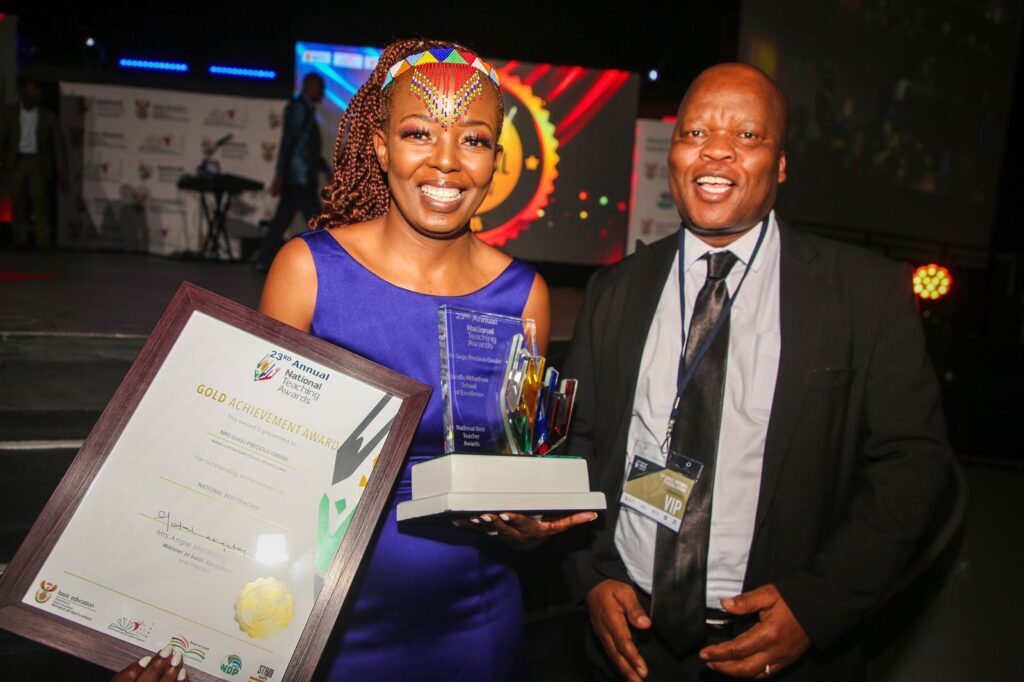
South Africa’s Best Teacher of the Year 2023 Gugu Qwabe’s mantra is ‘the best resource for any school is a motivated educator’. 

The English teacher and departmental head of languages at Mandla Mthethwa School of Excellence in Umkhanyakude in KwaZulu Natal should know. She walks the talk.

Qwabe is passionate about educating and grooming future leaders, so much so that she has authored “Applying Ubuntu Principles to Think, Learn and Succeed”, which is expected to come out in six weeks. 

The book focuses on practical applications of African values to corporate aims, merging progressive thinking with sustainability models. Qwabe supports using indigenous languages as instruction tools: “It has long been due for Africans to enjoy the fruits of their existence. 

“I believe that it is time as a country that we deserve everything others have,” she says while stressing the importance of uBuntu in developing a robust moral code and sense of social responsibility.

“One important value is exhibiting resilience in the process, believing in what you’re doing, and meeting with policymakers,” she says.

Qwabe was named the best South African Teacher at the 23rd National Teacher Awards by Deputy President Paul Mashatile at a ceremony in Pretoria last week.

The National Teacher Awards (NTA) were launched in 2000 and have become one of how the Department of Basic Education (DBE) acknowledges the extraordinary efforts made by excellent teachers, often in harsh conditions.

Qwabe, who’s been teaching for 15 years, expressed her gratitude at being awarded the prize and an appreciation for her seniors for recognising her vision of the humanising transformation of education for learners, especially for marginalised learners within the rural context.

Raised by a single mother who was also a teacher, Qwabe, who has three other siblings, says when she was 12 years old, her mother’s resourcefulness in the face of struggles and their low-income household inspired her.

“My mother did not want me to teach since she was a teacher. She faced so many struggles, and being as innovative and different as I am in a system of conformity, she experienced a lot of resistance,” Qwabe says in an exclusive interview with Inside Education.

After completing her basic education, interrupted by a transfer from a former Model C school to a local public school because of financial constraints, she graduated with a Degree in Psychology and English from UKZN. Then, she transferred to the School of Education, graduating in 2007.

Her teaching career started in one of the poorest schools in the Jozini, uMhlathuze area. She says she taught Life Sciences and English without any formal teaching qualifications simply because of her ‘good English’  in her Grade 12 results.

One of the primary reasons which motivated her to teach in Jozini was that both learners and teachers were making great strides despite the school being heavily under-resourced with poor provision for sanitation.

However, their resilience in facing challenges strengthened Qwabe’s resolve that only passionate educators should be recruited into teaching.

She took the great lessons and inspiration and, in 2009, moved to another school  – Amandla Awethu until 2017; she acquired a Postgraduate Certificate in Education before being recruited by a circuit manager who recognised her potential to join the newly formed Mandla Mthethwa School of Excellence (MMSE) in 2018.

The school has its roots in an initiative dating back to 2001 when members of the private sector and the KwaZulu-Natal Department of Education collaborated to improve the quality of the lives of the people of Ndumo, one of the poorest and under-resourced communities of KwaZulu-Natal.

MMSE Headmaster Dr B.H Mthabela has described the school’s mission as instilling in learners the values such as respect for self and others, level-headedness, self-control and self-discipline, compassion, and embracing others and the environment.

Mthabela said the school was designed primarily to offer the best possible education to learners of Umkhanyakude in particular and those of other parts of KZN and other provinces in general, and Qwabe was a natural fit in the equation at the school that has secured more than 200 distinctions in its existence.

Qwabe’s clarion call is for more teachers who are emotionally, morally and ideologically invested in ensuring equal and quality education for all children.

“We need more good people in our society; we need more people to stand up for the right things. Our learners need to grow up in healthy spaces”.

Qwabe, as an award winner, has been automatically entered into the African Union Continental Teachers Award of 2023/2024.

Mashatile, in his keynote address, acknowledged that teaching is a labour of love and passion and highlighted the importance of ensuring that all learners in the country have effective and adequate access to education.

“Acknowledging that teaching is a labour of love and passion, as Government, we are committed to reinforcing teacher support and prioritising the professional growth of the women and men who are key drivers of basic education,” Mashatile said.

INSIDE EDUCATION

Uncategorized

PanSALB observes International Translation Day at Sol-Plaatje University

Staff Reporter

THE Pan South African Language Board (PanSALB), an entity of the National Department of Sport, Arts and Culture in collaboration with Sol Plaatje University, marked International Translation Day in the Northern Cape last week. 

The annual International Translation Day event occurred on Thursday, 12 October 2023, at the Northern Cape Provincial Legislature in Kimberly.

The event aimed to promote linguistic diversity and multilingualism by advocating for the use of translation and interpreting services. It also paid tribute to the work of translators, terminologists, interpreters, and language practitioners who break down language barriers and allow great literature to be enjoyed far more widely. 

The 2023 International Translation Day is observed under the theme “Translation unveils the many faces of humanity”. This theme aims to encourage language practice students to use their languages to preserve their cultures and histories.

The event highlighted technological innovations that have taken translations to a much higher and more sophisticated level. This includes the Human Language Technologies funded by the Department of Sport, Arts and Culture. 

These advancements support translators’ work by providing them with computer-generated translations, glossaries, and translation memories. This facilitates speed, consistency, and, ultimately, high-quality work.

The International Translation Day observation forms part of the continued efforts of the institution to emphasise that the operations of translation and language practice, in general, are constantly evolving to respond to the changing environment.

INSIDE EDUCATION

Uncategorized

UKZN Hosts ‘Inspiring Impact Challenge’ 

Inside Education Reporter

THE University of KwaZulu-Natal (UKZN) is gearing up for the Finals of the 2023 UKZN Inspiring Impact Challenge – an annual competition showcasing initiatives by UKZN students, staff, and alumni. Participants in the competition are social entrepreneurs tackling some of society’s biggest challenges in alignment with the United Nations Sustainable Development Goals. 

Now in its third year, the competition forms part of the UKZN Inspiring Impact Campaign. This year’s instalment kicked off with a call for submissions in August. Following a rigorous screening and shortlisting, 30 out of around 220 entrants were selected. 

The 30 entrants are undergoing a 3-week Accelerator Training programme sponsored and led by enterprise development agency and implementing partner Kulisha Consulting. 

The training prepares competitors for the main event and focuses on leadership, design thinking, business modelling, sustainability, and pitch readiness. 

The competitors, divided into four categories – Undergraduate Students, Post-graduate Students, Staff, and Alumni – are experts in various disciplines, including mathematics, agriculture, business management and engineering. The focus of the projects to be showcased ranges from youth empowerment and career guidance to STEM education and Agribusiness. 

Managing Director of Kulisha Consulting, Kwazini Zulu, says this year’s competition has gained more entries from women as well as more international attention, “There are several local projects with international reach as well as entries from alumni who are based in a few Southern African Development Community (SADC) countries. We are impressed with the calibre of entrants and excited to see how they’ll perform as we enter the next phase of this competition.”

The finalists, to be shortlisted on the 24th of October, will go on to compete in the main event on the 30th of October, where they will deliver elevator pitch presentations on each of their social enterprises to a panel of judges made up of experts from the Banking industry, Academia and Small and Medium-sized Enterprises. 

INSIDE EDUCATION

Uncategorized

Naas Botha is Director of Rugby at Hoërskool Eldoraigne

Staff Reporter

To boost rugby at the school, former Springbok rugby fly half and media personality Naas Botha has been appointed Director of Rugby at Hoërskool Eldoraigne. 

The former Blue Bulls great started work last week to inspire youngsters and unearth new talent. 

A familiar face on local television as a commentator, Botha once coached Tukkies to Varsity Cup success. He also managed the junior Springboks. 

Botha brings rich rugby knowledge and more than four decades of experience to Hoërskool Eldoraigne.

INSIDE EDUCATION

Uncategorized

Ministry urges District Directors Forum to “push harder” for success in matric exams 

Inside Education Correspondent

THE Ministry of Basic Education met with district directors and national and provincial officials at the Premier Hotel OR Tambo in Johannesburg on 6 October 2023, to discuss shortcomings and the latest developments in the Basic Education Sector. 

The event was organised as part of the District Directors Forum hosted by Minister of Basic Education Angie Motshekga since she took office in 2009. The Ministry has urged education districts across all nine provinces to push harder to prepare for the 2023 National Senior Certificate (NSC) examination from October to November 2023. 

Before 2009, the overall performance of the majority of education districts was always between an average of 60% and 65%. Significantly, the Forum has allowed the education districts to share best practices. As a result, provinces have, over the years, shown a significant improvement in the NSC examination results.

Motshekga indicated that education districts are achieving excellent results due to the commitment and dedication of teachers in schools.

The meeting focused on taking the sector forward in the implementation of identified flagship programmes, as well as critical areas: The critical role of districts in the proposed Early Childhood Development (ECD) Service Delivery Model Using the Integrated District Improvement Programme (IDIP) to strengthen districts to drive sustainable education change; and The National Strategy on Improving Reading Literacy.  

INSIDE EDUCATION

Uncategorized

Report from the independent panel of investigation given to the UCT Council 

Staff Reporter

The University of Cape Town (UCT) Chair of Council, Norman Arendse (SC), has received the report from the independent panel of investigation into matters about governance at UCT. 

The report was issued and considered by the Council at its meeting on Saturday, 14 October 2023. This follows the Council’s decision in October 2022 to establish an independent panel, whose work commenced in January 2023.

Council extends its appreciation to the panel for the detailed and important work it has done and is confident that the report is a crucial step in assisting the Council to strengthen the university’s governance. The content of the report and recommendations are now under consideration by the Council and will be discussed at a further meeting scheduled shortly.

“Until the content and recommendations of the report have been fully considered, Council has resolved that the report will remain confidential. It is recognised that many of the university’s stakeholders expect to be more fully informed, and Council therefore undertakes to take the necessary steps to provide further details as soon as appropriate,” said Arendse. 

INSIDE EDUCATION

Uncategorized

It’s all systems go for the 2023 Matric Exams – Umalusi

Lerato Mbhiza

Umalusi, the council that sets and monitors standards for general and further education in South Africa has given the clear for the more than 920 000 learners to write their Matric Exams this year.

The class of 2023 will begin writing the National Senior Certificate (NSC) exams on Monday, 30 October and in a briefing last week Umalusi said the candidates would write at almost 6 340 public schools and more than 550 private centres.

Umalusi CEO Dr MS Rakometsi said measures have been put in place to mitigate the impact of load shedding during the exams and said Umalusi was satisfied with arrangements the Department of Basic Education had made to procure generators and engage with Eskom.

While the quality assurer was satisfied with the state of readiness, however, Rakometsi said he was concerned that exams could be negatively affected by various factors, including load shedding, cheating and community protests.

On load shedding, he said Umalusi had advised all assessment bodies to make alternative arrangements for the supply of power during the writing of exams.

“Umalusi would like to issue a stern warning to all learners and teachers to refrain from all forms of cheating, including group copying, where teachers are sometimes implicated.

“At the same time, Umalusi discourages communities from using the national exams as leverage for their protest actions,” he said.

Rakometsi also raised concerns about unaccredited institutions and the selling of fake certificates.

“Umalusi is satisfied with the work done to curb unaccredited institutions from registering candidates for the national exams.

“The meeting that Umalusi convened on 18 August 2023 with the senior officials from the national and provincial education departments, the Independent Examinations Board and the South African Comprehensive Assessment Institute agreed on measures to be taken to prevent the operation of illegal independent schools and ensure that examinations are only administered at independent schools accredited by Umalusi.”

Umalusi also urged parents to ensure that centres where candidates are registered to write their matric exams are accredited while warning against schools and colleges that had scammed unsuspecting candidates into registering with them when they were not accredited to carry out the exams.

“Umalusi and senior officials from different stakeholders agreed to prevent the operation of illegal schools and ensure that the schools are registered with the body as exam centres,” Ramoketsi said.

INSIDE EDUCATION