UWC are the 2023 Women’s Varsity Football champions
Uncategorized

UWC are the 2023 Women’s Varsity Football champions

Staff Reporter

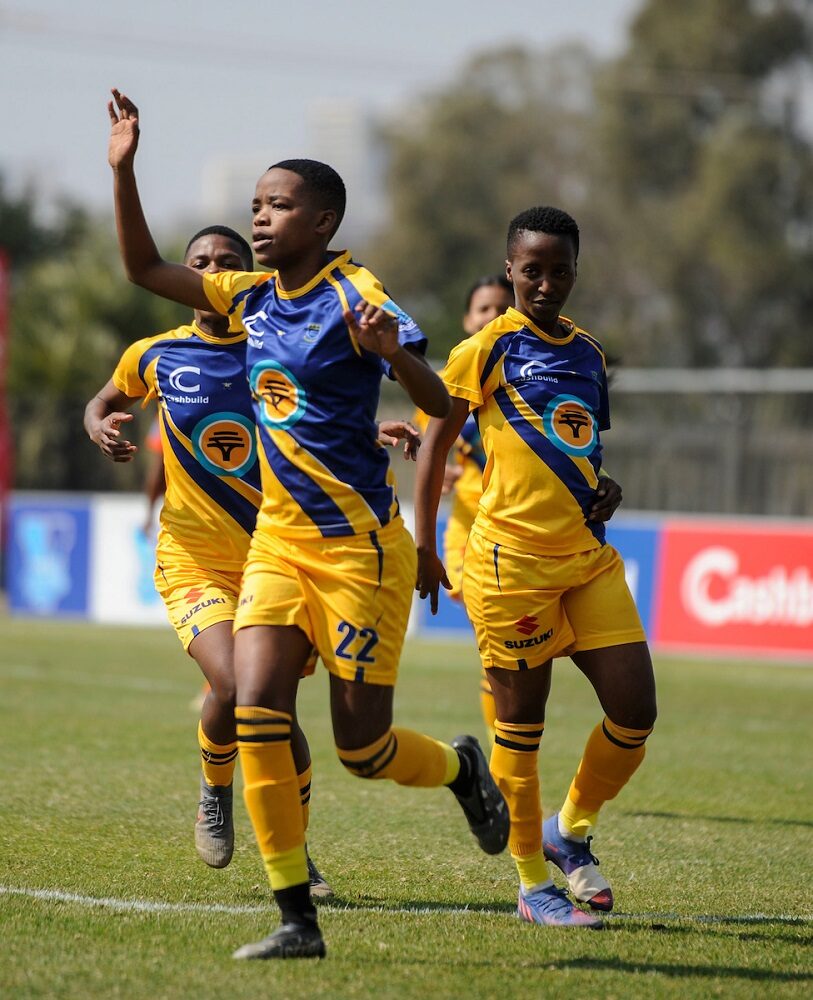
UWC are the 2023 Women’s Varsity Football champions after a comfortable 2-0 win over defending champions UJ in the final at the TUT Stadium in Pretoria.

The match repeated last year’s final, but the roles were reversed. This was UWC’s second title in five years.

The Orange Army lost concentration early in the game, and UWC drew the first blood inside the opening 10 minutes courtesy of a Lonathemba Mhlongo goal.

UJ were limited in chances and failed to get back into the game. A star-studded UWC team remained in control throughout most of the game, with the combination of Banyana Banyana’s Bongeka Gamede and Snegugu Zondi keeping things solid in the middle of the park. This gave the Western Cape side a slender 1-0 advantage at the break.

Lonathemba Mhlongo of UWC scores the first goal in the final
VARSITY LADIES FOOTBALL FINAL 2023
Saturday 19 August 2023. TUT STADIUM PRETORIA
FINAL UJ vs UWC

Photo by: CATHERINE KOTZE/C&C PHOTO AGENCY

Thinasonke Mbuli’s charges picked up where they left off as they walked from the tunnel rejuvenated. UWC doubled their lead 13 minutes after the break when Katlego Mabuza was fed a cheeky through ball and easily beat the UJ keeper.

UWC’s Chelsea Daniels, a nominee for player of the tournament, was stretchered off due to injury in the 67th minute. UJ’s Lusanda Mavundla earned top honours, while UWC goalkeeper Siphesihle Dlamini shared the Golden Glove award with UJ’s Matshidiso Masebe.

INSIDE EDUCATION

Sibanye Stillwater Sanitation Project restores dignity of learners in the Eastern Cape
Uncategorized

Sibanye Stillwater Sanitation Project restores dignity of learners in the Eastern Cape

Staff Reporter

THE Department of Basic Education (DBE) and the private sector are pushing hard to restore the dignity of education by delivering sanitation facilities to schools in rural communities.

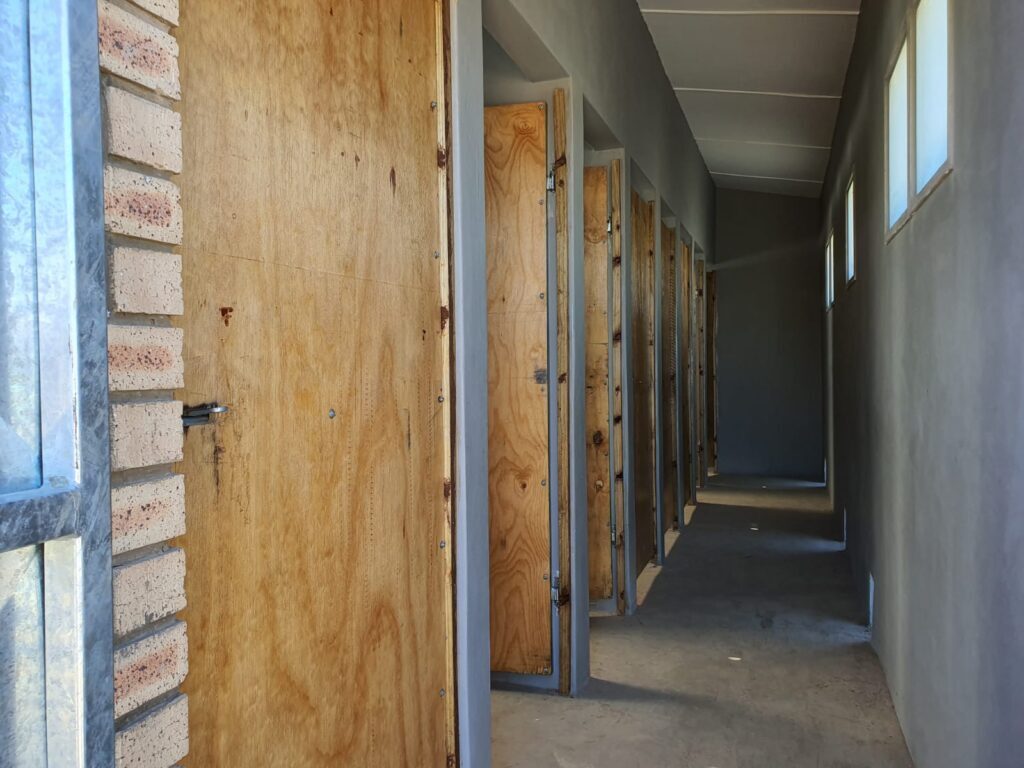
The Eastern Cape MEC for Education, Fundile Gade, joined by provincial and national senior education officials, has received a donation of newly built sanitation facilities from the Sibanye Stillwater Mining Company, one of the DBE’s partners in the SAFE initiative.

MEC Gade officially handed over the sanitation facilities to seven identified primary schools at Marubeni Primary School in Libode on 10 August 2023. The additional six schools that have received sanitation facilities are Dininkosi, Dlukulwana, Candulwandle, Mqanduli, Vulincobo, and Ndintanka Primary Schools.

Sibanye Stillwater initiated the project as part of its social responsibility programme in response to the call from President Ramaphosa for support for the Sanitation Appropriate For Education (SAFE) initiative. Sibanye Stillwater is an international mining and metal processing player and has made tremendous contributions to education in South Africa. Given the scale of the budget and the prevailing economic climate, the Government invited the private sector to consider participating in the SAFE initiative as part of their corporate citizenship agenda.

During the handover ceremony, Deputy Director-General for Infrastructure at the DBE, David van der Westhuijzen, indicated that the Basic Education Sector had made strides in addressing infrastructure challenges in the country.

The SAFE Initiative has delivered 1,794 projects since its inception, with 1,034 in the Eastern Cape alone. Van der Westhuijzen pointed out that initially, provinces such as the Eastern Cape, KwaZulu-Natal, Limpopo, Mpumalanga and North West had the bulk of pit latrines.

“Some of the backlogs of inappropriate sanitation structures have been addressed as part of the DBE’s Accelerated Schools Infrastructure Development Initiative (ASIDI), and some as part of the provincial infrastructure programme. Donor partners have contributed to 124 projects. The SAFE initiative demonstrates that the government responds to national crises and can summon the combined effort of its corporate citizens in addressing issues of national importance and dignity.”

Gade indicated that the private sector’s contribution to improving school infrastructure facilities will go a long way in transforming the education landscape in South Africa.

INSIDE EDUCATION

Ga-Rankuwa gets a school of specialisation focusing on research
Uncategorized

Ga-Rankuwa gets a school of specialisation focusing on research

Phuti Mosomane

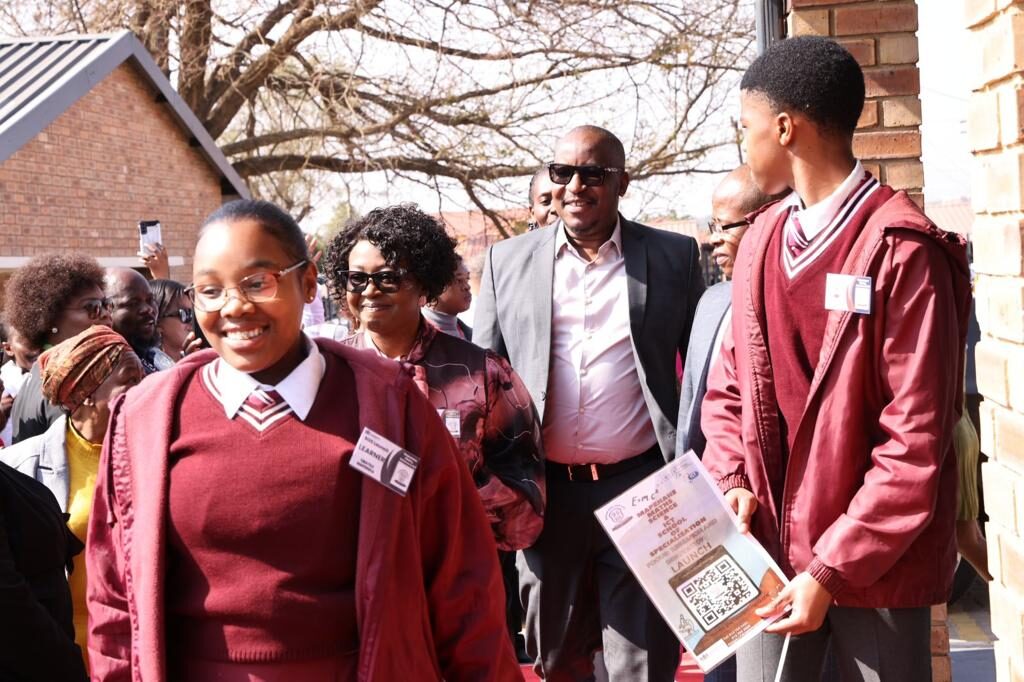
Gauteng MEC for education Matome Chiloane launched the Mapenane Maths, Science & ICT School of Specialisation in Ga-Rankuwa, about 37km northwest of Pretoria.

The school, which was launched on Thursday, will mainly focus on research and innovation.

“As the Gauteng province, we are getting this right. This is the 25th school of specialisation that has been launched,” said Chiloane.

“Our focus is to make sure that every school has a specialisation. We plan on doing this in primary schools as well, so that we take the learners to the high schools that have their desired skills.”

The MEC expressed the significance of a school that specialises in research and innovation, and the aspiration to ensure that all schools in Gauteng specialise in key skills.

Learners at the school researched the amount of blind people in the community and developed a GPS-enabled walking cane with sensors to assist them.

The MEC also unveiled a life-sized microscope which the learners had built themselves and which will be usable on the school premises.

Early in August, Chiloane launched the Oosrand Commerce and Entrepreneurship School of Chiloane launched the Oosrand Commerce and Entrepreneurship School of Specialisation in Reiger Park, Boksburg.

The school was Gauteng’s 24th school of specialisation and the second commerce and entrepreneurship school in Ekurhuleni, east of Johannesburg.

The school aims to cultivate talent across diverse fields and shape a future generation of leaders in South Africa.

INSIDE EDUCATION

Uncategorized

Man involved in the Crowthorne Christian Academy assault incident released on R2 000 bail

Lerato Mbhiza

A man seen pulling a 13-year-old pupil’s dreadlocks at Crowthorne Christian Academy in Midrand in a widely shared video was released on R2 000 bail on Thursday.

The 51-year-old Andries Booysen appeared in the Midrand Magistrate’s Court on a charge of assault after a widely circulated video showed the learner being forcefully removed from the classroom due to a new policy that prohibits dreadlocks. 

According to the school’s new hair policy the 13-year-old broke the school rules by having dreadlocks. The learner missed classes on Monday and Tuesday this week after she was forcefully removed from her classroom. 

A video capturing the moment, including the assault of the mother by a school official, alleged to be Booysen surfaced on social media yesterday.

The school, which the Gauteng Education Department has said had been operating illegally, has since closed its doors following the incident.

Booysen was seen in the video pushing the pupil during an argument between the school’s principal and the girl’s mother on the school premises on Monday.

The NPA’s spokesperson Phindi Mjonondwana said the case was postponed for further investigations.

“The husband of the school’s principal, who is the accused in this matter, Mr Booysen, allegedly, violently pushed the learner and her mother. He was released on R2000 bail on condition that he must refrain from communicating or interfering with state witnesses. He will be back in court on the 2nd of October.”

INSIDE EDUCATION

Uncategorized

Higher Education Minister Responds To Calls for his Resignation

Johnathan Paoli

THE Minister of Higher Education and Training, Blade Nzimande, has responded to the growing problems surrounding the National Student Financial Aid Scheme (Nsfas) direct payment system, by giving the Nsfas Board until the end of August to inform him of their proposed plan in rectifying the challenges.

This follows on the growing protest action of students, as well as several scandals that have rocked the scheme and specifically its CEO Andile Nongogo, who was placed on a special leave following corruption allegations surrounding his tenure at the Services Sector Education and Training Authority (Sseta).

Students are still battling to access Nsfas funds and accusations of corruption and maladministration in the awarding of funds are flying thick and fast, but the Minister has remained steadfast in his defence of the payment system.

“Notwithstanding the current challenges, the Minister is of the view that the direct payment solution is a necessary measure to reduce instances of unauthorized access to beneficiaries’ allowances, payment of ghost students, inconsistencies and delayed payments of allowances,” the Ministry said in a statement on Thursday.

The Ministry said the direct payment solution is in line with the Student Centered Model which the scheme adopted, and in the interests of transparency and claims of students being defunded, further called on Nsfas to make public the information and details of all individuals found to be defrauding the scheme.

It was further stressed that the scheme funding has increased more than five fold in the last nine years, from R5.9 billion in 2014 to R47.6 billion in 2023 for the funding of roughly 11 million students of which 49% are also SASSA beneficiaries.

There have been growing calls for Nzimande to resign over his department’s handling of the Nsfas direct payment system.

In a statement on Wednesday, the UDM called for his immediate resignation.

Earlier this year, both the EFFSC of North West as well as members of the Wits University SRC called for Nzimande’s head.

INSIDE EDUCATION

Uncategorized

UDM Calls For Blade Nzimande’s Immediate Resignation over NSFAS

Johnathan Paoli

THE United Democratic Movement (UDM) has officially called for the resignation of the Minister of Higher Education and Training, Blade Ndzimande, following the crisis surrounding the National Student Financial Aid Scheme (NSFAS) in recent months.

UDM President, Bantu Holomisa commended the work done by the Organisation Undoing Tax Abuse (Outa) in investigating both Nsfas, as well as allegations of corruption and maladministration in the Services Sector Education and Training Authorities (SSETA) since 2018.

Further, the OUTA report revealed that the four companies awarded the tender to handle the direct payment system for NSFAS were not registered as financial services providers.

Ezaga Holdings – held an affiliated banking licence with Access Bank. A banking licence or affiliation with a bank with a banking licence was a compulsory bid requirement. Two of the successful bidders, Norraco Corporation and Tenet Technology, were also not registered as VAT vendors when they submitted their tenders.

Holomisa further criticised the Hawks and Special Investigating Unit’s failure to respond to a report the UDM made to them in February this year concerning the R2 million NSFAS rental scandal.

Recently NSFAS CEO, Andile Nongogo was placed on special leave following the student payment controversies surrounding investigations of the four fintech companies, as well as other forms of corruption and maladministration within the scheme.

In addition, the Portfolio Committee on Higher Education, Science and Innovation came under scrutiny for their failure to properly investigate the problems within the NSFAS, the SSETA and the Department.

Holomisa compared the NSFAS issue to the Bosasa as a source of looted money for the government and expressed concern over the recent violence at the Walter Sisulu University calling onPresident Cyril Ramaphosa to dispatch a task team immediately.

Earlier this year, the EFF Student Command (EFFSC) North West similarly called for the resignation of Nzimande, following the SIU’s report that approximately R5.1 billion in NSFAS funds were improperly spent on funding students who did not qualify for financial assistance, which was revealed during a briefing to Parliament’s Standing Committee on Public Accounts.

It was found that more than 40 000 students in 76 institutions of higher learning were funded regardless of their home income being more than R350 000 per annum.

“It is proof to our long-standing argument that there is deeply rooted maladministration and corruption in NSFAS, which prohibits the deserving students from poor backgrounds from accessing financial assistance from the scheme. This report further proves that we don’t have a competent minister in the Department of Higher Education and Training. 

“We, therefore, call upon the President to release Minister Blade Nzimande from his duties and not keep him because of the unstable relationship between ANC, Cosatu and SACP,” EFFSC provincial secretary Senzo Hlazo said.

In March this year Wits University SRC president Aphiwe Mnyamana and National Education, Health and Allied Workers’ Union (Nehawu) branch secretary Thabo Modise, called for the Education Minister’s resignation, for the failure to tackle the years-long issue of historic debt affecting tertiary students.

“Historic debt is a concern. Every year, we see institutions protesting. Hence as the SRC we say Blade Nzimande and Buti Manamela must resign because there is something wrong which they are doing,” Mnyamana said.

Despite the scandal and allegations, and multiple calls for his resignation, the Education Minister has come out to both chastise the violent protests as well as defend the NSFAS payment system.

“Violence will never justify or cannot be associated with any legitimate forms of protest and should be condemned by all, including student leaders,” Nzimande said.

INSIDE EDUCATION  

Uncategorized

Parliament set to debate the BELA Bill

Staff Reporter

The Department of Basic Education and the Portfolio Committee on Basic Education is set to deliberate the consolidated National Basic Education Laws Amendment (BELA) Bill report post public engagements and the submission of comments by 8 August 2023.

A clause-by-clause engagement will take place today 15 August, until 18 August, analysing the public hearings and the oral and written submissions to rephrase, reject or take forward all 56 clauses contained in the Bill.

This is an opportunity for the DBE to respond to comments and concerns raised during the hearings, whether in support of the Bill or not. Parliament will then decide whether further amendments are required to the current version of the BELA Bill. Following this process, the Bill will be presented to Parliament before it is signed into law by the President.

The Committee, accompanied by DBE officials, concluded Public Hearings across all nine provinces earlier this year. Public hearings commenced in the Limpopo Province on 24 February and finished in the Eastern Cape Province on 11 June 2023. This week, the Committee finalised and approved the provincial reports, ending with the Eastern and the Northern Cape public hearings.

The public hearings were necessary to enhance public involvement to impact positively the mandate of participatory democracy to inform, consult, involve and provide feedback to South Africans on the way forward in respect of the Bill. During the hearings, we provided information in Braille, and sign language interpreters assisted in an inclusive engagement to leave no one behind during the consultative process.

The Committee remains cognisant of the importance of public consultation in law-making, and we wanted to secure the integrity of this process. In addition, there has been a significant interest in the amendments as stakeholders and individuals are interested in ensuring a functional educational system for the children of this country; thus, all plans had to be in place to cater for this interest. The Committee is now satisfied that Parliament’s internal units have addressed all the operational risks.

The Committee received oral submissions from 31 organisations from 8 – 29 November 2022. Some organisations support the Bill; some contest the Bill, and those feel that specific clauses need to be amended or removed.

The BELA Bill proposes to amend the South African Schools Act (SASA) of 1996 and the Employment of Educators Act (EEA) of 1998 to align them with developments in the education landscape and to ensure that systems of learning are put in place in a manner that gives effect to the right to primary education enshrined in section 29(1) of the Constitution of the Republic of South Africa, 1996.

INSIDE EDUCATION

Uncategorized

Countrywide varsity tension forces UKZN to return to online learning

Staff Reporter

The higher education sector in the country is currently experiencing challenges, with protests erupting at some universities. These demonstrations, which have been characterised by violence in some instances, have raised concern about the safety of staff, students and property. As a precautionary measure and to allay these fears, the University of KwaZulu-Natal switched to online learning on Monday, 14 August.

“We understand that the root cause of these protests is discontentment regarding the NSFAS allowances. Nationwide various universities have been affected, and there are indications that these protests will continue. This has necessitated the decision to switch to online leaming,” said Professor Sandile Phinda Songca, Deputy Vice-Chancellor: Teaching.

This means that besides academic activities that necessitate in-person engagement, such as practicals and clinics, all other teaching and leaming endeavours will transition to an emergency remote mode.

Songca said that to facilitate this transition, UKZN has already commenced the provision of data to both staff and students. “While this move might be seen as regrettable, it will attest to our agility and rapid response to disruptions to keep people safe while assuring the continuity and quality of the academic project,” Songca said.

INSIDE EDUCATION

Uncategorized

SPORTS CORNER: National Archives and Records Service of South Africa to host International Council on Archives biennial conference

Staff Reporter

National Archives and Records Service of South Africa to host the xxvii Eastern and Southern Africa regional branch of the International Council on Archives (ESARBICA) biennial conference

The National Archives and Records Service of South Africa (NARSSA), in partnership with the Gauteng Department of Sport, Arts, Culture and Recreation (GDSACR) and the University of South Africa (UNISA) is hosting the XXVII Eastern and Southern Africa Regional Branch of the International Council on Archives (ESARBICA) Biennial Conference in Boksburg, Gauteng, South Africa which began on Monday and continues until 18 August 2023 at the Birchwood Hotel.

The conference was preceded by a pre-conference training workshop for junior archivists from 14-15 August, led by knowledgeable experts from the sector.

“We expect 40 Junior Archivists from the region to attend this important training. The main conference programme will be convened on 16 and 17 August. It will be attended by practitioners and academics in the archives and records management sector from the region, which includes Sudan, Uganda, Kenya, Tanzania, Malawi, Zambia, Zimbabwe, Botswana, Mozambique, South Africa, Lesotho, Eswatini, Namibia, Angola, and Seychelles. Under the theme “Archives, Records and Memory in Digital Spaces and Global Chaos”, the conference will seek to address current issues and look at solutions to deal with disruption and chaos caused by 4IR and AI within the records and archive management environment,” said the Department in a statement.

There will also be a handover event of the digitised records of the constitutional development process of South Africa’s Road to Democracy.

The project was successfully implemented through a partnership between NARSSA and the Constitution Hill Trust. Honouring this event will be Justice Albie Sachs, renowned struggle icon and one of the founding members of the Constitutional Court of South Africa, who will also be the guest speaker at the event.

Chairperson of the Constitution Hill Trust, Mr Valli Moosa (former Minister of Constitutional Development in the Cabinet of Nelson Mandela), will also be in attendance.

The digitised collections include the Convention for a Democratic South Africa (CODESA), Constitutional Assembly (CA), Multiparty Negotiations (NEG). The digitised records will be made available to the public through the NARSSA website (www.nationalarchives.gov.za), and the Constitution Hill Trust website at (www.wethepeoplesa.org).

The Ministry of Sport, Arts and Culture will receive the digitised records on 16 August 2023.

Heads of national archives from the region will also have their business meetings during this period. This conference promises to be a melting pot of archive and records management experts, administrators and practitioners, and the media is invited to the opening ceremony on the 16th of August, 2023.

For more information about the XXVII Eastern and Southern Africa Regional Branch of the International Council on Archives (ESARBICA) Biennial Conference, including registration details and the conference programme, please visit the official conference website at: https://nssc.dsac.gov.za/esarbica/about_us.php

INSIDE EDUCATION

Uncategorized

Fort Hare VC Professor Buhlungu to deliver the TB Davie Lecture at UCT

Staff Reporter

The University of Cape Town (UCT) will host the Vice-Chancellor of the University of Fort Hare (UFH), Professor Sakhela Buhlungu, who will present the 57th annual TB Davie Memorial Lecture.

Professor Buhlungu, a former Dean of Humanities at UCT, will deliver the lecture organised by the UCT Academic Freedom Committee on Wednesday, 23 August 2023 in the New Lecture Theatre, Upper Campus at 18:00. It is titled “Academic Freedom and Institutional Autonomy: A View from the Thyume Valley”.

The late 1950s marked a negative turning point for higher education in South Africa. The Extension of University Act 45 of 1959 set the country on a path of ethnic segregation of university education whose effects remain more than 60 years later and after almost 30 years of democracy.

From 1959 eminent academics and activists were invited to present the TB Davie Memorial Lecture. Significantly for Buhlungu, Professor ZK Matthews – who graduated at UFH in 1924 and was an academic and political activist – gave the third lecture in 1961. Titled “African Awakening and the Universities”, Professor Matthews’ lecture made a link between academic freedom and the quest for liberation in South Africa and the continent.

UCT Vice-Chancellor (interim) Emeritus Professor Daya Reddy explained: “Professor Buhlungu, in this lecture, will identify four moments that marked the introduction of ethnic education and assault on academic freedom at UFH – the Extension of University Act of 1959, the appointment of Broederbonder Professor JM De Wet in 1968, the closure and subsequent annexation of the Federal Theological Seminary to UFH in 1974/5, and the handing over of the university to the Ciskei Bantustan in 1981.

“These developments had a debilitating effect on the university, which the current administration still has to contend with today.”

Buhlungu will present four propositions about academic freedom and institutional autonomy in the current conjuncture in South Africa. He will, among others, argue that academic freedom and institutional autonomy is contextual in that it means different things to different institutions because of our different histories, and that in the current period striving for academic freedom and institutional autonomy in one university is a futile exercise.

“Through the lecture, Professor Buhlungu will challenge people in the sector – staff, academics and administrators – to rethink the notions of academic freedom and institutional autonomy in the modern age,” said Reddy.

INSIDE EDUCATION