Uncategorized

Lesufi says every child must have access to Early Childhood Development phased education 

Lerato Mbhiza

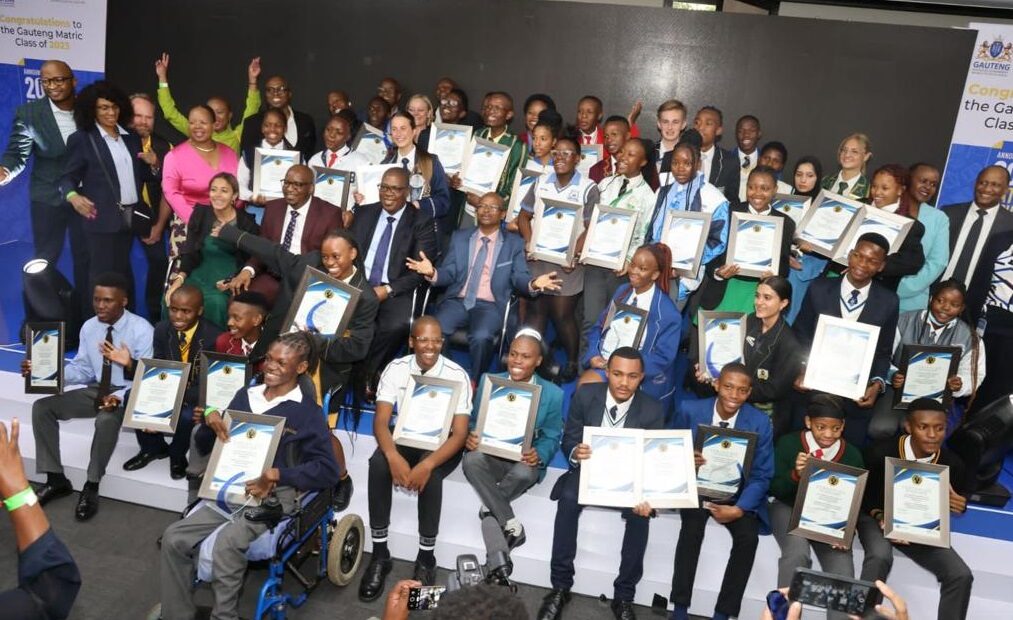
Gauteng Premier Panyaza Lesufi says every child must attend an Early Childhood Development phase of education and there must be no child left out just because they are poor.

Lesufi was speaking at the 2023 Gauteng  Matric Awards held at the Microsoft headquarters in Bryanston, Sandton, where the Gauteng Provincial Government celebrated the top matric learners who helped the province reach an 85.4% matric pass rate in the 2023 matric results.

Lesufi said: “There must be no child who cannot attend ECD because they can’t afford it. We want ECD to be exactly like Grade 1, all children must attend. If we don’t sign the law, we will be defeating the purpose of the BELA Bill on grounds of language. 

“Let our children go to school rather than spend time playing with bricks at informal settlements. As Gauteng, we are ready, we will unveil the crèche of the future, there will be no chalk, they will use the latest gadgets. 

“This is the foundation for the future. If we can’t get it right, we will fail. Mr President we are ready, sign the bill into law,” he said and added that education authorities are ready to meet those who oppose the BELA Bill in court. 

The National Assembly passed the controversial Basic Education Laws Amendment Bill  also known as the BELAl Bill  last year setting up a legal showdown with the Democratic Alliance and AfriForum who have vowed to fight it all the way to the Constitutional Court.

Lesufi had  earlier this week suggested on his X account that matriculants should write the same examinations instead of two separate exams – the Independent Examination Board (IEB) written by private institutions and the National Senior Certificate (NSC) for public schools. 

“I want to enter into this debate not influenced by emotions but to give practical examples. In 1995 the national matric results or pass rate was 53.4% and in 2023 the national matric results pass rate was 82%,” Lesufi said on Friday. 

He applauded the improvement in the results, where more than 57 000 learners in Gauteng passed with the Bachelors which allows them to study in a university or any tertiary institution .

“We want the best teachers to be where our learners are, what can we do when our best teachers produce 100% and they are recruited by the likes of Curro?” Asked Lesufi.

“It is within that context that we believe all our children should be treated equally and fairly and write one examination across the country to determine who is the best learner in our country.” 

He said there cannot be a situation where some children are perceived to have poor quality education and others quality education. 

“All these children are South African children. All these children are going to the same universities. All these children deserve quality if there is quality,” he said.

Gauteng Education MEC Matome Chilone said the GDE is one of the largest matric examination subsystems of the national system. “We pride ourselves that Gauteng produces some of the highest overall pass rates and bachelor pass rates in the country . 

“The class of 2023 achieved a pass rate of 85.4%. This is a 0.95% improvement over the 2022 achievement of 84.4%. Congratulations to the class of 2023. Your hard work and resilience has been justly rewarded”.

INSIDE POLITICS
Uncategorized

2023 Matric top achiever: Thwala is grateful for support from her family, church and school

The 18-years-old Zonke Thwala from KwaZulu-Natal told Inside Education that despite challenging home circumstances she had to find ways to get the best matric results. 

Thwala, together with other 33 matriculants, were awarded as top performers with multiple distinctions by Basic Education Minister Angie Motshekga on Thursday night.

Born in Verulam, she wants to study Bcom Accounting at the University of Pretoria.

INSIDE EDUCATION

GDE acclaims its finest in 2023 NSC Exams
Uncategorized

GDE acclaims its finest in 2023 NSC Exams

Johnathan Paoli

THE Microsoft Corporate offices were abuzz with learners, parents and educational staff as the Gauteng Department of Education awarded top-achieving candidates from the province’s 2023 cohort in Bryanston on Friday.

The ceremony, facilitated by Gauteng Premier Panyaza Lesufi and Education MEC Matome Chiloane, follows the publishing of the National Senior Certificate exam results on Thursday night which showed that Gauteng’s pass rate was among the top three in South Africa after the Free State and KwaZulu-Natal.

Free State kept its top spot with an 89.03% pass rate, KwaZulu Natal followed with 86.4%, and Gauteng retained its national top 3 position with an 85.4% pass rate.

Basic Education Minister Angie Motshekga announced on Thursday evening that the matric class of 2023 achieved an overall pass rate of 82.9%.

The province’s top-performing candidate will be awarded bursaries to study at any South African higher education institution of their choice.

KZN and Gauteng contributed the most Bachelor passes to the national tally.

In addition, a total of 253 807 distinctions were achieved, with the main contributors towards passes with distinctions being KZN, Gauteng, Eastern Cape, Western Cape and Limpopo.

In a preliminary technical stakeholder briefing held before the event, the department confirmed that 132 570 candidates enrolled, 127 697 candidates wrote the examinations, with 109 030 candidates passing, culminating in the provincial pass rate of 85.38%.

INSIDE EDUCATION

Uncategorized

Motshekga announces an 82.9% pass rate as Melissa Muller gets top achieving learner award

Lerato Mbhiza and Johnathan Paoli

Announcing the official release of the 2023 National Senior Certificate results at a briefing in Randburg on Thursday evening, Basic Education Minister Angie Motshekga said the class of 2023 had done the country proud.

“The class of 2023 showed the greatest determination, fortitude, and resolve to overcome all odds, similarly to the class of 2022,” Motshekga said.

All the top achievers from across all provinces were accompanied by their parents at an earlier breakfast meeting with the minister and her senior officials.

Top student Melissa Muller from Rhenish Girls’ High in the Western Cape succeeded against all odds and was quoted as saying she kept going “even when the last thing she wanted to see was a textbook”. Muller said she wanted to study mechatronics engineering at Stellenbosch University.

The 2023 NSC examinations recorded the highest pass rate since SA’s democracy with 82.9% – an overall increase of 2.8% from last year’s results.

Best performing provinces in that order are the Free State, KwaZulu Natal, Gauteng, North West, Western Cape, Eastern Cape, Limpopo, Mpumalanga and Northern Cape.

The minister said that there was no doubt that basic education had reached the desired level which was very important for the country.

Motshekga said that the quality of learner outcomes have seen significant improvement and that there was a high degree of stability within the system.

The minister awarded the top achiever of public schools, Melissa Muller from the Western Cape.

DBE deputy minister Regina Mhaule congratulated the award winners and said that it remained vital to equip the youth of the country with the skills required for achieving their dreams.

“Our education system is the cornerstone of society shaping our future leaders and providing them with the tools to meet the ever changing world,” Mhaule said.

The night ended with a performance amid jubilation and congratulations from parents, learners, department officials and supporters.

INSIDE EDUCATION

Basic Education Minister kicks off DBE Top Matric Learner Awards in Randburg
Uncategorized

Basic Education Minister kicks off DBE Top Matric Learner Awards in Randburg

Johnathan Paoli and Lerato Mbhiza

THE Department of Basic Education hosted a congratulatory breakfast on Thursday morning at the MTN Auditorium, Randburg with Basic Education Minister Angie Motshekga praising the top learners from last year’s Matric exams and that the awards were a testament to the resilience and determination of the country’s young people.

Motshekga said despite the challenges, namely the Covid-19 pandemic, she was proud to meet the award winning learners and called it a collective triumph of a nation that believes in transformation.

“The top learner awards today, is a testament to the resilience and determination of our young people,” Motshekga said.

The minister said in celebrating these achievements it was important to acknowledge the ongoing contributions to building and rendering the education system more effective in assisting learners in reaching their dreams.

“We must strive for an education system that not only imparts knowledge but one that enables us to have a free society where every child can reach their potential, regardless of their background,” Motshekga said.

The General-Manager of the MTN SA Foundation, Arthur Makhuva said that it was a great opportunity to meet what he called “celebrity” learners.

The GM said that the foundation was busy democratising access to education and to make sure that learners regardless of the challenges have the right tools in order to achieve what they need to.

“It is a synergy built on shared values and common purpose between MTN and the government, in order to bridge the technological divide that underpins education in the future,” Makhuva said.

Motshekga thanked and praised all the top achievers, and described the top 34 matriculants as the country’s best assets.

“You have proven to be the best and now we are expecting the best from you.” 

Motshekga also expressed gratitude to the guardians and parents. 

“Parents are the first reference to a support structure. Although it’s a joint effort between teachers, pupils and parents. Parents play a pivotal role in boosting their children’s morale to perform at optimal level,” she said. 

INSIDE EDUCATION

Uncategorized

Minister Motshekga calls for a broadening of skills for learners

Johnathan Paoli

Minister of Basic Education Angie Motshekga addressed learners at Kgatoentle Secondary School in Ga-Rankuwa on Wednesday and said the department was working hard to ensure a diversified curriculum that included vocational skills as an option for learners.

Motshekga was joined by Gauteng Premier Panyaza Lesufi and Gauteng Education MEC Matome Chiloane, who visited the school in order to monitor the reopening of schools for the new academic year.

“As a department we are very conscious of the fact that and we are working very hard with experts in the field that the world of work is changing very rapidly. We are working on ICC centres, we are working on diversified skills, and we have already introduced a number of different courses compared to our academic curriculum,” Motshekga said.

The minister said that the country required graduates with technical and vocational skills, and not simply academic.

“The economies that are successful in the world, harness their skills not only in one field, which is academic. Within the leading economies of the world, such as Germany, only a third of the children who complete schooling, go to university. Which means 75% of them go to technical and vocational careers,” the minister said. 

Motshekga previously said matric results for the last five years showed that the education system was stabilising, with over 900 000 candidates who wrote their matric exams between October and December last year.

Meanwhile, parents in some provinces are still struggling to obtain placements for their children in schools, with the department saying that its online admission system was not the problem but the lack of space at schools where parents want their children to be.

DBE spokesperson Elijah Mhlanga said that even in a perfect system, the frustrations and delays would remain since logistics remain the cause.

“What the system does though is to help in allocating spaces to learners who have applied at a given period in the time frame that has been given by the provincial education department,” Mhlanga said.

INSIDE EDUCATION

Uncategorized

UCT cheerleaders redefine inclusivity and embraces sport status

Sports Writer

THE University of Cape Town (UCT) Cheerleading Club has redefined the sport, focusing on inclusivity and skill development. The shift has sparked widespread interest, and the sport has been gaining attention both nationally and internationally.

Having started as just “part of the Ikeys vibe”, focusing on performing during the rugby games, it was only in 2022 that the club’s status changed from a society to being officially recognised as an official sport in accordance with international standards of the International Cheer Union. The union is a member of the Association of International Olympic Committee Recognised International Sports Federations.

Reflecting on the squad’s journey from being a small society to an official sport, choreography director of the UCT Cheerleading Club, Tayla Morrow, said “The UCT Cheerleading Club began as part of the Ikeys vibe, initially focused on rugby. Over time, we expanded to also perform during halftime shows for the basketball team. We were seen more as a society than a sport and managed ourselves without any funding”.

“We started as a small group with big dreams, and despite facing financial challenges, we persevered and worked hard to showcase our talent,” she added.

The club’s hard work and dedication finally paid off when they were approached by UCT Sport to become an official sport. 

“We’re now able to participate in major events like the Varsity Cup competition, and we have the resources to continue growing and improving as a club.

“In 2022, our hard work finally paid off when we gained recognition for our performances during basketball games and were invited to become an official sport.”

This provided the team with much-needed funding and a platform to engage with the university community on a larger scale. “We’re now able to participate in major events like the Varsity Cup competition, and we have the resources to continue growing and improving as a club,” Morrow added.

In addition to their regular performances, the team has also appeared in other media, such as Tyla Laura Seethal’s music video “Getting Late” in 2020.

“These opportunities did not only provide valuable exposure for the team to reach a wider audience, but also marked its entry onto a national and global stage,” she said.

“Cheerleading is no longer just a sideline activity. It requires strength, agility, and coordination, akin to other sports, and our ongoing efforts aim to have it acknowledged as such.”

Diversified auditions

Morrow and team have revolutionised their audition process, emphasising the holistic evaluation of candidates based on their choreography skills, performance quality, attitude, and optional demonstrations of gymnastics abilities.

 Tayla Morrow (left) and her fellow teammates performing at the UCT Day event.

“We welcome individuals from different backgrounds, regardless of their experience in dance or gymnastics. We want individuals who bring positivity and adaptability to the team,” she noted.

While prior experience in dance or gymnastics is not strictly necessary, the team does look for a baseline level of fitness from potential members. “Our auditions are competitive due to the growing popularity of the team, and we need to ensure that new members can keep up with the rigorous practices.”

She explained that while the team has not really attracted much male-identifying people, the team is committed to inclusivity. “We’re a welcoming team that strives to be as inclusive as possible. We don’t discriminate on the basis of gender, sexuality, or any other factor. 

We encourage anyone interested in joining to reach out, no matter their background. Our goal is to create a team where everyone feels empowered to express themselves and contribute to our shared success,” she said. 

“We encourage anyone interested in joining to reach out, no matter their background.

“However, we’re more concerned with a candidate’s ability to learn choreography and perform well, as well as their attitude and personality. We value a positive and supportive environment, so we consider these qualities during the selection process. And while dance and gymnastics skills can be helpful, we provide training throughout the year, so new members don’t need to be experts when they join,” she added.

Rigorous training regimen

The team, which consists of two squads – a competition squad and a social squad – has demonstrated their dedication to excellence through their rigorous training regimen.

“The competition squad is made up of 35 experienced and dedicated cheerleaders who train four to five days a week for around two-and-a-half hours each session. Meanwhile, the social squad is composed of 42 individuals who primarily participate in social events like campus activations and alumni gatherings, where the focus is more on creating a fun atmosphere than intense performances,” Morrow explained.

“Our training instills discipline, teamwork, and perseverance, pushing our cheerleaders to surpass their limits.”

Outreach initiatives and future goals

While the squad scaled back their outreach activities this year due to unforeseen circumstances, Morrow and team are eagerly looking ahead to the future. Community engagement and outreach initiatives will form a significant part of their plans for the upcoming year. “We are keen on extending our support to other communities, bringing cheer to local churches, and using our skills to uplift others,” she said.

Morrow’s passion for the sport is driven by a love for dance which was evident at an early age. She pursued competitive dancing from childhood until university.

“Throughout my life, I have been dedicated to dancing, beginning at the early age of three. I pursued competitive dancing until I had a change of plan and decided to attend UCT, with the intention of majoring in theater and dance,” said Morrow.

She recently completed her honours in organisational psychology at UCT.

INSIDE EDUCATION

Uncategorized

Umalusi – Quality assurance body happy with 2023 matric standards, concerned about copying

Inside Education Reporter

Matric 2023 examination results, which will be announced in Johannesburg on 19 January, have received the thumbs up from quality assurer Umalusi which has approved the release of the November 2023 National Senior Certificate (NSC) examinations. 

However, the quality assurance body says it is concerned about the unresolved irregularities associated with the previous cycle of examinations, especially in the private college space. 

“We urge the assessment bodies concerned to give this matter the priority that it deserves. At the same time, we are deeply concerned about the detected cases of group copying involving 945 candidates who wrote the NSC examinations in 2023. 

“Of this number, 763 (80.7%) cases were detected in KwaZulu-Natal and 164 (17.7%) in Mpumalanga. According to the report submitted, these are cases where the candidates displayed common answers and, in some cases, same wrong and right answers. These cases are not yet resolved because the numbers are still being verified,” said chief executive officer Dr Mafu Rakometsi. 

Providing an update on the progress made in connection with the problem of selling and buying of fake and /or fraudulent certificates, Rakometsi said eleven (11) suspects have been arrested by the South African Police Service (SAPS) on different dates. 

The first two suspects were arrested in Burgersfort in Limpopo on 27 October, one suspect was arrested in Pretoria in November, the next three were arrested on 20 November, and the last five were nabbed on 13 December 2023 again in Burgersfort, Limpopo.

On the other hand, the Hawks arrested an employee of the Department of Higher Education on 11 December 2023 for fraudulently issuing a diploma certificate for cash. 

The suspect has been charged with corruption and his court case has been postponed to 19 January 2024. “Police investigations are ongoing and Umalusi will continue to work closely with the law enforcement agencies in whatever way possible to ensure that the scammers or fraudsters are made to face the full might of the law. Umalusi would like to reassure the public that its certificates have robust safeguards to protect their authenticity and credibility.”

Rakometsi said Umalusi’s mandate is to issue authentic certificates to qualifying candidates and the organisation has no business with fake certificates. “Fake certificates are issued by scammers or fraudsters who are not employees of Umalusi. We advise all employers both in the public and private sectors to consider verifying their current and future employees’ qualifications through the verification agencies whose contact details are available on the website of Umalusi (www.umalusi.org.za).”

The wait is almost over for the Class of 2023 matriculants. 

INSIDE EDUCATION

Uncategorized

How to Cope with matric results

Staff Reporter 

Matric is a major rite of passage for South African children where thirteen wide-ranging and diverse years of schooling are suddenly distilled into one, all-important National Senior Certificate. Pass/Fail.  With or without university exemption. 

Getting Matric results is a sudden contraction and a drastic reduction of everything school has been to you that can feel quite brutal, especially when you don’t get the results you hoped for.  

Parents, teachers and learners commonly regard Matric as the high-stakes ticket to one’s future.  Get a good Matric, and you’ll go far.  But if your Matric turns out to be a misstep, then you face untold struggles.  

You have been warned about the severe lack of opportunities.  You have a strong sense that you will stare failure in the face, perhaps for your lifetime.  It’s no wonder that every year, waiting for Matric results takes such a heavy toll on teen and family mental well-being.

According to Counseling Psychologist, Dr Lauren Martin, who is also the Deputy Dean at SACAP (the South African College of Applied Psychology) waiting for Matric results and processing them when they are published in January is a rich opportunity for parents to model and support the development of grit and resilience.  

She says, “Parents may need to do some reflection on their assumptions and attitudes to effectively support their teen over this time.  If you have heavily invested in the idea that the Matric certificate shapes everything going forward, then you might be adding stress.  

The exams are done, and what we need to be focused on is moving forward.  It’s important to know that there is not one person whose entire future was defined by their Matric marks.  It’s true that Matric results may shape the opportunities you can access.  

“You will need a Matric with a Bachelor’s pass for university studies, and you may need a minimum percentage in certain subjects to find a place on certain educational programs. Falling short in these requirements can feel devastating, and therefore it’s important to shift the focus to looking more broadly at choices and considering other pathways.  

“This flexibility is so important because we want to avoid the rigidity in thinking and fear of shame or punishment that can lead to our teens leaning towards drastic measures in the face of disappointing Matric results.”

It can help for parents to be aware of the alternative pathways. For instance, it is possible for learners who failed a maximum of two Matric subjects to apply to sit for supplementary exams.  There is also a matric upgrade process for learners who passed subjects but didn’t get the marks they needed.  

Accredited Higher Certificate education programs are an effective route for learners who did not achieve a Bachelor’s pass.  These are typically one-year courses that can improve a student’s readiness for tertiary education, make up for a matric without a Bachelor’s pass and enhance critical skills for success not only in their upcoming studies but in their future work lives.  

SACAP’s Academic Dean, Dr Jaclyn Lotter says, “Open communication with your teen is key during this tense period of waiting for, and then receiving Matric results.  It’s important to create a safe space for your child to express their thoughts and feelings, and to listen with full attention and without judgement.  

“You may find it necessary to help manage expectations.  It’s natural for teens to have high expectations of themselves, however some may be fearful, pessimistic and anxious.  It’s important to emphasize that success is not solely defined by academic achievement, to discuss different pathways to success and shed light on the fact that there are numerous routes to achieving goals in life.  

“We develop vital life skills during times when everything doesn’t go our way.  We learn perseverance and use problem-solving skills, and we increase our capacity to be resilient and agile. Parents can help to encourage the exploration of other options and provide reassurance that one setback doesn’t define their child’s future.” 

Pathways such as SACAP’s accredited Higher Certificate programs can very well be the conduit to real and long-lasting success in life in that they help to build self-awareness, key interpersonal skills, and provide a solid grounding in work-related skills.  In 2024, SACAP offers three one-year, Higher Certificate programs set in an Applied Psychology framework that are available online or on-campus:

1. The Higher Certificate in Counseling and Communication Skills offers practical, work-related skills training that is relevant to students interested in people-centered careers across all sectors from business to education and health sciences.

2. The Higher Certificate in Business Management is a vocational training program that is a stepping stone into either further tertiary studies or an entry-level position in business fields.

3. The Higher Certificate in Human Resources Management is similarly focused on work readiness for junior positions while also focused on industry-oriented content that can serve as a bridge to further studies.

Dr Martin concludes, “The key features of SACAP’s Higher Certificate qualifications is that they offer essential industry-specific knowledge as well as insight into human behaviour and a better understanding of people.  This empowers young people to develop their capacities for self-management and self-mastery, which are abilities that are highly valued in the modern world of work.”

To apply at SACAP, visit www.sacap.edu.za

Teens and parents in crisis can contact:

SADAG (South African Depression and Anxiety Group) – Chat online with a counselor 7 days a week from 9am – 4pm via the Cipla WhatsApp Chat Line 076 882 2775. SMS 31393 or 32312 and a counselor will call you back – available 7 days a week, 24 hours a day.

The Counseling Hub – Book a session:  021 462 3902 or   067 235 0019 or Email: info@counsellinghub.org.za

LifeLine South Africa – 24 hours / 7 days per week National Counselling Line 0861-322-322.

INSIDE EDUCATION