Parental participation in school governance is a must, says GDE MEC Chiloane
Uncategorized

Parental participation in school governance is a must, says GDE MEC Chiloane

Lerato Mbhiza

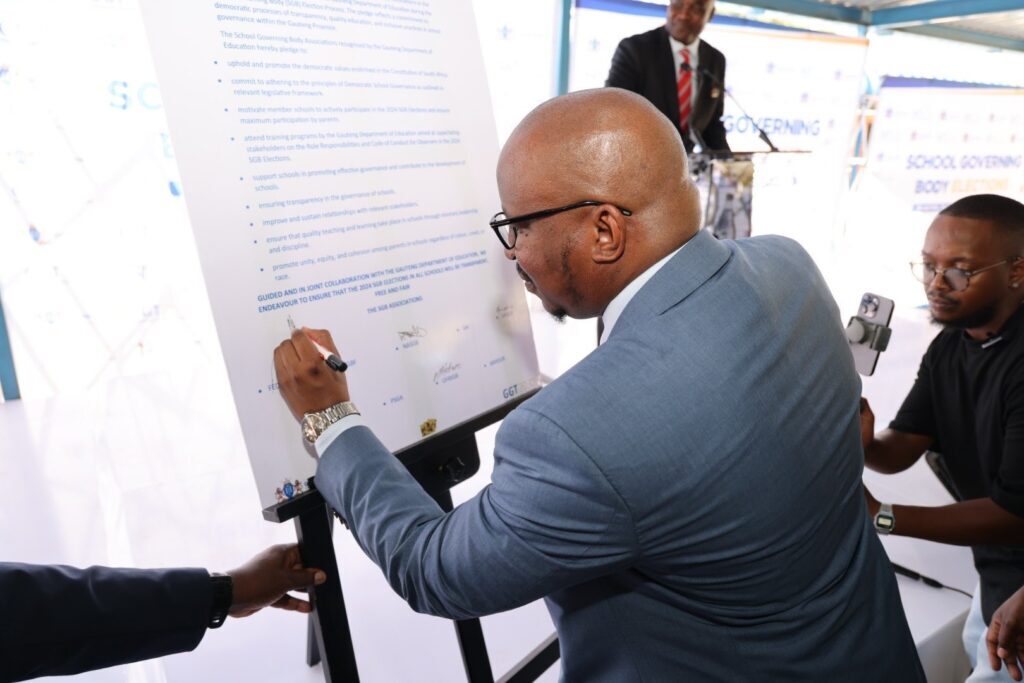
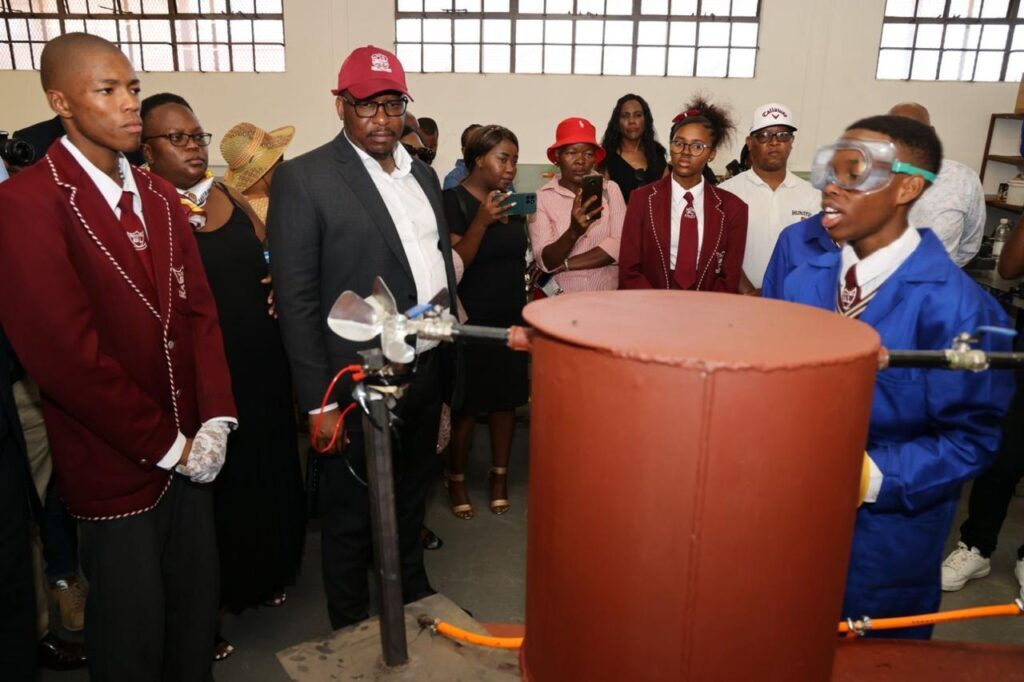
MEC of Education in Gauteng Matome Chiloane officially launched the 2024 School Governing Body (SGB) Elections on Wednesday, at Raymond Mhlaba Maths, Science & ICT School of Specialisation in Tshepisong, Roodepoort and urged the SGB members to appreciate the importance of parental participation in school governance

Every three years, schools in South Africa are expected to elect new SGB members, and the tenth cycle of elections will take place from 1 – 31 March 2024 at all public, ordinary, and special schools throughout Gauteng.

Chiloane said the parents need to ensure they elect people who have the best interest of the school in the upcoming elections.

“Don’t elect people who will cause confusion in schools,” he cautioned.

He added that all schools are urged to adhere to the current regulations and procedures established for conducting SGB elections as outlined in GENERAL NOTICE 786 of 1997.

Chiloane said SGBs serve as guardians and caretakers of the school and set the school culture and climate.

“The SGB election launch determines the school’s vision and mission, values and ethos, and policies,” he said while reminding the parents that SGB is established to ensure quality education for all learners at the school.

“We have every reason to have so much faith in our SGB’s because, upon election, our governors go through several developmental programs by Matthew Goniwe School of Leadership and Governance to ensure that they are fit for purpose,” he said.

On challenges faced by the school, Chiloane said SGB needs to find new ways to help the school, such as cleaning the premises and finding people to help patrol the facility if there is a crime taking place..

The SGB chairperson of Thulani secondary Nkosinathi Thwala said the comming elections are coming at a time where schools have difficulties such as school learners killing each other learners and shooting principals.

Thwala said members of SGBs need help from the parents to join hands with the school. SGB is in order to have a school that’s functional .

“We need help as pupils misbehave, such as fighting after school. We need parents to join hands with parents to reduce this situation”.

Noxolo Mtetwa from Slovoville primary school SGB Treasure said they welcomed the elections of which will bring new members of SGB

Makie Mtonga from Westridge High School said they need to move parents to be involved, and in her school, they need all parents to be involved in the school performance.

“It needs school governance parents and SGB .. The challenges that we face, such as school learners misbehaving in school and when you call parents in parents, don’t show up for meetings “

INSIDE EDUCATION

Uncategorized

Teacher allegedly caught in possession of drugs at a Tokoza, Ekurhuleni School

Tlholohelo Mosala

Gauteng Education MEC Matome Chiloane said he is deeply concerned following an incident where a teacher was allegedly caught in possession of drugs at Thoko Thaba Secondary School in Tokoza, Ekurhuleni.

The incident took place last Wednesday where the teacher was reportedly found with drugs on school premises which led to community protesting outside the school on Tuesday.

According to the department, the educator was allegedly found last week with a bag and box of drugs inside the school premises. Police were called in and he was arrested. He appeared in court last Thursday.

MEC Chiloane said he is also concerned that this matter was not reported to the Department by the School Management Team (SMT) in a timely manner, which has led to a planned protest by the community.

“We are disappointed about this incident, and vehemently condemn such conduct and we will be acting against it accordingly. We also plead with the community to allow this matter to be handled by the Department and relevant law enforcement authorities for appropriate resolution,” said MEC Chiloane.

The Department has launched an investigation, and the educator has been removed from the school as a precaution.

INSIDE EDUCATION

Uncategorized

With a clean audit and meeting 100% of its goals, CHIETA has a great story to tell 

 Inside Education Correspondence

Breaking the trend of negative publicity around institutions like them, the innovative Chemical Industries Education and Training Authority (CHIETA) has gone beyond the narrow confines of the industry to launch Smart Skills Centres in Saldanha Bay, Gqeberha and Babanango. 

More than 6,000 youth from the communities have used the centres. 

While the centres come in different sizes depending on the communities they serve, they all feature several pods in which virtual reality and augmented reality technologies can be used, with other pods providing laptops for surfing the internet, doing training or even job interviews. Connectivity and data are also provided. 

Getting people, especially women and girls, familiar with and confident in using technology is part of making them work-ready. At these centres, rural youth are taught digital skills, and they can keep up to date with artificial intelligence developments and get the latest in robotics and artificial intelligence. 

The following smart centre will be launched in the Highveld Industrial Park in Mpumalanga, on the former Highveld Steel and Vanadium factory site. The CHIETA wants to establish similar centres in all nine provinces. 

Although their research shows that data analysis is the number one skill petroleum companies seek, CHIETA remains duty-bound to do what it can to deepen the pool of data analytics talent for the benefit of its stakeholders. But it is also broadening how it interprets its remit, ensuring that it can positively impact the country’s high youth unemployment challenge. 

One of their groundbreaking initiatives is What About the Boys, a Gender Violence initiative in partnership with Primestars and several corporations, teaching 20,000 young boys about dealing with masculinity and learning about entrepreneurship. 

“We’ve got a good story to tell,” remarked Yershen Pillay, the chief executive officer of CHIETA, which received a clean audit, met 100% of its targets and grew levy income year-on-year from R592 million to R621 million. 

With a mission of “innovating for impact”, Pillay presented the CHIETA 2022/2023 Integrated Annual Report at its Annual General Meeting on 1 December in Sandton, saying that CHIETA was determined to continue making a difference and continue working on the hydrogen economy for which it has gained a growing reputation as a leader in the green economy. 

During International Day of Women and Girls in Science at the weekend, CHIETA could take comfort from the fact that they’re putting resources behind dozens of young girls – at least 217 last year – with positive results to boot. 

The Eastern Cape Department of Education recognised hard-working matriculant Liyabona Ncanywa as one of the province’s top achievers in the National Senior Certificate Examinations. 

CHIETA assisted her with tuition and school fees through its Science, technology, engineering, and Mathematics (STEM) fund, which supports 1,000 learners nationwide. 

Through its various programmes, including the upcoming Discretionary Grant Funding Windows and working with corporations. CHIETA provides potential opportunities for 615 internships, 1085 leadership, 1 395 skills programmes, and 1285 TVET students for Work Integrated Learning. 

Such investment in skills development is vindicated when learners like Liyabona show evidence that investment in our youth bears fruit. It certainly encourages others to do more to ensure that the goals of the United Nations become a reality for women and girls worldwide. 

In 2016, the UN declared the 11th of February International Day of Women and Girls in Science to encourage more girls and women to take jobs in science, technology, engineering, and mathematics (STEM subjects). But can they take their place without support? 

INSIDE EDUCATION

Uncategorized

Sports Minister, Deputy hand over facilities in KZN

Sports Reporter

Minister of Sports, Arts and Culture Zizi Kodwa and Deputy Minister Nocawe Mafu handed over sports facilities and sports attire in ministerial outreach programme in KwaZulu-Natal from 20 to 23 Feb

 
These engagements form part of the Ministerial Outreach Programme in which the Minister and Deputy Minister formally hand over sports facilities commissioned by the Department of Sport, Arts and Culture through its agencies. 

This programme continues interventions by the Department of Sport, Arts and Culture to develop schools in rural communities, and to make school sport the bedrock of sports development.
 
On Tuesday, 20 February 2024 at the Greater Kokstad Local Municipality, the Minister and Deputy Minister will hand over two multipurpose sports courts as part of the Netball World Cup Legacy programme, in conjunction with The Sports Trust, the implementation partner of the Department of Sport, Arts and Culture. The Sports Trust celebrates 30 years of enhancing education through sport. Following this engagement, the Minister and Deputy Minister will open a library at Shayamoya Secondary School.

On Thursday, 22 February 2024, a sports field will be handed over at Banqobile Secondary School in Mkhambathini, while on Friday, 23 February 2024, a sports field will be handed over in Impendle.

INSIDE EDUCATION

Uncategorized

NSFAS receives almost 2 million grant applications for the 2024 academic year

Lerato Mbhiza

NSFAS has received over 1 936 330 bursary applications of which 1 000 389 are provisionally funded, 395 265 are awaiting evaluations, 80 111 have been withdrawn by the student, 141 886 are in progress and 136 558 applications are on the not-started status as applicants only created profiles and did not submit applications. 

NSFAS has rejected 124 918 applications and 1 258 appeals have been lodged thus far.

The student finance loan scheme received 22 954 loan applications (as of 16 February 2024), and the application closing date was also on the 15 of February 2024.

Of the 22 954 loan applications received, 139 are provisionally funded, 12 890 are awaiting evaluations, 841 have been withdrawn by the student, 30 are in progress and 8 345 applications are on the not-started status as applicants only created profiles and did not submit applications. 

NSFAS has rejected 476 loan applications and only 5 appeals have been lodged so far

The NSFAS Board met over the weekend to consider various policy and operational matters relating to the commencement of the 2024 academic year.

Deployment of NSFAS servicing administrators

In a Statement NSFAS said it has deployed its Servicing Administrators to all institutions (TVET colleges and universities), to provide registration support-related to all NSFAS processes. 

“The servicing team has been assisting institutions to conclude all NSFAS outstanding processes, including data preparation and uploading”.

“The team will also assist students who have been confirmed for funding with their enquiries. They will assist students to upload supporting documents, guide students in the appeals process and in the student accommodation processes” said the statement .

In term of in-front payment to institutions

NSFAS said it has advanced an upfront payment to both the universities and the Technical and Vocational Education and Training (TVET) colleges.

“For universities, NSFAS disbursed R2.8 billion in January 2024. This disbursement does not include the calculation of the tranche payments, which NSFAS will disburse at the beginning of April 2024.

“This upfront payment covers one month of student accommodation and the book allowance. The book allowance is calculated at half of the total cost whilst the accommodation is calculated as one month of the accommodation cost” said NSFAS, in a statement.

“For TVET colleges, a total of R580,150,950.00 was paid to colleges as tuition upfront in January 2024. An additional R1 billion is earmarked for three (3) months’ worth of allowances to be paid based on registration from the January-march period”.

All these upfront payments are meant to enable institutions to register all NSFAS approved students for the academic year 2024.

INSIDE EDUCATION

GDE calls out parents and community for school violence
Uncategorized

GDE calls out parents and community for school violence

Johnathan Paoli

Speaking from the grounds of Primrose Primary school, the MEC for Education Matome Chiloane said the recent attack upon the principal was an unexpected shot from the dark, despite being a planned assault.

Chiloane said on Monday that whilst the department was taking every measure to ensure the health and safety of all pupils, it remained alarming that no one could really predict an extreme situation of violence such as this.

In line with the policy of the Gauteng Department of Education, maintaining and sustaining educational values in the area has proven all but impossible.

MEC Chiloane outlined the problem of both parents and communities abandoning children once they enter educational institutions.

He said that the department was setting out psycho-socio programs to assist the community in moving on from this traumatic event.

However, Chiloane has called for the might of the law be meted out against the 13-year-old learners’ parents, and confirmed that the father of the accused was similarly charged with child neglect

“How did the child get a hold of the gun is what is running in our minds. For that irresponsibility the parents will be charged. Such recklessness will be dealt with. I hope a high sentence is done to set an example to many parents that they must be responsible all the time and monitor their children ” Chiloane said.

This stands in line with previous calls, that while there is a desperate need for transformation within educational structures, similarly there is a requirement for transformation and specifically more involvement of parents and the community in the education of the youth.

INSIDE EDUCATION

Uncategorized

New Direction for Business Higher Certificate Course

Inside Education Reporter 

In the South African tertiary education landscape, Higher Certificate training plays an important role in providing bridging courses for school-leavers who are not yet ready for longer term studies, as well as stepping stones into entry-level positions for young job seekers.  

SACAP (The South African College of Applied Psychology) has announced a new direction for its Higher Certificate in Business Management and Higher Certificate in Human Resources Management programs to make these one-year training courses more accessible.

Lee-Ann Drummond, Head of SACAP’s Management & Leadership faculty says, “SACAP is committed to finding innovative ways to ensure that our high-quality education is within the reach of the many young people who are thirsty for knowledge, skills, and work opportunities in the business field.  

These two redesigned SACAP Higher Certificate programmes give students meaningful insights into the Business Management and Human Resource Managements fields.  

They are vocational qualifications that focus on the practical skills and theoretical knowledge required for taking up entry-level positions in different industries.  Students have opportunities to develop essential skills such as problem-solving, critical thinking and communications.” 

Higher Certificate qualifications can serve as a bridge to a bachelor’s degree studies for students who did not pass Matric with a university exemption or for those who need to gain a better understanding of the world of work before they feel ready to choose a degree study path.

Students enrolled in SACAP’s Higher Certificates in Business Management and Human Resource Management can expect high levels of academic excellence and opportunities to develop applied skills, while being surrounded by community.  

Drummond says, “We’ve streamlined course costs by redesigning our delivery model to focus on providing a facilitator-led, structured learning path that is more self-directed.  These smart adaptations to our business-focused Higher Certificate courses have meant that we can make them more accessible by offering them at a significantly lower cost.”

Every week a facilitator will guide students through the targets and requirements.  There will be facilitated learning activities such as a forum discussion or a live presentation with a Q&A session.  

Students will engage with video and multimedia content as well as academic readings in their own direction, in their own time. Assessments such as quizzes are embedded in the learning process so that students get feedback and can gauge their mastery of a topic in real-time. 

Technology within the course structure includes built-in automatic triggers to activate personalized support from SACAP facilitators. 

SACAP has also introduced several new subjects in the education programs. The Higher Certificate in Business Management now includes coursework on Professional Communication and the Digital Landscape, Principles of Economics, Marketing Management, Supply Chain Management and Project Management. New subjects in the Higher Certificate in Human Resource Management program are Occupational Health and Safety Management, Professional Communication and the Digital Landscape and Project Management.

Drummond concludes, “There’s facilitation, feedback and support, however, as with all online learning, these are courses that require students to be self-directed, self-motivated and able to engage independently with a variety of information sources and formats.  

“SACAP Higher Certificate programs offer adaptive learning pathways that empower young people to develop their capacities for self-management and self-mastery.  These are abilities that are highly valued in the modern world of work and so through studying, they have opportunities to hone the 21st century skills that employers are seeking.”

Applications for SACAP’s Higher Certificate programs are now open. Visit sacap.edu.za to register.

INSIDE EDUCATION

Uncategorized

Time to break the mould says former Mauritius President

Staff Reporter

There Is A Lot Of Stereotyping In The Way Sciences Are Taught To Girls, says Dr Ameenah Gurib-Fakim, the world-renowned biodiversity scientist and former first female President of Mauritius. 

Mom of two, Gurib Fakim, says increasingly on the continent, women and girls are not being encouraged to do the sciences, and this is for many reasons.

“For example, if you look at the [teaching] textbooks, there is a lot of stereotyping in the way that the sciences are being taught to girls. If you look at the infrastructures in schools, they don’t really cater for girls to stay. 

“These issues need to be looked into. We need more mentoring, more advocacy. We need to take the girls by the hand and make them believe that they can do anything. By building their confidence from a very young age, telling them that the sky’s the limit, it will lead to more in the sciences.”

When it comes to women in leadership, she said: “I have been advocating that we need to have better representation and there is a need to fix what we are all talking about – the ‘leaky pipe syndrome’ – which loses a lot of women in the pipeline, instead of bringing them along into systems and institutions. 

“But the onus is also on all Africans. People have to start asking the right questions. Politicians, leaders, policymakers in normal democracies, are all accountable to the people. But, and I am sorry for saying this brutally, we get the government that we deserve. The one we vote in. It’s your vote.”

Gurib Fakim said we all need to push gender be it in medicine, food, education, agriculture – in everything that we do in all sectors. “We cannot compromise on quality. This is the message that we need to spread across our continent. And to get to the required degree of excellence and quality, we need to empower our youth, more so our girls, with the right tools and education that will take them to the highest levels of excellency.”

INSIDE EDUCATION

Uncategorized

What economists will be listening for in the Budget speech

Inside Education Reporter

The Minister of Finance is up for a tough speech on Wednesday. 

Economists would like to hear about spending cuts accompanied by a major review of budgets and spending. 

However, further austerity measures can cause a service delivery crisis. 

This is according to Professor Waldo Krugell, an economist at the Faculty of Economic and Management Sciences at the North-West University (NWU), who looks ahead at what to expect when the Minister of Finance, Enoch Godongwana, delivers the 2024 Budget speech on 21 February.

Krugell said much will be said before and after the Budget speech this week. “It is normal to be concerned about how it affects your pocket – for example, can the minister increase the grant amounts and old age pension a bit, or what will happen to sin taxes and the fuel levy? Economists take a much broader view and will be talking about the sustainability of the fiscal stance,” said the Professor. 

Simply put, he added that it is about whether the government will be able to continue with its spending plans, tax plans and financing of the deficit over the next three years and beyond. 

“There are several things that can go wrong. The tax income that the minister budgets for is linked to the size and growth of the economy. If growth slows, the tax income shrinks. At the same time there is a lot of pressure for extra spending, such as extending grants and bailing out state-owned enterprises. 

“Put together, less tax income and more spending mean that the government must borrow more.”

Krugell added that there are a few issues with borrowing more. 

“Our quite large deficit is financed at particularly high interest rates compared to other emerging market economies. This pushes up the cost of servicing the debt. Debt service cost as a share of main budget revenue increased from 11,9% in 2024/25 to a projected 19,4% in 2024/25. 

“That is almost 20 cents of every rand of tax revenue collected. It crowds out other spending. If one considers that the compensation of government employees makes up 36% of current revenue and transfers to households make up another 35%, that does not leave a lot of income for other spending.”

The other issue is, he notes, who will buy the government’s bonds? 

Over the past ten years, according to Krugell, foreign investors have withdrawn from the bond market despite the relatively high interest rates that we offer. 

“South African financial institutions, particularly the banks, have stepped in, but the Reserve Bank has warned that for the banks to hold even more bonds may start to present a risk to the stability of the financial system. 

“In addition, offering very high interest rates to attract investors makes capital expensive for other borrowers, like corporates, who want to issue bonds. That limits investment. All in all, it is not straightforward to determine at what level the debt burden becomes unsustainable, but at a high level it does create uncertainty that has a negative impact on the exchange rate. That is bad for inflation, interest rates, the consumer, businesses, and the economy.”

So, Krugell says, economists will be listening for plans to put the government’s finances on a sustainable footing. That means increasing taxes or cutting spending.

“Though ideas like a wealth tax on individuals, or a tax on the super profits of a particular industry, are thrown about in the media from time to time, there are no serious proposals for a significant increase in taxes. 

“Our tax base is quite narrow. There are around 385 companies in South Africa that earn over R200 million in taxable income, and they contribute 65% of the total company tax take. Around 1,2 million personal income taxpayers earn over R500 000 per year, and they represent about 65% of the total personal tax liability. 

“There are more or less 275 000 taxpayers who earn over R1 million. This group represents under 2% of taxpayers and contributes over 35% of the total personal tax take. The geese that lay the golden eggs are relatively few and probably quite footloose. Any significant tax increases are likely to have negative consequences for investment and economic growth.”

Wits University is committed to enabling access to education*

In 2023, Wits disbursed approximately R1.5 billion to 26 076 students of which R646 million was NSFAS funding for 9 004 students. 

R169 million was disbursed during 2023 for Wits scholarships and bursaries, which includes, inter alia, the following:

•     R45 million for Undergraduate Merit and Scholarship Awards to support 3,343 undergraduate students,

•     R68 million for Postgraduate Merit Awards to support 1 354 students,

•     R28 million to the Wits Hardship Fund to help 1 441 students, and

•     R4 million for eligible LLB students who were defunded by NSFAS.

The University will match the funds raised via the SRC’s fundraising campaign. The Wits Hardship Fund was established in 2016 with an initial amount of R10 million per annum allocated to assist academically deserving, missing middle students to register and to secure emergency accommodation (limited number of beds available). For 2024, R28 million has been allocated to the Wits Hardship Fund to assist eligible students who meet the criteria:

Students with a family income of under R600 000 and who owe more than R10 000 can apply. 

Successful applicants receive 50% of the outstanding debt up to a maximum of R50 000, and students must meet the academic requirement of 48%. Students studying towards their first qualification are prioritised due to limited funds.

Funding sources

Students are encouraged to apply to NSFAS’ new loan scheme for the missing middle if they qualify and can also register for potential discretionary funding. Other options for funding include student loans, bursaries and sponsorships. 

Wits offers a range of support services to students including transport services to and from residences and between campuses, primary healthcare services, an after-hour ambulance service in partnership with ER24, career counselling, academic and psychosocial support, clubs and societies, food security programmes, and initiatives to end period poverty.

Wits is doing all that it can within its means to assist students, be it through funding students, fundraising from various sectors, and administering financial aid, bursaries, and scholarships. The University will continue to work with the SRC, the public and private sector, donors and partners to assist students.

INSIDE EDUCATION

MEC Matome Chiloane launches Thuto-Tiro School of Specialisation
Uncategorized

MEC Matome Chiloane launches Thuto-Tiro School of Specialisation

Tlholohelo Mosala

Gauteng Education MEC Matome Chiloane launched Thuto-Tiro Engineering School of Specialisation with a focus on Energy at Sebokeng on Thursday, making this the 33rd school of its kind to be launched by the Gauteng Province – etching it closer to the envisioned target.

“It is clear what we hope to achieve as a government, to create model citizens out of our learners by exposing them to critical skills that are needed in this economy. We are creating the future of our province, and our country as education is the foundation of all careers,” Chiloane said.

MEC Chiloane said that focus of School of Specialisation was based on the Southern Economic Development Corridor, which has tourism and entertainment, agri-processing and logistics industries.

The school is based in Sebokeng, a middle-class township in the Emfuleni Local Municipality in southern Gauteng; and in light of the township being segmented into various zones, the hostel residence was located on the periphery, when entering from Vanderbijlpark. 

Chiloane said the schools of specialisation do not have a fixed feeder area, so anyone should be able to benefit by having their children accepted at the school, depending on the outcome of the assessment for admission.

He said that the establishment of this school is aligned with the Gauteng Provincial Government’s (GPG) commitment to developing Townships, Informal Settlements and Hostels (TISH), enabling communities to benefit from the vast array of resources at the school’s disposal, as well as the advanced skills that learners will acquire.

As such, learners demonstrated an extensive knowledge in Engineering Graphics & Design (EGD) as a subject, which provides knowledge and skills that centre around mechanical, civil and electrical technology.

In addition, learners showcased their proficiency in Electrical Technology and Power Systems, demonstrating their own automated power system as well as solar inverter.

Mechanical Engineering and Civil Technology is also taught at the school, where learners gain skills in welding, sawing, fitting and turning, as well as woodwork and construction.

“This level of advanced education, coupled with commercial stream subjects, prepares learners to utilise these skills on an entrepreneurial level, not only tackling the skills gap, but addressing unemployment as well,” Chiloane said.

The MEC said enriching the foundation with an abundance of advanced skills, would result in more competent, knowledgeable, capable and proficient learners who were ready to either be employed upon exiting the system, or venture into entrepreneurship and create employment for others.

He said that the launch of these schools was in line with the department’s vision of creating problem-solvers that could effectively facilitate the development of solutions to the problems facing communities by members from the community itself.

INSIDE EDUCATION