Uncategorized

DBE Ministry briefs newly appointed Portfolio Committee on Basic Education

Staff Reporter

Basic Education Minister Siviwe Gwarube, Deputy Minister Dr Reginah Mhaule, Acting DG Dr Granville Whittle and senior managers briefed the newly appointed Portfolio Committee on Basic Education in Parliament, Cape Town, last week.

The purpose of the session was to reflect on the 2024 African Union theme, outcomes, and challenges related to Education; present the DBE’s Annual Performance Plan (APP) 2024/25 to the Portfolio Committee on Basic Education; and renew the focus on actions and efforts for improving learning and instructional effectiveness on outcomes and impacts.

The Portfolio Committee (PC) presentation was chaired by the newly appointed Chairperson, Khomotjo Maimela. With the establishment of the Portfolio Committee on Basic Education for the 7th Parliament, the Portfolio Committee urgently needed to process and engage with the DBE, as well as the South African Council for Educators (SACE) and the Council for Quality Assurance in General and Further Education and Training (Umalusi) on Budget Vote 16: Basic Education, including the Annual Performance Plan 2024/25.

Other important areas covered in the presentation included the size and shape of the Basic Education Sector; Government priorities; progress on selected deliverables, including school infrastructure, the National Senior Certificate (NSC), workbooks, Funza Lushaka, the National School Nutrition Programme (NSNP), the Early Childhood Development (ECD) shift; and the Annual Performance Plan towards long-term outcomes.

The first presentation was delivered by the DBE’s Ms Nosipho Mbonambi, Director for Strategic Planning and Reporting, whilst Mr Pat Khunou, DBE’s DDG for Finance, delivered the presentation on the DBE’s budget.

Minister Gwarube reaffirmed the Department’s commitment towards working with the PC to ensure vigorous accountability. “I encourage the PC to conduct oversight for the Department to engage with Provincial Education Departments (PEDs) where the rubber hits the tar to ensure follow-up and implementation.

“The Deputy Minister and I will visit all nine provinces to meet with MECs to establish the unique challenges each province faces. We must identify critical priorities to acknowledge and support the right and dignity of each child to attend school in safe environments.

“Collaboration through a transversal government approach with, amongst others, the Departments of Higher Education, Social Development, Health, Public Works and Transport are important for us to accelerate service delivery within our communities.”

Deputy Minister Mhaule added that, “we welcome vibrant PC members who will keep us on our toes”.

She encouraged them to continually engage with the Department on various matters related to education for these to be addressed.

Dr Mhaule gave insight on the relationship with provinces, infrastructure, budget cuts and overcrowding in urban schools. “As we are commencing with the 7th Administration and the Government of National Unity (GNU), I appeal to us to work together; it is in our hands to make a better world, and country for all who live in it,” she aptly quoted former President, Nelson Mandela during Nelson Mandela Month.

She took the opportunity to welcome the presentation and to introduce the DBE delegation to the newly appointed PC members. Ms Maimela highlighted the importance of meeting the 2024 African Union Theme: “Educating an African fit for the 21st Century: building resilient education systems for increased access to inclusive, qualitative, lifelong and relevant learning for Africa” with its 10 targeted outcomes, and presented the PC members an opportunity to engage with the Ministry and senior DBE officials. Matters of interest raised included, amongst others, school infrastructure, inclusive education, empowering learners with 21st Century skills, ECD and school safety.

Khomotjo Maimela, the Portfolio Committee on Education Chairperson, adopted its report on the 2024 annual performance plan (APP) and the budget of the Department of Basic Education (DBE) and its entities.

“The committee had extensive and fruitful discussions with the DBE and the entities that we oversee. We note all the progress made but want to emphasise that more needs to be done. We will strengthen the department’s work to ensure further engagement regarding issues of concern.”

INSIDE EDUCATION
Uncategorized

Minister Gwarube visits Carletonville school community to console families of deceased and injured learners

Inside Education Reporter

Basic Education Minister Siviwe Gwarube visited Rocklands Primary School and Laerskool Blyvooruitsig in Carletonville, Gauteng Province, yesterday accompanied by Gauteng MEC for Education, Sport, Arts, Culture and Recreation, Matome Chiloane.

The two schools have been in the news lately after a private scholar transport minibus was involved in a tragic accident in the Kokosi-Wedela area in Merafong on 10 July 2024, claiming the lives of the 12 learners and the driver of the vehicle from the schools. Seven other learners were also rushed to a medical facility for urgent medical attention.

“The loss of loved ones is never easy; the loss is markedly acute when it is our children that we have to bury. We offer our heartfelt sympathies to the parents of the children; we will keep you in our thoughts and prayers, hoping that healing and grace locate you. We also wish the learners who were hurt in the accident a full and speedy recovery,” said Minister Gwarube.

The accident occurred when their scholar transport was reportedly rear-ended by a bakkie, causing it to overturn and catch fire. Police are currently investigating the details surrounding the accident.

Today, Chiloane will attend a memorial service for the learners at Grace Bible Church, 128 Kaolin Street, Carletonville.

Last week in Parliament, Khomotjo Maimela, the Chairperson of the Portfolio Committee on Education, led colleagues in observing a moment of silence for the learners who passed away due to a scholar transport accident in Carletonville.

INSIDE EDUCATION

Uncategorized

Celebrating South Africa’s scientific and research excellence

Staff Reporter

THE Minister of Science and Innovation, Prof. Blade Nzimande, commended all the winners at the 26th annual National Science and Technology Forum (NSTF)-South32 Awards, last week in Johannesburg and Cape Town.

Along with scientists and researchers, the awards celebrated 20 students who are participating in the NSTF Brilliants Programme. The programme, supported by the Department of Science and Innovation (DSI), recognises students who performed with distinction in science and mathematics during the previous year’s matric examination, and who are enrolled in science, engineering and technology (SET)-related courses at universities across the country.

A record number of 17 awards in 15 categories were made at this year’s event.

“I wish to congratulate the winners and nominees who have been role models and, through their work, have made a significant contribution towards using science, technology and innovation to drive transformative change in our country,” said the Minister.

The Minister highlighted the important role of young scientists in South Africa, saying, “An investment in our young people who are doing science is an investment in our country’s future.”

Minister Nzimande said the country is facing a number of development complexities, and it is important to sustain the production of new cohorts of young scientists and researchers (in particular, black and women scientists and researchers) who will help generate innovative ideas on how best to solve some of those complexities.

Outstanding achievement awards were made in 15 categories, including scientific research, innovation and development, management and related activities, capacity development in engineering research, environmental sustainability and biodiversity conservation, science diplomacy, medical research, water research and innovation, data for research, and science communication.

The theme for this year’s awards was “The Fourth Industrial Revolution (4IR) in South Africa.” The Minister said the theme was very relevant to the general trajectory of technological innovation today and in the past 10 years.

“There is no doubt that digital solutions have become a major part of everyday life and present us with enormous opportunities for our country to chart a new digital-driven development path,” said Minister Nzimande.

He added that the NTSF’s focus on 4IR also aligns with one of the key focus areas of the Decadal Plan for Science, Technology and Innovation.

“Our Decadal Plan emphasises the alignment of science, technology and innovation to key sectors of the economy such as agriculture, manufacturing, mining, health, energy and the digital and circular economies.”

With some of the country’s key role players and stakeholders in the national system of innovation present at the awards, the Minister concluded his address by encouraging them to support the implementation of the Decadal Plan.

The Department’s former Director-General, Dr Phil Mjwara, was also honoured for his contribution to developing the science, technology and innovation landscape.

INSIDE EDUCATION

Uncategorized

UWC Poised for Glory in Varsity Football 2024

Staff Reporter

As the countdown to the 2024 Varsity Football tournaments begins, all eyes are set on the University of the Western Cape (UWC) teams.

With the kick-off just two weeks away, anticipation has been building for what promises to be a showcase of top-tier university football in the country.

Both the UWC men’s and women’s football teams have been a force to be reckoned with, having won three titles between them and finishing as runners-up at least five times.

The UWC women’s football team will be under the spotlight as the reigning champions of Varsity Women Football and a strong contender for the HollywoodBets Super League – the top women’s football league in the country.

They are currently second on the log standings of the Super League.

Coach Thinasonke Mbuli said that close to two thirds of her squad are new players, and it would be unfair to put pressure on them.

“We are going to the tournament with 60% of new players, so it will be unjust from our side to expect them to win,” she said.

“Yes, we want to win the title back-to-back, but at the same time, we mustn’t put unnecessary pressure on the new, young players. We have played in the finals many times and would love to win it again. It will be tough because we have a new team, but that’s the dream.”

The Varsity Football Women’s tournament, which UWC also won in 2021 and finished as runners-up in three times, will be hosted at the Tshwane University of Technology — the same venue where UWC triumphed last year — from 26 to 29 July. The final will take place on 9 August at a venue to be confirmed.

The UWC men’s football team will kick off their varsity football campaign on 25 July, aiming to improve on their semi-final loss last year.

Unlike the women’s category, where round-robin matches occur in one venue, the men will play home and away fixtures, with UWC hosting five of the seven clashes in the mini-league.

Coach Dr Lwando Mdleleni said the mood is settled in the camp, and his boys are focused as they complete the finishing touches to their preparations.

He said the aim is to improve their results by using the experience of losing in the penalty shootouts of their semi-finals.

“I think last year we were very naïve in some instances, both in terms of coaching and players’ perspectives. We have gathered the much-needed experience and depth in knowledge to propel us. Moreover, this year we have five home games – giving us a competitive edge,” he said.

Dr Mdleleni revealed that UWC has some exciting players they had brought in to bolster the squad, such as top talents Siyanda Mabhadi and Vuyani Ncontsa, to mention just a few.

“One thing we are looking forward to is to make our fans proud. We owe them a moment to rejoice. A lot is happening in our institution, and we have a role in bringing enthusiasm and excitement to the UWC faithful,” he said.

INSIDE EDUCATION

South African Students Shine on World Skills Youth Day
Uncategorized

South African Students Shine on World Skills Youth Day

Staff Reporter

On Sunday, on World Youth Skills Day, the Chinese technology giant Huawei recognised the contribution of two top South African students, Thembelihle Khumalo and Thagisa Percy, who achieved remarkable success through the company’s LEAP skills development programme.

Their journey, which included an exciting trip to China, highlights the positive impact of ICT skills development on young people’s lives. They plan on using their acquired skills to ensure that South Africa’s Fourth Industrial Revolution (4IR) is as inclusive and equitable as possible.

Standing for Leadership, Employability, Advancement and Possibilities, LEAP aims to advance young people’s ICT skills and employability in the region. At the recent LEAP Summit 2024: ICT Talent and Sustainable Development for Sub-Saharan Africa, held in Shanghai, China, a new target of training 150,000 students was announced, marking a significant step forward in the programme’s commitment to empowering the next generation of ICT leaders.

Thagisa Percy.

Khumalo and Percy were invited to the recent LEAP Camp Study Tour and closing event due to their outstanding participation in various ICT training initiatives. Their journey began with Huawei’s Seeds for the Future programme, which provides South African students and their peers worldwide the opportunity to experience cutting-edge technology and immerse themselves in Chinese culture.

Since its launch in April 2022, the programme has benefited 120,000 students across sub-Saharan Africa. LEAP aims to foster strong digital leadership and a skilled ICT workforce, build a digital talent pool, and promote digital literacy among citizens through various activities, from ICT training and certification courses to government digital capacity building and ICT skills competitions.

“South Africa has witnessed significant strides in talent development over the past few years, and this achievement would not have been possible without the collaborative efforts of government agencies, academia, and industry stakeholders,” remarks Charles Cheng, deputy CEO of Huawei South Africa. “LEAP has delivered remarkable growth and impact. After more than two years of development, we are thrilled that numerous individuals, including students like Thembelihle and Thagiso, have benefited from this initiative.”

LEAP has helped increase youth employability and bridge the gender gap in the ICT industry. Another notable programme is Huawei Seeds for the Future. Since 2016, over 100 South African students have participated in this elite programme. As we mark World Youth Skills Day, the successes of programmes like these highlight the private sector’s role in preparing young people for the future of work.

Khumalo, 24, from Isandlwana in KwaZulu Natal, developed a fascination for STEM subjects at school. This interest led her to study information technology, specialising in communication networks at the Tshwane University of Technology (TUT).

At TUT, Khumalo’s passion for ICT and its societal impact grew, fuelled by engaging classes, inspiring mentors, and hands-on experiences.

In 2023, her participation in the Seeds for the Future programme invited her to the Huawei LEAP Camp Study Tour in China. There, she gained valuable skills in digital technologies, cultural immersion, Mandarin Chinese, business, entrepreneurship, networking, personal growth, history, science, leadership, and teamwork.

“The most rewarding parts of my journey on the Huawei LEAP Camp Study Tour and in the technology, space have been gaining hands-on experience with Huawei’s innovative technologies, building meaningful connections with industry experts, enhancing my digital skills, and exploring cultural and historical aspects of China,” Khumalo says. “This incredible opportunity has motivated me to pursue my goals confidently and enthusiastically.”

Thembelihle Khumalo.

Khumalo aims to become a successful IT professional, a leader in her field, and an entrepreneur. Through hard work, determination, and a belief in her potential, she hopes to improve her family’s life and create a brighter future.

Percy, 20, hails from Thohoyandou in Limpopo and is currently studying for a BSc Honours in Computer Science at the University of Venda. His fascination with technology began when he received his first computer, leading him to enjoy programming and creating small projects. Inspired by tech leaders, Percy aims to specialise in artificial intelligence and cybersecurity, focusing on developing advanced facial recognition systems for secure identification.

His experiences on the Huawei LEAP Camp Study Tour have been instrumental in this journey. “Gaining hands-on experience with Huawei’s cutting-edge technologies like AI and machine learning, and seeing their real-world impact, has been incredibly rewarding,” he says. The camp also improved his skills in working with diverse teams, understanding different cultures, and building a strong professional network.

“Embrace the opportunity with an open mind and a willingness to learn,” advises Percy. “Network with peers and mentors, apply your knowledge to real-world projects and remain persistent through challenges. Above all, enjoy the process and stay passionate about technology.”

Percy believes that young South Africans can actively participate in and benefit from the Fourth Industrial Revolution by embracing these opportunities.

“In South Africa, 4IR has the potential to revolutionise sectors, enhancing efficiency and innovation,” says Percy. “I aim to leverage my ICT skills to develop technologies that address local challenges, improve services, and promote sustainable development.”

“I believe 4IR will bring significant opportunities for South Africa to become more competitive and connected,” says Khumalo. “I see my role in digital transformation as driving adoption, innovation, and inclusive growth. I aim to contribute to digital literacy, entrepreneurship, and job creation, bridging the digital divide and ensuring technology benefits all South Africans.”

World Youth Skills Day, celebrated on 15 July, highlights the strategic importance of equipping young people with skills for employment, decent work, and entrepreneurship. It also focuses on addressing global challenges and advancing sustainable development, principles at the core of Huawei’s LEAP Program philosophy.

INSIDE EDUCATION

Uncategorized

‘African languages must be integrated into the development of AI technology’ – expert during UP-hosted meeting of Design Justice AI Institute

Staff Reporter

Artificial intelligence (AI) has swept the board in terms of technology usage to acquire, accumulate and use knowledge in practical and theoretical ways – which is why it’s vital that African languages be integrated into the development of AI technology in a bid to preserve cultural and linguistic heritage.

This is according to Professor Kwesi Kwaa Prah, a sociology professor and the founder and Director of the Centre for Advanced Studies of African Society, who delivered a presentation at a recent meeting at the Pretoria Design Justice AI Institute hosted by the University of Pretoria (UP).

The Design Justice AI Institute is a global humanities institute sponsored by a consortium of humanities centres and institutes and the Mellon Foundation. The institute explores “community-centred, humanistic and interdisciplinary engagement of generative AI” and is an alliance of four university-based centres, one of which is UP’s Centre for the Advancement of Scholarship.

“The creation of knowledge can be traced back as far as the beginnings of humanity,” Prof Prah said. “Computers are now in use, but in order to make progress, we must create [AI technology] that makes use of our languages, or else some of our cultures will disappear from history. A language that continues to be unwritten and unused in a written form is likely to die in a 100 years.”

Our languages are what make us, he added.

“It is not our colour that determines who we are – it is our cultures. And when you think about culture, the main feature is language. That is the distinguishing feature between us and other animals – human beings create culture.”

Prof Prah encouraged Africans to embrace the world of AI and approach it with their eyes open, and to do so in their languages to preserve their cultures. This is entirely possible because African languages share dialects, meaning they can be translated in a way that can be understood by multiple communities.

Prof Vukosi Marivate, Chair of Data Science at UP and lead for the Data Science for Social Impact Group, was on the Design Justice AI Institute’s organising committee.

“The institute brings together a diverse group of scholars, practitioners and advocates from around the globe, and focuses on exploring transformative approaches in design that promote social justice and inclusivity,” he said.

Prof Marivate added that UP’s role in hosting the institute demonstrates its collective commitment to fostering an inclusive community that actively engages with the challenges and opportunities in design justice and AI.

Prof Themba Mosia, UP Interim Vice-Chancellor and Principal, said that while data-driven AI technology holds great promise for advancing global goals like the United Nations’ Sustainable Development Goals and accelerating economic growth for millions, realising these benefits requires substantial effort.

INSIDE EDUCATION

Uncategorized

Easy Matjila to receive honorary doctorate

Staff Reporter

Renowned broadcaster and SABC newsreader Masego Ezekiel Matjila will be awarded an honorary doctorate by the North-West University (NWU) on Thursday at the Mahikeng Campus.

Masego has demonstrated significant dedication in promoting the Setswana language at the SABC.

He started his career more than 30 years ago as an on-air radio personality for Radio Setswana, which later became Motsweding FM after merging with Radio Mmabatho. During this time, he also managed the archives for Radio Setswana, the Afrikaans Service, Radio Ndebele (Ikwekwezi FM), and Radio Swazi (Ligwalagwala FM).

His exceptional broadcasting skills and language proficiency, led to his appointment as a Setswana sports commentator for SABC Topsport (SABC Sports). He was later seconded to the News department, where he worked as a Sesotho, Sepedi and Setswana prime-time news presenter from 1993 until his retirement in 2021. He also served as a bulletin editor and executive producer.

Masego advocated for more multilingual youth programmes on SABC2, noting that Setswana, Sepedi, and Sesotho-speaking youth were underrepresented. His efforts at the SABC earned him numerous awards, including Best News Writer (SABC, 2008) and Commentator of the Year: AFCON 1996.

His contributions to South African society, particularly in promoting the Sesotho, Sepedi, and Setswana languages in broadcasting, are noteworthy. The honorary doctorate from the NWU recognises these significant contributions.

INSIDE EDUCATION

Uncategorized

GDE processes a record 229 000 Grade 1, 8 Online Applications

Inside Education Reporter

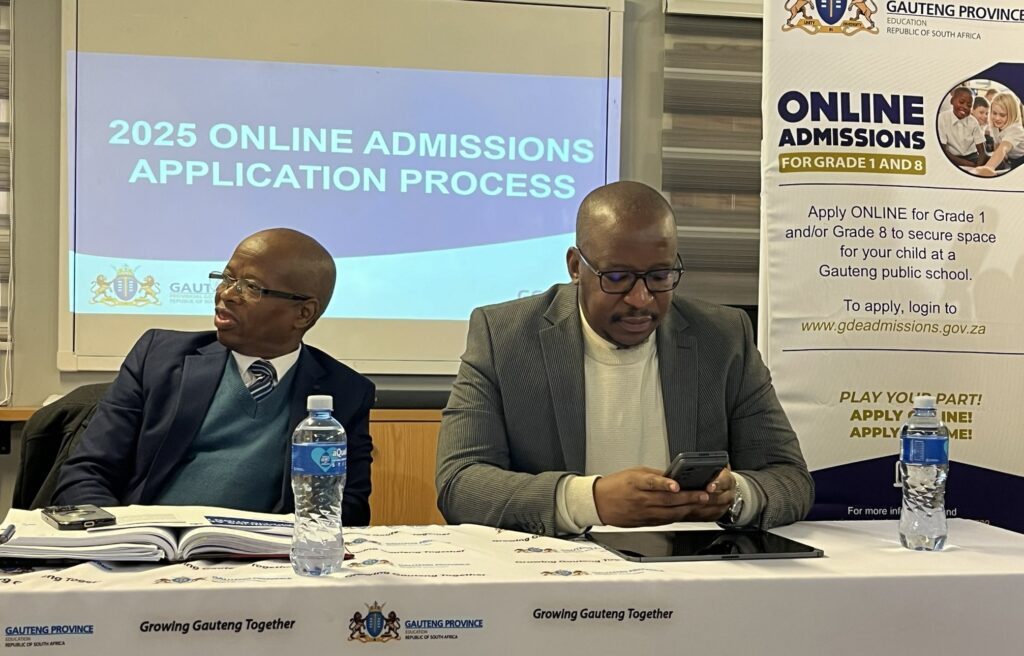
Gauteng’s MEC for Education Matome Chiloane said he is pleased that more than 229 000 Grade 1 and Grade 8 applications were processed on the first day of the 2025 Online Admissions application period.

The 2025 Online Admissions application period for Grade 1 and Grade 8 admissions in Gauteng commenced on Thursday.

“We are proud of this monumental achievement, processing such a high number of applications on the first day. This success reflects the improvements made to the system, which operated smoothly, and the demand for the quality education provided at Gauteng public schools. 

“We are delighted by the positive feedback from parents who completed their applications without issues and reassure others not to panic as the system will be open until 12 August,” said Chiloane.

According to the department, within the first hour alone, the system had recorded a total of 79 073 applications. By 4:00 PM, this number skyrocketed to a total of 229 885 successfully processed applications, comprising 100 291 Grade 1 applications and 129 564 Grade 8 applications.

MEC Chiloane led the official launch of the 2025 Online Admissions system at the Diepsloot Youth Centre, assisting parents and guardians with the application process for their children entering Grade 1 and Grade 8 in Gauteng public schools for the 2025 academic year.

The 2025 Online Admissions application period will remain open until 12 August 2024.

Parents and guardians can apply by visiting www.gdeadmissions.gov.za.

Applicants are encouraged to either upload certified copies of the required documents onto the system or submit them at the schools they applied to within seven (7) school days.

Additionally, parents are urged to visit District Offices or one of the 80 Decentralised Walk-in Centres for assistance with their applications.

INSIDE EDUCATION 

Uncategorized

12 learners die and 7 injured in a tragic scholar transport accident in Merafong

Tlholohelo Mosala

Twelve learners were reported dead on Wednesday morning in Carletonville after a tragic car crash involving a scholar transport.

The Department of Education issued a statement confirming the incident which took place in the Kokosi-Wedela area in Merafong and confirmed that twelve learners lost their lives along with their driver.

The report said eleven of the learners who died were from Rocklands Primary school and one learner was from Laerskool Blyvooruitsig in Carletonville.

Additionally, other seven learners who were part of the accident were rushed to a hospital to receive urgent medical care

According to the Department at around 06:45 in the morning a bakkie hit the scholar transport from behind causing it to overturn and subsequently catch fire.

The Department of Education has dispatched the psycho-social support team to the affected schools and families. Counselling will also be offered to all learners and staff members.

“I am profoundly saddened by this tragic event. The loss of our children is a devastating blow to our community and our thoughts and prayers are with the families of the deceased and injured learners,” said Gauteng MEC for Education, Sports, Arts, Culture and Recreation Matome Chiloane

Chiloane visited the accident scene and went to both schools where he urged parents to ensure that private scholar transports are in good condition.

“What I always urge parents (to do) is that you must look at the condition of the vehicle that is taking your children, the number of kids that are taken into this particular private transport, I have stopped one in an area of Motsweding, it had about 45 kids”.

INSIDE EDUCATION

Gauteng 2025 Online Admissions for Grade 1, 8 opens on Thursday
Uncategorized

Gauteng 2025 Online Admissions for Grade 1, 8 opens on Thursday

Phuti Mosomane

THE Gauteng Education MEC Matome Chiloane has declared Thursday as the opening for online application for the 2025 Online Admissions for Grade 1 and 8.

The period for online application will be opened from this Thursday till 12 August 2024 and Chiloane urges parents to use this period to make sure their children’s applications are in to stand a chance to be admitted in the 2025 Academic Year.

The online application was introduced in the province by current premier Panyaza Lesufi after chaotic queues in schools across the province in last ditch efforts to ensure their children were admitted in schools.

This was done to centralize all applications and do away with the Walk-In centers that were deemed chaotic.

All applications for Grade 1 and Grade 8 learners will be processed through the GDE Online Admissions System. This allows only parents and guardians applying for Grade 1 and Grade 8 to apply.

Further, parents of children that are currently in Grade R should also use this opportunity to also apply online for their children to be admitted to Grade 1.

Since its introduction in 2015, the Gauteng Online Admissions Application System has proven a success and assisting many parents and guardians of Grade 1 and 8 learners with securing a space for their children in schools.

The department said the current system has proven to be much more advanced than the previous manual approach, which led to thousands of parents and guardians camping outside of certain schools especially in high pressure areas for days when seeking placement.

Addressing the media in Midrand on Tuesday, Chiloane said the online system helps the department with immediate access to data and statistics to facilitate a transparent admissions process. It will also assist eliminate long queues at schools during application periods.

“Accordingly, the system has a 100% placement rate of all complete applications submitted online; which recently successfully processed the placement of approximately 400 000 learners ahead of the 2024 Academic Year,” Chiloane said.

To apply, parents and guardians must first register on: www.gdeadmissions.gov.za which will go live on Thursday, 11 July 2024 at 08:00 am for applications.

The department said parents will not be able to access the system before it goes live on 11 July 2024. Chiloane encouraged all parents to register, previous login details will not work.

“Only parents with children going to Grade 1 and/or Grade 8 seeking space at a public school in Gauteng for the 2025 Academic Year will be able to register and apply online. Applications will then close on Monday, 12 August 2024 at 00:00 AM (midnight). No new applications will be accepted once the application period has closed,” he said.  

After registering, the system will prompt parents to create login credentials (username and password) which they will use to access the Online Admissions System to view and manage their application details.

Once applicants have gained access to the system, they must begin with the application process and ensure that they complete the five (5) step process. When applying for Grade 1 and/or Grade 8 during the 2025 GDE Online Admissions application process, parents must complete the following 5 Step application process to submit a complete application:

STEP 1 Register Parent/Guardian Details

STEP 2 Register Home Address Details

STEP 3 Register Learner Details

STEP 4 Apply to a Maximum of Five (5) Schools

STEP 5 Uploading Documents to System or Submitting Documents at Schools (Within 7 school Days of Applying)

Applicants must ensure that they complete the full 5 step application process, and register one reliable and active cellphone number to receive SMS notifications.

Chiloane said the department will not be responsible for information shared with private entities such as Internet cafés that can be potentially misused.

The MEC rather urged parents and guardians to visit any of the 80 Walk-In Centres set up by the Department for assistance.

Parents are further encouraged to use the home address within school feeder zone application option to see schools with feeder zones that cover their home address

To increase the chances of placement closer to the parent’s home address, parents should select schools with feeder zones that cover the parent’s home address selecting a minimum of three schools and a maximum of 5 schools.

However, parents who select 1 or 2 schools when applying, limit the chances of their children being placed in the instance of those selected schools reaching full capacity.

Selecting more schools increases the chances of being placed and parents cannot make more than one application for one learner to the same school.

Gauteng Education launches 2025 Online Admissions for Grades 1, 8

INSIDE EDUCATION