Uncategorized

DUT’s School Engagement Project fosters a sense of community

By Zwakele Ngubane and Bérénice de la Croix

The phrase “it takes a village to raise a child” originates from an African proverb and conveys the message that it takes many people to provide a safe, healthy environment for children, where children are given the security they need to develop and flourish, and to be able to realise their hopes and dreams.

A safe, healthy environment for children is needed even more when we live in a society with high divorce rates, teenage pregnancies, broken families, sharp inequality and child-headed households – a grim reality in South Africa for many young people.

Therefore, fostering and promoting a sense of community, compassion and care is becoming more critical as we need to help each other fill the gaps. Indeed, many compassionate people amongst us step in to care for, protect, nurture, guide, support and mentor.

Many initiatives demonstrate this “spirit” of what can best be described as ubuntu.

The Durban University of Technology School Engagement Project (DUT SEP) is one such initiative that attempts to make a difference. The project, launched in 2018, involves seven partner schools, approximately 30 DUT students, several staff members from various DUT departments and external partners.

Young people are the future and need to know they are worth investing in. Through participating in holistic education opportunities, the gifts of our youth are unlocked for their benefit and the benefit of society.

With increasing unemployment and joblessness, it is vital that our young people access and develop their confidence, vision and creativity. These life skills are invaluable in both formal employment and entrepreneurial endeavours.

Every society needs ethical leaders to function effectively. Currently, we have a deficit of ethical leaders in all sectors of society, in South Africa and globally; through values-based education interventions such as DUT’s School Engagement Project, our young people are stepping forward as ethical, skilled, visionary leaders.

As one of its key strategic pillars, DUT embraces the tenet of being an engaged University. With this, comes a commitment to be socially responsible and responsive to local, regional and national needs. DUT SEP is an example of engagement in action and fully embodies this critical but often neglected responsibility. It enables DUT students and staff to be engaged in a worthwhile community initiative which enhances the education of both school learners and university students.

The project is informed by Otto Scharmer’s Theory of Change, Theory U, in which he posits that conscious, values-based leadership can give rise to strategic social change. Using his experience working with some of the world’s most successful leaders and innovators, Scharmer shows in Theory U: Leading from the Future as it Emerges, how groups and organisations can develop conscious leadership in order to implement sustainable solutions to socio-economic challenges.

On this premise, the project seeks to impact young people multi-dimensionally through the seven project pillars: Tuition in Gateway subjects, Peace Clubs, Social Entrepreneurship Clubs, Talent Show, Sports Tournament, Career Guidance and Super Chefs Competition. These project pillars are points of leverage that support one another to create inclusive and invigorated educational environments where skilled, ethical leaders can emerge.

A project review is conducted every year, and project stakeholders have consistently indicated the significant contribution that the project is making to academic progress and the development of entrepreneurial and values-based leadership skills.

Ngubane is Chair of the DUT School Engagement Project and De la Croix is the Project Manager.

INSIDE EDUCATION
Uncategorized

Celebrating excellence – meet the top achievers of SA’s 2024 matric exams

By Johnathan Paoli

For 2024, two matriculants have been honoured with the National Top Learner Awards by the Basic Education Department. While it has not always been plain sailing for Owethu Shangase and Ryyan Ebrahim, the two attribute their success to the support systems around them and their ability to dream big.

Shangase, 17, is from the John Wesley Kosi Bay Private School in Umhlabuyalingana in northern KwaZulu-Natal, and Ebrahim, 19, is from Pinelands High School in Cape Town

Shangase achieved a total of eight distinctions in the 2024, while Ebrahim passed with nine distinctions.

Shangase is described by the department as a spectacularly driven young man who is the product of “when consistency meets inspiration”.

His academic career boasts an impressive first place from Grade 3 to Grade 12, and comprises a full house of distinctions achieved for the entire FET phase (grades 10-12). He skipped two grades due to his aptitude for academics, especially Mathematics.

Speaking to Inside Education, Shangase expressed his immense gratitude and disbelief at his achievement.

“Being the top performer in the country has left me overwhelmed and humbled. Never in my wildest dreams did I imagine this,” he said.

Shangase revealed that procrastination and inconsistency were among his biggest challenges for Grade 12.

“I planned a lot, but struggled to follow through. This affected my confidence, making me doubt my ability to succeed,” he admitted.

Despite these hurdles, his determination and support from his family, who ensured that he had the necessary resources, helped him persevere.

Among his proudest moments was becoming the valedictorian at his school, achieving first place in every subject with a remarkable 96% average.

And securing second place in a provincial Inter-District Olympiad reinforced his belief in the value of hard work.

Looking ahead, Shangase plans to study Actuarial Sciences at the University of Cape Town, aspiring to become a fellow member of the Actuarial Society of South Africa and possibly a chief risk officer in the future.

He envisions a South Africa where funding and educational resources reach the most disadvantaged communities.

His advice to future matriculants is to set goals and persevere.

“Have clear goals, work diligently and help others along the way. Collaborating and supporting peers only brightens the path for everyone,” Shangase said.

He also emphasises the importance of prayer and maintaining humility throughout the journey.

For Ebrahim, who was the head boy at Pinelands, the recognition is “unbelievable and overwhelming”.

“I’m so grateful to have been honoured in this way, and it’s all by the grace of God,” he told Inside Education.

Described by the department as an exceptional, resilient young man, in his Grade 10 exams he faced significant challenges when his home underwent renovations. Undeterred, he devised a plan to wake up early and study in quieter places like the school library.  

Ebrahim, who had an aggregate of 97.57%, acknowledges that his matric year was not without its challenges, saying just like other students, there were moments when he was overwhelmed.

“I decided to step back, remind myself that my best was good enough, and leaned on the support of my family and friends,” he shared.

His ability to manage stress and maintain focus helped him navigate the intense academic year.

Ebrahim plans to study Data Science, which he describes as a fusion of maths, computer science and business, also at UCT.

“It’s an area I’m passionate about and one that aligns with South Africa’s growing need for innovation,” he explained.

The stories of Shangase and Ebrahim serve as a beacon of hope for future matriculants, demonstrating that with vision, effort and resilience, greatness is achievable.

The department celebrated the achievements of these exceptional matriculants and 37 others at a ceremony in Johannesburg, recognising the transformative impact of their hard work.

As they embark on their academic and professional journeys, Shangase and Ebrahim stand as shining examples of South Africa’s potential and the power of education to shape the future.

INSIDE EDUCATION

Uncategorized

Universities must address unscrupulous collection of millions from unsuccessful students

By Edwin Naidu

In 2014, South Africa’s National Development Plan stated that universities were key to developing a nation.

Universities play three main functions in society. First, they educate and train people with high-level skills for the employment needs of the public and private sectors. Second, universities are the dominant producers of new knowledge. They critique information and find new local and global applications for existing knowledge.

The NDP notes that universities also set norms and standards, determine the curriculum, languages and knowledge, and examine ethics and philosophy underpinning a nation’s knowledge capital.

Further, it states that South Africa needs knowledge that equips people for a constantly changing society. Given the country’s apartheid history, higher education provides opportunities for social mobility and simultaneously strengthens equity, social justice and democracy.

According to the plan, higher education underpinned by a strong science and technology innovation system in today’s knowledge society is increasingly important in opening people’s opportunities.

Therefore, it comes as a shock but no surprise that cash-strapped higher education institutions are minting money out of the misery of rejected students. They are all mindful that they can only accommodate a small number of students yet open it up widely, creating false expectations for which they charge a small sum that adds up to a princely windfall.

Reports are that the University of Witwatersrand received more than 140,000 applications for the 2025 academic year, but placed only 6300 new students, showing the heavy demand for places. They charge R100 for each online application, while non-South Africans, mainly from the continent, pay R700 for the privilege.

Wits, one of the country’s top universities and beneficiary of generous donations, makes an easy R15 million through rejected applications. After Christmas, this is a great bonus to start the academic year. However, the online application process is not unique to Wits; every institution is tasked with accepting applications in this manner.

Responding on social media as this debate escalates, the extremely proactive Wits head of communications, Shirona Patel, said that like other universities, Wits charges an application fee of R100 per applicant as approved by the education department.

“Wits University’s application fee has remained the same for the past six years. The university employs hundreds of assistants, senior students and part-time staff to assist with the application, administration and orientation programmes at the beginning of the year. In addition, online platforms and concomitant technology requires licensing and technical attention,” she said.

“Wits University received 31,136 postgraduate applicants and 86,893 undergraduate applicants, which makes up a total of 118,029 applications. It is quite a task to process all these applications. The university is a non-profit institution, and all proceeds go to the academic project and student support.”

While some universities have waived application fees for local students, institutions with application fees include the University of Cape Town (UCT), whose application fee in 2025 is R100 for South African and Southern African Development Community (SADC) applicants and R300 for other international applicants. Universities that charge a fee include:

The University of Pretoria application fee for 2025 is R300

University of Johannesburg: application fee is R200 for hardcopy applicants, free for online applicants.

University of South Africa’s fee is R140 for online applications

Tshwane University of Technology’s fee is R240 

Universities with no application fees are:

University of the Western Cape: Free online application

University of Limpopo: Free online application

Central University of Technology: Free application

Nelson Mandela University: Free for South African citizens

University of Free State: Free application

Walter Sisulu University: Free application for local students

The newly proposed Draft Fee Regulation Framework for South African universities, released on 1 November 2024 by the Department of Higher Education and Training (DHET), considers the feasibility and potential impact on the sector’s long-term sustainability.

Developed by a team of retired vice-chancellors, the framework came about as the government explored the possibility of limiting university fee increases. 

The idea is that, through a fee compact, there is a limit beyond which a university cannot increase its tuition fees for local undergraduate students annually. 

However, some institutions should consider whether to charge or not levy application fees. On the surface, and in terms of the Higher Education Act, the universities that are financially better off are allowed to mint money off students who will not have a chance to study at their institutions, while those who want to study at poorer, less-endowed historically black institutions can try their luck for free.

While the framework aims to address variations in fees charged for the same qualification across institutions, reduce student debt and improve accessibility to higher education, it must consider the morality of raising millions in application fees from students it ultimately rejects.

The broader issue of universities’ ability to accommodate growing student numbers should hark back to the 1995 National Commission on Higher Education under Professor Sibusiso Bengu. This framework for the transformation of the tertiary sector was largely ignored.

It’s time to go back to the drawing board to understand where South Africa is regarding the goals in the National Development Plan.

The Universities South Africa (USAf) chief executive Dr Phethiwe Matutu has consistently highlighted the challenges surrounding funding in higher education. She has been a key driver in raising the issue and finding solutions.

Dr Matutu has warned that enforcing such fee caps could exacerbate existing financial pressures on universities.

She noted that universities were increasingly becoming financially unsustainable, having to fork out the shortfalls in revenue that can’t be generated through fees across the board.

But should universities continue to make a quick buck from aspirant applicants? Former education chief Dr Blade Nzimande has always championed the poor but allowed this practice to continue longer than a decade in his reign. One hopes that the current DHRT Minister Dr Nobuhle Nkabane takes a more hands-on approach and really puts students first—not paying lip service to their aspirations.

Edwin Naidu is the Editor of Inside Education.

INSIDE EDUCATION

Uncategorized

McKenzie sings the praises of school sport

By Thapelo Molefe

Sports, Arts and Culture Minister Gayton McKenzie has promised to make school sports a priority, stating that it would have the most prominent space in the budget. 

“I’m passionate about school sports,” he said. “And you know, the good thing is that we have

a Minister of Basic Education that’s equally passionate about school sports.”

In a recent radio interview, McKenzie emphasised the importance of school sports in unlocking South Africa’s sporting potential. 

“There’s no country that can continue its greatness without involving school sports,” he said.

The minster expressed his frustration with the lack of resources and infrastructure for school sports, particularly in disadvantaged areas.

“If your child goes to a private school, model C school, they are definitely bound to be recognised,” he said. 

“You look at the best prospect to come out of South Africa, Walaza Bayanda (Olympic sprinter), he had to go to a private school, semi-private school, or whatever you call it. Curro.”

McKenzie also acknowledged that he would be judged on his ability to deliver on his promises regarding school sports. 

“If I don’t uphold the upliftment of school sports, then I failed,” he said. “And I’m one guy that tells you straight up. I would be the first one who walks around with a board around my neck,(written) ‘I’m a failure because I promised school sports would come back and I didn’t do it’.”

In addition to school sports, McKenzie discussed the current state of various sports in South Africa, including rugby, cricket, swimming and basketball. 

He criticised the lack of transformation in these sports, particularly with regards to the representation of black African players.

McKenzie also addressed the issue of the Formula One (F1) maybe coming to South Africa. When asked about Rwanda’s bid to host the F1, McKenzie expressed confidence in South Africa’s chances. 

“Rwanda stands no chance against us,” he said. “Our economy is 30 times bigger than the economy of Rwanda. We have a track, and in a few months, our track will be up to F1 standards.”

The minister also shared his thoughts on the current SA20 cricket tournament. 

“I think it’s a brilliant thing what the SA20 is doing,” he said. “Tickets are being sold out. It’s January and people are filling stadiums.” 

However, McKenzie also expressed some concerns, particularly with regards to team ownership and transformation.

“There’s no South African that owns a team,” he noted. “All six teams are owned by Indian gentlemen. That I’m never going to allow.”

McKenzie also criticised the lack of representation of black African players in the SA20. 

“I agree with the view that it’s unacceptable that there are no black African players in the SA20,” he said. “I’ve met with Cricket SA and raised this issue. I’ve told them that their transformation sucks, and it’s embarrassing.”

The minister also highlighted the need for transformation in other sports, including swimming and basketball.

And expressed his frustration with the lack of representation of black swimmers in South African swimming.  

“We’ve never had a black person qualify for the Olympics in swimming in the past 30 years.

You want to tell me what that is? We can’t even produce one person that qualifies.” 

“And basketball in this country is probably the worst organisation in South Africa,” he said.

McKenzie cited a recent incident in which Basketball South Africa failed to make arrangements for a group of 15-year-old players arriving at the airport for an international tournament. 

“I had to make a call to the African president of basketball to sort out the mess,” he said.

“It’s unacceptable, and I won’t tolerate it.”

McKenzie cited Mark Alexander, the president of the South African Rugby Union, as an example of a leader who has driven transformation in rugby. 

“Mark Alexander has transformed rugby whether we like it or not,” McKenzie said. 

“Rugby at the current moment, I don’t care who says what, is enjoying its best era in the history of the game of rugby.”

McKenzie emphasised the need for strong leadership and accountability in sports administration. 

“It’s time that we call them out,” he said. “Our people are hiring the coaches. And it’s time that we call them out.”

INSIDE EDUCATION

Uncategorized

Most of us trust scientists, shows a survey of nearly 72,000 people worldwide

By Mathew Marques, Niels Mede, Viktoria Cologna and Zoe Leviston

Public trust in scientists is vital. It can help us with personal decisions on matters like health and provide evidence-based policymaking to assist governments with crises such as the COVID pandemic or climate change.

In a survey of 71,922 people across 68 countries, our global team of 241 researchers has found most people have a relatively high trust in scientists.

Notably, people want scientists to take an active role in society and policymaking. Our results are published today in Nature Human Behaviour.

So what does this mean for us as a society, and for scientists and policymakers seeking to maintain and build trust? Here are the lessons we’ve learned.

Rumours of a ‘crisis’

According to reports and polls, most people trust science, and scientists are among the most trustworthy people in society. Yet there is an oft-repeated claim of a “crisis of trust” in science and scientists.

For instance, some research suggests media reporting about polls can act as a self-fulfilling prophecy or feedback loop – it can undermine scientific credibility by portraying a trust crisis.

Other research suggests media policy narratives influence public opinion through framing. For example, exposure to conservative media reporting on scientific controversies increases distrust in scientists, leading to greater climate change denial.

Our research goes beyond the Western world and covers many understudied countries in the Global South. We tested whether there is in fact low trust in scientists, and whether levels of trust vary appreciably across countries.

A truly global survey

We conducted a crowd-sourced Many Labs project involving the same translated survey across 68 countries on all inhabited continents.

Data were collected between November 2022 and August 2023. Our samples were weighted according to national distributions of age, gender, education and country sample size. You can interact with global and country level data using this data dashboard.

Trustworthiness of scientists was measured using four established dimensions: perceived competence, benevolence, integrity and openness.

How much do people around the world trust scientists?

Worldwide, we find most people have relatively high trust in scientists (mean trust level = 3.62, on a scale from 1 = very low trust to 5 = very high trust).

Globally, people perceive scientists to have high competence, moderate integrity and benevolent intentions, while also being slightly less open to feedback. A majority of respondents also perceive scientists to be qualified (78%), honest (57%) and concerned about people’s wellbeing (56%).

No country showed low trust in scientists.

Australia ranked equal fifth-highest in trust in scientists, scoring significantly above the global average, and ranking only behind Egypt, India, Nigeria and Kenya.

Are there differences in trust based on who you are?

Globally, our findings indicate trust is slightly higher for women, older people, residents of urban (versus rural) regions, and people with high incomes, religiosity, formal education and liberal and left-leaning political views.

In most countries, political orientation and trust in scientists were unrelated. However, we found that in Western countries people with conservative (right-leaning) political views have less trust in scientists than those with liberal (left-leaning) views. This is consistent with research from North America.

In Australia, having a conservative versus liberal political orientation didn’t seem to matter when it came to trust in science, unlike in North America and many other European countries. This could mean political polarisation around science is not as much of an issue as it is for specific scientific issues, like climate change.

Globally, what did seem to make a difference was how much a person endorses something called social dominance orientation – a preference for inequality between social groups. People high in this orientation were significantly less trusting of scientists. This is also consistent with previous research.

How do people think scientists should behave?

A majority of survey participants are in favour of science playing an active role in society and policymaking.

Globally, 83% of respondents believe scientists should communicate about science with the general public. This is particularly the case in African countries.

Overall, around half (49%) believe scientists should actively advocate for specific policies, and that scientists should be more involved in the policymaking process (52%).

In Australia, around two-thirds believe scientists should actively advocate for specific policies (66%), and a majority believe scientists should be involved in the policymaking process (62%).

What do people think scientists should prioritise?

Many people worldwide feel the priorities of science don’t always align well with their own priorities.

This is important because the discrepancy between perceived and desired research priorities is associated with trust in scientists. The less people trust scientists, the more likely they think scientists’ efforts don’t meet their personal expectations on what they should prioritise in their work.

In general, respondents assign the highest priority to research dedicated to improving public health, followed by solving energy problems and reducing poverty.

Research on developing defence and military technology was assigned the lowest priority. Globally, respondents believe science prioritises this more than it should.

There are, however, large differences between global regions. People in African and Asian countries believe there should be a higher priority on developing defence and military technologies.

There’s no crisis – but these are valuable insights

Our findings echo Western polls that scientists are among the most trusted people in society. Worldwide, our results show there’s a high level of trust in scientists and a belief they should be involved in society and policymaking.

All this doesn’t support the narrative that there’s a crisis of trust in science.

Importantly, our findings do also highlight some areas for concern. Globally, less than half of respondents (42%) believe that scientists pay attention to others’ views. While scientists are viewed as highly competent, with moderate integrity and benevolent intentions, there is a perception they are less open to feedback.

There is also a gap between the perceived and desired priorities for research, which is associated with trust.

We recommend scientists take these results seriously. They should find ways to be more receptive to feedback and open to dialogue with the public. In Western countries, scientists should consider new ways to reach conservative groups.

In the long term, scientists should also consider their role in setting priorities aligned with public values.

Marques is Senior Lecturer in Social Psychology, La Trobe University, Mede is Senior Research and Teaching Associate, Department of Communication and Media Research, University of Zurich, Cologna is Postdoctoral Researcher, Swiss Institute for Advanced Study, Swiss Federal Institute of Technology Zurich, and Leviston is Research Fellow in Social Psychology, Australian National University.

The Conversation

Uncategorized

What one university’s 30-year transformation reveals about Afrikaans and language planning

By Lloyd Hill

When South Africa became a democracy in 1994, five of the country’s universities used Afrikaans as a medium of instruction. There were also two bilingual universities teaching in Afrikaans and English.

Stellenbosch University, about 50km from Cape Town, is the oldest historically Afrikaans university. Over the past three decades English has gradually replaced Afrikaans in the core functions of teaching and research.

The status of Afrikaans at formerly Afrikaans or bilingual universities remains the subject of considerable debate. This has led to litigation and three judgments in South Africa’s apex court, the constitutional court.

Afrikaans is commonly categorised as an Indo-European language, related to Dutch. It can be more accurately described as a Creole language that developed after the Dutch colonised the Cape in 1652. In 1925, standardised Afrikaans became an official language alongside English. It subsequently became associated with white Afrikaner nationalism and, from 1948, apartheid education policies. In 1976, Black students mobilised against attempts to make Afrikaans a compulsory medium of instruction in schools.

I’m a sociologist who studies language and communication in science and higher education. In a recent article and presentation I examined the three phases in which the language shift and the decline of Afrikaans at Stellenbosch University has unfolded.

The first phase (1994-2002) involved an attempt to defend Afrikaans institutional monolingualism. The second (2002-2015) saw a shift to institutional bilingualism. Afrikaans and English were used in undergraduate classes. The final and current phase began with the 2015-16 #FeesMustFall student protests. Pressure for the transformation of a predominantly white campus escalated. This triggered a rapid shift to English.

In 2024, the university’s language policy is, on paper, a scaled-down version of institutional bilingualism (Afrikaans and English). However, in practice English is the main medium of instruction. Afrikaans is, increasingly, not used across all disciplines. This reflects the trend at other formerly Afrikaans or bilingual public universities.

There is a case to be made for defending Stellenbosch University’s position as a centre of Afrikaans language and culture. But the centralised language planning apparatus it has developed over the past two decades is simply unsustainable. This case study prompts a broader reflection on languages and language planning within South African higher education.

First, for reasons related to its global academic status and its national second-language status, English has emerged as the dominant language of teaching and research at South African universities.

The second issue has to do with the nature of “language” at different levels of the education system. The official languages adopted in 1994 are not uniform “mother tongues” or “vehicles” moving from basic education to PhD.

Languages are more than individual “competencies”: they are political and economic projects. They are also particularly expensive and difficult to “plan” in university teaching and research.

First phase (1994-2002)

In 1994, South Africa’s then-interim constitution recognised 11 official languages. It committed “the state” to “practical and positive measures to elevate the status and advance the use of these languages”.

Afrikaans universities faced a particular dilemma. How could they retain Afrikaans as a medium of instruction and open enrolment to formerly excluded Black students? These are generally second-language English speakers who opt to study in English.

Other historically Afrikaans institutions adopted parallel medium instruction. Stellenbosch University resisted this trend and asserted its autonomy as a monolingual institution. Postgraduate teaching and research, however, shifted to English. Afrikaans was reframed as an undergraduate teaching issue.

The university argued that the predominantly Afrikaans-speaking Western Cape and Northern Cape provinces needed an Afrikaans-medium university.

Two factors undermined this demographic argument. First, the university enjoys national status. This can be traced back to an elite Anglophone college system in the 19th century British Cape Colony. Second, after the 1994 transition, the university focused on internationalisation. It also established itself as a leading research-intensive institution. As a result it has increasingly attracted students and academics with little or no Afrikaans competency.

Second phase (2002-2015)

In the early 2000s South Africa’s higher education system was overhauled. This involved institutional mergers, which coincided with the adoption of the 2002 Language Policy for Higher Education. The policy effectively disestablished monolingual Afrikaans universities, stating: the notion of Afrikaans universities runs counter to the end goal of a transformed higher education system.

Stellenbosch University adopted its first language policy and plan in 2002. Afrikaans was reframed as one of four undergraduate language options and described as “the default language of undergraduate learning and instruction”. A heated debate erupted in the Afrikaans media. In this first public – and acrimonious – taaldebat (language debate) many criticised the new “default” status of Afrikaans. That’s because, like a default setting on a computer, this option could be switched.

The new policy introduced formal language planning as an institutional process that would involve periodic policy updates. It also presented three module “options” that represented possible routes away from institutional monolingualism.

First, dual medium instruction involved using both English and Afrikaans in one lecture. Second, parallel medium instruction involved separate lectures in English and Afrikaans. Third was an English medium option. However, the second and third options were reserved for “exceptional circumstances”.

Within a few years, most modules shifted to the dual medium option. The university shifted to a dual medium form of institutional bilingualism. But a tacit racial assumption underpinned this model. The language policy ignored the growing enrolment of Black students and the appointment of Black staff members who didn’t have the required bilingual proficiency.

A new language policy, adopted in December 2014, tried to address the bilingual proficiency problem. It prioritised parallel medium instruction and “educational interpeting”. It never got off the ground.

Third phase (2015 to date)

Beginning in March 2015, a series of “Fallist” movements mobilised on South African campuses. A predominantly Black student movement called Open Stellenbosch was established. It aimed “to challenge the hegemony of white Afrikaans culture and the exclusion of Black students and staff”. Language policy was a key point of contention.

The university responded by redrafting its language policy. In June 2016 it established English as the primary medium of teaching at the undergraduate level.

This moment also marks the shift to what I term the second taaldebat. Afrikaans language activists now argued that English and Afrikaans ought to enjoy equal status. Institutional bilingualism became the new ideal framework for defending Afrikaans at Stellenbosch University.

Language activism included litigation, which ended in a constitutional court ruling. The court upheld the 2016 language policy review process. It also noted the “hard racial edge” to the evidence produced by Stellenbosch University. It remarked that:

Seen as a bloc, the new entrants for whom Afrikaans is an obstruction are not brown or white, but overwhelmingly Black.

Today, Stellenbosch remains notionally committed to “multilingualism”. In practice, this means a scaled down version of institutional bilingualism. It involves very limited parallel medium instruction and some simultaneous interpreting. English is the compulsory medium in modules where no duplication occurs.

Hill is a Lecturer at Stellenbosch University.

The Conversation

Major concerns reported as North West schools re-open
Uncategorized

Major concerns reported as North West schools re-open

By Amy Musgrave

The North West education department is ready for the new year on paper only, with a severe lack of resources at many schools, according to the Democratic Alliance in the province.

DA members of the provincial legislature conducted a school readiness oversight assessment in the province.

At the schools it visited, it found that all learner and teacher support materials had been delivered. 

“However, we have noted major concerns specifically with school infrastructure, safety, security, problems with the national school nutrition programme, overcrowding of classrooms, lack of internet connectivity, non-existent science and computer laboratories and unsuitable ablution facilities,” said DA provincial education spokesperson CJ Steyl.

Major problems were also identified with the roll-out of the Grade R function.

Many schools are now offering Grade R due to new education legislation, however, some of them do not have the appropriate facilities to accommodate the special needs required for these learners aged between aged 4-5.

At Geysdorp Secondary School in Geysdorp, classes were badly overcrowded. One Grade 8 class recorded 80 learners, while another had almost 100 learners. Pupils sat three at a desk, and where desks were broken, many were required to stand.

Classes were filled up to the blackboard, leaving no space for adequate interactive teaching.

There were also dilapidated and unsuitable ablution facilities. While new facilities have been built, they have not been connected. Exacerbating matters was that the quality of the new facilities is unsuitable for a school with more than 900 learners.

There was unhygienic storage of food alongside stationery, and an unsuitable and unhygienic food preparation area.

At Kelebogile Primary School in Doornlaagte, the principal was not there the day the DA visited as he had to travel to Mahikeng to attend to the school’s broken network router. The school does not have any connectivity to support learning and teaching.

Issues included dysfunctional ablution facilities, a library with no books, and there were 42 learners in the Grade R class, while the number should not exceed 25.

At Moshoette Primary School in Khunwana Village, two posts for teacher departmental heads remain vacant for sciences and foundation phase.

One class block’s foundation was giving way, there was a severe shortage of desks and chairs, and unsuitable ablution facilities. Learners have to make use of inadequate facilities, while newly built toilets were far from the school, without adequate water supply, and were locked. 

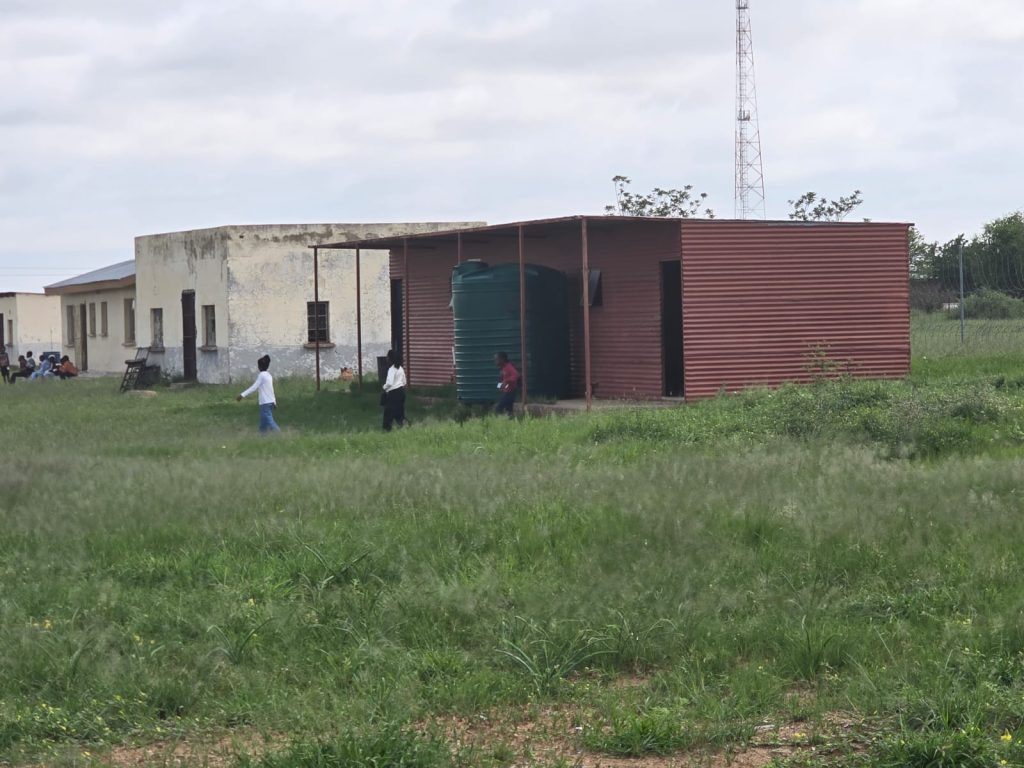
Ablution facilities at many school in the North West are in a state of disrepair. Picture: Supplied

Grade R facilities are housed in a temporary structure, without suitable ablution facilities for minors. The playground is also unsafe and unsuitable.

“While all the teachers and principals we engaged were committed to educating learners, they struggle with a severe lack of resources. We commend these dedicated teachers for their commitment to shaping young minds,” Steyl.

“The DA will engage the provincial department of education on a plan to address the concerns we have identified, specifically to limit overcrowding by providing mobile classrooms and upgrading facilities.”

He said that more importantly, schools must have internet connectivity to support teaching and learning to pupils for a world that was moving to a knowledge-based economy.

“There is little use in attracting learners to the sciences on paper but fail to provide the necessary laboratories to conduct the experiments necessary for learning. This is a focus area the provincial department of education must give attention too,” Steyl said.

The party will also demand that the department revisit the implementation of the school nutrition programme.

Maize meal, milk, samp and beans may stem hunger, but young bodies needed nutrition, and required fruit, vegetables and adequate protein varieties to support brain function and adequate growth, the party said.

It would also demand that the food preparation facilities were brought up to standard to improve hygiene and ventilation. Currently, the facilities visited posed a health risk to learners, as food handlers did not have the necessary soap, disinfectant, ventilation, PPEs and hand sanitiser to ensure compliance with food safety preparation codes.

At the end of 2023, the SA Human Rights Commission issued a report detailing the dire situation at North West schools.

Although the investigation focused on infrastructure challenges that had been identified in a few schools in the province, it became apparent during the probe that infrastructure challenges at schools in the North West remain endemic, manifesting along racial and socio-economic lines.

The identified infrastructure challenges ranged from blown-off roofs to collapsed ceilings, cracked walls, cracked floors, broken windows, asbestos in school structures, inadequate parameter fencing, and inadequate access to water and sanitation. Overcrowded classrooms were also highlighted as a major concern for qualitative outcomes in the education system.

In the report, the department cited several reasons for the state of affairs, including an influx of foreign nationals into the province, an inadequate budget and a lack of preventative maintenance.

“While the commission finds in its report that the first two cited reasons do not fully explain the existence of the identified challenges, the lack of preventative maintenance, as well as the absence of an effective system to report and monitor infrastructure challenges, was a significant factor leading to non-prioritisation of these matters. The lack of an effective system to report and monitor infrastructure challenges, also impedes infrastructure planning and budget management,” the report reads.

INSIDE EDUCATION

Uncategorized

Govt hands out bursaries to students who want to help build SA

By Johannah Malogadihlare

The Public Works & Infrastructure Department has awarded 63 bursaries to students who plan on pursuing studies in the built environment.

They were celebrated at an event in Boksburg in Ekurhuleni on Friday, which was attended by Minister Dean Macpherson.

“This ceremony is not just about awarding bursaries to students pursuing studies in the built environment – it sends a powerful message to South Africans across the country – we are building the human foundation necessary for continued infrastructure investment in our nation,” Macpherson said.

According to new policy introduced by the minister, the bursaries require beneficiaries to work for the department or one of its entities for two years or in the private sector, ensuring improved skills retention and diversity across the country’s provinces.

“These students will soon become qualified engineers, quantity surveyors, architects and electricians, creating a vital skills pipeline that will help South Africa become a construction site for decades to come,” he said.

Additionally, the minister said it was the department’s mission to drive economic growth and to create thousands of jobs.

He also mentioned that through acquired skills, learners and the department would lay the foundation for meaningful change in urban and rural communities.

Macpherson said that the recipients came from schools with strong Mathematics and Physical Sciences programmes.

And, schools that wished to be part of the development programme would be given a chance to showcase themselves.

“While these schools were identified prior to my appointment, I am pleased to announce that I have expanded the reach of this bursary programme to include more schools, ensuring every South African with an interest in studying in the built environment can access this opportunity,” Macpherson noted.

Explaining the change in policy, he said it was the country’s loss if the learners did not work in South Africa after studying.

He said the vision of ‘turning South Africa into a construction site’ was not about erecting buildings or laying roads, but creating opportunities, improving lives and building a nation where every citizen could thrive.

“Globally, infrastructure development is among the most powerful tools for stimulating economic growth. It drives local investment, creates jobs and forms the foundation for essential services like healthcare, education and public safety,” the minister said.
Furthermore, he mentioned the responsibilities that defined a constructor and that the success of the bursary scheme would be the result of partnerships with schools, universities, SETAs  and professional bodies.

INSIDE EDUCATION

Uncategorized

Hawks nab man for allegedly selling matric results

By Amy Musgrave

The Hawks have arrested a 21-year-old suspect man connection with the suspected leak of the 2024 matric results that were allegedly sold on the internet.

This follows Basic Education Minister Siviwe Gwarube announcing on Monday that the department had identified a breach in its system.

“If the leak is from our side, we will deal with it. If it is from processes outside the department, we will deal with it. But either way, we will take this breach seriously,” Gwarube said.

She said that if the leak should be found outside the department, they were obligated to share the information with the Hawks to investigate the matter.

Results were being offered on the internet for R99.90 before their official release on Tuesday.

Gwarube said that she grateful law enforcement agencies were able to step in quickly for a speedy investigation. 

Hawks spokesperson Col Katlego Mogale said the department lodged the complaint in Pretoria and the case was transferred to the Hawks for further investigation.

The Hawks’ serious economic offences unit descended on a house in Hillcrest, north of Johannesburg, after a search and seizure warrant was approved.

The Hawks proceeded to the identified premises where the man and his were living.

“During the search, electronic gadgets and an unlicensed shotgun with live ammunition were found. The 21-year-old suspect will be detained for the unlawful possession of a firearm and investigations into the matric result leakages will continue,” said Mogale.

Gwarube stressed on Monday that the breech occurred at the “tail-end” of the process, and would consequently not affect the integrity of the results.

INSIDE EDUCATION

Uncategorized

Solidarity Movement likely to challenge Bela Act in court

By Johnathan Paoli

Solidarity, AfriForum and the Support Centre for Schools (SCS) under the Solidarity Movement have initiated legal proceedings against the complete promulgation of the Basic Education Laws Amendment (Bela) Act, citing irrationality and the breech of agreements.

The three organisations came together on Thursday and contended that President Cyril Ramaphosa and Basic Education Minister Siviwe Gwarube acted contrary to prior commitments and legal norms.

The controversy centres on the promulgation of the Act in its entirety, despite recommendations from Gwarube to delay implementing the language and admission clauses due to the lack of established norms and standards.

According to the organisations, the minister’s earlier recommendation at the National Economic Development and Labour Council aimed to safeguard mother-tongue education, particularly for Afrikaans-speaking learners, and to ensure a more orderly implementation process.

They told reporters that legal letters have been sent to both Ramaphosa and Gwarube, arguing that their actions were irrational. They have given the government 10 days to resolve the issue, failing which they will proceed to court.

Solidarity Movement head of operations Werner Human emphasised that the institutions within the movement also planned to advocate for fair norms and standards in the forthcoming regulations governing language and admission policies for schools.

“The institutions of the Solidarity Movement also reserve the right to take legal action against the unconstitutionality of the Bela Act itself as well upon completion of the legal action against the promulgation notice,” Human added.

AfriForum CEO Kallie Kriel criticised the government’s actions, describing the promulgation as an act of aggression against Afrikaans schools and learners.

He accused the African National Congress of undermining national unity and fostering discord by ignoring agreements and excluding protections for Afrikaans and mother-tongue education.

“The promulgation is an indication that the ANC is turning the Government of National Unity into a government of national disunity that seeks to simply co-opt parties like the Democratic Alliance and Freedom Front Plus to help the ANC in implementing its policy,” Kriel said.

Similarly, Solidarity CEO Dirk Hermann expressed dismay at what he called a breach of trust by the government.

“The Constitution and case law confirm that the minister’s recommendation, as the person responsible for the implementation of the Act, carries weight. The promulgation of a law is not the sole task of the President.

“The purpose of the minister’s recommendations is to postpone the implementation of the Act so that the necessary steps can be taken to implement the legislation effectively,” Hermann said.

SCS CEO Leon Fourie added that the president’s failure to provide reasons for disregarding the minister’s recommendations suggested political motives driven by anti-Afrikaans factions within the ANC.

“It therefore appears that the president’s irrational promulgation of the Bela Act in its entirety succumbed to political pressure from the anti-Afrikaans elements in the ANC,” Fourie said.

While challenging the promulgation notice, the Solidarity Movement is preparing to monitor and influence the drafting of norms, standards and regulations to prevent misuse of the law.

The organisations said that their aim was to ensure that the regulations included provisions to curb the abuse of power and protect Afrikaans schools.

The department and the Presidency were not available for comment at the time of publishing.

INSIDE EDUCATION