Uncategorized

W.Cape wins schools athletics competition

By Lungile Ntimba 

The Western Cape has secured victory at the inter-provincial SASA Primary School Athletics Championships for the second consecutive year.

The competition saw young athletes showcasing their skills and talents across multiple sport disciplines in Germiston, Gauteng.

The province claimed 88 medals- 41 gold, 24 silver and 23 bronze – outshining Gauteng which secured 78 medals and the North West that finished third with 28 medals.

The Western Cape education department praised this accomplishment as a testament to the commitment of schools, coaches and the department in fostering sporting excellence.

“This is the second year in which the department has sponsored the costs of our provincial team so that any talented school athlete would be able to attend and compete with the best without struggling to fund their participation,” it said in a statement.

“We thank all of the schools and department staff members, coaches and parents who have supported our learners so that they could achieve their goals and shine on the national stage.”

Cultural affairs and sport MEC Ricardo Mackenzie also applauded the team for its achievement.

“We are so proud of these outstanding young athletes, who have showed dedication and commitment to developing their sporting skills,” Mackenzie said.

“With such talented stars in primary school, the future is bright for Western Cape sport.”

The department reaffirmed its commitment to working with Sport, Arts and Culture Minister Gayon McKenzie to improve access to school sports in the province.

INSIDE EDUCATION

Uncategorized

Higher education committee warns UFS to hire local academics

By Alicia Mmashakana

The Portfolio Committee on Higher Education is concerned about the University of the Free State (UFS) hiring of 141 foreign academics and 26 foreign support personnel.

The committee met UFS senior management, unions, student representatives and other stakeholders. It encouraged UFS to prioritise local talent development and hiring, cautioning against using the ‘scarce skills’ argument to dismiss qualified South African candidates.

The committee is in the Free Sate on a week-long oversight visit to post-secondary education and training institutions to evaluate academic readiness and infrastructure.

“The committee also raised concerns about the underrepresentation of African, coloured and Indian staff in professorships and associate professorships, highlighting ongoing transformation challenges at UFS,” said committee spokesperson Jabulani Majozi.

“University management acknowledged that there is a need to address employment equity, agreeing on the need for greater diversity in leadership to better reflect to the Free State’s demographics.”

The committee supported student preferences for English as the medium of instruction and acknowledged concerns regarding lecturers who only utilised Afrikaans.

The Student Representative Council also advocated for better support for pregnant students, however, the committee reminded them that the university could not bear this responsibility alone.

The committee emphasised the need for accredited student accommodation regarding the QwaQwa campus, noting that academic success rates were higher among students residing in university housing compared to those staying at home.

Committee chairperson Tebogo Letsie warned against “pouring billions into student housing without accountability”, saying it meant that students may end up in substandard conditions.

INSIDE EDUCATION

Uncategorized

MPs in North West and Gauteng this week to check on schools

By Staff Reporter

The Portfolio Committee on Basic Education will conduct oversight visits to schools in Gauteng and the North West this week.

The primary focus of the visits was to assess the state of readiness of schools in these provinces for the 2025 academic year, said committee chairperson Joy Maimela.

She said the focus areas were learner admissions and teacher-to-learner ratios, Early Childhood Development, National Senior Certificate results and improvement plans for 2025, and the curriculum including Coding and Robotics, Mathematics, Science and Technology.

The committee would also look at support for rural education and special schools, user-friendly infrastructure and preparing learners for post-school education/entry to workplace-based learning programmes.

The committee would visit Leruntse Lesedi High School in the North West on Monday. A petition from the School Governing Body was referred to the Portfolio Committee on Public Works and Infrastructure for consideration.

During engagements between the two committees they decided to visit the school with a view to finalise the report to the be submitted to the National Assembly.

The petition calls for the National Assembly to intervene to address the school’s deteriorating infrastructure, which the SGB says poses a direct risk to the safety and well-being of learners and staff.

The committee will then move to schools in the greater Johannesburg and in the Ekurhuleni education districts.

Maimela said the committee visited districts and provinces to monitor and oversee the implementation of key priority areas.

The framework for the state of schooling for the 2025 academic year oversight visits is guided by key interventions and priorities for the basic education sector, which are set out in major government plans to ensure that enabling conditions for quality teaching and learning are established.

INSIDE EDUCATION

Uncategorized

Gondwe drives education reform across Southern and Eastern Africa

By Johnathan Paoli

There is an urgent need to modernise education systems to recognise a wider range of learning experiences, according to Higher Education and Training Deputy Minister Mimmy Gondwe.

At the same time, countries must look at adopting a more inclusive, accessible and adaptable credentialing system.

“As we look to the future, let us be guided by a vision of a Commonwealth where education is not an exclusive privilege, but a non-negotiable right for all,” Gondwe said.

Gondwe was addressing the Southern Africa, Eastern Africa and the Mediterranean Regional Stakeholder Meeting on Developing a Commonwealth Credit Transfer Framework: Micro-credentials in a Digital Age in Ekurhuleni on Monday.

She described the event as a significant step towards transforming education across Southern and Eastern Africa, as well as the broader Commonwealth.

It brought together prominent education specialists, policymakers and institutional leaders from across the Commonwealth, with a primary focus on developing a systematic and cost-effective framework for credit transfer and micro-credentials that align with contemporary learning methods.

Gondwe’s keynote address emphasised that traditional education frameworks, while valuable, no longer captured the diversity of modern learning experiences.

She highlighted the need to recognise informal, non-formal and alternative learning pathways, particularly as digital, open and distance learning gained prominence.

“In today’s world, recognising learning in all settings, not just through traditional degrees, is essential to validating the diverse pathways of every learner. This recognition ensures inclusivity, promotes lifelong learning and enhances access to opportunities,” she said.

A major theme of her address was the role of micro-credentials in reshaping education.

Micro-credentials provide students with industry-relevant skills in a shorter timeframe than traditional degree programmes, enabling them to stay competitive in rapidly evolving job markets.

Despite the potential of micro-credentials and credit transfer frameworks, several challenges persist.

With various education systems operating independently, ensuring compatibility across countries remains a complex task, resulting in a lack of standardisation.

While many institutions and employers do not yet recognise micro-credentials as equivalent to traditional degrees, infrastructure and technology disparities further exacerbate the situation, with many regions still struggling with inadequate access to digital learning tools, particularly in rural areas.

In addition, financial constraints mean that developing a large-scale, cross-border framework for credential recognition requires significant investment.

Acknowledging these hurdles, Gondwe urged for stronger collaboration among governments, universities and regulatory bodies to build a robust, adaptable system.

To tackle these challenges, the deputy minister outlined a strategic approach, including establishing agreements between nations to ensure uniform standards in credential recognition, to facilitate cross-border cooperation.

Gondwe proposed leveraging technology by utilising digital platforms to make micro-credentials more accessible to learners in remote areas.

She called for strengthening institutional capabilities to administer and regulate micro-credentialing programmes effectively and encouraged collaboration between educational institutions and industries to enhance the credibility and employability of micro-credential holders.

Lastly, the deputy minister called for affordable and scalable solutions by ensuring that micro-credentialing frameworks were cost-effective and could be scaled to fit diverse education systems.

“We must ensure that credit and credentialing systems are compatible across borders, meet international standards and are adaptable to the needs of each country. This is essential for student mobility, qualification recognition and fostering a culture of lifelong learning across the Commonwealth,” Gondwe said.

The country has been at the forefront of education transformation, with initiatives such as the National Qualifications Framework and ongoing efforts to integrate alternative learning methods.

The department has also partnered with the Project on the Potential of Micro-credentials in Southern Africa, which is a collaborative effort among leading Southern African and European universities, national councils and policymakers.

Gondwe reaffirmed South Africa’s dedication to advancing this initiative.

“We understand that this is not a task we can undertake alone. We need collaboration, dialogue and partnerships that transcend national boundaries, just as we see here today,” she said.

As the conference continues over the next two days, stakeholders will work to develop an actionable framework that ensures a seamless, transparent and equitable credentialing system.

The goal is to create an education ecosystem that is responsive, agile and capable of meeting the demands of the 21st century and beyond.

The deputy minister said the outcomes would have a lasting impact on the future of education and lead the way in shaping an education system that recognised and rewarded learning in all its forms.

INSIDE EDUCATION

Uncategorized

Peer review is meant to prevent scientific misconduct. But it has its own problems

By Gail Wilson

In 2023, an academic journal, the Annals of Operations Research, retracted an entire special isssue because the peer review process for it was compromised.

The case brought into sharp focus broader concerns about the peer review process in contemporary science. It showed that a process intended to catch problems with research before publication can itself go wrong.

And when it does, it creates large ripple effects that undermine the integrity of scientific research.

So how is the peer review meant to work? Why does it sometimes fail? And what can be done to improve it?

An evolving process

Peer review as we know it arose in the mid 20th century as the demand for specialised research grew following the end of the second world war. Contrast this with the 18th and 19th centuries, when peer review was undertaken mainly by editors of learned societies and university publishing presses.

Today, peer review is done largely by external peer reviewers who have been asked by a journal’s editor to conduct a review of a manuscript focusing on the quality and value of the research.

They are selected from a pool of reviewers according to their discipline and their areas of expertise. Their task involves ensuring the paper is relevant to the aim and scope of the journal receiving the paper, reviewing the relevant literature, checking methodology, determining the importance of findings, highlighting areas that have been omitted in the paper, and suggesting changes to improve the paper overall.

Traditional forms of peer review occur before a paper is published. Both reviewers and authors remain anonymous.

Different disciplines take a slightly different approach to the review process. In the humanities, for example, double-blind peer review is favoured. This is where two external peer reviewers review the paper and send their reviews to the editor handling that paper. The author then responds to the editor’s and reviewers’ recommendations.

Based on editorial approval, the paper goes forward to publication.

Contrast this approach with open peer review which can occur both before and after the publication of an article. Supporters of this approach state that it promotes transparency and accountability.

Challenges with the current system

The example of the Annals of Operations Research retracting an entire special issue because of problems with the peer review process isn’t isolated. Springer Nature retracted a total of 2,923 papers from their large journal portfolio in 2024, citing research and academic integrity issues.

A year earlier, the Journal of Electronic Imaging also retracted nearly 80 papers following an investigation into peer review fraud.

Actions like this highlight the many challenges to the current peer review system.

For example, heavy academic workloads and institutional pressures on academics to produce more and more publications reduces the time they can spend as external peer reviewers. It also prevents them from agreeing to be a peer reviewer in the first place.

This leads to what is called peer reviewer fatigue, meaning the reviewer simply doesn’t have the capacity to do any more reviews at this time. Any journal editor can attest to this reason being given. Reviewers who produce quality manuscript reviews often also get more requests from journal editors than they are able to respond to, because of the time factor and their workload and institutional commitments mentioned above.

There’s also the potential for manipulation of the peer review process. This can include the issue of a fake peer review – a process by which authors are asked to suggest reviewers and where fake email addresses and fake peer reviews are submitted. There are signs artificial intelligence is exacerbating this problem.

Predatory journals with dubious publishing practices such as charging authors a fee for publishing an article also publish low-quality articles that have not gone through a rigorous peer review process.

In a guest post for the academic integrity website Retraction Watch, educational researcher Richard Phelps blamed journal editors for not reviewing an article’s literature review for accuracy. The post criticised dismissive claims from researchers about the absence of previous research on the topic, and low-quality literature reviews more broadly.

Strengthening the process

There are ways for journal editors to strengthen their journal’s peer review process in relation to the quality of the reviewer pool and the quality of reviews received.

Journals can regularly review their current reviewer pool and broaden that pool by writing directly to authors of recently published papers. They can also make personal approaches to researchers in the field to undertake a review or be added to the reviewer pool list.

Journals can also review their current guidelines for reviewers to ensure there is a consistent set of criteria reviewers can use to rate the paper and explain the reasons for their ratings across key elements of the manuscript.

A “strength-based approach” to review can be encouraged. This is where feedback about the paper’s strengths as well as the gaps in the paper makes the feedback more “developmental” and less focused on what’s wrong with the paper.

From my experience as a journal editor, authors also find it helpful to receive the reviewers’ comments together with an overall summary from the editor highlighting the key issues raised by the reviewers.

Gail Wilson is an Adjunct Associate Professor in the Office of the PVC (Academic Innovation), Southern Cross University.

The Conversation

Uncategorized

Ford SA continues to support literacy development in E.Cape 

By Lungile Ntimba 

Ford South Africa recently launched its new three-year cycle of Rally to Read project, reinforcing its commitment to education and community upliftment. 

It will support four schools in Nelson Mandela Bay and four schools in Sarah Baartman District in the Eastern Cape, ensuring that learners and teachers receive sustained assistance.

The previous three-year project in Nelson Mandela Bay assisted eight schools in and around Gqeberha and Kariega. 

Since 1998, Ford SA in partnership with the READ Educational Trust, has provided vital education resources and teacher training to underserved schools.

“Walking into the schools and seeing the excitement on the faces of both learners and teachers reinforces why this initiative matters,” Ford SA government affairs and transformation director Esther Buthelezi Buthelezi said in a statement.

“This is where the transformation begins, with a book in a child’s hands and a teacher empowered with the right tools and training.”

She said the programme extended beyond just distributing resources, but to fundamentally improve literacy levels through structured and long-term interventions.

It also provided teachers with training sessions to help them build strong literacy foundations for their students. 

Buthelezi said the province was deeply embedded in Ford’s legacy, not only as the home of the Struandale Engine Plant in Gqeberha, but also as the place where its journey began in 1923.

She said for more than a century, Ford has been part of the region’s economic and industrial fabric, creating jobs, driving innovation and investing in the future of the country’s communities. 

Buthelezi said that while the province’s matric pass rate showed a positive increase last year, early childhood education remained a crucial factor in sustaining this progress and ensuring long-term success.

“By investing in education today, we are investing in the future workforce. Many of these young learners could one day be part of the Ford ecosystem, whether as engineers, technicians, or business leaders shaping the automotive industry,” she said.

INSIDE EDUCATION

Uncategorized

Pay back the money!

Should South Africa write off billions in unpaid student debt? No! argues Edwin Naidu.

Julius Malema and the Economic Freedom Fighters can indeed talk, but can they walk the talk?

The Private Member’s Bill in Parliament wants to cancel student debt as the EFF’s contribution to making education more accessible to all South Africans.

But is it a feasible solution? And will it make education more accessible?

The Bill, they say, represents a significant intervention in the fight against the growing financial burden of student debt, which increased from approximately R11 billion in 2017 to R17 billion in 2024, with an average annual rise of R2 billion.

The EFF argues that this national crisis stifles the aspirations of young people and limits their financial freedom and career prospects. How is this so?

Annually, the government invests an estimated R50 billion in ensuring that the current crop of matriculants has access to study spaces at the country’s 26 universities and 50 Technical and Vocational Education and Training colleges.

Given the financial constraints under which the government operates, this is not an inconsiderate amount to spend on education.  For the EFF to push to write off the student debt of the past is irresponsible and encourages a culture of not paying for services one receives.

While the right to education is enshrined in the Constitution and should be free in a perfect world, it does not mean that debt owed to educational institutions should be waived. One might argue that one’s water, electricity or tax bill to municipalities or the state should be written off, as it perpetuates inequality in South Africa. Right?

Wrong! Thirty years after democracy, it does not make sense to hear the EFF claim that writing off billions would help anyone. Instead of empty rhetoric, the EFF should provide evidence.

Just as Malema and his former minions shouted “pay back the money” to former president Jacob Zuma over his ill-gotten Nkandla upgrades, why does the EFF play politics and give those who owe the state money a free ride?

The Bill is a disservice to South Africans who work hard and pay their taxes expecting to get adequate service delivery as a bare minimum. 

The EFF has long championed the cause of student debt cancellation. But unless I am mistaken, there is no moral reason or obligation to write off debt in a democracy?

Were those who incurred the debt prejudiced in any way by having studied or pursued studies at tertiary institutions to which they owe money? And what about those who have passed and have qualifications but do not honour the debt?

Is it not ludicrous that one can get blacklisted by the SABC for not paying one’s television licence, but an ivory tower of learning can escape without sanction for allowing student debt to escalate to unreasonable levels? The vice-chancellors and those in charge should be held accountable for failing to manage student debts effectively.

Inevitably, should the government be asked to explain how it allows a soft stance on students who owe billions while allowing parastatals under its watch to make criminals of consumers through blacklisting for a variety of reasons?

Instead of this Bill, which will make a noise but not win supporters, the EFF should be encouraging students to walk in the footsteps of Malema. Their inspirational leader got an H in mathematics and a G in woodwork, yet successfully obtained degrees through correspondence at Unisa, the world’s oldest distance-learning institution.

Youth need role models to look up to, not someone who encourages them to default on their debts. Malema worked hard and did not earn those degrees easily. I am certain Malema also paid for his studies. Unisa does not dish out studies freely unless you have A symbols in matric, which Malema did not have.

Therefore, one believes, as the leader of a party wanting to make a difference to the millions of black youths in South Africa that paying back one’s debt to society is the right thing to do. Even if half of the current student debt is paid, imagine what the proceeds can do to eliminate the failed attempts at instilling a reading culture in South Africa.

Malema and his wise former leaders, who have abandoned him, have demonstrated that education is the most effective way to address inequality.

By this token, the debate around writing off student debt is not cut and dried. Let those who have qualified and earn a salary pay back the money. Those who are unemployed must indicate a willingness to pay when they get jobs. That way, the culture of a welfare state which keeps people down is eradicated.

But it starts with understanding the landscape and being honest about where South Africa is headed and what the nation can afford. The EFF has started a debate that we can no longer avoid. Can South Africa afford to write off R17 billion in unpaid student debt? The answer affects us all.

Edwin Naidu is the Editor of Inside Education.

INSIDE EDUCATION

Uncategorized

NWU Vanderbijlpark Campus launches Inter-Res tournament

By Zenoyise John

The North-West University’s (NWU’s) Vanderbijlpark Campus has officially launched its much-anticipated Inter-Res tournament, a sports event designed to provide all students with a chance to showcase their athletic talents while fostering inclusivity and unity.

This exciting initiative, which runs from March to July, brings together students from various residences, providing them with a competitive yet fun environment to engage in sports, connect, and celebrate their unique cultures and talents.

The tournament is set to include three major sporting codes: soccer, netball, and e-sports, with each residence fielding teams to represent their communities. With the aim of encouraging maximum participation, the event has an open registration policy, ensuring every student can join in and be part of the action.

Ntinyiko Mazwaya, Student Campus Council sports officer for 2024/25, says he is excited and shares the vision behind the initiative. “The goal of Inter-Res is simple: to provide a platform for students who may not have the opportunity to compete on a varsity level, to showcase their skills in a supportive and vibrant environment. This event is about much more than just sports; it’s about community, inclusivity, and creating memorable experiences that resonate with students long after the tournament is over.”

Not only does the tournament serve as a space for competition, but also as a stage for social awareness. For 2025, the event will spotlight critical socio-economic issues, with each residence championing a unique cause. These include:

· Faranani: LGBTQI+ Rights

· Ebukhosini: Sexual Health

· Longfellow: HIV & AIDS Awareness

· Bohlale: Gender Diversity

· Moahi: Mental Health

· On-Campus Residences: Gender Equality

· Oracia: GBVF Rights

Ntinyiko highlights the importance of these campaigns.

“Through the Inter-Res tournament, we want to not only celebrate sport but also raise awareness on pressing social issues that affect us all. Each residence will champion a cause, and we hope this will encourage students to engage in meaningful discussions and actions around these topics.”

The tournament has already seen impressive levels of participation, with an overwhelming number of students signing up to compete. Ntinyiko notes that the open registration policy has played a significant role in the high turnout, emphasising the importance of ensuring every student feels welcomed and encouraged to participate.

“We’ve seen incredible support from students, both in terms of the players and the enthusiastic crowd cheering them on. This tournament is truly about fostering school spirit and creating an atmosphere where everyone is included, regardless of their skill level.”

In addition to sports, the event featured a collaboration with Red Bull, where students enjoyed side games and refreshments. DJ performances added to the excitement, creating a lively and festive atmosphere throughout the day.

According to Ntinyiko, one of the standout moments was the pre-game moment of silence. “Before the games kicked off, we had a moment of silence to honour those affected by the socio-economic issues in our country. It was a powerful and humbling reminder of the impact we can have, not just in sports but in the larger context of society.”

As the tournament progresses, Moahi Village has emerged as a dominant force, topping the standings across all sporting codes, but the competition remains fierce, and every residence is in the race for the top.

THE NORTH-WEST UNIVERSITY

Uncategorized

Global crises have hit education hard: 24 years of research offers a way forward for southern Africa

By Emmanuel Ojo

Global crises have shaped our world over the past two decades, affecting education systems everywhere. Higher education researcher Emmanuel Ojo has studied the impact of these disruptions on educational opportunities, particularly in southern Africa.

He looked at 5,511 peer-reviewed articles published between 2000 and 2024 to explore what the research suggests about making education systems more resilient. Here, he answers some questions about his review.

What are the global crises that have undermined education?

In my review I drew up a table documenting how multiple crises have disrupted education systems worldwide.

The cycle began with the 2000-2002 dot-com bubble collapse, which reduced education funding and slowed technological integration. This was followed by the 2001 terrorist attacks, Severe Acute Respiratory Syndrome (SARS) outbreak (2002-2004), Iraq War (2003-2011), Indian Ocean tsunami (2004), and Hurricane Katrina (2005). The Israeli-Palestinian conflict since 2000, global food crisis (2007-2008), financial crisis (2007-2008), and European debt crisis (2010-2012) continued this pattern of disruption.

More recently, the Ebola epidemic, COVID-19 pandemic, and Russia-Ukraine war have destabilised education systems. Meanwhile, the ongoing climate crisis creates challenges, particularly in southern Africa where environmental vulnerability is high.

Who suffers most, and in what ways?

Education has consistently been among the hardest-hit sectors globally. According to Unesco, the COVID pandemic alone affected more than 1.6 billion students worldwide.

But the impact is not distributed equally.

My research shows crises have put vulnerable populations at a further disadvantage through school closures, funding diversions, infrastructure destruction and student displacement. Quality and access decline most sharply for marginalised communities. Costs rise and mobility is restricted. Food insecurity during crises reduces attendance among the poorest students.

In southern Africa, the Covid-19 disruption highlighted existing divides. Privileged students continued learning online. Those in rural and informal settlements were completely cut off from education.

Climate change compounds these inequalities. Unicef highlights that climate disasters have a disproportionate impact on schooling for millions in low-income countries, where adaptive infrastructure is limited.

What’s at stake for southern Africa is the region’s development potential and social cohesion. The widening of educational divides threatens to create a generation with unequal opportunities and capabilities.

What makes southern African education systems fragile?

My review focused on the 16 countries of the Southern African Development Community, revealing what makes them vulnerable to crisis impacts.

Southern Africa’s geographic exposure to climate disasters combines with pre-existing economic inequalities. The region’s digital divide became starkly visible during the Covid-19 pandemic. Some students were excluded from learning by limited connectivity and unreliable electricity.

The region’s systems also rely on external funding. The Trump administration’s sudden foreign aid freeze was a shock to South Africa’s higher education sector. It has affected public health initiatives and university research programmes.

Research representation itself is unequal. Within the region, South African researchers dominate and other nations make only limited contributions. This creates blind spots in understanding context-specific challenges and solutions.

Each successive crisis deepens educational divides, making recovery increasingly difficult and costly. Weaker education systems make the region less able to respond to other development challenges, too.

How can southern Africa build education systems to withstand crises?

One striking finding from my review was the surge in educational research after the Covid-19 pandemic began – from 229 studies in 2019 to nearly double that in 2020, with continued rapid growth thereafter. This indicates growing recognition that education systems must be redesigned to withstand future disruptions, not merely recover from current ones.

Research points to a number of ways to do this:

Strategic investment in educational infrastructure, particularly digital technologies, to ensure learning continuity.

Equipping educators with skills to adapt teaching methods during emergencies.

Innovative, context-appropriate teaching approaches that empower communities.

Integration of indigenous knowledge systems into curricula, enhancing relevance, adaptability and community ownership.

Interdisciplinary and cross-national research collaborations.

Protection of education budgets, recognising education’s role in crisis recovery and long-term stability.

Community engagement in education, ensuring interventions are culturally appropriate and widely accepted.

In my view, African philanthropists have a duty to provide the independent financial base that education systems need to withstand external funding fluctuations.

What’s the cost of doing nothing?

The economic and social costs of failing to build resilient education systems are profound and long-lasting. Each educational disruption creates negative effects that extend far beyond the crisis period.

When students miss critical learning periods, it reduces their chances in life. The World Bank estimates that learning losses from the Covid-19 pandemic alone could result in up to US$17 trillion in lost lifetime earnings for affected students globally.

Social costs are equally severe. Educational disruptions increase dropout rates, child marriage, early pregnancy, and youth unemployment. These outcomes create broader societal challenges that require costly interventions across multiple sectors.

Spending on educational resilience avoids those costs.

The question isn’t whether southern African nations can afford to invest in educational resilience, but whether they can afford not to.

The choices made today will determine whether education systems merely survive crises or make society better. Evidence-based policies and regional cooperation are essential for building education systems that can fulfil Southern Africa’s human potential.

Emmanuel Ojo is an Associate Professor at the University of the Witwatersrand.

The Conversation

Cell C brings digital revolution to schools
Uncategorized

Cell C brings digital revolution to schools

By Thapelo Molefe

For many learners at Madibatlou Middle School in Olifantsfontein in Ekurhuleni, the future has just arrived in the form of a brand-new digital lab, turning what was once a distant dream into a powerful reality. 

With 25 fully equipped laptops, high-speed connectivity and an advanced e-learning system, this initiative by Cell C, in collaboration with the Gauteng education department, is a game-changer for the school and a significant step towards digital inclusion in South Africa.

The event was marked by vibrant celebrations as learners showcased their talents through various activities. 

Some learners sang while others performed traditional dances, creating an atmosphere of excitement and gratitude. The energy of the performances reflected the enthusiasm of the school community in embracing this new digital era.

At the handover event on Thursday, Cell C CEO Jorge Mendes emphasised the transformative impact of technology in education. 

“We have committed ourselves to driving digital inclusion in not only the products we sell, but promoting it in our communities through initiatives such as providing digital classrooms to empower students with the tools they need to thrive in a digital future,” he said.

“We want to leave a lasting impact on education and ensure that young learners have the opportunity to excel in their academic journeys.”

The digital lab is fitted with a high-performance server, a printer, a projector for interactive learning, and air conditioning to maintain an optimal study environment. 

The C3 Micro Cloud solution installed in the lab ensures students have access to curriculum-aligned content, lesson packs and essential e-learning resources, setting a new standard for technology-driven education.

Gauteng education MEC Matome Chiloane expressed his appreciation for the partnership. 

“This is what we call social responsibility—real investment in the future of our learners. Access to technology is no longer optional; it is essential for bridging the digital divide and ensuring our children are prepared for a world where IT, artificial intelligence and digital content creation define career paths,” Chiloane said.

Mendes praised the discipline and passion of the learners, noting the school’s strong value system and the leadership of its educators. 

He reiterated Cell C’s commitment to digital inclusion. 

“It’s really about giving the kids of today, the youth of today, an unbelievable opportunity that is only fair—it is your divine right. And it’s the role that Cell C would love to play in making sure that we are real partners and allies to these communities where we derive profits from, to put back in and show a small contribution to make a difference together in this partnership,” he noted.

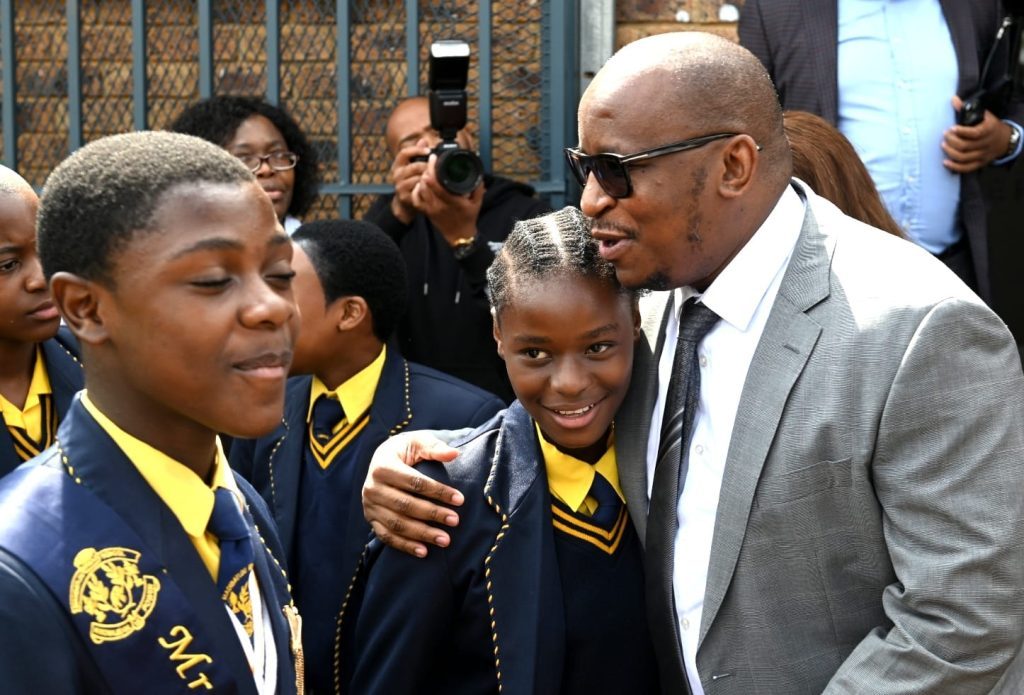
Gauteng MEC Matome Chiloane engages with learners from Madibatlou Middle School in Ekurhuleni. Picture: Eddie Mtsweni.

Chiloane highlighted how the introduction of digital labs aligned with the province’s broader goal of transitioning schools into paperless environments. He stressed that technology was not a luxury but a necessity, emphasising that future jobs were increasingly linked to IT and automation. 

“We need to prepare our learners for the Fourth Industrial Revolution. Many jobs are being replaced by machines, but those who understand technology will be the ones controlling them,” he said.

He further noted that digital inclusion was not just about job preparation, but also about fostering creativity and innovation. 

“One of the learners told me that they dream of becoming a filmmaker. Without access to computers, that dream could have faded away. Now, with this lab, learners have a chance to explore opportunities they never thought possible.”

Chiloane also highlighted the importance of investing in education over other infrastructure, drawing attention to the contrast between Africa’s reliance on churches and other institutions while other regions focus on factories and technological advancement. 

“A nation that does not take care of its education does not deserve its future. Schools like this should be where we invest the most,” he said.

The digital lab was officially handed over to Chiloane by Cell C, symbolising a strong public-private partnership aimed at bridging the digital divide.

Beyond Madibatlou Middle School, Cell C has committed to expanding similar initiatives across all nine provinces, with the focus on bringing connectivity and digital tools to under-resourced communities. 

Mendes highlighted that this lab was just one of many projects in the pipeline, stating: “We’ve already provided connectivity to over 1,300 schools and launched digital labs in seven provinces, with more to come. Initiatives like Girl Code, which has trained over 4,000 young women in tech skills, further reinforce our dedication to empowering the youth.”

He also reflected on the enthusiastic reception of the initiative, recalling how the energy of the pupils reminded him of major sporting events.

“Whenever I hear the national anthem in such an environment, it feels like we’re about to witness something truly transformative.”

The CEO also noted the importance of investing in education and shared his thoughts on public-private partnerships moving forward to speed up economic development.

Video By: Kgalalelo Setlhare Mogapi 

For the learners of Madibatlou Middle School, the digital lab represents more than just technology—it’s a bridge to new possibilities. 

The school’s principal, Kgabo Molokomme, echoed this sentiment, saying: “This lab will inspire innovation, creativity and a hunger for knowledge. It gives our students the chance to compete on equal footing with their peers in the digital world.”

As digital transformation reshapes industries worldwide, initiatives like these ensure that South Africa’s youth are not left behind.

INSIDE EDUCATION