Uncategorized

Gwarube launches Thrive by Five Index, calls for urgent action to strengthen early learning foundations

By Johnathan Paoli

Basic Education Minister Siviwe Gwarube has urged a renewed national focus on early childhood development (ECD), warning that South Africa’s long-term educational success depends on the foundations laid in pre-school years.

Speaking at the launch of the 2024 Thrive by Five Index in Sandton on Monday, Gwarube said the findings provide both a sobering reality check and a roadmap for urgent action

“Literacy does not begin when a child learns to read in Grade 1. It begins in the preschool years, in the way a child holds a pencil, in the stories they hear, and in their earliest attempts at writing. If the beginning of the story is weak, the chapters that follow will always be harder to write,” she said.

The Thrive by Five Index, conducted by DataDrive2030 in partnership with the department, assessed more than 5 000 four-year-old children across 1 388 early learning programmes (ELPs) nationwide.

It is the largest survey of its kind on the continent and the first comprehensive post-COVID snapshot of pre-school development.

Gwarube stressed that the availability of high-quality data was crucial to shaping education policy.

“The 2021 Index confirmed the correlation between poverty and poor outcomes, and the 2024 Index reinforces this. That clarity has guided us to double our efforts in making the case for investing in the early years. The R10 billion for ECD support announced by the Minister of Finance [Enoch Godongwana] shows that we are on the right course,” she said.

One of the most striking findings was the stark inequality between high- and low-fee preschools.

Only 42% of enrolled children were found to be developmentally on track, with those in well-resourced centres twice as likely to thrive as those in underfunded programmes.

Fine motor coordination and visual motor integration emerged as the weakest domain, with just 29% of children on track, undermining the ability to transition into reading and writing in primary school.

The minister highlighted another critical challenge: the home environment.

Among enrolled children, only 11% of households had more than five children’s books, while 26% had none. For non-enrolled children, the figure rose to 77%.

To address the gap, the department has partnered with UNICEF and Book Dash to create Stories for Joy, a multilingual collection of storybooks that will be made freely available online.

Gwarube underlined that early childhood development is not only about education but also about health, nutrition, and safe communities.

She outlined four areas of government’s commitment.

In terms of finance and investment, she said it remained important to make subsidies predictable and remove barriers for the poorest children.

In order to facilitate empowering practitioners, the department is planning on investing in training and strengthening pedagogical practices.

Gwarube called for integrated services by partnering with health departments and supporting parents.

Lastly, she emphasised strengthening Grade R and ensuring it bridges gaps for those who start behind and builds on strengths for others.

“The Thrive by Five Index is not just a measure, it is a movement to ensure every child starts school ready to learn, to grow, and to thrive. By 2030, no child should be left behind because of where they were born or how much their parents earn,” she concluded.

DataDrive2030 Executive Director Sonja Glese presented the findings with a stark demonstration: attendees were asked to stand according to colour coded dots representing children on track, falling behind, or far behind.

Most stood in the “falling behind” categories.

Glese highlighted three key obstacles: nutrition, programme quality, and access.

While stunting among enrolled children stood at 7%, she warned that even mild malnutrition can set children back by months of learning.

She also revealed that only 27% of ELPs were rated good, while 30% were inadequate, with strong teaching strategies present in just 17%.

“ECD qualifications alone are not enough, we need to focus on what truly matters in the classroom: curiosity-driven, interactive teaching,” Glese said.

The plight of non-enrolled children was particularly alarming. Only 18% were on track, while more than half were far behind. Most lived in homes with no books and had never been read to.

Despite the challenges, Glese struck a note of optimism.

“We have evidence that poor outcomes for poor children are not inevitable. Some children in difficult circumstances do exceptionally well, showing us what is possible. If we make this a national priority, we can change their story,” she said.

The Thrive by Five Index is set to be repeated every three years until 2030, providing an evolving picture of South Africa’s progress.

Both Gwarube and Glese framed the Index as a rallying point for collective action across government, civil society, and families.

INSIDE EDUCATION
Uncategorized

KZN school shooting suspect found almost five years after the incident

By Palesa Nguqu

A suspect involved in the killing of a KwaZulu-Natal school principal has been killed in a shoot-out with police at a hostel in Soweto in Johannesburg on Sunday.

The 40-year-old suspect was linked to the murder of Zwelebantu Zuma, a Msinga school principal who was shot and killed in his office at the school in 2020.

According to the South African Police Service (SAPS) the suspect was a person of interest in various other cases in KwaZulu-Natal involving car hijacking and possession of an unlicensed firearm.

He was tracked down by a tactical unit of the SAPS.

SAPS spokesperson Brigadier Athlenda Mathe said in statement on Monday, “Members of the National Intervention Unit(NIU) tracked down the suspect to a hostel in Mapetla Soweto. When the suspect noticed the presence of the police, he began shooting and the NIU returned fire fatally wounding him.’’

Two other accused in the case of the murder of Zwelabantu Zuma are already serving life sentences, while another died before the case went to trial.

SAPS is still on the lookout for one suspect.

INSIDE POLITICS

EFF slams move to criminalise student debt 
Uncategorized

EFF slams move to criminalise student debt 

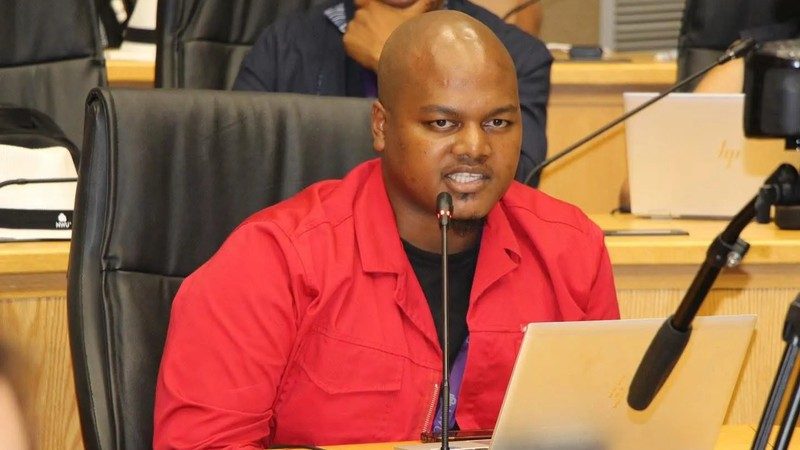
EFF MP Sihle Lonzi says new student fees regulation seeks to exclude students from the economy. Picture: i-Report

By Johnathan Paoli

The Economic Freedom Fighters (EFF) has written to the Chairperson of Parliament’s Portfolio Committee on Higher Education, Science and Innovation, Tebogo Letsie, requesting an urgent joint sitting with the Portfolio Committee on Trade, Industry and Competition to address what it describes as “a devastating and anti-poor” draft regulation that threatens millions of students across South Africa.

EFF’s Sihle Lonzi, a member of the Higher Education Portfolio Committee, penned the strongly worded letter, warning that the proposal would entrench economic exclusion for poor and working-class youth.

“It is no secret that the majority of students struggling to pay university fees come from poor and working-class communities, ravaged by the legacy of apartheid and ongoing structural inequality. This proposed amendment to the law will punish them for being poor by turning their unpaid fees into permanent scars on their credit records,” Lonzi argued.

The regulation in question, published in Government Gazette 53154, proposes that universities and other higher education institutions be permitted to report unpaid student fees to credit bureaus.

This, according to the EFF, would effectively criminalise student debt by saddling young graduates with blacklisted credit records.

The EFF contends that blacklisting young graduates for unpaid fees will create long-term economic consequences, barring them from accessing loans for housing, cars, or business start-ups, and trapping them in generational poverty.

“This is a life sentence, keeping our youth trapped in cycles of poverty and exclusion, before they even have a fair chance to build their futures,” Lonzi said.

The party insists that the draft regulation undermines the very principle of education as a liberating force.

It has called for a coordinated parliamentary response, demanding Letsie convene a joint sitting between the two committees to scrutinise the department’s proposals.

Alongside its opposition to the draft regulation, the EFF previously released the first draft of its Student Debt Relief Bill, 2025, which it describes as a legislative breakthrough aimed at dismantling the “structural crisis” of student debt in South Africa.

According to the EFF, more than 500,000 students nationwide are weighed down by institutional debt. Of these, around 300,000 have completed their academic requirements but are unable to graduate or obtain certificates due to outstanding fees.

In 2022 alone, over 120,000 students were barred from graduating. Student debt, which stood at R16.5 billion in 2021, has ballooned further.

“This is not failure; this is poverty being weaponised,” Lonzi said, stressing that debt exclusion is not simply a financial issue but a structural barrier to economic mobility.

The Bill proposes the creation of a state-backed Student Debt Relief Fund, through which eligible students may apply to have their debts cancelled.

Importantly, the fund would reimburse universities and colleges, protecting institutional finances while lifting the burden off students.

The draft legislation also seeks to compel all higher education institutions to release qualifications to students who have completed their studies, regardless of outstanding balances.

EFF national spokesperson Sinawo Thambo framed the Bill as “a people’s bill, grounded in the pain and suffering of students who have been excluded for too long”.

He argued that clearing debt would empower graduates to enter the workforce and stimulate the economy.

“This is not simply about financial relief; it is about restoring dignity, enabling graduates to work, to specialise, to start businesses, and to participate in the economy,” Thambo said.

Parliament has opened a 30-day public consultation period on the draft Bill, inviting written submissions from students, academics, trade unions, civil society organisations, and the general public.

The EFF has also announced nationwide consultative meetings at universities and TVET colleges to refine the legislation and build momentum.

INSIDE EDUCATION

SA celebrates national coding winners in honour of Mandela
Uncategorized

SA celebrates national coding winners in honour of Mandela

The South African winners of the #Coding4Mandela national championship will represent the country to compete for the World Cup. Image: Youtube.com/Tangible Africa

By Johnathan Paoli

The winners of the 2025 #Coding4Mandela National Championships have been crowned, following a record-breaking season that saw more than 50,000 learners participate in July’s regional tournaments.

Tangible Africa, an initiative of Nelson Mandela University (NMU) and the Leva Foundation, develops offline-friendly coding games such as Rangers and Juicy Gems to promote 21st-century skills through play.

“Our vision is to make the #Coding4Mandela movement an annual, national event in South Africa, preparing teachers and learners for the roll-out of the gazetted Coding and Robotics curricula,” said Andre Greyling, Head of Computing Sciences at NMU.

Leva Foundation CEO Ryan le Roux highlighted the global reach of the programme:

“Tournaments are one of three main components of Tangible Africa’s activities. The World Cup has now caught the attention of major role players. It is always amazing to see how excited educators on other continents are about an application developed in Gqeberha.”

Global Engagement Manager Jackson Tshabalala emphasised the growing interconnectedness among young people:

“From looking at social media posts by participating teams over the past week, it is clear that the digital connection among learners from diverse backgrounds brought about by the nationals has great added value. At the world champs, where part of the event involves teams interacting via Zoom before the tournament, this takes on an exciting global scale.”

The virtual finals, held late last month, brought together 147 winning teams across three age categories, competing through the new Tangible Tournament app. Each team coded from their own school, with their solutions transmitted to Tangible Africa’s headquarters in Gqeberha for evaluation.

After a day of intense competition, the national champions emerged:

• Stanger Manor Primary School (KwaDukuza, KwaZulu-Natal) in the primary category.

• Southlands Secondary School (Chatsworth, KwaZulu-Natal), which clinched victories in both the Grades 8–9 and Grades 10–12 divisions.

Building on this success, a squad of 48 South African teams was announced to represent the country at the Tangible World Cup on 30 September. The global event will feature hundreds of teams from more than 25 countries, with Tangible Africa and the Leva Foundation leading South Africa’s preparations.

For learners, the impact extends beyond competition. Some schools have launched coding clubs, while others report participants securing bursaries and career opportunities in technology.

INSIDE EDUCATION

Uncategorized

VUT launches Green Hydrogen Centre to drive SA’s clean energy transition

By Akani Nkuna

The Vaal University of Technology (VUT), in collaboration with Standard Bank, has launched a Green Hydrogen and Alternative Energy Hub to safeguard the environment and advance sustainable energy education, research, and innovation.

The initiative aims to cut carbon emissions while empowering students and driving economic growth in the Vaal Triangle and beyond.

Speaking at the official launch on Thursday, VUT Vice-Chancellor Khehla Ndlovu said South Africa has responded through the Hydrogen Society Roadmap, a national strategy that positions hydrogen as a key pillar of the country’s just energy transition.

“Here, in the heart of the Vaal, we know that industries are energy-intensive and that communities bear the burden of pollution and unemployment. We also know that our people carry the ambition to innovate, to engineer, to lead. That is why this Centre matters. It is not just about technology—it is about justice, jobs, and the joy of building a sustainable future,” said Ndlovu.

Ndlovu, speaking during the launch at the VUT Southern Gauteng Science & Technology Park in Sebokeng, said that the state-of-the-art facilities are designed to accelerate South Africa’s green energy transition through multidisciplinary academic collaboration and strategic partnerships.

The Centre will produce hydrogen gas from waste products and renewable-powered systems, incorporating the ideas of both academics and students to develop practical solutions that make hydrogen a viable tool in addressing the challenges of climate change.

Ndlovu stated that the Centre will be critical in equipping students with skills, research opportunities, and real-world experience to meet growing industry demand.

He also highlighted the significance of its Sebokeng location, offering students first-hand exposure to the effects of carbon emissions in an industrial area.

“It houses our Advanced Manufacturing Precinct, Technology Transfer Office, and innovation labs that connect researchers with local and global networks. Its mission has always been to foster industrial renewal through science and technology,” he added.

“By situating the Green Hydrogen Centre here, we anchor it within a space designed for applied research, skills development, and enterprise incubation.”

The Vice-Chancellor further emphasised that the Centre will provide green energy solutions specifically tailored for South African industry, arming the next generation of engineers, scientists, and entrepreneurs with essential knowledge for the green economy.

“[The Centre] will empower communities by creating jobs, nurturing skills, and ensuring that the benefits of innovation are felt beyond the laboratory, in homes and in local enterprises. The ripple effects are profound: reduced carbon emissions, strengthened energy security, new business opportunities, and, above all, hope,” said Ndlovu.

During an interview with Inside Education outside the Centre, Ndlovu further reiterated the institution’s commitment to decarbonising the entire Sebokeng area and mitigating the health hazards posed by polluting firms.

“We have received R600,000 from Standard Bank and we are matching that amount for the initial costs. We also have our master plan for Sebokeng—not just the campus but the surrounding area—where we are committed to bringing in more buildings to decarbonise the region,” Ndlovu told Inside Education.

Meanwhile, Standard Bank Head of Business and Commercial Banking South, Simone Cooper, reaffirmed the bank’s commitment to funding projects across sectors to combat carbon emissions.

She said the bank has allocated R33.6 billion in sustainable finance for infrastructure and R19.8 billion for new renewable energy power plants over the past year, resulting in an estimated cumulative installed renewable capacity of 1,703 megawatts.

“In the past year alone, our climate-focused approach has resulted in R2.4 billion in green finance for homes, R2.2 billion mobilised for planet-smart agriculture, and R2.9 billion provided to 1,500 businesses for renewable energy solutions. This represents a 27% increase in green energy generation capacity, reaching 235 megawatts,” Cooper added.

INSIDE EDUCATION

Uncategorized

Manamela calls for sustainable funding in higher education

By Rafieka Williams

The Department of Higher Education and Training (DHET) Deputy Minister, Buti Manamela, said Wednesday that stabilising student funding remains a top priority in order to ensure the long-term sustainability of tertiary education.

Manamela delivered a keynote address at the Portfolio Committee on Higher Education’s Strategic Planning Workshop, held in Cape Town from 2 to 4 September 2025.

He told particpants at the workshop that the DHET is adopting a long-term approach to managing challenges in the sector, with a particular focus on funding.

“There has to be urgent reforms with regard to the national skills fund, there are ministerial recommendations on the table which I think we need to accelerate in their implementation and some of that work would require us to come to committee in terms of legislative changes as it relates to the national skills fund,” Manamela said.

“(These are) discussions that would require us to consider bold decisions if we are to have sustainable student funding model. ”

He told participants that the DHET has engaged with National Treasury to address funding stability in the higher education sector, suggesting the reprioritisation of resources to plug the shortfall in the National Student Financial Aid Scheme (NSFAS).

Manamela added that the department is also working to position Technical and Vocational Education and Training (TVET) colleges, community colleges, and government departments as central to skills development for school leavers.

However, he cautioned that governance inconsistencies remain a major obstacle to progress.

“There are urgent issues around governance challenges, filling up vacancies with the University of South Africa forum and the college council, TVET’s and the guidance principals of the university and colleges,” Manamela said.

“We are prioritizing stabilizing governance of councils and TVET colleges, finalising the process for the accounting authorities of sector education training authorities and the process for the chairperson of SETA’s.”

Manamela said that by stabilising governing councils, the department could help restore stability to institutions, noting that governance failures and financial misconduct have hampered its ability to deliver.

Referring to the ongoing challenges with Sector Education and Training Authorities (SETAs), he revealed that investigations by the Auditor-General (AG) and the Special Investigating Unit (SIU) have uncovered serious concerns.

“We have had engagements with both the AG and the SIU and, of course, we are concerned with the volume of the work they are doing within our universities and TVET colleges, and the investigations happening there,” he said.

Manamela also urged the sector to reconnect with the original purpose of TVET colleges, established two decades ago.

“I said to the team at the department, we are supposed to be the factory of the brains and thoughts and thinking and skills in the country, we have to show that, that is what we are. Building capacity of our department,” he said.

INSIDE EDUCATION

Uncategorized

AfriForum urges public to comment on BELA regulations amid growing debate

By Johnathan Paoli

Civil rights organisation AfriForum has welcomed the Department of Basic Education’s decision to extend the deadline for public comments on the draft regulations of the Basic Education Laws Amendment Act (BELA).

The move has reignited calls from civil society organisations, unions, and advocacy groups for South Africans to help shape the future of schooling.

AfriForum’s Head of Cultural Affairs, Alana Bailey, described the extension as “positive and necessary.”

“Both sets of regulations will have a significant impact on the nature of public schools and the provision of high-quality education. It is essential for as many institutions, organisations, and individuals as possible to submit comments,” she said.

Originally set to close on 5 September, the deadline has now been extended to 5 October, according to the Government Gazette.

The regulations, published in August, focus on school capacity and admissions and form part of implementing the BELA Act, which came into effect on 24 December 2024.

Bailey welcomed the extra time, saying it would allow the public to provide more thoughtful and detailed input. She also warned that vague or contradictory regulations could trigger costly legal battles.

“Legislation is often broad, and regulations must bring clarity on its application. If people feel the regulations are unclear, inconsistent, or out of touch with realities in schools, these concerns must be raised with the Minister and the Department. This is particularly important if they infringe on the rights of learners, teachers, or the Constitution itself,” she added.

AfriForum confirmed it is finalising its submission in consultation with its legal team.

The South African Democratic Teachers’ Union (SADTU) has also weighed in, voicing “great concern” over the minister’s approach.

SADTU General Secretary Mugwena Maluleke argued that the regulations undermine both the letter and spirit of the Act, which followed more than a decade of consultations and parliamentary processes.

“Regulations cannot be used to change the text of the Act, impose requirements not provided for, or undermine its purpose and intent,” he said.

The union criticised the Minister for publishing regulations on only two areas instead of the eight originally envisaged, warning this piecemeal approach could create confusion. It further claimed that several provisions fall outside the Minister’s legal authority, encroaching on other ministries such as Home Affairs and Public Administration, and ignoring Constitutional Court rulings on learners’ rights.

Civil society group Free SA has also raised objections, warning that the regulations could weaken school governing bodies (SGBs) and marginalise parents in decision-making. A key concern is a clause that allows provincial officials to override SGB decisions on admissions, zoning, and language policy.

Free SA argues that this shift would erode accountability and weaken the democratic role of SGBs, which were designed to secure parental and community involvement in education.

The Department has defended the regulations as necessary to ensure uniformity, fairness, and improved governance in public schools. Officials say they will enhance equity and accountability while modernising school governance for the country’s 13.5 million learners.

INSIDE EDUCATION

Uncategorized

KZN education department probes viral classroom discipline incident

By Rafieka Williams

KwaZulu-Natal Education MEC Sipho Hlomuka on Wednesday visited Dr. Joseph Shabalala High School in Ladysmith following public outcry over a viral video showing a teacher physically disciplining learners.

The clip, which has garnered more than one million views on X (formerly Twitter), shows a teacher raising his hands against three learners lined up at the front of a classroom while others watch.

The footage prompted swift action from the provincial education department.

On Wednesday morning, Hlomuka met with learners, educators, the School Governing Body (SGB), and the teachers’ unions during his visit.

“The necessary measures have been put in place to ensure the safety of learners and to protect the integrity of the investigation and its outcome. These measures are meant to ensure stability in the school as all learners prepare for final exams,” he said afterwards.

The South African Democratic Teachers’ Union (SADTU) condemned the use of violence in classrooms.

“SADTU does not condone violence against learners in any form,” said union spokesperson Nomusa Cembi.

However, Cembi cautioned against blanket criticism of teachers, noting that many face challenges with unruly learners, but maintained that physical punishment is unjustifiable.

Corporal punishment in schools is outlawed in South Africa.

However, a recent Stats SA report found that 40% of households with children still support its use in classrooms, with rural households more likely than urban ones to view it as acceptable.

“More households in rural areas than urban areas had perceptions that it was acceptable for children to be physically punished for breaking the rules,” the report said.

Link to video: https://x.com/zanewsflash/status/1962793980342509687?s=46&t=sAkwO42qu_SM2NeCbQPBlQ

INSIDE EDUCATION

Uncategorized

DBSA posts record profit, boosts collections, and improves school sanitation

By Thebe Mabanga

The Development Bank of Southern Africa (DBSA) has posted record financial results, reporting higher profits, improved loan collections, and expanded infrastructure support for municipalities and schools.

The results, for the year ending March, were released on Wednesday.

Despite what it described as a challenging domestic and global environment, the state-owned financier delivered a record net profit of R5.3 billion, up 14.4% from R4.6 billion last year.

Net interest income rose 8.6% to R8.4 billion, while operating income increased 12.3% to R8.8 billion. Sustainable earnings grew 13.7% to R5.1 billion.

The DBSA also maintained strong asset quality, with net non-performing loans at just 1.2% of total development loans and bonds of R114.6 billion, down by 0.5% from last year.

Global conditions weighed on performance, with supply chains disrupted by US trade tariffs, conflicts in Europe and the Middle East, and tighter financial markets.

Domestically, easing load-shedding and structural reforms offered some relief, but challenges remained, including logistics bottlenecks, weak municipal financial management, and limited government capacity to implement infrastructure policy.

During the year, the bank disbursed R17.5 billion in loans and equity (up 2.9% from R17 billion), supported by a R120 billion asset base.

Collections rose 19% to a record R27.4 billion. Its debt-to-equity ratio, including R20 billion callable capital, improved to 78% from 89%, well below the 250% regulatory limit.

The DBSA also mobilised R91.3 billion in infrastructure support, including R22.9 billion in catalysed funds.

The bank said it delivered R5.2 billion in infrastructure implementation support and unlocked a further R2.6 billion for under-resourced municipalities.

Key projects worth R39.9 billion were enabled and supported, while projects valued at R2.4 billion were prepared and approved. In addition, specially identified District Municipalities received R800 million.

The DBSA also made a notable impact on school sanitation through the Department of Basic Education’s SAFE programme, with 22,722 learners benefiting from new sanitation facilities built in 98 schools funded by the programme.

A further 11,397 learners benefited from improved sanitation facilities constructed in 67 schools funded through provincial allocations.

In terms of inclusive development, black-owned enterprises delivered projects worth R4 billion, while women-owned businesses accounted for R2.6 billion.

A total of 956 small, medium and micro enterprises (SMMEs) were contracted to deliver projects, with local construction SMMEs receiving R584 million in benefits.

These initiatives created approximately 35,000 jobs and provided skills training to 1,650 young people.

INSIDE EDUCATION

Uncategorized

Soshanguve school principal suspended following learner protests

By Rafieka Williams

Calm has returned to Tiyelelane Secondary School in Soshanguve, north of Pretoria, following a protest on Tuesday by learners that left one student injured and damaged four state vehicles and one private car.

This comes after irate learners were seen pelting stones and moving between schools in an uproar over allegations of sexual assault by the teaching staff.

It is alleged that a teacher at the school had sexually assaulted one of the learners and one of the bus drivers had been in a relationship with another learner at the school.

The learners had reported the incidents to the principal who they said had ignored their outcry.

On Tuesday, the Gauteng Department of Education (GDE) removed the principal of Tiyelelane High School to restore calm to the school and the surrounding area.

GDE spokesperson Steve Mabona said: “The department has taken the precautionary step of removing the principal from Tiyelelani Secondary effective from Wednesday, 3 September 2025.”

“We believe that this action will play a significant role in stabilising the school environment and allow for an impartial process. The acting deputy principal will assist with the day-to-day running of the school, supported by district officials.” 

Mabona said GDE are investigating the allegations of sexual assault, however the Tshwane South Africa Police Service (SAPS) said no allegations of sexual assault had been reported by the school.

Education MEC, Matome Chiloane said: “We are determined to act in the best interest of learners at Tiyelelani Secondary School and surrounding schools. Allegations of misconduct by educators or any employee even those from our service providers will be subjected to disciplinary processes.”

During the protests one learner was injured and rushed to a medical facility where they are recovering.

“The SAPS and TMPD continue to monitor the situation in Soshanguve after learners reportedly disrupted schools in that area. The police used stun grenades to disperse the crowd, which was pelting stones,” police said.

Matric learners who were scheduled to sit for preliminary examinations managed to write their papers as planned while law enforcement keeps a watchful eye on the situation.

INSIDE EDUCATION