Uncategorized

WATCH: BOSA, ActionSA claim real matric pass rate is under 60%

By Levy Masiteng 

Build One South Africa (BOSA) and ActionSA have challenged the government’s announcement of an 88% matric pass rate for the class of 2025, and have instead put forward “real” pass rates of 54.7% and 57.7%, respectively.

What is the real pass rate @Siviwe_G? Tell South Africa the truth. pic.twitter.com/JNBPQ7s8mM

— Mmusi Maimane MP (@MmusiMaimane) January 12, 2026

The criticism came after Basic Education Minister Siviwe Gwarube announced on Monday night that the Class of 2025 had achieved an overall pass rate of 88% — the highest in the country’s history.

ActionSA spokesperson Lerato Ngobeni said that the government’s celebration of the 88% pass rate was “triumphal rhetoric” that masked the true performance of South Africa’s basic education system. 

BOSA spokesperson Roger Solomons echoed this sentiment, saying the 30% pass mark was “nothing more than Bantu Education in the modern era”, entrenching low expectations and masking systemic failure.

While welcoming the achievements of learners who passed, both opposition parties said the headline figure masked the true extent of dropout and exclusion within the education system.

According to BOSA, out of 1,250,791 learners who started school in grade 1 in 2014, only 684,640 full-time learners passed matric in 2025, indicating a system that was “jeopardising the future of our young people”.  

“This means over 566 000 young people didn’t make it; the 88% pass rate is misleading,” said Solomons. 

ActionSA said that nearly half of learners who entered the final phase of schooling never successfully completed matric.

“Using the accepted cohort methodology, the effective completion rate falls to 57.7%,” said Ngobeni. 

“Despite the minister’s triumphal rhetoric, nearly half of the learners who started the final phase of schooling did not successfully complete matric.”

“This gap is not an abstraction,” she said. “It reflects a system that continues to lose learners through dropout, repetition and disengagement long before they ever reach the examination hall. Success is defined by shrinking the denominator rather than improving outcomes.”

Both parties said that poverty, inequality and weak institutional support were major drivers of learner attrition, particularly between Grades 10 and 12.

“The sharp drop-off between Grades 10 and 12 shows that hundreds of thousands of learners are being lost before matric,” Solomons said. “Often poverty forces young people out of classrooms and into work opportunities to support their families.”

Additionally, ActionSA criticised the state of school infrastructure and learner safety, pointing to the continued use of pit toilets in some schools. 

“A system that cannot guarantee basic safety and dignity for learners cannot credibly claim success based on pass percentages alone,” Ngobeni said.

The Democratic Alliance struck a more measured tone, congratulating the Class of 2025 while warning against an overemphasis on headline pass rates.

Gwarube belongs to the DA and was made basic education minister as part of the country’s government of national unity negotiations in 2024.

“The real story in the matric results is not a single percentage, but whether the system improved on quality indicators and whether learners are being retained through to Grade 12,” said DA spokesperson for Education Horatio Hendricks. 

He said learner dropouts between Grades 10 and 12 remained “the biggest pressure point in the system” and cautioned that “a headline pass rate cannot hide” the fact that too many learners are lost along the way. 

Hendricks also criticised attempts by provincial leadership to deflect responsibility for weak performance, and stressed that learner safety and accountability must come first.

BOSA and ActionSA both said that fundamental reform was required, starting with assessment standards.

“To fix this crisis, the 30% pass mark must be scrapped and replaced with a 50% minimum for all subjects,” Solomons said. “The current standard entrenches low expectations, inflates pass rates and masks systemic failure.”

BOSA said it was “deeply unfortunate” that the ANC, DA, FF+, PA and Al-Jama-ah voted against its recent parliamentary motion to end the 30% pass mark.

“These parties sold out the future of South Africa’s young people, telling them that low standards and mediocrity are acceptable,” said BOSA.

INSIDE EDUCATION
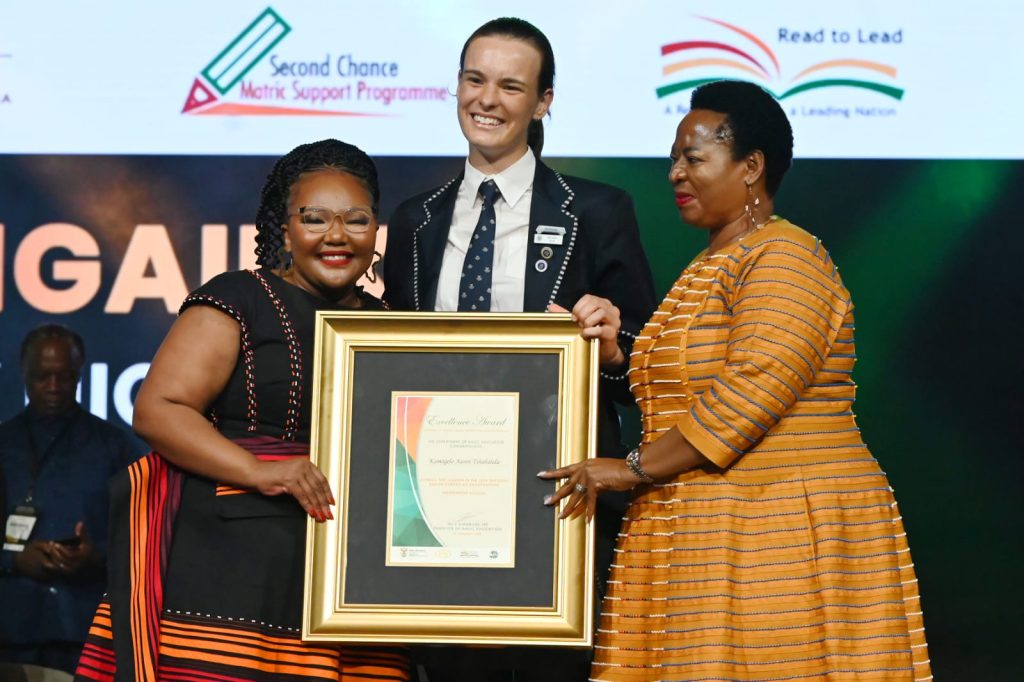
A dream come true: York High learner Abigail Kok tops 2025 NSC
Uncategorized

A dream come true: York High learner Abigail Kok tops 2025 NSC

By Lebone Rodah Mosima 

Abigail Kok, an 18-year-old matriculant from York High School in the Western Cape, was honoured as the Top Learner in the 2025 National Senior Certificate (NSC) at an awards ceremony held at the Mosaïek Theatre in Fairlands, Johannesburg.

In her vote of thanks, Deputy Minister of Basic Education Reginah Mhaule said the recognition marked another milestone in celebrating South Africa’s most promising young achievers in the basic education sector.

Speaking moments after receiving her awards — which also included Top National Achiever in Quintile 5 schools and Top National Achiever in Physical Sciences — Kok described the moment as “completely surreal”.

“To be perfectly honest, this is a bit of a dream come true,” she said.

Abigail received seven distinctions, with her highest marks of 100% for accounting and 99% for physical science and mathematics. She also achieved 100% for Life Orientation.

While the accolade represents a major achievement, Kok admitted she is still reflecting on what it might mean for her future.

“I have absolutely no idea right now. I don’t know if it’s going to open job opportunities,” she said.

Kok plans to study at Stellenbosch University in the Western Cape and intends to pursue data science, having initially registered for actuarial science.

[WATCH] Abigail Kok, South Africa’s top achiever, describes her award as surreal. Though the future is uncertain, she’s filled with excitement, pride, and optimism for the journey ahead. 🌟🎓#TopAchiever #NSC2025 #AbigailKok #AcademicExcellence #FuturePlans #EducationSApic.twitter.com/kuhKxh1hBA

— Inside Education (@Inside_Edu) January 13, 2026

Explaining her decision to change course, she said actuarial science is largely focused on mathematics, statistics and risk, with career paths mainly in insurance and banking.

“Data science still involves maths and statistics, but also computers, and I really enjoy working with data,” she said.
“That’s why I want to make the change — it can be applied across many industries and still includes a strong maths component.”

Originally from the Eden District in the Central Karoo, Kok described her matric year as both demanding and rewarding.

She took English, Afrikaans, Mathematics, Physical Sciences, Life Sciences, Accounting and Life Orientation, relying on early preparation, mind maps and a strict study timetable.

“My only tip would be to start early,” she said.
“Don’t procrastinate, and make an effort to understand your work instead of learning it like a parrot.”

Family support played a crucial role in her success. Kok said her parents fostered a strong learning environment from an early age and encouraged balance through weekly hikes to help manage stress.

At school, she credited her teachers for motivating her to go beyond the curriculum and for their constant encouragement and support.

Despite her achievements, Kok admitted that perfectionism was her biggest challenge during exams.

“I tend to overthink things,” she said.
“My biggest challenge was learning that my best is good enough — and it’s something I’m still getting used to.”

Reflecting on her matric year, which she described as her “nicest year”, Kok encouraged the Class of 2026 to embrace the experience.

“Your first term is solid, but by term two you’re already preparing for exams, with terms three and four being almost entirely exam-focused,” she said.
“Matric is a lot of work. Enjoy the last chance you have to be a child — because after that, you’re no longer a child.”

The event underscored the importance of recognising young achievers not only for their academic excellence, but also for their potential to inspire others — something Kok’s achievement clearly embodies.

INSIDE EDUCATION

Uncategorized

From no-fee school to national stage, Thabang Mashigo lost his father during Trials, but never gave up

By Thapelo Molefe

At just 17 years old, Thabang Mashigo has already etched his name among South Africa’s brightest young minds.

The Khutsalani Secondary School learner from Mbombela, Mpumalanga, was named one of the Top 40 Matric Achievers nationally during the Ministerial National Senior Certificate (NSC) results announcement, where he was also honoured as the third best mathematics pupil in the country.

Mashigo passed the 2025 NSC examinations with a Bachelor pass and seven distinctions, excelling in Accounting, Mathematics, Physical Sciences, Life Sciences, English First Additional Language, Siswati Home Language, and Life Orientation.

Behind the accolades, however, lies a story shaped by perseverance through personal loss.

During his matric year, Mashigo faced one of the most devastating challenges imaginable: the death of his father in the middle of his trial examinations. The loss came at a critical academic moment, threatening to derail years of hard work.

“I was emotional and struggled to focus at first. But I told myself that I had to do it for him and for myself,” he told Inside Education.

That resolve became his anchor. With the support of his family, especially his twin brother, Mashigo found the strength to adapt and continue.

“All he ever wanted was for me to succeed,” he said of his father. “This achievement means everything to me.”

Mashigo’s father was himself a mathematics teacher, making his recognition as the third best Grade 12 Mathematics learner nationally a deeply symbolic moment.

“I feel so grateful and emotional,” he said. “This is just the beginning of something great.”

Mashigo credits much of his success to teamwork, hard work, and resilience. Throughout the year, he studied collaboratively with friends, sharing resources and explaining concepts to one another — a method he believes strengthened his understanding.

“I’m a step-by-step person,” he said. “Explaining work to others helped me master it myself.”

He also received extensive academic support from his school. Teachers at Khutsalani Secondary School made themselves available beyond classroom hours, with his mathematics teacher, Mr Ngomane, playing a pivotal role.

“My maths teacher lived nearby, so I could even go to him at night when I didn’t understand something,” Mashigo said. “The teachers went the extra mile with no restrictions.”

Another crucial pillar was the Kutlwanong programme, a free initiative offering additional Mathematics and Physical Sciences lessons. Mashigo says the programme helped him overcome early struggles, particularly in Physical Sciences, which he found challenging in Grade 10.

“With Kutlwanong, I was able to adapt and truly understand the concepts,” he said. “It made a big difference.”

Despite excelling in analytical subjects, Mashigo admitted that not everything came easily. Life Orientation and English posed challenges, especially the subjective nature of assessment and literature components.

“Life Orientation needs flexibility, there’s no specific memo,” he said. “And English literature surprised me, especially the poems.”

Still, his consistency across subjects resulted in one of the strongest performances nationally.

Looking ahead, Mashigo has set his sights firmly on the future. He plans to pursue Actuarial Science, with aspirations to study at either the University of Cape Town or Wits University.

For current and future matriculants, his message is simple but powerful: “Try and fail, but never fail to try. Even if you struggle during the year, keep fighting until you achieve something.”

INSIDE EDUCATION

Uncategorized

WATCH: Wheelchair-bound Takunda Muchuweni’s matric triumph

By Johnathan Paoli

Takunda Muchuweni’s presence at the National Senior Certificate (NSC) Top Achievers Breakfast on Monday stood as a powerful reminder that academic excellence is not defined by circumstance, but by resilience, discipline and unwavering belief.

Among South Africa’s top-performing learners celebrated at the prestigious event, Muchuweni emerged as one of the most inspiring achievers of the Class of 2025.

Muchuweni is a learner from Jan Kriel School in the Western Cape, a specialised education institution known for supporting learners with physical disabilities and learning barriers.

For Muchuweni, the journey to matric success was marked not only by the usual academic pressures faced by thousands of candidates nationwide, but by intense physical and emotional challenges that tested her endurance daily.

Paralysed from the neck down and reliant on a wheelchair, Muchuweni had to navigate her final school year while managing constant pain and recurring illness.

But she refused to allow these realities to define her outcome.

“The most difficult part of my year was battling self-doubt and being in real physical pain. I had to write exams while sick, and I was wondering whether I would be physically able to make it,” she told Inside Education.

She recalled the emotional challenge of arriving at school after summoning every ounce of strength, only to face hours-long examinations while in discomfort.

“It was demotivating to put in all the work and get the strength to go to school, and then when you sit for the exam, you are hit with sharp pain. You have to focus and write for three hours with a smile on your face when you are just racked with pain,” she said.

But Muchuweni persevered, driven by a determination not to let her circumstances overshadow her goals.

She described matric as an unpredictable and demanding journey, but one that rewards consistency and self-belief.

“It was often tough. There was a lot of self-doubt. There were a lot of days where I was in pain and a lot of days where I felt like giving up. But I just kept going despite all of that,” she said.

Now celebrating her academic success on a national stage, Muchuweni is already looking ahead.

She plans to pursue studies in psychology or industrial psychology, motivated by a desire to understand human behaviour and resilience; qualities she has embodied throughout her schooling.

Her message to the Class of 2026 is simple but profound: matric is a roller coaster, and no one is ever fully prepared. What matters is persistence.

“Just keep on going, keep on believing in yourself and working hard each and every day,” she said, while also reminding learners to allow themselves moments of joy along the way.

INSIDE EDUCATION

Uncategorized

St John’s College top achiever Siza Gule set for Harvard

By Lebone Rodah Mosima

Siza Gule, a top-performing learner from St John’s College in Johannesburg, is set to begin his studies at the prestigious Harvard University in August, marking a major milestone in an already exceptional academic journey.

Gule achieved nine distinctions in the 2025 National Senior Certificate examinations, finishing with an impressive 94% average. He said he intends to pursue a multidisciplinary programme that reflects his wide-ranging interests, including law, politics, theatre and literature.

“My interest is really to do a bunch of different things because I’m not entirely sure of one key thing that I want to focus on at the moment,” Gule said on Tuesday.

Known for his strong academic record as well as his creative flair, Gule’s passion for the arts was evident throughout his time at St John’s College, where he actively engaged in cultural and intellectual pursuits alongside his studies.

Looking ahead to life at Harvard, Gule said he is particularly excited about exploring creative disciplines while keeping his academic options open.

“I’m very much a creative person. Theatre and literature are definitely my biggest interests at the moment,” he said.

Gule’s admission to Harvard places him among a small group of South African students who gain entry to the Ivy League institution each year, a testament to both his academic excellence and his diverse talents.

INSIDE EDUCATION

WATCH: Gauteng top matric achiever Kamogelo Tshabalala eyes Actuarial Science
Uncategorized

WATCH: Gauteng top matric achiever Kamogelo Tshabalala eyes Actuarial Science

By Akani Nkuna

One of Gauteng’s top matric achievers, Kamogelo Tshabalala from Acudeo College Kirkney, described the matriculation journey as “easy” thanks to good preparation and a well-coordinated support structure, including peer groups and assistance from teachers.

“The journey was easy if I am being honest. It was easy because of the preparations that was done the previous year, particularly after the grade 11 examination preparation for the next year. It made the journey quite easy with the assistance of the educators and support of my classmates as well,” Tshabalala told Inside Education.

Kamogelo Tshabalala. Photo: Eddie Mtsweni

Tshabalala has already set his sights on studying Actuarial Science at the University of Cape Town, saying it is a path where his passion for mathematics and science can be fully harnessed.

Confident and resolute about his chosen career path, Tshabalala said he is ready to take on the subject to fulfil a childhood dream born from his love of science, and to challenge perceptions that the course is too difficult.

“Actuarial Science is considered a challenging course, I am ready for the challenge and it’s even maths based,” he said.

He also expressed a desire to promote a culture of literacy, make studying fashionable, and give back to the community he comes from, ensuring that his pursuit of Actuarial Science benefits not only him but society.

Tshabalala emphasised the need to empower young people beyond education and into other fields, including sports, arts and culture, to help uncover raw talent and ensure every pupil’s prospects for success are explored.

“The infinite opportunities I will earn from this career path will in turn enable me to establish other ventures that I would like to go into which empower the youth of South Africa the same way I was empowered and given an opportunity to thrive,” Tshabalala said.

He urged pupils moving into Grade 12 to waste no time getting started with their studies, encouraging them not to wait for schools to reopen before beginning.

“You need to really try your best, understanding that it is not going to be easy at all. Give it all that you have, the time that you have, use it for your studies. Focus and ask your teachers as many questions as you can,” Tshabalala said.

“To that pupil in any grade — if you lay the foundation now, if you start collecting the bricks to build now, trust me it is highly possible that you end up here and even higher places.”

INSIDE EDUCATION

Uncategorized

Education districts break records with 80% and above pass rates

By Charmaine Ndlela

For the first time, all 75 school districts across South Africa have recorded matric pass rates of 80% and above.

Basic Education Minister Siviwe Gwarube announced the milestone during the official release of the 2025 National Senior Certificate (NSC) results on Monday night in Johannesburg.

Gwarube said the achievement signals a significant shift in the education system, noting that performance gaps between districts and provinces are narrowing compared to previous years.

“District performance is one of our clearest quality indicators – because it shows whether improvement is spreading system-wide or remaining concentrated in pockets of strength,” she said.

She added that this marks a turning point where improvement is no longer limited to a few pockets of excellence but is being realised across all districts.

“[W]e see what is possible when schools are supported and districts are strong. Districts like uMkhanyakude and Umlazi remind us that outstanding outcomes can come from communities overwhelmed by lack and need,” she said.

Johannesburg West in Gauteng was the top-performing district, achieving a 96.20% pass rate. The district remained in first place nationally, after recording 97% in 2024.

Close behind was uMkhanyakude in KwaZulu-Natal with 93.63%, followed by the Overberg district in the Western Cape with 92.36%. Overberg was also listed among the most improved districts, with an increase of 4.06 percentage points year-on-year.

Despite the overall improvement, several districts ranked at the lower end of the national scale, although they still met the historic 80% benchmark.  

Amathole West in the Eastern Cape recorded the lowest pass rate nationally at 80.34%. It was followed by Alfred Nzo East, also in the Eastern Cape, with a pass rate of 81.13%, while OR Tambo Inland recorded 81.17%.

Nationally, the Matric Class of 2025 achieved a record 88% NSC pass rate — the highest in South Africa’s history.

INSIDE EDUCATION

Uncategorized

Back to school costs bite as parents cut back on essentials

By Lebone Rodah Mosima and Charmaine Ndlela

From R900 stationery lists to R4,500 registration fees, parents say the price of sending children back to school is spiralling.

The 2026 academic year officially starts in 24 hours, and families across South Africa are still cutting back, making plans to skip holidays, and turning to loans to cover basic schooling requirements.

The country’s official unemployment rate was 31.9% in the third quarter of 2025, meaning many families entered January with limited or unstable income.

At the same time, consumer inflation was 3.5% year-on-year in November 2025, with food and non-alcoholic beverages rising 4.4%, keeping basic shopping baskets elevated for many homes.

January also comes with a predictable cash-flow squeeze, as many salaried workers face a longer gap between December and January paydays.

Standard Bank has described this as a “pay gap” dynamic that forces people to stretch earlier December salaries over more days than usual.

The National Credit Regulator (NCR) has repeatedly warned that January is a high-risk month for borrowing decisions, particularly after festive-season spending. It has urged consumers to borrow only from registered credit providers, and to avoid “unlawful” lenders that may skip affordability checks or use prohibited collection tactics.

For most parents, the reality of back-to-school expenses has now fully set in.

Stationery lists alone can consume a significant portion of household savings, while other costs include new school uniforms, registration fees, transport and school fees, particularly for children starting at new schools.

Inside Education spoke to several parents about their readiness for the school year. Many described the process as severely stressful and, in some cases, unaffordable.

A Gauteng parent whose child has been enrolled in Grade R said she fears her child may miss the first day of school because she cannot afford all the items on the stationery list.

Teboho Lizzy Lestoalo, a single mother of three from Johannesburg, said back-to-school expenses increase every year.

“Every year there’s always something new added to the stationery list. For my son, who attends a government school, registration and school fees alone cost about R1 500. Stationery is around R900, although textbooks are provided. For crèche, stationery is even more expensive — I spend about R1 500,” she said.

Lestoalo said uniforms add to the strain.

“You still have to buy five white T-shirts, trousers, socks, and sometimes a new school bag. I don’t really budget directly; I just try not to go overboard and cut unnecessary items,” she added.

The Competition Commission last week urged schools and governing bodies to end exclusive school-uniform supply deals that it said could push up prices for parents and shut out rival suppliers.

In 2021, the watchdog said it published procurement guidelines after receiving complaints dating back to 2010 that some schools had signed long-term exclusive agreements with selected uniform suppliers without transparent or competitive bidding, limiting competition and leaving parents with higher costs.

Between 2020 and 2025, the commission received 490 complaints about school uniforms and learning materials and resolved 465, it said, adding that it continued to work with the Department of Basic Education on a price-and-supplier monitoring tool expected to be rolled out to schools before the end of 2026.

Another Johannesburg-based mother of three, with two children in school — one entering Grade 3 and the other Grade 8 — told Inside Education she had to sacrifice holiday spending to cover school costs.

“I paid R900 for stationery for my second-born in December. I didn’t travel to the villages or buy Christmas clothes because I had to prioritise school expenses,” she said.

The woman, who asked not to be named, said she paid R4 500 in registration for her Grade 8 child and spent a further R1 000 on uniform items, including skirts, a jersey, a tie and socks. Transport and additional stationery costs further stretched the household budget.

Adelle Chittray, a mother of five, described the system as “insane”, citing high school fees and the price of uniforms.

“Teachers sometimes shame learners in front of others when they don’t have all the required items. That hurts the children emotionally,” she said.

Celia Makgabo Mokwele, a mother of three, said she is struggling to cope financially, especially with a child moving into high school.

“I have a child starting high school, which means a new uniform, new stationery, and school fees. His budget is about R6 000,” she said.

She said her primary school child’s fees and stationery amount to R2 300, while her tertiary student requires R10 600 a month for tuition and supplies.

“It’s tough. I’m still looking for placement for my high school learner as schools are opening next week,” Mokwele said.

Another parent, Nqobile Mabizela, who has children in Grades 3, 6 and 11, said holiday spending left the family under severe pressure.

“During the holidays, we spent money unnecessarily eating out and enjoying ourselves. Now we’re forced to cut back just to afford uniforms and stationery,” she said.

Mabizela said the family has prioritised essentials such as uniforms, stationery and school fees, while cutting back on other household expenses.

INSIDE EDUCATION

Uncategorized

Basic education director-general Mweli hails ‘resilient’ Class of 2025

Thebe Mabanga

Basic education director-general Matanzima Mweli paid tribute to the matric Class of 2025 on Monday for its resilience, likening the cohort to an “abandoned Baobab tree”, known for its ability to withstand adverse conditions. The Class of 2025 achieved an 88% pass rate.

Mweli said that the group, which started school in 2014, had to transition to high school in 2020 and 2021 during the Covid-19 pandemic, when learning was disrupted.

Reduced contact time meant they spent 2021 to 2023 rebuilding exam muscle, or “catching up”, and have now emerged triumphant with a record pass rate.

There were 764,014 full-time candidates — about 40,000 more than in 2024 — while there were 137,776 part-time candidates, down from 155,948 the year before.

Mweli said the reduction in part-time candidates showed learners had faith in the system and preferred to repeat full-time to improve their chances of success.

Over the past five years, the education system has grown from supporting 12 million learners to 13.7 million, he said.

But the number of teachers and schools has not kept pace with this growth, with 613 new schools built over the period and 6,500 additional teachers, bringing the total to 474,432 teachers.

Mweli highlighted the increased uptake of technical subjects as a welcome development, with subjects such as technical graphics and design being taken up by more than 4,000 additional learners.

He noted that technical subjects are “for now and the future” and are no longer being viewed as being for those who are not academically gifted. He said that each of the country’s 889 circuits should have a technical high school.

But the results also showed a worrying trend: a decline in the number of passes by grant recipients.

The DG noted that learners reach matric at 18 — the age at which the child support grant falls away — and losing the grant at such a critical stage may prove decisive. He said 44,000 learners were no longer receiving the grant in their matric year.

To mitigate this, he suggested the criteria may have to be tweaked so that “as long as you are in school, you receive the grant,” which would require a “sacrifice” by the country’s taxpayers.

The matric exam is a complex national operation, second only to national and local government elections. About 11 million question papers are used across 6,948 centres.

Apart from the stress and trauma of events like Covid, other challenges the department had to deal with included water and electricity disruptions, inclement weather and protests, which were kept to a minimum last year.

INSIDE EDUCATION

Uncategorized

Excellence is becoming a pattern, says Gwarube, as Class of 2025 hits record 88% pass rate

By Johnathan Paoli

Basic Education Minister Siviwe Gwarube said on Monday night that South Africa’s 2025 National Senior Certificate (NSC) result was evidence that “excellence is becoming a pattern”, but warned that deep, early learning reforms remain essential to sustain progress and close persistent inequalities.

Announcing the historic national pass rate of 88%, the highest on record and up from 87.3% in 2024, Gwarube said the results reflect a system that is stabilising, expanding participation and holding firm on integrity, while beginning a decisive shift toward quality learning from the earliest grades.

“The 2025 results show us that excellence is spreading into communities that have carried the heaviest burdens, but they also remind us that the number of learners enrolling should never run ahead of our ability to ensure that they perform well,” Gwarube said.

More than 656,000 learners passed the NSC in 2025, with KwaZulu-Natal emerging as the best-performing province at 90.6%, followed by the Free State (89.33%), Gauteng (89.06%), North West (88.49%) and the Western Cape (88.20%).

The Northern Cape recorded the biggest year-on-year improvement to 87.79%, while Mpumalanga (86.55%), Limpopo (86.15%) and the Eastern Cape (84.17%) completed the provincial spread.

For the first time, all 75 education districts achieved pass rates of 80% and above, a milestone Gwarube described as a key indicator that improvement was spreading system-wide.

Crucially, the minister emphasised that the headline numbers are underpinned by credibility.

The 2025 examinations, written by over 900 000 candidates at about 6,000 centres, were quality assured by Umalusi, with irregularities investigated and controls strengthened. “These results are earned, not gifted,” said Gwarube.

Beyond the aggregate pass rate, Gwarube pointed to gains in quality outcomes.

The percentage of Bachelor passes declined slightly, meaning Bachelor passes made up a slightly smaller share of all passes.

But the total number of candidates writing and passing increased significantly, because the 2025 matric class was the largest in South Africa’s history.

A further 28% achieved Diploma passes and 13.5% Higher Certificate passes.

Notably, over 66% of Bachelor passes were achieved by learners from no-fee schools, reinforcing the minister’s message that poverty need not determine destiny.

At the same time, she cautioned against complacency, particularly in gateway subjects.

Mathematics participation increased but performance declined, with the pass rate falling from 69% to 64%; accounting dropped from 81% to 78%, while physical science edged up to 77% from 76%.

Fewer distinctions were recorded in these subjects than in 2024.

“Growing participation without the foundations to support mastery risks widening access while weakening quality,” Gwarube warned.

The minister situated these outcomes within a broader reform agenda launched over the past year. Since assuming office, the department has stabilised governance, rebuilt trust with provinces and unions, protected exam integrity and shifted from crisis management to long-term reform, she said.

Central to that shift is a focus on early learning illustrated by expanded early childhood development (ECD) registration, which exceeded a 10,000-centre target to reach more than 33,000 registered sites, enabling over a million children to access subsidies for nutrition and quality learning.

Other achievements include the release of the Funda Uphumelele national reading survey, expansion of mother tongue-based bilingual education, the first bilingual Grade 4 assessments in mathematics and natural science, an updated catalogue of learning materials for Grades 1–3, and a review of the teaching post allocation formula for the first time in over two decades.

Teacher development has been strengthened through targeted Funza Lushaka bursaries, while learner well-being has been prioritised through the school nutrition programme, strengthened safety protocols with SAPS, and a planned anti-bullying campaign in early 2026.

Looking ahead, Gwarube outlined priorities for 2026: accelerating early learning quality and access, including a new target of 250,000 ECD spaces; deepening mastery in gateway subjects with earlier intervention; finalising the review of White Paper 6 on inclusive education, streamlining reporting to protect teaching time; and addressing financial sustainability across provinces following a first-ever analysis that flagged seven provinces as at risk.

She was candid about the remaining challenges.

Learner retention drops sharply between Grades 10 and 12; boys are increasingly underrepresented in matric cohorts; mathematics uptake remains low at 34%; and social protection gaps affect performance, with learners whose grants lapse at 18 performing worse.

Fiscal constraints, she warned, could undermine early learning, nutrition and support if austerity measures are applied without care.

INSIDE EDUCATION