Uncategorized
By Charmaine Ndlela
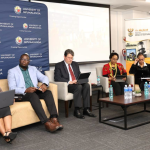
Gauteng Premier Panyaza Lesufi has launched the Gauteng Human Resource Development Council (GHRDC), saying the province’s economic future depends on equipping young people with skills that match the demands of a rapidly changing economy.
The council, launched at the University of South Africa (UNISA) in Pretoria on Tuesday, is expected to provide strategic leadership in the implementation of the Gauteng Master Skills Plan 3 (2026–2030), while aligning education, training and workforce development with the province’s economic priorities.
Chaired by Lesufi, the council brings together government, higher education institutions, business, organised labour and civil society to tackle youth unemployment, poverty, inequality and critical skills shortages.
Speaking at the launch, Lesufi said investing in people was central to achieving sustainable economic growth and building a capable state.
“History teaches us that nations that prosper are nations that invest in their people. If you can’t get the skills right, you will not get the country right. If you can’t get the skills right, you will not get the economy right,” he said.
Lesufi warned that job creation without a skilled workforce would not resolve South Africa’s unemployment crisis.
“You might have ambitions to eliminate unemployment, but when jobs are created and the skills are not there, unemployment will be permanent. We are choosing the other path of building the skills, building capabilities and converting our schools to be the pipeline of future skills,” he said.
He said the GHRDC would ensure that the province’s economic plans translate into tangible outcomes by placing skills development at the heart of Gauteng’s growth strategy.
“I come to launch a council that will convert these master plans and economic plans into reality. This council is not only a human development capability or an engine room. It’s expanding people’s choices. It’s making it easy for our children to say there is a future in this province,” Lesufi said.
The Premier highlighted Gauteng’s investment in Schools of Specialisation, saying they were key to preparing learners for industries expected to drive future economic growth.
“The launch of almost 34 Schools of Specialisation in our province is an investment that must not be undermined,” he said.
“If a school says we’re a School of Specialisation in aviation, maritime studies, business development or engineering, you must know that’s the future, and that school is in Gauteng.”
Lesufi said the establishment of the council represented more than the creation of another government structure.
“Today is more than the establishment of another institution. It’s the beginning of a renewed partnership that places people at the centre of development,” he said.
He said collaboration between government, universities, industry, labour and communities would be crucial to ensuring education and skills development respond to changing labour market needs.

UNISA Principal and Vice-Chancellor Professor Puleng LenkaBula welcomed the launch, describing the council and the Gauteng Master Skills Plan 3 as important milestones in advancing skills development and inclusive economic growth.
She said education remained the foundation of human development but required support from research, innovation and partnerships to address society’s challenges.
“I am of the view that the launch of the Gauteng HRDC represents a decisive investment in the vision of the province. It reflects our collective commitment to harnessing evidence-based decision-making, cultivating innovation and strengthening collaboration among government, higher education institutions, industry, organised labour and civil society,” LenkaBula said.
She said universities and colleges had a critical role in producing graduates equipped for the digital economy while contributing to social and economic development.
LenkaBula challenged stakeholders to consider how South Africa could build a socially just economy that promotes inclusive and sustainable development.
“How do we create a socially just economic system that promotes inclusive and sustainable development?” she asked.
Deputy Minister of Higher Education and Training Dr Nomusa Dube-Ncube described the launch as a historic milestone, noting that Gauteng was the final province to establish a Provincial Human Resource Development Council.
She said the council builds on the Human Resource Development Strategy 2025–2035 and the National Master Skills Plan launched earlier this year.
“The launch marks a historic milestone, completing the establishment of Provincial Human Resource Development Councils across all nine provinces,” Dube-Ncube said.
She said provincial councils would help translate national skills priorities into practical interventions in communities, schools, workplaces and training institutions.
Dube-Ncube also outlined efforts to modernise Technical and Vocational Education and Training (TVET) college curricula by prioritising occupational and technical programmes aligned with industry needs.
“We are modernising our curriculum, particularly the TVET curriculum, to ensure that it focuses on occupational and trade skills that respond directly to the economy,” she said.
She said stronger partnerships between education institutions and industry were necessary to ensure young people acquire skills relevant to the labour market.
“We want to make sure that those skills that are given to the young people are skills that the industry needs, but also talk to today’s realities of the artificial intelligence age,” Dube-Ncube said.

INSIDE EDUCATION
The post Lesufi puts skills development at centre of Gauteng economic growth strategy appeared first on Inside Education..