Category: Uncategorized

Uncategorized

Time to break the mould says former Mauritius President

Staff Reporter

There Is A Lot Of Stereotyping In The Way Sciences Are Taught To Girls, says Dr Ameenah Gurib-Fakim, the world-renowned biodiversity scientist and former first female President of Mauritius. 

Mom of two, Gurib Fakim, says increasingly on the continent, women and girls are not being encouraged to do the sciences, and this is for many reasons.

“For example, if you look at the [teaching] textbooks, there is a lot of stereotyping in the way that the sciences are being taught to girls. If you look at the infrastructures in schools, they don’t really cater for girls to stay. 

“These issues need to be looked into. We need more mentoring, more advocacy. We need to take the girls by the hand and make them believe that they can do anything. By building their confidence from a very young age, telling them that the sky’s the limit, it will lead to more in the sciences.”

When it comes to women in leadership, she said: “I have been advocating that we need to have better representation and there is a need to fix what we are all talking about – the ‘leaky pipe syndrome’ – which loses a lot of women in the pipeline, instead of bringing them along into systems and institutions. 

“But the onus is also on all Africans. People have to start asking the right questions. Politicians, leaders, policymakers in normal democracies, are all accountable to the people. But, and I am sorry for saying this brutally, we get the government that we deserve. The one we vote in. It’s your vote.”

Gurib Fakim said we all need to push gender be it in medicine, food, education, agriculture – in everything that we do in all sectors. “We cannot compromise on quality. This is the message that we need to spread across our continent. And to get to the required degree of excellence and quality, we need to empower our youth, more so our girls, with the right tools and education that will take them to the highest levels of excellency.”

INSIDE EDUCATION

MEC Matome Chiloane launches Thuto-Tiro School of Specialisation
Uncategorized

MEC Matome Chiloane launches Thuto-Tiro School of Specialisation

Tlholohelo Mosala

Gauteng Education MEC Matome Chiloane launched Thuto-Tiro Engineering School of Specialisation with a focus on Energy at Sebokeng on Thursday, making this the 33rd school of its kind to be launched by the Gauteng Province – etching it closer to the envisioned target.

“It is clear what we hope to achieve as a government, to create model citizens out of our learners by exposing them to critical skills that are needed in this economy. We are creating the future of our province, and our country as education is the foundation of all careers,” Chiloane said.

MEC Chiloane said that focus of School of Specialisation was based on the Southern Economic Development Corridor, which has tourism and entertainment, agri-processing and logistics industries.

The school is based in Sebokeng, a middle-class township in the Emfuleni Local Municipality in southern Gauteng; and in light of the township being segmented into various zones, the hostel residence was located on the periphery, when entering from Vanderbijlpark. 

Chiloane said the schools of specialisation do not have a fixed feeder area, so anyone should be able to benefit by having their children accepted at the school, depending on the outcome of the assessment for admission.

He said that the establishment of this school is aligned with the Gauteng Provincial Government’s (GPG) commitment to developing Townships, Informal Settlements and Hostels (TISH), enabling communities to benefit from the vast array of resources at the school’s disposal, as well as the advanced skills that learners will acquire.

As such, learners demonstrated an extensive knowledge in Engineering Graphics & Design (EGD) as a subject, which provides knowledge and skills that centre around mechanical, civil and electrical technology.

In addition, learners showcased their proficiency in Electrical Technology and Power Systems, demonstrating their own automated power system as well as solar inverter.

Mechanical Engineering and Civil Technology is also taught at the school, where learners gain skills in welding, sawing, fitting and turning, as well as woodwork and construction.

“This level of advanced education, coupled with commercial stream subjects, prepares learners to utilise these skills on an entrepreneurial level, not only tackling the skills gap, but addressing unemployment as well,” Chiloane said.

The MEC said enriching the foundation with an abundance of advanced skills, would result in more competent, knowledgeable, capable and proficient learners who were ready to either be employed upon exiting the system, or venture into entrepreneurship and create employment for others.

He said that the launch of these schools was in line with the department’s vision of creating problem-solvers that could effectively facilitate the development of solutions to the problems facing communities by members from the community itself.

INSIDE EDUCATION

Uncategorized

NSFAS not up to scratch, says the Auditor-General’s office

Johnathan Paoli

THE National Student Financial Aid Scheme (NSFAS) has received an adverse finding from the Auditor-General’s (AG’s) for its 2021/2022 financial report; this emerged in Parliament on Wednesday when officials from both entities were deliberating on student funding for 2024 and on the Werksmans report on corruption allegations.

Officials from the AG’s office and NSFAS briefed parliament’s higher education portfolio committee and the AG representative Ignatius Fourie told the committee that the adverse audit stems from unreliable financial statements provided by NSFAS and said this was due to the inefficient systems and a lack of capacity within the scheme.

“We were not able to conclude on the accuracy of the information in the annual performance report. There’s insufficient measurement definitions and processes to collate and to report performance information. As a result of that we are then unable to do reliability testing, and to see if the figures that are being included are reliable,” Fourie said.

Fourie told the committee that when they audited the books of NSFAS, they found a number of mistakes and that a lot of data was not supported, and subsequently could not be audited, and that there were errors in the calculations.

Fourie said the adverse audit meant that there were a number of material misstatements in the financial statements and the figures in the financial statements were not reliable, nor were they fairly stated.

The office found that there was no reconciliation between what is owed by universities to NSFAS and what is owed by NSFAS to universities and that there was a delay in submitting the annual report by NSFAS to Parliament, which was finally tabled in December last year.

Fourie confirmed that in terms of addressing those matters, NSFAS started the process of reconciling between the institutions’ students data and their own data to determine any overall underpayments to students.

“There are various reasons why over and underpayments can happen, because they do payments on the original registration and if there are changes, like students changing their course, there could be an impact on that,” Fourie said.

INSIDE EDUCATION

Uncategorized

TUT Giyani Campus Set for 2025 Opening says Nzimande

Lerato Mbhiza

THE Department of Higher Education, Science and Innovation says it is pressing ahead with the completion of the establishment of the Tshwane University of Technology (TUT) campus in Giyani and opening the facility’s doors in 2025.

“The Minister of Higher Education, Science and Innovation, Blade Nzimande, has become aware of the circulation of information on various social media platforms that are designed to create the false impression that the Minister is blocking or deliberately delaying the finalisation of the establishment of the Tshwane University of Technology Giyani campus,” the statement read on Tuesday.

This misrepresentation according to the department “This false impression, according to the department, is designed to create confusion, ferment chaos and disrupt the finalisation of this important project”.

“In the interest of transparency and concern for the future of the young people of Giyani and surrounding areas, the Minister wishes to provide the necessary clarification.”

The department has since clarified the decision to establish the Giyani campus under Nzimande’s leadership.

“This decision was informed by a number of strategic considerations, including the need to extend access to higher education for the young people of Giyani and surrounding areas. It then becomes utterly ridiculous and mischievous to suggest that the Minister is delaying or frustrating his very own initiative,” the statement read.

According to the department, the team commenced a feasibility study for the establishment of the TUT Giyani campus in May last year when it hit delays of more than five months from the Limpopo Department of Education.

However, according to the department, it is now working with the Limpopo MEC for Education, Lerule Ramakhanya, to address these obstacles.

The department announced that an agreement was reached in October 2023 after the Minister allocated R31.916 million to the project the previous month.

The department said it will carry out renovations and address deferred maintenance once the feasibility study is completed, within the allocated budget.

“TUT will now commence with the refurbishment and deferred maintenance in February this year, which will enable the first intake of students during the 2025 academic year.”

Meanwhile, the department said more funding will be allocated from 2024/25 onwards and over an anticipated six-year period.

“The funding to be allocated during 2024/25 will enable TUT to start with the planning of the major projects during the 2024 calendar year.

“As this work was unfolding, the departmental project team that was appointed by the Minister and is responsible for the implementation of this project has been engaging the relevant community, government and private sector stakeholders in Giyani, regularly.”

In addition, stakeholders have since been provided with regular feedback and together with the departmental project team agreed on a mechanism to resolve any concerns that may arise in implementing this project.

“It is also in the public interest that we should also state that there was a group of individuals who actively prevented the appointed technical team from carrying out its work. As stated, all this seems to be calculated to create confusion, ferment chaos and block the finalisation of this important project.

“Furthermore, it is the department’s experience that this project has regrettably attracted many interest groups, some of which seek to hijack the legitimate concerns of the community of Giyani and use these for their narrow and malicious ends.”

The department said it had also noted a malicious attempt to exploit the legitimate concerns of the community of Giyani to further what seems to be an established campaign to tarnish the name and reputation of the Minister, through lies and misinformation.

The department said it continues to enjoy the full support of TUT, the Limpopo provincial government and Ramakhanya.

“As the Department of Higher Education and Training, we remain committed to completing the establishment of the Tshwane University of Technology campus in Giyani.”

INSIDE EDUCATION
Uncategorized

Grassroots must provide Bafana Bafana talent, says Minister Zizi Kodwa

Inside Education Reporter

Minister of Sport, Arts and Culture Zizi Kodwa is optimistic about the future of Bafana Bafana following a third-place finish at the African Cup of Nations (AFCON) in Côte d’Ivoire. 

“What is clear for me now is that after a long time with Bafana Bafana, we now have sufficient building blocks for a national team to prepare for the next World Cup,” Kodwas says, adding that grassroots talent must provide the future pipeline to the national team. 

“We must focus on the grassroots to build on. Bafana Bafana have made us proud as a country. All our national sports teams are performing extremely well. Bafana Bafana have come to the party.”

Turning his attention to Boxing South Africa (BSA), the Minister said reflected on the urgency of the BSA matter that is currently before the court. The Minister once again highlighted the government’s focus to stabilise leadership and governance at BSA.

“We are dealing with the issue. It takes time, but we have got to be careful in whatever we do.”

Kodwa says in a matter of days, he would be considering a number of options, including that in the interim, while we are dealing with the issue of the main application of the court ruling, whether appointing an administrator to do the same work that the Board would have done should be pursued. 

“I want to bring boxing to its glory days. Whatever we do, we must make sure that there is clarity on issues of governance, there is clarity on issues of stability of leadership.”

INSIDE EDUCATION

Uncategorized

Free State MEC Mohale tackles ECD challenges with Minister 

Inside Education Reporter

Basic Education Minister, Angie Motshekga, accompanied by Free State Education MEC, Makalo Mohale, last week, met with Free State education officials at the Fezile Dabi District Office to pinpoint challenges hampering the smooth implementation and integration of ECD into the sector. 

Minister Motshekga said that quality drivers such as resources, infrastructure, training and centre registration remain some of the key areas of focus to build on an inclusive and holistic ECD space within the sector.

The Minister has been engaging with ECD practitioners as part of a mass registration drive since the latter part of 2023 as the Basic Education Sector continues to ramp up its efforts to ensure full-scale integration of ECD. 

In addition, the engagements serve at better capacitating forums and centres on what the landscape of ECD will look like as the five outcomes for ECD in 2024 are being identified and implemented. During the session, challenges hampering the smooth implementation and integration of ECD into the Sector, were discussed to find solutions to common challenges.

According to Dr Janeli Kotze, Acting Director for ECD, the Department has put measures in place to ensure that South African children have access to opportunities for learning through play, and to integrate with other departments to enable all children to have access to good health, adequate nutrition, safety and security, as well as responsive caregiving.

“Our goal as the Department is to coordinate the distribution of health and safety packs and play and learning materials to ensure key resources reach the most under-resourced early learning programmes. 

“Another focus will be on scaling up access to early learning programmes for 3 to 5-year-olds, targeting 170,000 children each year, by building new public private partnerships with social partners. 

“In addition, parental support interventions across departments, to ensure families with young children access support, and reaching 17,000 parents and caregivers in 2024. New mechanisms to drive progress against an agreed ECD Outcomes Framework must be put in place to improve ECD leadership and coordination across departments and spheres of government. 

“Government is using population-based planning to target resources and effort so that families in townships, informal housing and deep rural areas benefit most. Government is also launching a Social Compact for ECD to bring together the best efforts of the ECD sector, donors, business and social partners behind these ambitious goals,” explained Dr Kotze.

“The Department is implementing the mass registration drive, which will target 20,000 unregistered ECD programmes and provide them with conditional registration for one year. 

During this year, the DBE and municipalities will support ECD programmes to become compliant through the provision of pre-registration support packs, after which they will be required to apply for full registration.

“All ECD programmes will need to register according to legislation. This includes independent community-based programmes, private programmes, NPOs and micro-enterprises. A certificate with the DBE’s logo will be provided to ECD programmes to indicate that they have been conditionally/fully registered. However, registration does not equate to funding,” added Dr Kotze.

INSIDE EDUCATION

Uncategorized

Gauteng hat trick for University of Pretoria as top matrics #ChooseUP

Inside Education Reporter

“South Africa needs doctors and if I can make a difference it would be an honour for me to give back to my country,” says Gauteng’s top matric student, Sheliza de Wet who was head girl at Hoërskool Menlopark in Pretoria. 

De Wet will be studying medicine and surgery at the University of Pretoria (UP) from February this year.

“I’m very excited, I was a bit overwhelmed as I didn’t expect to be first but I am very thankful and very happy that I got into UP as it has a fantastic medical campus and I can’t wait to experience student life.”

With 9 distinctions, she is in good company as Gauteng’s second and third top matric students have also chosen to study at UP, all with and 96%+ averages.

Wian van Rooyen from Afrikaanse Hoër Seunskool in Pretoria achieved 8 distinctions, he was second in Gauteng and will also be studying medicine and surgery at UP. “It was an easy choice for me,” he says.

 “The new era of medicine is an exciting field with rapidly evolving technologies that assist doctors and surgeons in their work and expand the reach of medical professionals to people everywhere.”

They are both keen to meet Stevie the telemedicine robot in UP’s Faculty of Health Sciences at the Steve Biko Academic Hospital. Stevie is a mobile robot who assists in the treatment of patients through live discussions between intensive-care unit teams in Germany and South Africa.

“UP positions itself on being a future-oriented university in all the programmes it offers,” says UP’s interim Vice-Chancellor and Principal Professor Themba Mosia. 

“We are ranked in the top 1% of universities worldwide in 10 fields and incredibly proud of our brand, reputation and educational quality. This is confirmed year on year by the escalating number of top matric achievers choosing to study at UP.”

Competition for admission in 2023 proved hugely competitive in a range of courses, including medicine, engineering, veterinary, law and actuarial science, with many of the top students being admitted to UP achieving 95%+ and 7+ distinctions.

Second in South Africa for mathematics, first in Gauteng for mathematics and third overall for all subjects in Gauteng is Jéan Goodey from Hoërskool Oos-Moot who achieved 7 distinctions and who will be studying actuarial and financial mathematics at UP.

I focused on consistency every day so that I didn’t fall behind and I always do the best that I can, says Goodey. “I chose actuarial and financial maths because I have a natural feeling for numbers. Maths is one of my favourite subjects and actuarial science fits well with it. I think I got the ability from my parents because they are both chartered accountants.”

Another top matriculant with a gift for numbers is Zonke Thwala from Siphesihle Secondary School in Waterloo, KwaZulu-Natal, who came third in South Africa in the Quintile 3 schools. She achieved 7 distinctions and is pursuing accounting sciences at UP.

She says a lack of electricity “made studying for matric very hard”. “The transformer in my area blew and I had to use a candle and torch to study. I persevered and I am so proud of myself. It’s really unbelievable and I am grateful to God, my family and teachers. Matric was the longest year of my life!”

One of the top private school matriculants, Carine Pretorius, from Helpmekaar College in Johannesburg who achieved 10 distinctions will be studying industrial engineering at UP. “I attended the engineering faculty’s career week last week and industrial engineering appealed to me because it’s all about processes, systems and productivity. 

“During the week we also experienced the virtual mine – it’s as if we were standing in a real mine. I hadn’t seen anything like that, and the technological advancements that are happening now are amazing.” 

Pretorius also plays the recorder and did her UNISA Grade 8 exam in 2023 and will be doing her licentiate this year.

INSIDE EDUCATION

Uncategorized

MEC Chiloane launches Sikhululekile School of Specialisation

Inside Education Reporter

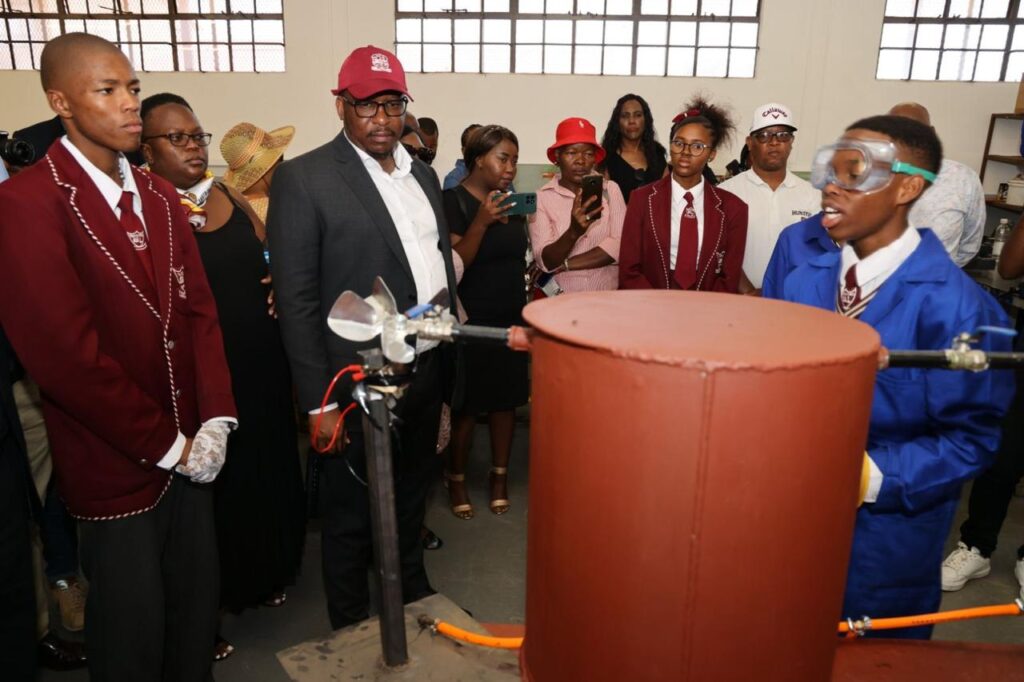
Gauteng Education MEC Matome Chiloane officially launched Sikhululekile Maths, Science & ICT School of Specialisation with a focus on Research and Innovation on Thursday, 8 February 2024, at Temba, Hammanskraal. 

The focus of this School of Specialisation is based on the Economic Development Corridor in Tshwane, which has Research, Innovation (Knowledge) Nuclear Science & Technology and Automotive industries. 

Learners from the school demonstrated an array of innovative scientific solutions for issues faced by their community. Grade 9 and 10 learners created a smart farm from a dumpsite on the school premises, where they cultivate a wide variety of vegetables using their very own four-switch water irrigation system. Grade 11 learners developed their own biofuel using bioethanol, which will be utilised by the school as an alternative sustainable energy source. 

Learners also created their own water purification system following a cholera outbreak in the community. They also developed a water testing kit which can be sold to the community for only R80. All of these innovations emanated from their own research into issues affecting the community. 

The school is also fully equipped with smart classrooms, 3D printers, virtual reality/augmented reality headsets, science labs, and a maths park. 

Schools of Specialisation are a legacy programme that was started in 2014 following extensive research on contemporary curriculum. A need to provide a more advanced curriculum that equips learners with skills that are pertinent in today’s economy, and increasingly prepares them for diverse careers upon exiting our system, was identified. 

The answer to this was re-establishing existing schools into institutions that specialise in Maths, Science and ICT, Engineering, Commerce and Entrepreneurship, Performance and Creative Arts, and Sports respectively. 

The specialisation, and focus, within each of these is determined by the economic corridor they reside in. Therefore, the Department forms partnerships with industry-leading companies to enhance the provision and credibility of these skills. 

Sikhululekile Maths, Science & ICT School of Specialisation is the 31st School of Specialisation to be launched in the province, and the first of six such schools that will be launched between February and March 2024. The province aims to have 36 School of Specialisations in total. 

“With the launch of this school, we are not only cementing our commitment to quality education and youth development, but we are also building highly skilled learners whose knowledge and innovation has the capability of revitalising the economy of Temba, and the province at large. They need to be the beacon of hope for the community, the country and the world. This is what we seek to achieve across our province, equipping our learners to compete on a global scale and become industry leaders,” said MEC Chiloane.

INSIDE EDUCATION

Uncategorized

Motshekga praises the central role of SGBs in education

Johnathan Paoli

Minister for Basic Education Angie Motshekga has praised the central role Student Governing Bodies play in the more general and communal landscape of education and said the department hoped for increased participation for elections this year.

Motshekga was speaking during an address under the theme: “Empower, Engage, Educate”, which she said aims to catalyse a shift, with a multifaceted strategy leveraging both digital and traditional media, and intended to reach every corner of South African society.

The minister confirmed that the SGB elections will be held from 01-31 March 2024 in all ordinary public schools, in line with the legal requirement of conducting the elections for SGBs every three years.

The minister said research had consistently illustrated that schools with active SGBs excelled across various metrics, including academic performance, learner wellbeing, and community engagement, with schools exhibiting a higher SGB participation reporting an average of 20% higher pass rate than those with a lower engagement.

“From rural townships to bustling urban centres, our message is clear: your voice shapes the future,” the minister said.

Motshekga said the department intends to initiate conversations across communities, creating platforms for questions, discussions, and sharing ideas and that these dialogues will bridge gaps, dispel myths, and build a shared vision for the country’s schools.

However, the minister said past participation rates have not matched departmental aspirations, and despite the undeniable importance of SGBs, turnout has lingered around the 40% mark.

“This is not just a missed opportunity—it’s a call to action,” Motshekga said.

The minister used KwaZulu-Natal as an example, in which the department witnessed a remarkable improvement in results, as a result of what the minister claims was the unwavering support of SGBs who played a pivotal role.

“They represent not just an exercise in democracy but an opportunity for parents, educators, and community members to join hands and contribute to improving our schools,” the minister said.

Motshekga said transparency and inclusivity were the guiding principles in order to ensure every voice was heard.

“The future of basic education isn’t a distant horizon; it’s being built today. Through these elections, we can influence policies and decisions that will guide our educational landscape for years to come. We must choose a path toward excellence, equipping our children with the skills and knowledge needed to thrive in a dynamic world,” the minister said.

Motshekga confirmed that throughout this month, the DBE would share detailed information on the electoral process, nomination procedures, and critical dates, and said that in line with their commitment, these elections would be a model of democracy and accountability.

“My call to action today is simple yet powerful: get involved. Whether you choose to stand for election or cast your vote, your contribution holds immense significance. It will not only impact the lives of our children but also shape the future of our nation,” the minister said.

INSIDE EDUCATION

Uncategorized

Gauteng Government employed 32,000 Youth Brigades as teacher assistants through Nasi iSpani

Lerato Mbhiza

Gauteng Premier Panyaza Lesufi said the Nasi iSpani Gauteng youth recruitment programme is aimed at reducing unemployment in the province, while addressing young people gathered at Dobsonville Stadium in Soweto on Sunday.

The provincial government will employ 32 000 people to work as Education Assistants, General School Assistants, and Early Childhood Development Assistants in Gauteng schools.

Lesufi said this incentive is to give young people an opportunity rather than them joining the unemployment queue. “What is strange is that everyone in the political landscape wants to fight unemployment, when you do that they also accuse you of electioneering. 

“Our mission is to ensure that young people get opportunities. I’m excited more that than 20,000 of the youth are here to collect and the employment letter so that they can go and work for their families rather than live on handouts and food parcels,

“They will do the attendance registers, they make sure that the class is convened orderly and they collect books after homework has been written. They ensure that administrative support of teachers is there,” he said

“Many People don’t understand this. They say we live in a world of emails, but to me an email is cold. I have called you today as the Premier of Gauteng saying to the Minister of Social Development that all these 32 000 people gathered in this stadium today; Minister of Social Development keep your social grant, we don’t need social grant for these people. We will employ them to work and stand on their own,”said Lesufi”.

The Premier also rejected the criticism from opposition parties who claim the Nasi iSpani programme, which was launched in June 2023, was “electioneering” ahead of this year’s national and provincial elections.

“It’s just our enemies, they don’t want to dig deeper and understand what you’re trying to do, they’re just taking it just above face value and rejecting it out of hand. These 20,000 young people, if we don’t convince them, they’ll be hijacking your car properly today. 

“They are now reclaiming their lives and doing something good for everyone and we’re excited about it and those that want to help insert feel free we’re insult proof we are vulgar proof we are only.

“So if people say it’s electioneering work, it’s unfortunate. We just want to give these people an opportunity rather than for them to join the unemployment queue”.

INSIDE EDUCATION