Uncategorized

SIU freezes more bank accounts of companies linked to the GP department of education tender for sanitizing schools

NALEDI SHOTA|

The Special Investigation Unit (SIU) will freeze seven more bank accounts of companies that were irregularly appointed by the Gauteng Department of Education to decontaminate schools. 

Last month, the SIU announced that it had been granted an order to freeze 14 bank accounts and assets to the value of R40.7 million belonging to 14 companies that were also irregularly appointed to do work in schools. 

Today, the SIU said the value of the bank accounts that had been frozen for the seven accounts was R22.4 million. 

The department has been under fire after an investigation by Daily Maverick revealed that it had spent R431 million on decontaminating schools between June and August last year.

That investigation further established that there was no need to decontaminate the schools as they were not occupied for months because learners were at home during the hard lockdown. 

The SIU has said that the seven companies were irregularly appointed along with over 200 others. 

READ: SIU freezes accounts of decontamination companies contracted by GDE

“Special Tribunal order prohibits Chachulani Group Investment Holdings, Muta Investment Holdings, Netvision Energy Savers, Psychin Consulting, Home Ground Trading 1105, Mpale Investments Holdings, and Naledzi Investment Trust from dealing with the funds held in the bank accounts.

“The companies began dissipating the funds received from the Gauteng Department of Education, upon receipt. Traces of the funds show that the companies made large payments to unidentified recipients who have, in turn, disposed of them,”  reads a statement by the SIU. 

The SIU has further revealed that some of the companies were appointed through whatsapp by senior officials in the department. 

The post SIU freezes more bank accounts of companies linked to the GP department of education tender for sanitizing schools appeared first on Inside Education.

Uncategorized

Boosting connectivity in African universities: a lofty ideal, but doable

WILLIE TAFADZWA CHINYAMURINDI|

Connecting African universities to high speed internet can help drive the development of digital skills and capabilities. This would also benefit secondary schools and technical and vocational colleges.

strong argument has been made, that improving connectivity should be viewed as a priority infrastructure investment.

The World Bank published a report last year pointing out the drawbacks of poor connectivity. It noted that the lack of affordable and high-speed broadband for African universities was the main barrier to the use of technology in education and research. And it prevented African faculty and students from linking to international teaching and research resources.

There are other reasons why African governments should prioritise investment in greater connectivity to high speed internet. These include its spillover benefits for the wider education system. This is particularly true for secondary schools and technical and vocational centres. Both are key for development. It will also have an impact on economic and social growth.

Despite this unified acknowledgement of the importance of connectivity, challenges remain.

On one side is the need to address the growing digital divide. Then there is the issue of high connectivity costs. This results in high mobile data costsStatistics show that the price of data on the continent remains high and out of the reach of ordinary citizens.

All these issues appear to be barriers on the path towards better connectivity in Africa. Yet there are opportunities.

Opportunities

An increase in tertiary enrolments on the continent is one opportunity. This trend isn’t surprising given the continent’s young population – a demographic hungry to connect with the rest of the world.

The increase in tertiary education enrolments coupled with the fact that young people are early adopters of technology makes the higher education sector a vital cog in any strategy for increasing internet connectivity.

Higher education is an important step towards digital inclusion. And technology is an important vehicle in enabling it.

So how can connectivity in African universities be enhanced?

The answer revolves around five related pillars.

The pillars

The first revolves around a mindset shift. This entails believing Africa can be pioneering in global innovations. This approach has been well articulated in the writing of author and commentator Victor Kgomoeswana. In particular is accounts of African innovations making it to the global arena.

There’s a need to set in motion the belief that Africans can be trend-setters rather than mere adopters of technologies. This mindset needs to be inculcated, particularly in Africa’s higher education sector.

A second priority should be improving connectivity in universities and addressing infrastructure challenges. A report by the consultancy firm Deloitte bemoans the challenge of infrastructure as a significant obstacle to Africa achieving full economic growth. Investment priorities should include infrastructure that encourages connectivity in higher education institutions.

Thirdly, collaboration among African universities matters more than ever. If done well it would maximise economies of scale and foster synergies. Building collaborative libraries on the continent is an excellent example. Take the R200-million Phyllis Ntantala Collaborative library in South Africa. This is a collaboration between the University of Fort Hare, Walter Sisulu University and the University of South Africa in East London.

A fourth pillar would be universities investing in cyber-infrastructure resources and the provision of high-performance computing capabilities. Connectivity becomes an important priority here. This also has the potential to benefit universities’ research and teaching activities.

A final issue is a focus on addressing regulations. This includes breaking the hold of telecommunication monopolies prevalent in many African states.

Minding the digital gap and addressing connectivity issues is a lofty ideal. But I believe it’s achievable for African universities.

The post Boosting connectivity in African universities: a lofty ideal, but doable appeared first on Inside Education.

Uncategorized

TUT suspends all contact classes

NYAKALLO TEFU| 

Students at the Tshwane University of Technology (TUT) will now go back to online classes after the institution suspended contact classes on Monday.

The suspension of contact classes comes after a student from the university succumbed to Covid-19 related illnesses last week.

TUT spokesperson Phaphama Tshisikhawe said the higher education institution does not have an exact date of when they will resume contact classes.

“This will be determined by the cases of the coronavirus in the country. It is not only because of the Covid-19 related death that we are experiencing in the university, it is mostly because the infections that are increasing,” said Tshisikhawe.

Adding that the institution believes a second student from the university has succumbed to the deadly virus.

The number of coronavirus cases continue to increase across the country. Statistics from the Department of Health show that the total number of positive cases now stands on the verge of 1.7 million infections with 57 063 people having lost their lives to the virus since the start of the pandemic.

The department said South Africa has recorded 3825 new Covid-19 infections along with 89 related deaths in the past 24 hours.

Tshisikhawe said TUT students will be provided with data bundles so that they are able to attend online classes.

READ: ‘Schools cannot open if all health protocols are not in place’ say teachers and parents

The post TUT suspends all contact classes appeared first on Inside Education.

Uncategorized

Africa countries have highest global death rate among critically ill Covid-19 patients – says study

Insufficient critical-care resources, high comorbidities such as HIV/AIDS, diabetes, chronic liver and kidney disease and well as severity of organ dysfunction upon admission suggest that African countries may have the highest global death rate among critically ill Covid-19 patients.

Chairperson of the School of Medicine at UP Professor Robin Green said Africans at higher risk of more severe disease and death when Covid-19 positive.

Green said this suggests that the African population is desperately in need of better ICU resources and medications, but especially prevention through vaccination.

“The current vaccine roll-out in Africa is hopelessly ineffective. We would appeal to all humanitarian and health agencies to make vaccines for Africa a priority,” said Green.

Until now, little had been known about how Covid-19 was affecting critically ill patients in Africa, as there have been no reported clinical outcomes data from Africa or any patient management data in low-resource settings.

To address this evidence gap, the African Covid-19 Critical Care Outcomes Study (ACCCOS) aimed to identify which human and hospital resources, underlying conditions and critical-care interventions might be associated with mortality or survival in adults (aged 18 or older) admitted to intensive-care or high-care units in Africa.

The study – published in The Lancet – focused on 64 hospitals in 10 countries namely: Egypt, Ethiopia, Ghana, Kenya, Libya, Malawi, Mozambique, Niger, Nigeria and South Africa.

According to the study, between May and December 2020, about half (or 3 752 of 6 779) of patients with suspected or confirmed Covid-19 infection referred to critical care were admitted. Of those, 3 140 patients participated in the study.

The study states that all those patient received standard care and were followed up for at least 30 days unless they died or were discharged.

According to the researchers, modelling was used to identify risk factors associated with death.

“After 30 days, almost half (48% – 1 483/3 077) of the critically ill patients had died. The analysis estimates that death rates in these patients were 11% (in best-case scenarios) to 23% (in worst-case scenarios) higher than the global average of 31.5%,” reads the study. Leading to the conclusion that the mortality rate is higher in African countries than reported from studies done in Asia, Europe, North America and South America because of existing illnesses prevalent in people living in Africa.

University of Cape Town’s Professor Bruce Biccard (and research co-leader) said the study is the first to give a comprehensive picture of what is happening to people who are severely ill with Covid-19 in Africa.

Biccard said the findings show that poor access to potential life-saving interventions such as dialysis, proning – turning patients onto their stomachs to improve breathing, and blood oxygen monitoring could be factors in the deaths of these patients.

“These could also partly explain why one in eight patients had therapy withdrawn or limited. Sadly, it indicates that our ability to provide sufficient care is compromised by a shortage of critical-care beds and limited resources within intensive-care units,” said Biccard.

He added that he hopes these findings can help prioritise resources and guide the management of severely ill patients – and ultimately save lives – in resource-limited settings around the world.

Clinical and Academic Head of the Critical Care Department at UP Professor Fathima Paruk said the unique findings such as the high death rate, being male not being associated with a higher risk of death, ICU bed shortages, underuse of resources or a paucity of certain ICU resources, highlight the importance and need for our own data.

She said the findings provide much-needed evidence in terms of guiding clinical management and in terms of the pressing need to ensure the appropriate provision, allocation and use of resources, so that we can save more lives in resource-limited settings.

She added that this high death rate among severely ill Covid-19 patients in Africa further strengthens the case for prevention through vaccination.

The post Africa countries have highest global death rate among critically ill Covid-19 patients – says study appeared first on Inside Education.

Uncategorized

To understand bullying, we must address drivers of violence

NEZISWA TITI| 

In the last year, we have seen worrisome media reports of children bullying each other. The public has expressed grave concern with calls for schools to take action against children who violate their peers. In one particular case, we witnessed the detrimental psycho-social effects of bullying which can lead to suicide or children being unable to return to school.

The pervasive question lingering in the air, as if children are to blame, is, “Why do children abuse each other?”

Findings from my doctoral research that sought an in-depth understanding of the life stories of children who had experienced sexual trauma within a context of poly-victimisation (exposure to different forms of violence) in South African townships indicated bullying as one of the multiple forms of violence they experience.

While the study sought to understand how children made meaning of sexual trauma, surprisingly, children focused more on the detrimental effects of parenting, suggesting that parental physical and emotional abuse affected them more than sexual violence.

The findings also indicated, once again, the detrimental psychological and social effects of childhood in lone parenting and single mother households.

Children also reported that they live in perpetual fear of victimisation in the townships resulting from witnessing and experiencing different forms of violence at the same time.

READ: Grade 10 learner from Limpopo school dies after bullying video goes viral

To understand the root cause of bullying, we must address corporal punishment and the underlying drivers of violence in children’s environments. Films like Underground Railroad and 12 Years a Slave portray slavery and apartheid, with religion being used to promote and perpetuate corporal punishment.

The demonstrated brutal use of corporal punishment is therefore a historical form of punishment over subordinates. The generational repercussions of this kind of discipline is the ongoing historic trauma our society is dealing with today.

Given that humans are products of their environments and the integral role history plays in people’s realities, there is a need to acknowledge the impact of South Africa’s brutal and violent past on children’s realities. Historic trauma has a generational impact on cultural approaches to conflict resolution and informs parenting practices in the country as a whole.

The stressors that are embedded in the daily struggles of communities create frustration in households which result in mismanaged anger and violence, and this is, ultimately, both witnessed and experienced by children.

In a recent virtual session with Parliament, Cooperative Governance and Traditional Affairs Minister Nkosazana Dlamini-Zuma outlined the root cause of the problems in South Africa, and identified the loss of land and forced removals; fathers and men living in dormitories away from their wives and children; cheap and long hours of labour; and job reservations for white people only with the economy being monopolised by a few.

These roots causes are the consequence of Apartheid laws with visible inequalities evidenced by the racial segregation in the make-up of townships and the suburbs, which means the majority of childhoods in South Africa are disadvantaged.

Franz Fanon in his classical work, Wretched of the Earth, aptly describes the locale in which most South African children live, calling it a damned zone. The violent colonial history and apartheid laws such as the migrant labour system and the construction of townships have had detrimental effects on family systems, and the presence of fathers in their children’s lives.

The works of Nhlanhla Mkhize, a professor of psychology and Acting Deputy Vice-Chancellor at the University of KwaZulu-Natal, demonstrates how this difference is attributable to the absence of collective child-rearing as a consequence of Western individualistic norms of parenting.

His views on culture, modernisation and fatherhood are supported by findings from the Understanding Fatherhood in South Africa report by Heartlines which outlines cultural (i.e. ilobolo and intlawulo), environmental (i.e. historical and migrancy), notions of masculinity, socio-economic and systemic factors (governmental and religious) as some of the drivers of absent fatherhood.

In the paper, Reflections on Parenting Practices that Impact Child-rearing in a Low-income Community, Naiema Taliep, Ghouwa Ismail and I demonstrate how parenting is influenced by the way societies are organised. Ineffective parenting practices have been associated with multiple negative social and health outcomes among young people, with children demonstrating low emotional intelligence and aggressive behaviours which both constitute bullying.

Social disorganisation, and family structure comprised of women-headed, single-parent families with poor parental monitoring and formal and informal social networks, influence a child’s outcomes.

Nonzuzo Mbokazi’s doctoral research explained how low-income, employed mothers navigate care strategies and childcare for their young children in KwaZulu-Natal while navigating work and mothering responsibilities in the absence of support from the father’s family.

This is demonstrated by the fact that single mothers lack parenting support which is an outcome of patriarchal norms which have rendered women with less economic power. Women’s lack of financial autonomy, in conjunction with an internalised violent response to stress, strips mothers of the ability to give nurturing care in the form of supportive, consistent, and involved parenting.

During the children’s hearings on the Children’s Amendment Bill (to adjust the Children’s Act) in Parliament on May 21, 2021, a Western Cape Government child monitor from the Office of the Children’s Commissioner stated that “children are the outcome of parental performance.”

READ: Sexual assaults and violence at South Africa’s schools

This means that when corporal punishment is used as a form of discipline, children learn to use force, violence and abusive speech as a means to be heard or seen, which are all forms of bullying.

While media reports are based on older children’s experiences of bullying (usually at school), bullying behaviours are evidenced quite early in children’s life courses, as is the case with toddlers whose emotions are not properly managed and do not possess the language to express their feelings as this has arguably not been modelled to them.

The question to be asked then is: “How would toddlers learn to manage their emotions and use positive vocabulary to express their feelings if this is not modelled by parents?”

Child outcomes are the responsibility of both parents. While, in the South African context, single motherhood and lone parenting are highly prevalent, all parents need support to unlearn the ineffective and abusive parenting practices currently being employed and to model healthy disagreement to children.

Women, due to patriarchal privilege for men, carry most of the parenting responsibility, and as such, children experience mothers to be more aggressive in parenting. To this effect, another child monitor in her submission to Parliament reflected on the emotional abuse of children by their mothers, describing them as rude and vulgar towards their children. The children, in turn, called for legal repercussions against mothers who are violent towards their children.

As with the South African Schools Act of 1996, which prohibits the use of corporal punishment on learners, corporal punishment by women against children in the home is seemingly only enforced in the most severe cases. It should, however, be noted that male-headed households also contain violent parenting practices with men violating both women and children.

READ: DBE launches nationwide anti-bullying drive

In a webinar titled, Promoting an understanding of the intersections between violence against women and children organised by the Children’s Institute, UCT on 13 October 2020, researcher at the University of Johannesburg Lisa Vetten, unpacked the history underpinning men’s entitlement to uphold their sense of power through their perceived right to punish women and children.

While all children are affected by corporal punishment and bullying, black children experience multiple intersecting oppressions namely race, gender and class – in addition to age – leaving them at the bottom of the social ladder.

As a result, children across all races, social classes and genders are exposed to men’s and women’s violence against them.

When alone, children then violate and bully each other as an outlet for all the anger they have built up inside. This is to say, children experience and inflict violence on each other across all settings like at home, in school and within the community. They are therefore merely modelling society when bullying and harassing each other.

It is time we rethink how the country can begin reshaping how to express discomforts, how to listen to different perspectives and embrace change and agency.

In his seminal book, I Write What I Like, Steve Biko called it a “miracle” for someone to make it to adulthood in a township. Therefore, knowing the history and design of townships and its residual legacies, the law must be redressed to correct the miserable worlds of South Africa’s children through the Children’s Amendment Bill.

Apartheid laws created this misery that South Africa’s children and their caregivers find themselves in, therefore modern-day policies should make provision for fathers to have access to their children.

Parliament is currently conducting hearings on the Children’s Amendment Bill. To give children a better environment; the economic stressors and hard living conditions in which mothers must parent their children has to be addressed.

Focusing on the role that structural factors play in parenting can ensure that we address the “causes of the causes” concerning parental stressors which are transferred to children. The Children’s Amendment Bill must be amended to make provision for fathers to have equal parental responsibilities and rights as mothers and strengthen parental support for children.

Programmes are needed to help caregivers and parents learn alternative disciplining mechanisms to corporal punishment, which will, in turn, support parents with choosing better ways to discipline and engage with their children.

Considering our history, it must be acknowledged that South Africa is a traumatised country as we see in the hostility of its people and the behaviours of children.

A model that is a contradiction to the violent and aggressive persuasive parenting style and demand for authority is gravely needed to take care of bullying in its early stages.

Neziswa Titi is a researcher at the University of Cape Town’s (UCT) Children’s Institute.

The post To understand bullying, we must address drivers of violence appeared first on Inside Education.

Uncategorized

Student success in a time of crisis

Universities have had to adopt a hybrid approach to teaching and learning since the coronavirus outbreak.

University faculties were requested move to online teaching platforms something that was a relatively new experience to both students and lecturers.

Director at the Department of Education Innovation at UP Professor Gerrit Stols said during the first week of fully online teaching and learning in 2020, 21 791 UP students attended virtual online classes on a daily basis.

Stols said this figure compared relatively well with university’s earlier statistics, which indicate that for the same period in 2019, on average, 23 319 students accessed the University’s campuses on a daily basis.

Stols said UP adopted a hybrid approach to teaching and learning in 2015 already.

He said this earlier move eased the switch to remote teaching significantly in 2020 when the country was under lockdown level five.

“Of course, it must be remembered that we have a fairly mature learning management system – our online platform called clickUP – that we have been using for several years, with which both lecturers and students are familiar,” he said.

“This is also why during the orientation programme for first-year students, UP ensures that all students attain a reasonable level of digital literacy largely by means of the first-year module, Academic Information Management,” said Stols.

Adding that even though the transition was relatively easy, teaching and being taught solely online was a new experience for all.

The University of Pretoria’s student population is about 53 000 students so the full and complete transition from some online usage to total online usage required complex logistical planning and processes.

READ: Boosting connectivity in African universities: a lofty ideal, but doable

Norman said this is why UP’s Department of Education Innovation developed a series of intensive courses to enhance the digital literacy and fluency of academics who felt that they needed to upskill, while the Department of Information Technology Services developed a platform, UP Connect, that provided students with free internet access and gratis data when the platform was slow to connect.

But there were challenges. Vice Principal for Academic at UP Professor Duncan Norman said there were about 200 students who could not access online learning platform “clickUP” due to living in areas with no internet reception or access to electricity.

“Loan laptops were provided to those who required them and. There was also a team of dedicated Education Innovation staff who developed a strategy to ensure that these students received at least hard copies of their study material as well as telephonic tutoring,” said Norman.

Norman added that the Education Innovation department also developed a series of intensive course material to enhance the digital literacy and fluency of academics who felt that they needed to upskill, while the Department of Information Technology Services developed a platform, UP Connect, that provided students with free internet access and data when the platform was slow to connect.

More than a year later, a total of 87% of students indicated that they were fairly/mostly/fully able to manage studying online, Norman said.

Norman said the most encouraging matter about this process is that 85.47% of students reported participating in online tutoring sessions in order to better understand their course content.

“This showed that the vast majority of staff and students managed to move with confidence into the new dispensation of remote teaching,” he said.

The post Student success in a time of crisis appeared first on Inside Education.

Uncategorized

‘Schools cannot open if all health protocols are not in place’ say teachers and parents

NALEDI SHOTA|

Teachers and parents want the Department of Basic Education (DBE)  to use the month of June to ensure that primary schools and special education needs schools have all the resources required to allow for the full-time return of learners back in class. 

On 26 July all primary school learners and all learners in special education needs schools are expected to return back to class full-time, as opposed to the rotation system that has been in place since last year. This was gazetted by DBE Minister Angie Motshekga last month. 

Speaking to Inside Education on Monday, General Secretary for the National Association of School Governing Bodies (NASGB) Matakanye Matakanye said the move for all primary school learners to return to school was, in part, initiated by parents because they saw their children are losing out on a lot of teaching time. 

“We saw that in future they will be referred to as the lost generation. When they go to school once a week and skip the next week, when they return, they have already forgotten what they did last week,” said Matakanye. Adding that because it is not clear when the pandemic will end, children cannot be kept at home forever. 

READ: The Northern Cape sees sharp increases in Covid-19 infections in schools

In the gazette, Motshekga said the head of department must provide all reasonable support to enable the safe return of learners to the traditional timetable. 

Matakanye said the NASGB called on the department of basic education to put all measures in place that will continue to save the children and teachers from Covid-19. 

“We thought that they would have put mobile classes by now to add on the classes that are already there … What we are also thinking is that  they could put shields around the desks , like those from the chemists, a shield that will protect this child against this child. 

“They must not lose any step from now. From now onwards all steps to ensure that our children are protected must be put in place,” he said. 

The gazette had suggested that learners can also be taught outside, where practicable, but even in this case all health and safety measures on Covid-19 must be followed. 

The DBE also said schools need to use all the available space to prevent overcrowding in a classroom. 

READ: “We are at risk. They do not care about us” – Free State Teacher

Before the opening of schools last year in June, following the hard lockdown, the five unions represented in the Education Labour Relations Council including the South African Democratic Teachers Union (Sadtu), the National Professional Teachers’ Organisation of South Africa, the National Teachers’ Union, the South African Teachers’ Union and the Professional Educators Union released a statement with non-negotiables before schools could be opened.

These included the need for proper infrastructure which includes toilets and classrooms, the provision of sanitizers, masks and soap, personnel available for screening and the reduction of class sizes. 

On Monday Sadtu General Secretary Mugwena Maluleke told Inside Education that the non-negotiables would remain until the pandemic is over. 

“Returning all primary school and special needs education learners to school obviously depended on those things,” he said. 

Already the DBE has flagged some of the issues raised by the teacher unions as what is “likely to compromise” the compliance of schools with health protocols. 

In parliament last week, the department said there were 14 issues that may make schools not ready and these include:  adequate water, sanitation, hygiene packages, screeners and the provision of Covid-19 essentials.

Maluleke said if the non-negotiables were not in place then schools could not open. 

“Teachers must not be overburdened when the state is not providing the necessary resources. Teachers are already at school but the issue is how do you support them to ensure that there is  still social distance, enough sanitizers for everyone and screeners and so forth. So June must be used to assess whether the schools are going to be ready,” he said. 

The DBE told the Portfolio Committee on Basic Education last week that Director-General Mathanzima Mweli will start weekly one-on-one engagements with provinces to see their readiness and also that on a weekly basis , provinces will be expected to report progress they are making to comply with health protocols to minimise the spread of the virus. 

Teachers who spoke to Inside Education said they were worried about having learners back full-time because as it is the health protocols are not being adhered to at school. 

A primary school teacher in KwaZulu-Natal, who asked to remain anonymous because is not permitted to speak to the media, said at her school they only have sanitizer and none of the other protocols are being followed. 

Another teacher from the Eastern Cape said the school only provides sanitizer for learners and teachers have to bring their own. The teacher said last year classes used to be cleaned throughout the day after two periods, for example, but that now was not the case. And also that there were no screeners at the school. 

However, the teachers said they were happy to have the children back at school because they also worried that the rotation system was not working in the learners’ favour. 

READ: Union calls for schools in South Africa to close as Covid-19 third wave hits

Maluleke said the rotation system has exacerbated the inequality in the education system. He said children who attend schools with resources have long gone back to school full-time. 

“We are having a generation catastrophe here in our country. Where the working-class children, in particular poor, have been taught four times a month whereas they are going to have to compete at matric level with somebody who in grade five was taught every day. 

“Inequality is a problem. It is now the time for the government to provide resources to ensure that there is additional personnel to ensure that they provide mobile classes as a way of mitigating this issue of perpetuating inequality that is going on.

“June must be used for that purpose so that by the time the 26 of July comes those particular things are in place and therefore we are able to see an African child receiving education,” said Maluleke.

READ: DBE Portfolio Committee supports return to class full-time for primary and special education learners

The post ‘Schools cannot open if all health protocols are not in place’ say teachers and parents appeared first on Inside Education.

Uncategorized

‘Siyaya eJapan, Tokyo here we come,’ say UJ sportsmen, women in SA squad

The 2021 Olympic Games are going ahead, and the University of Johannesburg (UJ) has a team of 13 – including students and alumni – selected for the South African team that will jet off to Tokyo, Japan, in July.

The University received the news last month when Team South Africa released its selected list of athletes and technical professionals who will represent the country in various sporting codes.

UJ Sport Senior Director Nomsa Mahlangu said the selected students, who will raise the UJ and South African flags high, include Jason van Rooyen, Cheswill Johnson, Kristen Paton and Toni Marks.

Mahlangu said the students will compete in athletics, hockey, long jump, and shotput.

The team members from the university include one staff member and seven alumni.

Mahlangu said it gives the institution immense pleasure to see their UJ student-athletes and staff as well as alumni become included in the selected South African squad that will travel to participate in the 2021 Tokyo Olympic Games.

“At UJ, we pride ourselves in producing talent that contributes to the growth of the South African sports community,” said Mahlangu.

There have been concerns that the Olympic Games may not go ahead, because of fears over the rising Covid-19 infections in the Tokyo.

However, the Olympics Committee said the games would continue while the International Olympic Committee Vice-President John Coates said they had all the plans and measures in place to protect the safety and security of athletes and the people of Japan, even if the city was under a state emergency.

“The advice we have got from the World Health Organisation and all of the scientific advice, is that all the measures we have outlined in the playbook, all those measures are satisfactory to ensure a safe and secure Games in terms of health, and that’s whether there is a state of emergency or not,” said Coates.

He added that Japan has long insisted that there was no question the Games, which should have taken place last summer, would be held and will be safe.

The post ‘Siyaya eJapan, Tokyo here we come,’ say UJ sportsmen, women in SA squad appeared first on Inside Education.

South Africa’s youth unemployment crisis – a ticking time bomb
Uncategorized

South Africa’s youth unemployment crisis – a ticking time bomb

A week ahead of the commemoration of National Youth Day in South Africa and 45 years after the massacre of school children during the Soweto Uprising of 1976, the country’s youth still suffer massive unemployment, extreme violence, and an outdated education system.

This is according to University of Johannesburg (UJ) Professor Leila Patel who said young people continue to grapple with the well-documented failings of the education system which has left many school-leavers unprepared or unable to access tertiary education or become entrepreneurs.

Lauren Graham, UJ Professor and associate at the Centre for Social Development in Africa said youth unemployment is one of South Africa’s most intractable challenges and has been made worse by the Covid-19 pandemic.

“Prior to the pandemic the unemployment rate, including people who had given up looking for work was just under 70% for people aged 15 to 24. A year later [in 2021] the rate had increased to 74%,” said Graham.

Adding that young people on the continent are the most affected by unemployment and underemployment and they are struggling to survive.

“They are poor and are stuck in ‘waithood’ –a prolonged period of suspension in which people’s access to social adulthood is delayed or denied,” she said.

READ: DA has requested the Free State government to hire unemployed engineering graduates in the province

Statistics South Africa (Stats SA) ‘s official unemployment rate rose to 32,6% between January and March (first quarter) of 2021 from 32,5% in the previous quarter. The Quarterly Labour Force Statistics (QLFS) places the country’s expanded unemployment rate, which includes discouraged workers, at 43,2% – an increase of 0,6 of a percentage point from the previous quarter.

According to the agency, these new unemployment figures show that young people are the most affected.

The Statistician General, Risenga Maluleke, said a major issue of concern remains the extremely high youth unemployment numbers.

The latest QLFS report shows that youth unemployment for those between 15 and 24 years sits at 74,7% when using the expanded definition of unemployment.

Maluleke said some young people have been discouraged with the labour market and they are also not building on their skills base through education and training.

“The reason we calculate youth unemployment for those between15 – 24 years is to be able to make international comparisons.

“This age group unemployment remains the highest in the country. Young people of that age group remain vulnerable to labour markets.

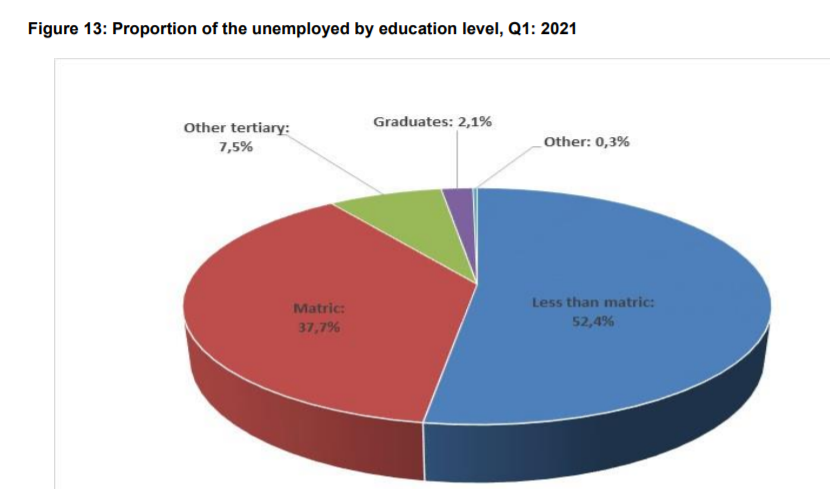
Maluleke said of the 7,2 million unemployed persons in the first quarter of 2021, 52,4% had education levels below matric, followed by those with matric at 37,7%.

He said only 2,1% of unemployed persons were graduates, while 7,5% had other tertiary qualifications as their highest level of education.

Maluleke said some young people have been discouraged with the labour market and they are also not building on their skills base through education and training.

“These young people are not in employment, education or training (NEET). The NEET rate serves as an important additional labour market indicator for young people.

“Of the 10.3 million young people aged between 15 and 24, 3.3 million are not in employment, education or training. This overall rate increased by 1,7 percentage points in the first quarter of 2021 compared to the last quarter of 2020,” said Maluleke.

The Quarterly Labour Force Statistics (QLFS) also shows that the NEET rate for women is higher than that of their male counterparts in both years.

Compared to the first quarter of 2020, the percentage of young persons aged 15–34 years who were not in employment, education or training increased by 1,9 percentage points from 41,7% to 43,6% in the first quarter of this year.

Maluleke said the NEET rate for males increased by 2,0 percentage points, while for females the rate increased by 1,7 percentage points in the first quarter of 2021.

The report also shows that when we compare quarter one of 2020 with the first quarter of 2021, more than four in every ten young females were not in employment, education or training.

READ: Dear graduate, you should take that ‘crappy’ job

Analysts say limited economic and educational prospects have exacerbated youth frustrations in the country.

Former Wits University Student Representative Council (SRC) deputy president and researcher in the EFF Parliamentary caucus Tokelo Nhlapo, said the National Treasury budget cuts led to 2021 Fees Must Fall protests around the country.

Nhlapo said the brutal killing of 35-year-old Mthokozisi Ntumba in March this year must be understood in the context of government’s systematic defunding of public universities and the fascist culture cemented by former Wits University Vice-Chancellor and former chair of Universities South Africa, Adam Habib.

Adding that over the past few years, students have protested against fee exclusion, insourcing of cleaning and security workers, decolonisation of universities and gender equality.

“Since the 2015/16 Fees Must Fall protests, one thing that been permanent at many of the student protests has been the violent repression of students’ voices through the deployment of private security and the South African Police Service, effectively criminalising protests at universities.

“The consequence has been the abandonment of democratic liberties through violence and repression in almost all public universities in South Africa,” said Nhlapo.

The post South Africa’s youth unemployment crisis – a ticking time bomb appeared first on Inside Education.

Uncategorized

Nine schools in the Northern Cape expected to reopen following Covid-19 cases

NYAKALLO TEFU| 

Nine schools in the Northern Cape are expected to reopen their doors on Monday after shutting down due to Covid-19 cases.

The Northern Cape Education Department has seen a major increase to see a rise in Covid-19 for a fourth consecutive week.

The Department last week recorded over 300 new Coronavirus cases which include the infection of learners, teachers, and staff.

“11 schools closed in the Northern Cape due to Covid-19 infections. Of these schools, nine are scheduled to reopen on Monday, 7 June 2021,” said department spokesperson Geoffrey Van Der Merwe.

READ: The Northern Cape sees sharp increases in Covid-19 infections in schools

This as the number of Covid-19 cases in the country continues to increase.

The Department of Health recorded 5074 new cases in the past 24-hours.

The Northern Cape province alone recorded 348 positive Covid-19 cases in the last week.

“These include 52 educators, 276 learners and 20 support staff at schools,” said Van Der Merwe.

Van Der Merwe said parents must ensure that they limit the movement and social interaction of their children in and around communities.

“This is evidence that our schools are mirrors of the rising infection rate in our communities. Parents must ensure that they limit the movement and social interaction of their children in and around their communities,” said Van Der Merwe.

Inside Education reported that teachers over the age of 40 are expected to be vaccinated. The Department of Health said more than 500 000 Johnson & Johnson vaccines have been secured for the education sector.

READ: Teachers over 40 to be vaccinated from Wednesday

The post Nine schools in the Northern Cape expected to reopen following Covid-19 cases appeared first on Inside Education.