Uncategorized

Teachers over 40 to be vaccinated from Wednesday

Teacher unions have confirmed that educators, cleaners and other support staff at public schools in South Africa will be vaccinated against the Covid-19 virus starting Wednesday this week.

Unions say at least 500,000 Johnson & Johnson vaccines have been secured for the education sector.

Inside Education saw a letter by the Head of Health in KwaZulu-Natal, Dr Sandile Tshabalala, addressed to the Head of Education Enock Nzama asking that he makes departmental coordinators available for planning meetings last week.

READ: Teachers set to be vaccinated in the next week

In the letter written on Thursday titled: Vaccination of educators, Tshabalala said the national department of education has confirmed that the J&J vaccines would be made available in the next week and that “most of which should be used for educators”

Media reports state that the doses are still awaiting approval from the food and drug administration.

Following consultations between the Department of Basic Education and various stakeholders, Naptosa Executive Director Basil Manuel said they anticipated that teachers aged 40 and above will start to receive their jabs from Wednesday.

“The efforts to secure a vaccine for education workers, not just teachers, have been successful,” Manuel.

Manuel added the Department of Health will confirm vaccination schedules and allocate sites according to each school district

“We are busy currently with the logistics around rolling that out to all the schools including governing body paid teachers, starting with those over the age of 40 and starting with public schools.”

READ: Teacher unions push to have teachers vaccinated in June

The post Teachers over 40 to be vaccinated from Wednesday appeared first on Inside Education.

Uncategorized

School District Agrees To Pay $3M In Bullied Child’s Suicide

THE parents of an 8-year-old boy who killed himself after being bullied repeatedly at an Ohio school have reached a tentative $3 million settlement with his school district.

The agreement announced Friday will go to the school board for Cincinnati Public Schools on Monday for approval in the Gabriel Taye case that dates to 2017.

The schools also agreed to actions to prevent a repeat of such bullying with such steps as training and supervising all staff on anti-bullying reforms and to working to identify repeat offenders, victims and locations. There will be two years of oversight of the district’s anti-bullying plan.

A memorial to Gabriel will also be placed at Carson School, the elementary school he attended.

 “In honor of Gabe, his family is using this settlement to protect current and future CPS students,” said the family’s lawyer, Al Gerhardstein. “We will make sure these reforms take root and end bullying throughout the CPS system.”

The Cincinnati Enquirer reported that attorney Aaron Herzig, a partner at the Taft law firm who represented the school district in the case, said a resolution was in everyone’s best interest.

“The defendants strongly believe that neither CPS, its employees, nor the school nurse were responsible for the tragic death of Gabriel Taye,” Herzig said.

“CPS embraces the goal of eliminating bullying within schools, as well as continuing to refine and improve reporting, management, and training processes related to incidents of bullying.”

The wrongful death lawsuit cited repeated examples of Gabriel and others being bullied at his elementary school. His parents contended that school officials knew about the bullying but were “deliberately indifferent,” allowing a “treacherous school environment.”

NBCNEWS

The post School District Agrees To Pay $3M In Bullied Child’s Suicide appeared first on Inside Education.

Uncategorized

Nzimande clarifies NSFAS funding criteria

NALEDI SHOTA|

Higher Education, Science and Technology Minister Blade Nzimande said that students funded by the National Student Financial Aid Scheme (NSFAS) will not lose their funding if they change their course or move to another higher education institution, as long as they are still eligible for funding. 

Nzimande was responding to a parliamentary question, this week, by DA MP Tarabella Marchesi who asked, amongst other things,  whether the scheme stops funding students if they change universities.

In a press statement on Wednesday, addressing the same issue, Nzimande said that changing a course does not affect funding. 

“No, Nsfas does not stop funding because students change institutions.  Nsfas  funding stops when the student fails to meet the academic eligibility criteria and the N+ rule,” said Nzimande. 

The N rule is the minimum qualification completion time also known as regulation time specified by the institution for a programme of study funded by NSFAS. 

“ N+1 applies to first-time entering students first registered after December 2017, whilst N+2 applies to students who first registered before January 2018.

“If a student has transferred from any other public university, regardless of whether they were funded at that university, the number of years already registered for the qualification must be counted as part of the minimum qualification completion time,”  he said.

Students who qualify for NSFAS are those who are recipients of the SASSA grant, and whose combined household income is not more than R350 000 per year. And for students who are disable the combined household income must not exceed R600 000 per year for them to qualify for funding by the scheme. 

Recently, the NSFAS board told the portfolio committee on higher education that for this year the scheme had assessed 323 445 Technical and Vocational Education and Training college and 940 226 university students to be eligible for funding. 

The post Nzimande clarifies NSFAS funding criteria appeared first on Inside Education.

Uncategorized

Teachers set to be vaccinated in the next week

NALEDI SHOTA|

Teachers are set to be vaccinated within the next few weeks.

Inside Education has seen a letter by the Head of Health in KwaZulu-Natal, Dr Sandile Tshabalala, addressed to the Head of Education Enock Nzama asking that he makes departmental coordinators available for planning meetings today. 

Inside Education has confirmed the authenticity of the letter from two independent sources. 

In the letter written on Thursday titled: Vaccination of educators, Tshabalala said the national department of education has confirmed that the J&J vaccines would be made available in the next week and that “ most of which should be used for educators”

“The target group is basic education (all staff members of primary and secondary schools). It is expected that the dedicated vaccination sites for educators will be ready by Wednesday, 9th June 2021, and the vaccination period will be for two week,”  reads the letter.

Inside Education also understands that teacher unions are meeting with the Department of Basic Education today and the agenda is teacher vaccination. 

Inside Education reported on Tuesday that teacher unions had written to the national departments of health and education asking that teachers be prioritised for vaccination this month. 

READ: Teacher unions push to have teachers vaccinated in June

The teacher union leaders that spoke to Inside Education said ideally they wanted their members to be vaccinated before 26 July when all primary school learners and learners in special education needs schools are expected back in class daily. 

Basil Manuel, Naptosa Executive Director said, at the time, teachers must also be regarded as frontline workers because they come  into contact with large groups of people compared to the police, for example. 

While General Secretary of Sadtu, Mugwena Maluleke, also told Inside Education on Tuesday that a delay in vaccinating teachers may lead to education of learners being disrupted. 

The post Teachers set to be vaccinated in the next week appeared first on Inside Education.

Uncategorized

Matric June exams scrapped

The Department of Basic Education has scrapped mid-year exams for matric pupils.

This was announced by Minister Angie Motshekga during a presentation to the Portfolio Committee on Basic Education.

Motshekga said the move is to allow Grade 12 pupils more time to cover the curriculum.

“We want to make up for the loss of time and for them to cover the curriculum. They did not go on holiday in March and most of the schools are giving extra classes.

“The June period of exams will be used to cover the curriculum. We also have a team monitoring Covid-19 infections on a daily basis,” Motshekga said.

The South African Democratic Teachers Union (Sadtu) General Secretary Mugwena Maluleke said learners have lost a lot of learning time due to the Covid-19 pandemic and lockdown which has put restrictions on how many can attend class at a time.

“Last year’s grade 11 pupils were hit hard by losing so much of the school year in 2020.

“Grade 11, in terms of the phased opening of schools, after those first couple of months in the first term, they didn’t return to school in 2020 until July,” he said.

Adding that the grade 12 class of 2021 was in a much more difficult situation than last year’s class.

Maluleke said grade 12 teachers had to work backward to help their learners catch up with the grade 11 syllabus.  “There is a serious backlog and the situation is very serious,” he added.

The minister said regarding the grade 12 class of 2021, the education authorities will try to keep these learners in school for as long as possible, in order to try to cover the gaps.

“They are grade 11s of 2020 and already the whole curriculum was not covered. They lost close to 60% of school time over the period,” said Motshekga.

Committee chair Bongiwe Mbinqo-Gigaba said all public-school learners lost 54% of teaching time.

 She said the committee noted the loss in learning hours that has already occurred in the 2021 school year, due to the academic year starting later.

“The majority of learners not attending five days of schooling per week as they were using a rotational system.

“This together with the loss of learning hours in 2020, does not bode well for our education system. We know and understand that it is not a South African phenomenon but a world-wide challenge, however we remain concerned,” Mbinqo-Gigaba emphasised.

She said this was quite a lot and it would not be easy to recover.

The post Matric June exams scrapped appeared first on Inside Education.

Uncategorized

Provinces gear up for the 2022 academic year as they open admission process in schools

NALEDI SHOTA|

Several provinces have opened the process of application for admissions in public schools for the 2022 academic year. 

The provincial departments of education that have already begun with this process have urged parents to apply on time to allow them enough time to prepare for the academic year next year.

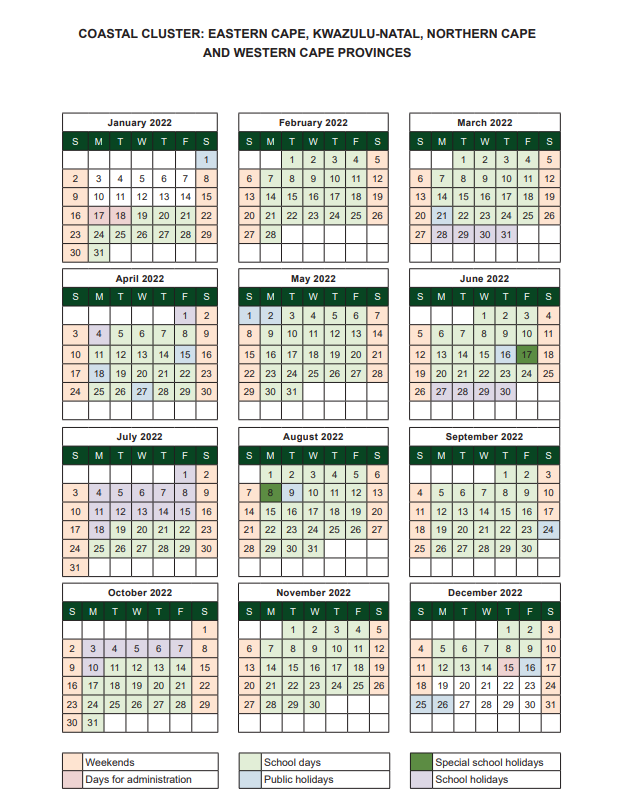
This week, the Department of Basic Education released the academic calendar for coastal and inland schools. Coastal schools will open on 19 January while inland schools will do so on 12 January. 

READ: DBE releases 2022 school calendar

The Western Cape Department of Education was the first to kick off admissions in February and the process ended on 31 March. In a statement last month, the department said between the time admissions opened until they were closed in March it had recorded 408 672 applications. 

The Western Cape is one of the provinces that battle with an influx of learners into that province that it battles to place them in schools on time. For this academic year some learners in that province were only placed last month in schools.

The Northern Cape Department of Education opened online admissions on Tuesday for grades R, one and eight and it said on the first day it had already received 5600 applications. 

MEC of Education in the Northern Cape, Zolile Monakali, encouraged parents to be “responsible” and apply on time. 

“[Let’s] make sure we register our children on time so that the education system can open and run smoothly as we are preparing for the 2022 academic year,” said Monakali on Tuesday.

The KwaZulu-Natal Department of Education opened for admissions on 3 May and the process will run until 1 October. In Limpopo the process opened on 17 May to 30 July for walk-in registration, while the online registration, at selected schools, will run from Today until 6 August. The province is piloting online admission. 

Other provinces are yet to announce the start date of their admissions processes. 

Last month, the DA in Gauteng criticized the Gauteng Education for not having started with its admission process. 

In a statement, DA shadow MEC Khumo Ramulifho, urged MEC of education Panyaza Lesufi to open online admissions from last month and for the process to be concluded in October. 

“By moving the online admission earlier, this will ensure that no learner misses a day of schooling when the new academic year begins as all allocations will be done timeously,”  said Ramulifho at the time. 

However, the province is yet to announce when it will open the online application system for the 2022 academic year. Gauteng, just like the Western Cape, is one of the provinces that battles large numbers of learners applying at the province’s schools. Some learners were also just placed in schools at the end of March. 

The post Provinces gear up for the 2022 academic year as they open admission process in schools appeared first on Inside Education.

Uncategorized

DBE Portfolio Committee supports return to class full-time for primary and special education learners

NALEDI SHOTA 

The National Assembly Portfolio Committee on Basic Education has come out in support of the plans by the Department of Basic Education (DBE) to allow primary school learners and learners from special education needs schools to return to class daily. 

On Friday, DBE Minister Angie Motshekga gazetted that on 26 July learners in grade R to seven would return to class daily as well as grade R to 12 at special education needs schools.

Since the outbreak of Covid-19 last year, learners have been attending school on a rotational system in order for schools to adhere to Covid-19 regulations such as social distancing. 

On Monday the department appeared before the committee to, amongst other things, present its plans to allow all primary school learners and those at special education needs back at school daily next month. 

In the presentation, the department said last year alone primary school learners lost 54% of contact time, 23% of this was due to the total closure of schools during lockdown and about 27% was as result of rotational attendance. 

The department said Director General, Mathanzima Mweli, will be doing weekly one-on-one engagements with provinces to gauge the extent of readiness before 26 July.

Provinces will also be expected to report on their progress to comply with health protocols to minimise the spread of the virus, and this they would have to do weekly. 

DBE has said that it expects a pushback on its decision from various quarters including through litigation, but said it was having ongoing engagements with stakeholders and would also use science as a defence in litigation. 

In a statement, committee chairperson Bongiwe Mbinqo-Gigaba, said the committee supports the decision to have primary school learners returning to school full-time. 

“We support this decision as long as the DBE can ensure that there is a safe and secure environment to go back to school. I have noticed that there has been regress when the younger ones only have alternative days of schooling,” she said.

Mbinqo-Gigaba said the loss of learning hours in 2020 is not good for the education system. 

“We know and understand that it is not a South African phenomenon but a world-wide challenge, however we remain concerned.”

In the gazette, Motshekga said the return of the learners to class full-time would depend on the direction the pandemic is taking in district municipalities and the country. 

Motshekga has also told the committee that the DBE decisions on the return to school is done in consultation with the Department of Health and that  should the health department  advise otherwise if the country finds itself in third wave the DBE would  reconsider and revise its position regarding the daily return of learners.

On Sunday, President Cyril Ramaphosa announced that the country would return to level 2 of the lockdown as cases of Covid-19 are going up again. Ramaphosa said provinces such as Gauteng, Northern Cape , North West and Free State were already in the third wave. 

The post DBE Portfolio Committee supports return to class full-time for primary and special education learners appeared first on Inside Education.

DBE releases 2022 school calendar
Uncategorized

DBE releases 2022 school calendar

Basic Education Minister Angie Motshekga has published the new 2022 calendar for South African public schools.

The country’s inland provinces are set to officially begin the school year on 12 January 2022 and conclude on 14 December.

This is a total of 199 school days across the four terms including the holidays.

The coastal cluster of schools will start a week later on 19 January and conclude on 14 December, with the extra days made up through slightly longer terms throughout the year.

Coastal schools

Inland schools

Motshekga recently gazetted updated lockdown regulations for South Africa’s primary schools and special needs schools.

She said primary school pupils and pupils attending schools with special needs are to return to full-time learning from the end 26 July.

Currently, most students in South Africa are learning on a rotational basis, with a large amount of learning and coursework still expected to be done at home in an effort to increase social distancing.

Motshekga said her department will now use a risk-adjusted differentiated strategy – where school attendance is determined by the direction the pandemic is taking in specific districts or the country as a whole.

The minister came upon huge criticism after making this decision. A number of provinces including the Free State, the Northern Cape, North West and Gauteng have seen sharp increases in the Covid-19 infection rate.

These schools saw schools close down in an attempt to control the outbreak.

READ: Union concerned about DBE’s ability to manage full-time return to primary schools

The post DBE releases 2022 school calendar appeared first on Inside Education.

Uncategorized

Education activist says Equal Education should account for learner’s death

Education activist Hendrick Makaneta has called on Parliament’s Portfolio Committee on Basic Education to institute an enquiry into Equal Education’s fitness to work with children following the untimely death of a minor, who died at a camp that was organised by Equal Education.

This comes after 15-year-old grade 10 pupil from Xolani High School in the Eastern Cape Avethandwa Nokhangela drowned while attending a leadership camp at Palm Springs Resort outside East last month.

Makaneta said the teaching community is extremely disturbed by the news of the untimely death of Avethandwa passing.

Makaneta asked that the Portfolio Committee on Basic Education institute an enquiry into Avethandwa’s death “with a view to ensure that the NGO is held accountable for the incident that has caused trauma and shock to the entire country”, he said.

“It should be clear from preliminary reports that Equal Education failed to protect the life of Avethandwa, and they should therefore take full responsibility and apologise to the nation.

“Equally they should offer to appear before the Portfolio Committee on Basic Education even before they are called to explain themselves,” said Makaneta.

Equal Education has since released a statement that its law centre is leading an independent investigation and will conclude a fact-finding process.

The NGO said its national council has appointed an independent panel to review the process and make finding on the circumstances surrounding learner’s passing.

“It has not been easy to respond to some criticism in the media around the immediate disclosure of what happened on 29 April.

“We believe that the compassionate approach – which was to prioritise support to the grieving family, learners and our staff – was the correct one in the circumstances. We also chose to respect Avethandwa’s family’s request for space after laying her to rest. Not only would divulging details in these circumstances have been insensitive and uncaring, it would prejudice the Equal Education Law Centre’s fact finding inquiry and the work of the independent panel,” said the Equal Education’s board.

Last week Department of Basic Education spokesperson Elijah Mhlanga also criticised the NGO.

“So many unanswered questions yet Equal Education is nowhere to take responsibility and shed light publicly on what really happened regarding Avethandwa’s death,” said Mhlanga.

In response, Equal Education’s Professor Mary Metcalfe said the loss of Avethandwa is terrible – and in such tragic circumstances for the family.

“But it is unfair to take such a hostile attitude to Equal Education. Let the enquiry inform us of what can all learn from this incident,” said Metcalfe.

Adding that she regards the NGO as an asset to the country.

Mhlanga, Like Makaneta, said the department has not taken a hostile attitude against the NGO but that Equal Education must account like everyone else.

Makaneta said Equal Education as an NGO should not only fight for equality, but they must also obey the laws of the country by ensuring that the lives of the children under their care are protected.

“It cannot be correct that such a young life was lost whilst under the care of the NGO,” he said.

The post Education activist says Equal Education should account for learner’s death appeared first on Inside Education.

Uncategorized

Cornwall Hill College: Learners and parents protest racism at the prestigious school

Gauteng Education MEC Panyaza Lesufi visited Cornwall Hill College in Irene, Pretoria, on Monday morning following allegations of racism at the school.

Last week, at the school’s annual fund-raising golf day at the Pretoria Country Club, parents held a peaceful protest against the racism experienced by their children at the school as well as the lack of diversity and the slow pace of transformation.

Parents and learners also gathered at the school this morning. They handed a memorandum against racism and the lack of transformation at the school to the school management and to Lesufi.

Parents also called on the school’s principal to resign for what they say is his failure to ensure an anti-discriminatory and non-racial environment at the school.

Learners at the school shared their traumatic experiences on video. Some said their teachers told them that black people come from apes.

Others said they have been referred to as “bloody k*ffirs”.

The learners also said they are not allowed to speak their mother tongues at the school and their natural hair is often called messy and dirty.

Singo Ravele, a learner at the school, shared how racism at the school has affected her.

Singo shared her first and most vivid memory when she was only in the fourth grade.

I was so happy to he accepted into the school, she said.

“And as a child I began to imagine a fairy-tale for myself. And that didn’t happen. Very soon that dream died,” said the girl.

“It died when a community that I loved did not love me back.

“And although I managed to find friends,” she said and began to cry, covering her face with her hand.

At this point, another girl walked to Singo at the podium holding the placard: “Racists must leave Cornwall Hill College”. The words “racists” and “leave” boldened and highlighted in red. The girl stood at Singo’s side, silent.

Singo’s father walked to her at the podium and held her.

Other learners screamed words of encouragement and began to clap.

“… and although I managed to find friends,” Singo said, her voice breaking, “I didn’t manage to escape the discrimination.”

“And that is not a dream at all. It is a nightmare,” she said.

This is not the first time that Cornwall Hill College is In the news because of racism.

Former Cornwall Hill College learner Kholofelo Mashitisho said, “I went to Cornwall Hill College, I am so glad these kids are doing what we were scared to do. I am proud.”

She added that at the high school, “you raise your voice, you get expelled”.

Another former pupil and head boy said: “I stand and fully support the class of 2021 calling out racism and standing up for a fully inclusive CHC (sic). Why has the school’s leadership ignored such accounts of racism for so long? Racists are not welcome, they must leave,” he said.

Addressing parents, media and learners this morning, Gauteng education MEC said: “I am worried about time, we committed that we will conclude this session by 07:30 so that we can demonstrate to those that think we are not human beings that we can adhere to time as well.

Lesufi said they, “these people”, may have oppressed our grandparents and succeeded. They may have oppressed our parents and succeeded, but they will not oppress our children and our children’s children, said Lesufi.

“It ends here, and it stops here,” said Lesufi.

He said his discussion with the school leadership was clear in that the school management had to go back to the negotiating table and make it clear everyone is very welcome in the school.

This was met with applause.

He added that the school management must stop “with the obsession with the hair of our children”.

In his address, Lesufi declared “racism ends here and goes no further”. The MEC made commitments that the school will have teachers that represent everyone.

He said all the policies will be reviewed so that they become accommodative.

The South African Reserve Bank Governor, Lesetja Kganyago, also took part in the morning protest.

Kganyago said his protest was done in his capacity as a parent and not as the SARB governor.

Kganyago held a placard with the words: “We stand by our children. No to racism”.

Kganyago ‘s daughter is a learner at the school.

He said there is systemic racism at Cornwall Hill College.

“The number of black learners has never been more than 25%. Secondly, the school has 66 educators and five of them are black and three of those black educators are concentrated in the Sepedi department,” Kganyago said.

Learners at the school also said there were incidents of racism including being separated at the tuckshop lines based on race. White learners would have their own line, while black learners had their own line.

Lesufi said that no one was out for revenge for what had happened in the past but he was pleading for inclusivity.

“We will have teachers that represent all of us and all the policies will be reviewed, so I urge you to protect this school. But in protecting this school, we must not protect the wrong things. Even those that hate non-racialism, this is the future and no one can stop it,” Lesufi said.

Singo penned three testimonies into the addendum that was later handed to Lesufi and the school’s management.

Singo said her first and very vivid memory of racism happened when she was only in the fourth grade. She said she was  happily on my way to break when a teacher stopped her.

“She had this big frown that swallowed me whole.

“She looked me dead in the eyes and said, ‘Your hair’s unpresentable, it is messy and it’s not the Cornwall way.’ She also proceeded to tell me that I would look better if I chemically straightened my hair.

“When I got older, I became angry. I was stripped from my African identity. And that was one time, one moment, one person,” she said.

Leon Kunneke, Executive Principal at Cornwall Hill College said the school was aware at the peaceful protest action around diversity and transformation of the school. He said the school acknowledges the parents’ pleas and recognise the importance of active and inclusive engagement.

He said the school’s board is unequivocally committed to transformation.

“Matters relating to diversity are being revisited,” he said.

“They include hair policy, anti-discriminatory policy and a framework where matters of concern raised by pupils, past and present, could be addressed,” said Kunneke.


The post Cornwall Hill College: Learners and parents protest racism at the prestigious school appeared first on Inside Education.