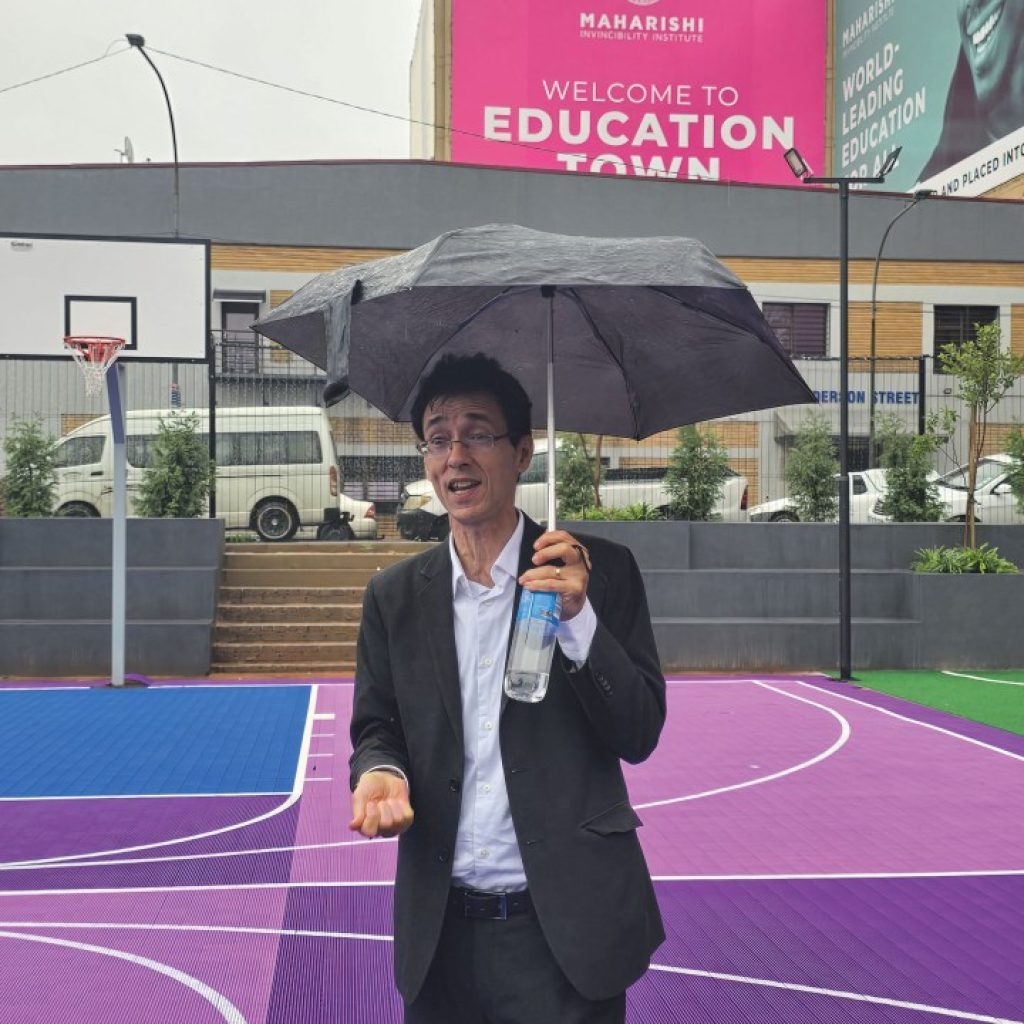
‘Field of Dreams’ brings new goals for Joburg inner-city children
Uncategorized

‘Field of Dreams’ brings new goals for Joburg inner-city children

By Johnathan Paoli

A new initiative in the heart of Johannesburg’s inner city is tackling the dangers faced by children playing football on unsafe streets.

The Field of Dreams, developed by the Maharishi Invincibility Institute (MII) in partnership with Standard Bank, Italtile, the BW Cares Foundation, and former cricket captain Ali Bacher, intends to bring safe, accessible recreational facilities to the communities that need them most.

MII CEO Taddy Blecher, speaking during the recent sod-turning ceremony to celebrate what will soon become the first full-sized soccer field ever built in the Johannesburg CBD, described the field as a green beacon of hope visible to nearly a million motorists each day along the M1 highway.

“This is more than just grass, it is a promise to our youth. For decades, this city has been known for its gold and industry. Today, we are digging deep for something more valuable; the genius, creativity, and infinite potential within the city’s youth. The Field of Dreams will be a place where they build confidence, learn teamwork, and see that their futures are boundless. It is a symbol that pride is being restored to our city,” Blecher said.

He said that the field forms part of MII’s broader “Education Town” campus, a hub where thousands of young people from nearby townships and informal settlements come daily to study, learn skills, and access career opportunities.

The field, he said, represents a green gateway to a space where education and recreation meet to empower the next generation.

The project has been driven by Bacher, with the support of Jozi My Jozi, a civic and corporate coalition focused on transforming the Johannesburg city centre into a place of safety, opportunity, and pride.

For Bacher, whose long-standing career in sport administration includes rebuilding South African cricket in the post-apartheid era, this is another chance to use sport as a force for unity and development.

While the Field of Dreams is new to the inner city, it forms part of a wider movement using sport as a tool for education and upliftment.

One such example is the SafeHub network, founded by AMANDLA Social Enterprises in 2007.

The organisation provides secure environments where young people can play, learn, and access education and mentorship programmes.

According to the SafeHub global website, there are 13 SafeHubs either operational or in development across South Africa.

In Johannesburg, three hubs in Diepsloot, Alexandra, and Jabulani are anchored by high-quality soccer pitches and community programmes offering after-school tutoring, digital literacy, job readiness training, and mentorship.

Refiloe Tsiyane, acting facility manager at the Alexandra SafeHub, said the initiative tries to bridge the gap between physical education and life skills from an early age.

“We also have an ECD (Early Childhood Development) programme that we run. We fetch kids for an hour session once a week. In Alex, most of our ECDs don’t have space for movement, and many teachers aren’t equipped to provide physical education,” she said.

Lindani Ntuli, Youth Café programme manager at the same SafeHub, expressed optimism at the opportunities afforded by the project.

“Young people in Alex come from disadvantaged backgrounds. Through programmes like EduFootball and digital training partnerships, we are creating pathways to opportunity. Projects like the Field of Dreams will help expand that ecosystem of hope,” Ntuli said.

But while new spaces of hope are being built, the decline of public recreational areas remains a serious concern.

Once-vibrant parks such as Jukskei Park and Joubert Park have fallen into neglect, plagued by crime, vandalism, and poor maintenance.

Joubert Park, once the city’s proudest green haven and its oldest park, now stands as a symbol of urban decay, with its playgrounds broken, walkways overgrown, and reputation marred by crime and drug use.

Blecher said the Field of Dreams represents a different kind of investment, not in concrete or commerce, but in the spirit of community and the future of Johannesburg’s children.

INSIDE EDUCATION

Uncategorized

Gondwe pushes for ‘opportunity-driven’ TVET model to tackle youth job crisis

By Palesa Nguqu

Deputy Minister of Higher Education and Training Dr Mimmy Gondwe has called for a shift in South Africa’s skills strategy, saying the country must move beyond training for existing jobs toward creating new ones through an ‘opportunity-driven’ Technical and Vocational Education and Training (TVET) model.

Gondwe made the remarks during her participation in the Going Global Conference 2025 in London, where she promoted South Africa’s TVET and community colleges as engines for youth employment and innovation.

Invited by the British Council, Gondwe joined international education leaders and met with organisations such as King’s Trust International to strengthen partnerships that can help align the country’s training programmes with global standards and industry needs.

“Our goal is to build strong, sustainable partnerships that will enhance skills development for our youth and create real employment opportunities. International cooperation is key to achieving this vision,” said Gondwe.

Her visit included panel discussions on the future of skills development and the resilience of higher education systems in times of global uncertainty.

Gondwe said the government is intent on repositioning the TVET and community college sectors through international cooperation and innovation. “By leveraging global expertise and resources, South Africa seeks to position its TVET system as a cornerstone of economic growth and social development,” she said.

She said a fundamental rethink was needed of how the country approaches vocational training.

“The distinction between opportunity-driven, supply-driven, and demand-driven TVET models is becoming increasingly important in South Africa’s current skills development discourse, especially as the system transitions toward more agile and inclusive skills ecosystems.

“Historically, much of the TVET college system operated on a supply-driven model. Programs like NATED (N1–N6) and NC(V) were rolled out nationally with little regional differentiation, leading to misalignment with provincial and local economic opportunities.

“The introduction of Centres of Specialisation (CoS) moved towards a demand-driven system which is employer- and industry-led, focusing on current labour market needs. Demand-driven responds to specific skills demands from sectors or employers. However, while demand-driven systems improve relevance, they often prioritise existing industries, sometimes neglecting emerging or informal economic opportunities.

“An opportunity-driven TVET model goes beyond current employer demand to anticipate or create new economic opportunities especially in emerging sectors like the green economy, digital innovation, and community-based enterprises. It is entrepreneurial, forward-looking, and inclusive, seeking to equip learners to generate livelihoods, not just fill existing jobs,” she said.

Among the initiatives under way are the development of industry-relevant curricula, digital learning integration, and international exchange programmes for students and educators, efforts the department says are aimed at modernising training and improving graduate employability.

Gondwe said that long-term reforms should include a future-focused national planning framework.

INSIDE EDUCATION

Uncategorized

As backlash grows, Gauteng Education defends timing, funding cuts for Quintile 5 schools

By Johnathan Paoli

The Gauteng Department of Education has defended its decision to slash subsidies for Quintile 5 schools from R879 to R315 per learner for the 2026 academic year, insisting the move complies with national funding norms and was necessary due to budget cuts.

Department spokesperson Steve Mabona said the revised allocations were finalised on 30 September, the statutory deadline for confirming resource allocations, and that schools were notified in accordance with national guidelines.

“Since the 2021 medium-term expenditure framework, departments have faced budget cuts due to fiscal consolidation by the National Treasury. There’s no additional funding received, and there remains a shortfall in the 2026/27 budget even after implementing the new funding model,” Mabona said.

According to the department, the reduction aligns with the adequacy amount applied to Quintile 4 schools, as the department seeks to balance its books in the face of declining real-term allocations from Treasury.

Quintile 5 schools, typically fee-paying and located in better-off areas, have for several years received a discretionary provincial top-up to close the gap between their funding and that of Quintile 4 institutions. That top-up has now been withdrawn.

While Mabona said the decision was necessary to contain financial pressure and ensure compliance with national guidelines, the move has provoked a storm of criticism from opposition parties, teachers’ unions, and school governing bodies (SGBs), who warn it will trigger higher fees, job losses and larger class sizes.

The Solidarity Teachers’ Network has written to the department urging an immediate review of the cuts, warning that the 66% reduction will push the education system to breaking point.

Johan Botha, head of the network, said teachers and support staff would bear the brunt of the cuts.

“Overcrowded classrooms, rising workloads, and increasing emotional strain will make it nearly impossible for teachers to maintain effective instruction. This will erode teaching quality and ultimately harm our children’s education,” Botha said.

In a strongly worded letter, Solidarity accused the department of procedural failures and loss of professional trust, noting that some schools only received their funding letters after 14 October, well beyond the required deadline.

Solidarity has called on Gauteng Education MEC Matome Chiloane to restore funding to at least Quintile 4 levels pending consultation, release transparent data on how the cuts were determined, and ensure timely payments going forward.

The Federation of Governing Bodies of South African Schools (FEDSAS) estimates that at least 750 Gauteng schools will be affected by the cuts. Deputy CEO Jaco Deacon said the reduction represents a loss of about R500 per learner per year, or roughly R600,000 annually for a medium-sized school with 1 200 pupils.

“Schools have already finalised their 2026 budgets based on previous allocations. Many now face the impossible task of finding hundreds of thousands of rand to balance their books,” Deacon said.

Gauteng FEDSAS manager Deon Lerm added that the assumption that all Quintile 5 schools are wealthy is false.

“At some schools, up to 35% of fees cannot be recovered. Combined with this sudden loss of more than 60% of the subsidy, the enormity of the provincial department’s decision becomes clear,” Lerm said.

He warned that schools may have to cut School Governing Body (SGB)-funded teaching posts and scale back on staff development, directly impacting classroom quality.

Equal Education researcher Mahfouz Raffee said while Quintile 5 schools are usually located in better-resourced communities, many still serve learners from low-income households.

“This decision will disproportionately affect poorer pupils attending those schools, as their parents will now face higher fees or deteriorating school services,” Raffee said.

The department said schools may apply for fee increases or compensation in 2026.

“We acknowledge the concerns raised, but the department must align with national norms and manage within available resources,” Mabona said.

The department said it would continue to review spending priorities to manage the shortfall and prevent similar disruptions in the future.

INSIDE EDUCATION

Uncategorized

Manamela to meet with Karen Stander, following allegations of racism, bullying, and intimidation

By Johnathan Paoli

Higher Education Minister Buti Manamela has formally acknowledged the resignation of Dr Karen Stander as chairperson of the National Student Financial Aid Scheme (NSFAS) Board, following allegations of racism, bullying, intimidation, and threats to her personal safety.

In a statement issued on Monday, Manamela said he was deeply concerned by the gravity of the issues raised and would meet with Stander later in the day to discuss the matter directly.

“These matters warrant serious attention, and I will engage thoroughly before determining the necessary course of action. NSFAS plays a vital role in expanding access to higher education, and we must ensure that it operates in a manner that is ethical, transparent and accountable,” Manamela said.

A previously scheduled meeting with the full NSFAS board is expected to proceed on Wednesday, where the minister will engage on issues of governance, accountability, and organisational culture.

The department reaffirmed its commitment to supporting NSFAS in delivering on its core mandate — providing financial assistance to deserving students while ensuring that public resources are managed with integrity.

Stander’s resignation letter, addressed to Manamela and leaked to News24, reportedly paints a disturbing picture of dysfunction within NSFAS’s highest structures.

She described the working environment as increasingly toxic, alleging bullying, intimidation, racism and hostility among board members.

“These conditions have made it impossible to continue discharging my duties effectively and in good conscience,” she said.

She claimed that the hostility had extended into her personal life.

“In recent months, this hostility has also extended beyond the professional realm, creating a real and present danger to the safety and well-being of my family.”

Appointed earlier this year by former minister Nobuhle Nkabane, Stander described her departure not as an act of defiance, but one of conscience.

“The concerns I raised during my tenure were never personal nor directed at any individual. They were strictly governance-related observations made in good faith,” she said.

Stander added that her communications with the department were aimed at strengthening oversight and accountability, not discrediting colleagues.

Her resignation comes amid ongoing turbulence at NSFAS, which has been plagued by governance crises, administrative instability and student protests over delayed payments.

Stander herself has previously been outspoken about systemic weaknesses within the organisation.

In September, she warned that NSFAS’s information and communications technology systems were severely flawed and posed significant cybersecurity risks, noting that the systems were misaligned with operational needs and lacked integration.

She also pointed to leadership instability spanning nearly a decade, describing it as a key factor behind organisational dysfunction and reputational damage.

In her letter, Stander allegedly expressed hope that her resignation might allow the board to stabilise under new leadership better suited to its internal dynamics.

She also commended the acting CEO and senior department officials for their professionalism under difficult circumstances, and expressed appreciation for their support.

Manamela’s office confirmed that further communication would follow after his meetings with both Stander and the NSFAS board later this week.

Inside Education reached out to Stander, who refused to comment on the matter at the time of publication.

INSIDE EDUCATION

Uncategorized

University ranking systems are being rejected. African institutions should take note

By Sioux McKenna

The Sorbonne University, founded in Paris in 1253 and known globally as a symbol of education, science and culture, has announced that, starting in 2026, it will stop submitting data to Times Higher Education (THE) rankings.

It is joining a growing movement of universities questioning the value and methodology of these controversial league tables.

Rankings companies add together various indices that purport to measure quality. The indices include research outputs, the results of reputation surveys, the amount of money they receive in research grants and donations, and how many Nobel prize winners they have ever employed.

Nathalie Drach-Temam, president of the Sorbonne, stated that the data used to assess each university’s performance is not open or transparent and the reproducibility of the results produced cannot be guaranteed.

This echoes wider concerns about the lack of scientific rigour of ranking systems that claim to measure complex institutional performance through simplified metrics.

The problem is that the general public believe that the rankings offer an indication of quality. As a result rankings have enormous influence over the market. This includes the choice of where to study and where to invest funding.

The university’s decision aligns with its commitment to the Agreement on Reforming Research Assessment, an agreement signed by over 700 research organisations, funders and professional societies, and the Barcelona Declaration, signed by about 200 universities and research institutes.

Both advocate for open science practices to make scientific research, data, methods, and educational resources transparent, accessible and reusable by everyone without barriers. And both recommend “avoiding the use of rankings of research organisations in research assessment”.

The Sorbonne joins a growing list of high-profile institutions abandoning rankings. Columbia UniversityUtrecht University and several Indian institutes have opted out of major ranking systems. In the US, 17 medical and law schools, including Yale and Harvard, have withdrawn from discipline-specific rankings.

There are five major rankings companies and at least 20 smaller ones. On top of these are a similar number of discipline specific and regional rankings. Together they make up a billion dollar industry. Yet the rankings are accessible without charge.

The rankings industry has increasingly targeted African countries. It sees the continent as a new market at a time when it is losing traction among high profile institutions in the global north.

There has been a rapid increase in snazzy events run by rankings organisations on the continent. These events are very expensive and often quite luxurious – attended by vice-chancellors, academics, consultants and others.

As an academic involved in higher education teaching, I believe that chasing the rankings can harm Africa’s fragile higher education system. There are two main reasons for this.

Firstly, the rankings metrics largely focus on research output, rather than on the potential for that research to address local problems. Secondly, the rankings fail to consider higher education’s role in nurturing critical citizens, or contributing to the public good.

The Sorbonne’s decision reflects a growing body of opinion that the rankings industry is unscientific and a poor means of measuring quality.

Nevertheless, many vice-chancellors are not willing to risk the cost of withdrawing. Rankings might do a poor job of indicating quality, in all its nuanced forms. Nevertheless, they are very good at shaping public opinion. And even if a university chooses to stay out of the ranking by refusing to hand over its data, the industry continues to include it, based only on limited publicly available data.

The ranking industry

Rankings themselves are available for free. The ranking industry derives most of its revenue from reselling the data that universities provide. Universities submit detailed institutional data to ranking companies without charge. That information is then repackaged and sold back to institutions, governments and corporations.

This data includes institutional income. It often also includes contact details of staff and students. These are used for “reputation surveys”. In the case of QS University Rankings, “reputation” makes up more than 40% of the rankings.

This business model has created what can be described as a sophisticated data harvesting operation disguised as academic assessment.

Mounting criticism

Academic research has extensively documented the problems with ranking methodologies. These include:

the use of proxy metrics that poorly represent institutional quality. For example, while many university rankings do not include a measurement of teaching quality at all, those that do, use measures such as income, staff to student ratio, and international academic reputation.

composite indexing that combines unrelated measurements. The metrics that are collected are simply added together, even though they have no bearing on each other. Our students are repeatedly warned of the dangers of using composite measurement in research, and yet this is at the heart of the rankings industry.

subjective weighting systems that can dramatically alter results based on arbitrary decisions. If the system decides to weight reputation at 20% and then make university income worth 10%, we have one order of institutions. Switch these weightings to make the former 10% and the latter 20% and the list rearranges itself. And yet, the quality of the institutions is unchanged.

Rankings tend to favour research-intensive universities while ignoring teaching quality, community engagement and local relevance.

Most ranking systems emphasise English-language publications. This reinforces existing academic hierarchies rather than providing meaningful assessment of quality.

Where new rankings are being introduced, such as the Sub-Saharan Africa rankings, or the Emerging Economies rankings, or even the Impact rankings, they sadly still have the problem of proxy measures, and composite and subjective weightings.

In addition, many of the ranking companies refuse to reveal precise methodological detail. This makes it impossible to verify their claims or understand on what basis institutions are actually assessed.

Researchers argue that rankings have thrived because they align with the idea of higher education as a marketplace where institutions compete for market share. This has led universities to prioritise metrics that improve their ranking positions rather than activities that best serve their students and communities.

The emphasis on quantifiable outputs has created what scholars call “coercive isomorphism” – pressure for all universities to adopt similar structures and priorities regardless of their specific missions or local contexts.

Research shows that striving for a spot in the rankings limelight affects resource allocation, strategic planning and even which students apply to institutions. Some universities have shifted focus from teaching quality to research output specifically to improve rankings. Others have engaged in “gaming” – manipulating data to boost their positions.

Looking forward

Participation in methodologically flawed ranking systems presents a contradiction: universities built on principles of scientific research continue to support an industry whose methods would fail basic peer review standards.

For universities still participating, Sorbonne’s move raises an uncomfortable question: what are their institutional priorities and commitments to scientific integrity?

This article was first published in The Conversation.

INSIDE EDUCATION

Uncategorized

DUT student’s short film wins at Canada festival

Inside Education Reporter

Amanzi, a short film by Newcastle-born Lindani Msibi (26), who is studying an advanced diploma in drama and production at the Durban University of Technology (DUT), has won the award for best editing at the Canada Mobile International Film Festival (CIMFF).

Amanzi trounced entries from 10 countries to take the title. It was also nominated in the best cinematography and best mobile film categories.

Msibi described the nominations and win as “surreal”.

“I didn’t expect Amanzi to travel this far, let alone win an international award. Seeing my name among filmmakers from around the world reminded me why I started storytelling in the first place. Winning best editing was more than a personal victory; it was validation that stories from South Africa can stand tall on the global stage,” he said.

Amanzi, which is the isiZulu word for water, is the story of a woman tormented by ancestral spirits that demand that she embrace her calling as a traditional healer.

Msibi said the film explores the tension between modern religion and ancestral duty, using water as a metaphor for life, struggle, and renewal.

“The idea came from observing how water, something so ordinary, holds deep emotional, cultural and spiritual meaning. It’s about healing, connection and rediscovery. I wanted audiences to reflect on what sustains us, not just physically but spiritually,” said Msibi.

Behind the camera, Amanzi was a collaborative effort. “I was blessed with a passionate and creative team. From the cinematographer who captured the poetry in every shot to the sound designer who gave the film its heartbeat, every member brought something personal. That’s what made Amanzi truly alive,” he said.

Studying at DUT, he added, played a crucial role in his growth as a filmmaker.

“DUT gave me a space to experiment, to innovate and to learn without fear. The mentorship and training sharpened my skills but also helped me find my authentic voice. I learned to think critically about representation and storytelling ethics, which shaped who I am as a filmmaker today.”

Competing internationally taught him valuable lessons about creativity and authenticity, said Msibi.

“The biggest lesson is that your story matters, no matter where you come from. Don’t chase trends, chase truth. Our local stories are rich and layered; the world is waiting to hear them,” he added.

Msibi is already working on his next short film, exploring identity and memory through the eyes of a young South African woman reconnecting with her ancestral past. He also hopes to expand Amanzi into a feature-length project.

“The goal is to keep telling stories that carry both cultural depth and emotional honesty,” he said.

Inside Education

Uncategorized

Resilient’ Brink is back as City Manager: Lessons for future administrators

Marcus Moloko

Dr. Floyd Brink’s reappointment as Johannesburg City Manager offers a compelling case study for students of public administration and governance. 

Removed previously for irregular appointments, Brink returned after reportedly topping a competitive interview process.

The new City Manager topped 10 other candidates for the position, including former Johannesburg Property Company chief executive Helen Botes.

He was the leading candidate while Botes and Bryne Maduka followed closely behind on scores.

Brink’s appointment has been described as a strategic move for robust leadership and effective governance. He boasts over 22 years of work experience, which includes 16 years in senior management roles.  

His background includes financial management, engineering, and business administration.

On Thursday, the Johannesburg City Council approved Brink’s return.

His return, a third time in the role, has been met by challenges as he was previously removed due to a court order that deemed his appointment irregular.

Brink is believed to have close ties to the Economic Freedom Fighters (EFF), a concern for some ANC councillors who fear the appointment could shift power dynamics within the coalition. 

The ANC-led coalition, which includes the DA, IFP, Patriotic Alliance, and other smaller parties, faces a new test of unity as Brink’s tenure officially begins on November 1, as the city prepares to host the G20 summit. 

Brinks’ mandate will include stabilising service delivery in a city facing water shortages, power outages, and concerning infrastructure challenges.

While the DA has distanced itself from endorsing Brink, citing concerns over Brink’s previous tenure and the legal controversies surrounding his earlier appointments, a determined Brink allegedly proposed a city plan that outshone other potential candidates for the city manager role.

Brink left the city in December 2024 after a judgment found his appointment invalid following an application by the DA.

INSIDE EDUCATION

Uncategorized

Publishing matric exam results in newspapers facing potential ban

By Thapelo Molefe

The North Gauteng High Court has reserved judgment in the high-profile case about the legality of publishing matric examination results in newspapers and online public platforms, a long-standing South African tradition now facing a potential ban.

The two-day hearing held this week saw the Department of Basic Education (DBE) and the Information Regulator argue over whether the public release of National Senior Certificate results in their current format breaches the Protection of Personal Information Act (POPIA).

The case follows an earlier urgent application brought by the Regulator in January to block the release of the results, which the court dismissed for lack of urgency.

The Regulator has since sought a full review of the DBE’s publication practice, arguing that even publishing examination numbers without names on newspapers and digital platforms amounts to a violation of learners’ privacy under POPIA.

However, the department maintains that its current method of displaying only examination numbers does not violate the law. According to the DBE, the information cannot be linked directly or indirectly to any individual without prior or insider knowledge, meaning that it does not qualify as “personal information” under the Act.

“For decades, the publication of matric results has been a matter of public interest and national transparency,” the DBE said in a statement on Wednesday.

“It provides reassurance to learners, families, and the broader public regarding the integrity of the national examination system. The Department remains committed to balancing the right to privacy with the principles of openness, accountability, and public confidence in education.”

AfriForum, which joined the matter as a party supporting the continued public publication of results, has strongly defended the practice.

The organisation’s head of cultural affairs, Alana Bailey, said the dispute dates back to 2022, when the DBE initially sought to halt the release of results through newspapers and other media platforms.

“In that case, the judge agreed that publishing results was in the public interest and that using examination numbers instead of names sufficiently protected learners’ privacy,” Bailey said.

She added that at the start of the year, the Information Regulator once again attempted to block the publication of matric results in newspapers and online platforms, a move that was unsuccessful when Judge Ronel Tolmay ruled in favour of publication on 8 January.

“With that court order still in place, the DBE had no other choice but to oppose the Regulator’s instruction to withhold publication of the results,” Bailey said.

During this week’s proceedings, both parties argued over the definition of personal information and the balance between privacy rights and public access to information.

Bailey said AfriForum continues to receive requests from matriculants asking the organisation to help ensure that results remain publicly available.

“We will protect their interests as far as possible. It’s important that more clarity is obtained about when individuals’ privacy must be protected at all costs and when disclosure is in the public interest. The ruling in this case will provide greater certainty in this regard.”

At the conclusion of the hearing, Information Regulator Chairperson Advocate Pansy Tlakula welcomed the opportunity for the matter to be ventilated in open court, saying that it is crucial in clarifying learners’ privacy rights under POPIA.

The court will deliberate on the submissions made by both sides before delivering its judgment.

INSIDE EDUCATION

Uncategorized

Robotics, cybersecurity take centre stage at launch of 4IR hub in Sasolburg

By Levy Masiteng

Deputy Minister of Higher Education and Training Nomusa Dube-Ncube on Wednesday launched the Fourth Industrial Revolution (4IR) Centre of Excellence at Flavius Mareka TVET College in Sasolburg.

The state-of-the-art centre includes advanced robotics and cybersecurity laboratories designed to give students hands-on experience and support applied research in emerging technologies.

According to the Department of Higher Education and Training (DHET), the 4IR centre is a “strategic initiative” in partnership with the Education, Training and Development Practices Sector Education and Training Authority (ETDP SETA) to establish 4IR centres across selected TVET colleges in the country.

“The centre is designed to provide students with future-ready skills aligned with the demands of digital transformation and smart industry,” the department said.

During the launch, Dube-Ncube emphasised the importance of equipping young people with skills for the future world of work.

“Today we celebrate more than the opening of a new facility, we also celebrate the birth of a new era of opportunity — an era where young people from communities across our country and in the Free State can access cutting-edge knowledge, digital tools, and hands-on innovation that will prepare them for the jobs of the future,” she said.

Dube-Ncube said that 4IR centres represent the department’s commitment to reimagining the role of TVET colleges as hubs of digital skills, creativity, and applied research that serve the needs of industry and society.

The Flavius Mareka college was one of 10 TVET colleges selected for the flagship initiative by the ETDP SETA.

The centre is expected to bridge the gap between education and industry, and support inclusive participation of youth and women in emerging technology fields.

As a regional catalyst for innovation, the centre is also expected to serve the Free State and surrounding provinces, “contributing directly to the department’s skills strategy for 4IR and promoting TVET transformation for future work”, according to the department.

During her visit, Dube-Ncube also engaged with the Sasol Foundation on potential public-private collaboration opportunities in the TVET sector, and met with the ETDP SETA to discuss lecturer development and capacity building programmes in 4IR.

“This initiative also aligns with the broader national vision outlined in the National Development Plan, the Economic Reconstruction and Recovery Plan, and the Presidential 4IR Commission’s recommendations — all aimed at equipping South Africans with future-ready skills that will ensure inclusivity, competitiveness, and sustainable development,” she said.

INSIDE EDUCATION

Uncategorized

DA calls for forensic audit after more than R1m looted from Eastern Cape’s Ulwazi High

By Thapelo Molefe

The Democratic Alliance (DA) has called for a full forensic investigation into the alleged looting of more than R1 million at Ulwazi High School in Mdantsane, Eastern Cape, where funds meant to feed and support learners were allegedly spent on luxury meals, alcohol, and fuel.

In a statement on Tuesday, DA provincial education spokesman Horatio Hendricks said the revelations showed “a shocking abuse of public money that has robbed learners of both dignity and opportunity”.

The DA accused the principal and members of the School Governing Body (SGB) of treating the school’s account “as a private cash machine”.

“Ulwazi High is a no-fee school serving over 1,200 learners, yet children are being fed plain samp without fruit and often receive only one meal a day,” Hendricks said.

“Meanwhile, the principal and individuals linked to the School Governing Body have allegedly treated the school account as a private cash machine.”

Financial statements seen by the party show that more than R250 000 was spent at high-end restaurants such as Grazia Fine Food & Wine and La Grato, while over R450,000 was withdrawn from ATMs and another R226 000 in cash back from grocery stores.

Payments were also made to liquor outlets, lounges, and car washes using a card linked to the school’s account.

“This is a blatant violation of the South African Schools Act, which requires full documentation and approval of school expenditure,” Hendricks said.

“The money that should be feeding hungry children has instead funded fine dining and personal luxuries”.

Learners interviewed by the DA confirmed that they do not receive the full meals listed on the official menu of the National School Nutrition Programme (NSNP).

“Many learners report receiving only one meal a day instead of two, with fruit rarely provided despite being supplied and budgeted for,” Hendricks said.

The school now reportedly owes service providers over R375,000 in unpaid invoices, plunging the feeding scheme into debt.

Some members of the SGB allegedly benefited from food, fuel, and cash payments, in direct contravention of the Schools Act, which prohibits governing body members from being remunerated.

The scandal led to the suspension of principal Mihlali Makhalima by the Eastern Cape Department of Education on Friday.

An internal probe found that funds intended for school nutrition, maintenance, and learning materials were instead used for personal spending over a 16-month period.

Makhalima has denied wrongdoing, claiming that the expenses were related to school events and meetings. However, the investigation reportedly uncovered weak financial controls, unauthorised debit card transactions, and personal benefits to SGB members.

This latest scandal comes amid ongoing criticism of the Eastern Cape’s education system, which has been long plagued by corruption, infrastructure collapse, and mismanagement. 

Hendricks said the DA views the Ulwazi case as a symptom of a deeper governance crisis. 

“This kind of abuse robs learners of dignity and opportunity,” he said. 

“It is unconscionable that those entrusted with the welfare of children are enriching themselves while pupils go hungry.”

To address the crisis, the DA said it will table a motion in the Eastern Cape Legislature demanding urgent intervention, including a full independent forensic audit of Ulwazi High and its nutrition programme, criminal referrals under the Public Finance Management Act for all implicated individuals, and recovery of stolen funds through civil claims.

The party is also calling for lifestyle audits of school and district officials, and a province-wide audit of high-risk schools starting in Buffalo City.

“This cannot go unpunished. If the provincial government fails to act decisively, it will be complicit in the ongoing theft from the poorest children in this province,” Hendricks said.

“Public education funds belong in classrooms, not in restaurants and liquor stores.”

INSIDE EDUCATION