Uncategorized
By Lebone Rodah Mosima
The Department of Higher Education and Training (DHET) is grappling with how to assess students in an artificial intelligence era where a completed assignment may no longer prove that a student has actually learnt the material.

Deputy DHET minister Yusuf Cassim said AI was already part of student and lecturer life, but its growing use raised difficult questions about assessment, accuracy, bias and when human judgement remained essential.
ALSO READ: NSF under fire as Denel learners face unpaid stipends and accommodation crisis
“AI can give a confident answer that is wrong. It can reproduce bias. It can make a completed assignment look like evidence of learning when it is not,” Cassim said.
“We need guidance that helps lecturers teach and assess well, and helps institutions protect student information. A policy is useful only when people can apply it in a classroom, office or college centre.”
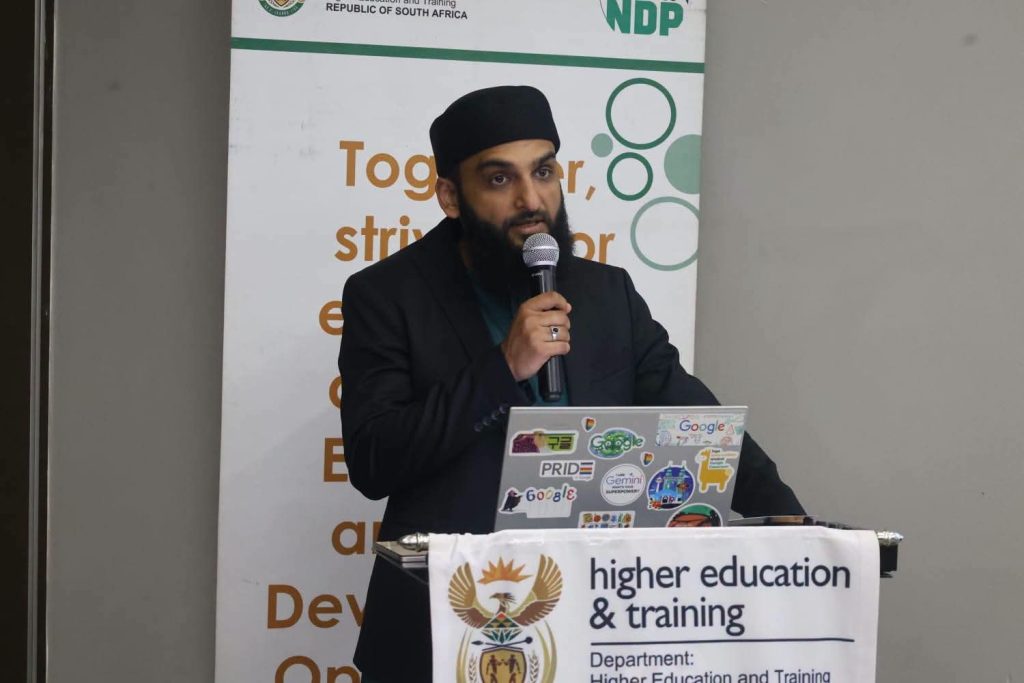
He was speaking at the DHET and Google AI Policy and Guidance Lab in Pretoria, where officials, universities, colleges and Google representatives were developing a position statement and practical roadmap for the use of AI across the post-school education sector.
“Artificial intelligence is already part of student life. A student uses it late at night to understand a concept. A lecturer considers whether it can help prepare a lesson. An official sees an opportunity to respond to a request more quickly,” Cassim said.
“Each example presents a possibility, and each calls for judgment. We need people who can question an answer, recognise when it is wrong and know when a human decision is essential.”
ALSO READ: Waseem Carrim appointed RAF CEO as fund faces financial crisis
Cassim told participants in the policy lab to move beyond broad discussions about AI and establish clear responsibilities for government, technology companies and institutions.
“Today you are moving towards a position statement and a practical roadmap. I ask you to be specific. What should the department do? What can Google support? What must each institution own? What can we test first, and how will we know whether it helps students and educators?” he said.

The policy work forms part of an agreement signed between the department and Google South Africa in March covering skills training, educator development, curriculum support, devices and AI policy.
The agreement includes an initial 10,000 Google Career Certificate scholarships across public universities, TVET colleges and Community Education and Training colleges, with particular attention to rural and township institutions.
Cassim said, however, that access to AI and digital skills could not be judged only by the number of opportunities created.
“Those numbers matter, but they are only a starting point. I want us to ask who finds out about these opportunities, who can access them, who completes the training, and what they are then able to do with the skills,” he said.
“A certificate cannot benefit someone who has no reliable connection, no place to learn or no support when the work becomes difficult.”
He said this was particularly important for Community Education and Training (CET) colleges, which serve adults and out-of-school youth, including people returning to learning after their education was interrupted.
“We cannot simply take a model designed for a well-resourced university student and assume it will serve them,” Cassim said.
CET colleges needed stronger ICT hubs, practical digital skills and more flexible combinations of online and in-person learning, he said.
He that greater use of technology should not remove human accountability.
“Students’ personal information must be protected, and a student must still be able to reach a person who takes responsibility for the case.”
The post AI is blurring proof of learning, says Cassim appeared first on Inside Education..