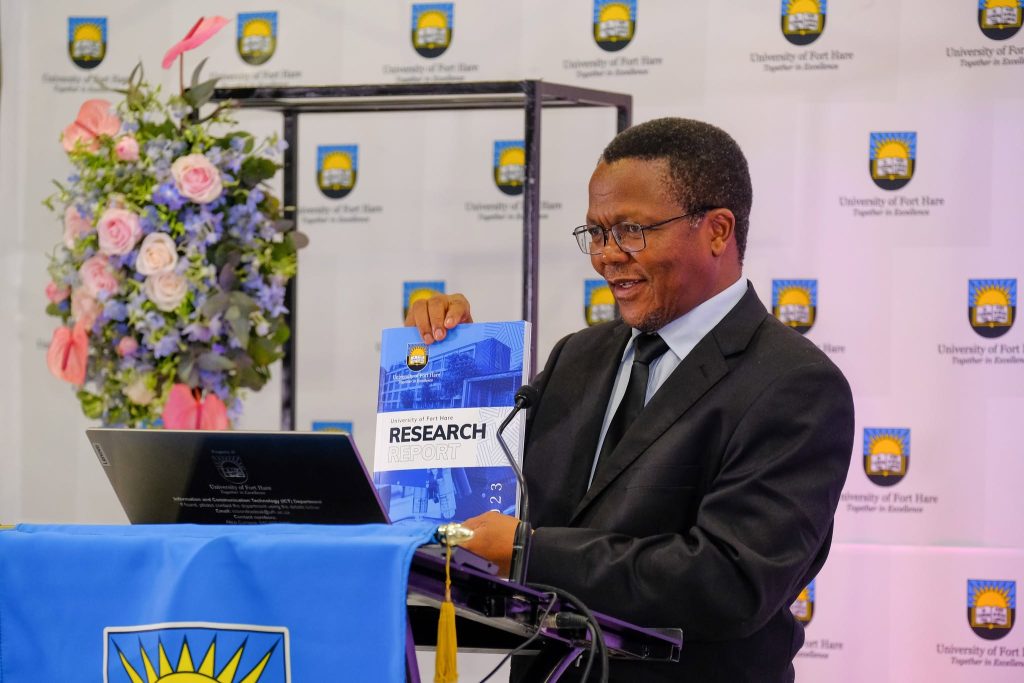
The University of Fort Hare (UFH) has emerged as the top-performing university in the Eastern Cape for research output, outperforming several institutions and ranking among South Africa’s leading research universities.
According to the 2024 Department of Higher Education and Training (DHET) Research Outputs Sector-Wide Report, released this month, UFH achieved a weighted per capita research output score of 2.39, surpassing the national average of 2.23.
The score places Fort Hare among only 11 universities nationally that performed above the sector benchmark and makes it the highest-ranked university in the Eastern Cape on the key measure of research productivity and postgraduate success.
UFH also outperformed several institutions, including the University of South Africa (Unisa), which recorded a score of 2.34, and Rhodes University, which achieved 2.36.
UFH Director of Research and Innovation Dr Aceme Nyika said the achievement reflects the university’s commitment to conducting research that responds to societal challenges.
“As an institution that is rooted in communities and conducts research which addresses issues that affect communities, excelling in research means that UFH is making a significant contribution to the socioeconomic development of communities in the Eastern Cape,” he said.
Nyika said the ranking demonstrates the progress made by the university despite historical challenges.
“Being the only historically disadvantaged university among the top 11 universities in the country demonstrates that UFH is making strides in transforming itself into a research-focused university against all odds,” he said.
The university attributed its improved performance to a series of interventions introduced after research output declined between 2017 and 2021.
A major turning point came in 2021 when the institution separated its Academic Affairs Division into dedicated Teaching and Learning and Research, Partnerships and Innovation portfolios, allowing for greater focus on research development.
UFH also introduced mentorship programmes for emerging academics, research seed grants and specialised training programmes to strengthen research capacity.
As part of its research strategy, the university identified five key focus areas: renewable energy; agriculture and climate change; infectious diseases and medicinal plants; township economies; and African liberation heritage.
The institution has also intensified efforts to secure research funding from the private sector, national partners and international collaborators.
The impact of these initiatives is evident in the growth of National Research Foundation (NRF)-rated researchers at the university. The number increased from 29 in 2021 to 53 in 2025, representing growth of nearly 83%.
The university also achieved its first-ever B1 NRF rating in 2025 after producing two B2-rated researchers the previous year.
Postgraduate research capacity has expanded significantly. The proportion of permanently employed academics holding doctoral qualifications increased from 47% in 2022 to more than 65% in 2025, strengthening supervision capacity and contributing to higher master’s and doctoral graduation rates.
“The university’s improved postgraduate throughput contributed to its weighted per capita research output, which has now surpassed the national average,” Nyika said.
UFH plans to further strengthen its research and innovation profile through the establishment of a new Research and Innovation Hub, for which funding has already been secured.
The facility is expected to support collaboration between researchers, industry and investors while helping to commercialise innovations developed at the university.
The university said it is also advancing plans to establish a Faculty of Veterinary Sciences, building on its strengths in agricultural and animal science research.
Sergeant Marline Niemand is part of a new generation of police officers using mounted policing to reach areas where vehicles cannot easily tread.
A SAPS horse rider with the Ekurhuleni Mounted Unit in Gauteng, Niemand carries out crime-prevention duties on horseback, patrolling areas such as mountainous terrain, riverbanks, farms and informal settlements.
Her four-legged colleague, “Bujo”, has become what she considers a loyal best friend, helping her serve communities and fight crime in a unique way.
Niemand joined the police in 2012 at the age of 21 after applying while serving as a volunteer at Springs Police Station.
Now 35, she remains driven by what “an unwavering passion for policing and a determination to expand her knowledge on every aspect of law enforcement”.
Becoming a police officer had always been her dream, although her mother initially had reservations about her chosen career path.
With her father being a police officer and her role model, SAPS said it was “only meant to be” for Niemand to fall in love with the profession.
She was ready to submit her application to join the organisation when she turned 18, but did not have her mother’s blessing at the time. However, Niemand refused to give up on her dream and three years later she was enlisted.
Her love and passion for animals first attracted her to the K9 Unit.
Niemand said she admires horses for their intelligence and enjoys the specialised nature of mounted policing.
Performing crime-prevention duties on horseback is pure joy for her, despite having no horse-riding experience before joining the unit.
She trained for the Basic Mounted Riding and Stable Official courses at the Potchefstroom Mounted Academy, where SAPS also breeds its horses.
“It is said that one policeman on a horse back is equal to 20 policemen on foot,” said Niemand.
In celebration of Youth Month, SAPS said it was highlighting the energy, dedication and leadership of young officers through its national campaign, “SAPS Youth – Leading the Reset Agenda.”
This year’s campaign recognises young men and women in blue who are playing an active role in advancing the SAPS’ vision of professional, ethical and community-focused policing.
In a message to South African youth, Niemand said: “I joined the SAPS because it is my calling, my passion, my childhood dream. I will continue to serve my community with dignity, honour, and pride.”
The countdown is over, and the world’s biggest football spectacle kicks off tonight in Mexico City as the 2026 FIFA World Cup officially opens.
Fans across the globe are gearing up for the highly anticipated opening ceremony, a dazzling showcase of music, culture, and football spirit that sets the stage for a month-long celebration of the beautiful game.
South Africa’s own Bafana Bafana will face Mexico in the tournament’s opening clash, carrying the hopes and pride of the nation.
Government has called on citizens to unite behind the team by wearing green or gold on Bafana Fridays and sharing in the excitement of this historic moment.
Stay tuned as the opening ceremony unfolds, a spectacular fusion of tradition and modern energy, marking the start of football’s greatest show.
Tyla is set to sing the South African national anthem during the opening ceremony of the 2026 World Cup.
The South African star will take center stage as part of the official opening ceremony celebrations.
Gauteng Education MEC Lebogang Maile has warned municipalities against cutting water and electricity to schools over disputed bills, saying service interruptions disrupt learning and place additional pressure on already struggling communities.
Maile’s warning follows complaints from school communities in Emfuleni, where parents, school governing body members and principals accused the municipality of threatening to disconnect schools over disputed municipal accounts, including at schools where they said meters had not been installed.
Speaking during a community engagement at Sebokeng Technical School Hall on Wednesday, Maile said municipalities should engage the Gauteng Department of Education (GDE) before taking action.
“I don’t understand why a municipality would find it easy to switch off services at a school and disrupt schooling. We will write to Emfuleni on these matters,” Maile said.
The meeting, attended by parents, school leaders and stakeholders from Sebokeng, Bophelong and surrounding areas, formed part of the province’s It Takes a Village to Raise a Child programme, a two-month initiative aimed at strengthening direct interaction between government, education stakeholders and communities on challenges affecting schools.
Stakeholders at the meeting said some schools were being billed “arbitrarily” and were not receiving adequate explanations for municipal charges. They said threats of disconnection were worsening pressure on schools already grappling with overcrowding, ageing infrastructure and social challenges.
In May, Maile said schools in the province owed municipalities R583.9 million in debt older than 60 days by the end of March 2026, while municipalities had physically cut electricity to at least 36 schools and more than 500 schools had been flagged for some form of billing-related disconnection.
A written response previously tabled in the Gauteng Provincial Legislature showed that 536 schools had experienced some form of billing-related disconnection in 2025, including 293 schools that were without services for at least 30 days and 16 schools that had water, electricity, waste and sewerage services disconnected simultaneously.
Maile said municipalities and the education department needed to work together to resolve billing disputes instead of resorting to service interruptions.
Community members also raised concerns about school infrastructure and overcrowding, calling for decommissioned schools in the area to be reopened to ease pressure on existing institutions.
Maile said the department was exploring several options to address overcrowding.
“The department [is] also looking at buying former missionary schools and renovating them as a measure of dealing with overcrowding in some parts of Gauteng,” he said.
Former Orlando Pirates goalkeeper Avril Phali also attended the event and encouraged the department to strengthen school sport programmes as a way of keeping young people away from crime and social ills.
Maile said the province was considering installing cameras in classrooms to help tackle bullying, crime and violence.
Higher Education and Training Minister Buti Manamela said on Thursday that government will gazette targeted extensions for some pre-2009 qualifications next week, as it moves to phase in a modern occupational qualifications system.
The extensions, expected to be published in the Government Gazette on Monday, form part of transitional arrangements under the Directive on Transitional Arrangements for Pre-2009 Qualifications, which was published on 3 June 2024.
Minister of Higher and Training Buti Manamela Buti Manamela on developments regarding the modernisation of qualifications at GCIS Headquarters in Pretoria. Photo: Eddie Mtsweni
“As government advances the transition towards a modernised occupational qualifications system, our foremost priority is to protect the value of qualifications, uphold public confidence in the skills development system, and ensure that every learner is afforded a fair and meaningful pathway to success and employability,” Manamela said.
“This transition is about far more than the replacement of legacy qualifications. It represents a fundamental step in building a more responsive, relevant and future-focused skills development system aligned with the needs of a rapidly evolving economy.”
He said the transition was one of the most significant reforms in South Africa’s post-school education and training system.
The directive established a policy framework to move South Africa from pre-2009 qualifications towards a modern occupational qualifications system that better reflects workplace requirements, technological advancement and the changing needs of the economy.
Its objectives include ensuring an orderly transition to a modernised qualifications framework, accelerating the development and implementation of occupational qualifications, strengthening the responsiveness and credibility of qualifications, improving alignment between education, training and labour market needs, and reinforcing accountability among SETAs, quality councils and other implementing bodies.
Manamela said substantial progress had been made through collaboration between the DHET, the South African Qualifications Authority, Quality Council for Trades and Occupations, SETAs, public institutions, Skills Development Providers and industry stakeholders.
To date, 948 occupational qualifications and part-qualifications have been registered on the National Qualifications Framework.
When the directive was issued, 1,475 pre-2009 qualifications had reached their registration end date.
Following consultation with stakeholders, 630 qualifications were approved for learner enrolment extension, while the remaining qualifications were deregistered because they had no learner enrolment or had been replaced by occupational qualifications.
“All affected qualifications allowed currently enrolled learners sufficient opportunity to complete their studies,” Manamela said.
He said government had assessed qualifications individually and grouped them according to their readiness and impact on learners and the skills development system.
Pre-2009 qualifications that qualify for further transitional support will receive targeted extensions ranging from six to 24 months, depending on sector readiness, learner impact, the availability of replacement qualifications and labour market requirements.
“These are not blanket extensions — each qualification has been assessed on its own merits,” Manamela said.
The list of qualifications approved for extension will be published in the Government Gazette and on the SAQA website, together with the affected qualifications and their replacement occupational qualifications.
Manamela said learners currently enrolled in affected qualifications may continue their studies within the approved transitional arrangements, while accredited Skills Development Providers should familiarise themselves with the applicable extension periods and teach-out requirements.
The department has also issued separate teach-out arrangements for NATED Report 190-1 programmes because of their continued relevance in the education and training landscape.
“Students currently enrolled in N4 to N6 programmes should therefore continue with their studies as planned and should not be concerned that their qualifications will lose recognition,” Manamela said.
The department is working with SETAs, industry partners and other government departments to facilitate placement opportunities that will allow qualifying students to complete their National N Diplomas.
Manamela said government would grant extensions of up to three years for regulatory unit standards that continue to underpin statutory and industry programmes, to allow regulators and industries time to review programme requirements and transition to replacement occupational skills programmes.
For trades, he said no further extension would be required where occupational qualifications had already been developed and implemented. However, targeted transitional arrangements of about one year may be considered where replacement occupational qualifications have not yet been fully developed or implemented.
The department has appointed a technical task team to oversee and coordinate the transition process.
Manamela said the team would identify and resolve implementation bottlenecks, monitor progress against clear timelines, and coordinate workstreams dealing with communications, legal and regulatory matters, SETA coordination, data management, assessment to certification, quality assurance, TVET rollout, funding norms and monitoring and evaluation.
He said the department, with support from SETAs, facilitates the placement of about 21,000 TVET students in workplaces annually.
The department was also prioritising engagements with public- and private-sector employers to expand work-integrated learning opportunities, while exploring funding mechanisms with SETAs, the National Skills Fund and employers.
“Every qualification that has already been awarded remains valid, recognised and recorded on the National Learners’ Records Database (NLRD),” he said.
He said legacy qualifications had contributed meaningfully to workforce development and economic participation over many years, but the economy had changed and the skills system had to adapt.
“However, these qualifications have favoured the classroom over the workshop. What we are introducing are qualifications that guarantee practical experience and workplace placement,” Manamela said.
DDG responsible for TVET Colleges, Sam Zungu, said TVET colleges had experienced an oversupply in areas such as Office Administration, Human Resource Management, Public Administration and Marketing, where demand was not matched by the number of students enrolled.
He said these programmes were under review to ensure TVET colleges offer skills that are in demand.
He said after requests from the mining sector, TVET’s would be amplifying drone technology and robotics.
Manamela said the reforms were aimed at building public confidence in the post-school education and training system and making qualifications more responsive to industry needs.
“Our objective is clear: to build a qualifications system that commands public trust, meets the demands of industry, supports economic development and equips South Africans with the skills required to thrive in the jobs of today and the opportunities of the future,” he said.
He said SAQA and the QCTO would continue to monitor implementation, qualification uptake, learner progression and overall system performance beyond the extension period, in collaboration with SETAs, Skills Development Providers, TVET colleges, employers and industry stakeholders.
“Finally, South Africa is moving towards a modern, high-quality occupational qualifications system that responds to the needs of industry, strengthens the competitiveness of our economy and expands opportunities for all. This transition is the beginning of a stronger, more responsive and future-ready skills development system that will serve generations of South Africans to come,” Manamela said.
South Africa is ready. The wait is finally over as Bafana Bafana return to football’s biggest stage when they take on Mexico in the opening match of the 2026 FIFA World Cup on Thursday night, local time.
Across the country, fan parks, shopping centres and public viewing venues are gearing up for what promises to be a memorable night of football, music and national pride. Whether you want to celebrate with thousands of supporters or enjoy the action with family at home, here are some of the best places to catch the big game.
Mall of Africa, Midrand
One of the biggest public viewing events in Gauteng will take place on the lawns near the food court at Mall of Africa. Deputy Minister of Sport, Arts and Culture, Peace Mabe, will join supporters alongside Bafana Bafana legends for an evening filled with football fever.
Fans can look forward to live entertainment, featured artist performances, spot prizes and exciting supporter experiences.
Gates open at 18:00 and entry is free on a first-come, first-served basis.
Melrose Arch, Johannesburg
The Piazza and Square at Melrose Arch will transform into a vibrant fan park atmosphere with giant LED screens showing the match live. Supporters are encouraged to arrive early, dress warmly and soak up the electric atmosphere.
With restaurants and entertainment venues surrounding the viewing area, it is expected to be one of Johannesburg’s most popular destinations for the World Cup opener.
The Pavilion Shopping Centre, Durban
Football fans in KwaZulu-Natal can head to The Pavilion Shopping Centre in Westville. Gates open at 18:00, with live performances from DJ Tira and the Q Twins adding to the excitement before kick-off.
The combination of football, music and family-friendly entertainment promises an unforgettable evening for supporters.
Makhado Crossing, Limpopo
Limpopo supporters can gather at Makhado Crossing for a full day of entertainment. Gates open at 14:00, giving fans plenty of time to enjoy music, food stalls, family activities and competitions before the match begins.
Supporters are encouraged to wear their green and gold colours, with prizes up for grabs throughout the day.
Lemo Green Park, Bloemfontein
Free State football lovers have their own World Cup celebration at Lemo Green Park in Bloemfontein. The venue will host a dedicated fan park experience from 18:00, featuring live match screenings, entertainment and commentary from soccer legends.
Cape Town Fan Zones
The Mother City is buzzing with World Cup excitement. Popular viewing venues include the V&A Waterfront’s Time Out Market, Mojo Market in Sea Point and several fan-friendly venues across the city.
Supporters can expect big screens, food, music and an atmosphere worthy of the occasion as Bafana Bafana begin their World Cup journey.
Watching from home
For viewers at home, the match kicks off at 21:00 and will be broadcast live on SABC Sport, SABC 1, and SABC 3, with streaming available on SABC Plus and SABC Sport’s live platform.
KZN police have identified crime hotspots and will deploy uniformed and undercover officers along the Comrades Marathon route after vehicle-related thefts were reported during last year’s race.
The KwaZulu-Natal Provincial Joint Operational and Intelligence Structure (PROVJOINTS) said it had “put the necessary safety and security measures in place” to ensure the province delivers an incident-free ultra-marathon.
More than 21,000 runners are expected to take part in the 2026 up-run, which starts in Durban and finishes in Pietermaritzburg on Sunday.
“Various departments and entities that form part of the PROVJOINTS have been participating in plenary meetings for months and have developed a comprehensive operational plan that ensures safety and security for runners, officials, and spectators,” PROVJOINTS said.
Spectators were urged “to be vigilant at all times and be mindful of their surroundings”.
PROVJOINTS said the Comrades Marathon Association, working with eThekwini Metro and uMgungundlovu traffic officials, had communicated road closures, and road users were urged to cooperate with law enforcement officers during the marathon weekend.
It said the entire route had been declared a no-fly zone, with only authorised operational aircraft and drones permitted to fly.
“Any unauthorised drone will be taken down operationally in accordance with the law,” PROVJOINTS said.
They also warned against the display of offensive or political material along the route.
“The displaying of banners depicting unsavoury and/or politically aligned messages on bridges, road signs, and buildings will be dealt with in compliance with municipal by-laws and other statutes.”
Thousands of Gauteng learners could again face school placement challenges in 2027 as the Gauteng Department of Education (GDE) has yet to announce when Grade 1 and Grade 8 admissions will open, despite the academic year already being well underway.
DA shadow MEC for Education Sergio Isa Dos Santos on Tuesday urged the department to urgently release the admissions timetable, warning that continued delays could leave learners unplaced when schools reopen next year.
“The delay in opening the admissions process reduces the time available to properly process applications, verify information, and finalise placements before the start of the academic year,” Dos Santos said.
He said past delays had already had serious consequences for learners and parents.
“During the 2026 admissions cycle, thousands of learners remained unplaced as schools prepared to reopen, with some only receiving placements in March when the first term was almost over,” he said.
Popular schools in Gauteng continue to reach capacity quickly, while infrastructure expansion has struggled to keep pace with rising learner numbers.
At the same time, administrative backlogs in the admissions system have added to delays in finalising placements, leaving many parents uncertain about where their children will be placed.
In this environment, perceptions of unfairness often arise, particularly when communication from education authorities is limited and clear timelines are not provided.
In previous years, some parents only received placements weeks into the academic year, heightening frustration over the system’s efficiency.
The issue of school non-placement is not framed around citizens versus non-citizens, but rather as a system under strain that is struggling to meet demand.
While the Constitution guarantees every child the right to basic education, stakeholders argue that this right is undermined when learners are not placed timeously and consistently.
The Democratic Alliance (DA) has called for the immediate opening of the 2027 admissions process, alongside improved planning measures such as decentralised walk-in centres and stronger communication with parents.
The party argues that earlier application windows would give the department more time to process placements, reduce administrative pressure, and allow families to plan for school-related costs such as uniforms, transport and stationery.
“The department must learn from its past mistakes. We cannot continue to repeat a cycle where learners are left unplaced or placed too late into the school year,” Dos Santos said.
The DA further maintains that improved and earlier admissions management would help reduce administrative errors and ensure learners are placed before the start of the academic year, limiting disruption to schooling.
The Organisation Undoing Tax Abuse (OUTA) said on Tuesday that the suspension of Insurance Sector Training Authority (Inseta) CEO Gugu Mkhize should trigger a forensic investigation into governance, procurement and financial management concerns at the public entity.
OUTA has for several years raised concerns about governance, procurement, transparency and accountability at Inseta.
The organisation said the suspension should mark the beginning, rather than the end, of efforts to establish the full extent of any maladministration or wrongdoing at the SETA.
The Sunday Times reported that Mkhize had been placed on precautionary suspension over failures regarding a multimillion-rand tertiary education bursary funding scheme, which had left hundreds of students unpaid for the first five months of the year.
According to the report, 879 vulnerable beneficiaries faced threats of eviction, food insecurity and possible academic exclusion after Inseta paid Mabophe Business Solutions almost R70 million in March, but the funds did not reach students, universities or accommodation providers.
The Sunday Times said that Inseta later made a direct emergency payment of R4.6 million during the week of 21 May, while Inseta said the suspension was a procedural step and “not a finding of wrongdoing”.
Inseta manages billions of rands collected through skills development levies and is responsible for advancing skills development within South Africa’s insurance sector. OUTA said those public funds must be managed with the highest levels of integrity, transparency and accountability.
“For years, serious questions have been raised about governance, procurement, and transparency at Inseta,” said Wayne Duvenage, OUTA CEO.
“A suspension is not accountability. It is the start of a process. South Africans now need assurance that these concerns will be investigated thoroughly, independently, and without fear or favour.”
OUTA is currently challenging Higher Education and Training Minister Buti Manamela’s decision to reappoint Mkhize for a further five-year term from 2025 to 2030.
It has instituted legal proceedings to review and set aside the decision to reappoint Mkhize to the Inseta Board, contending that the appointment process was procedurally flawed and failed to consider concerns relating to governance and accountability adequately.
During Mkhize’s tenure as the accounting authority, Inseta received qualified audit outcomes for five consecutive years.
OUTA said it had submitted numerous requests for information to Inseta over several years in terms of the Promotion of Access to Information Act, seeking records related to governance and procurement matters. Despite following the prescribed processes, it said the requested information was not provided.
After escalating the matter to the Information Regulator, OUTA said it continued to pursue all available avenues to obtain access to the information and remained committed to ensuring transparency and accountability at Inseta.
“Transparency is not optional in publicly funded institutions,” said Duvenage.
“When access to information is repeatedly denied, and concerns remain unanswered, public confidence is undermined. Accountability requires openness, particularly where public funds are involved.”
OUTA said any investigation should go beyond the immediate circumstances of Mkhize’s suspension and examine governance, procurement, and financial management concerns within Inseta.
“A credible investigation must follow the evidence wherever it leads,” said Duvenage.
“It should establish whether there was irregular or wasteful expenditure, whether procurement processes complied with the law, whether conflicts of interest existed, and whether any provisions of the Public Finance Management Act were breached.”
OUTA said the suspension represented an important development, but that accountability would ultimately be measured by the quality of the investigation and the consequences that followed if wrongdoing was uncovered.
“If misconduct is identified, appropriate disciplinary, civil, and criminal action must follow. South Africans deserve confidence that public institutions are governed in the public interest and not for the benefit of a few.”
KwaZulu-Natal’s departments of education and health face deductions from future budget allocations after the provincial Treasury tabled a bill to recover more than R1 billion in historic unauthorised expenditure.
The recovery forms part of the KwaZulu-Natal Second Unauthorised Expenditure Authorisation Bill, 2026, tabled by Finance MEC Francois Rodgers in the provincial legislature on Thursday.
The Department of Education faces the largest repayment, of about R955 million, while the Department of Health, faces a repayment of about R91 million.
The deductions are expected to be made over seven financial years.
“Where departments have overspent their budgets, they should rightfully pay those amounts back to the Revenue Fund, as they spent money they did not have and were effectively operating in overdraft,” Rodgers told the legislature.
“The money must be repaid and, more importantly, controls should be implemented to prevent the same situation from recurring.
“Consequence management should be considered where there has been blatant financial misconduct by government officials,” he said.
Rodgers said the unauthorised expenditure that was not condoned would be recovered through future budget allocations.
“This, in effect, is a reduction in the budget of these departments and will be implemented over a period of seven years, given the fiscal constraints and the need to limit the impact on service delivery.”
The bill follows recommendations by the Standing Committee on Public Accounts (SCOPA), which considered unauthorised expenditure incurred by provincial departments over several financial years.
Under the Public Finance Management Act (PFMA), unauthorised expenditure includes spending more than the amount appropriated for a vote or programme, or spending funds for purposes not approved by the legislature.
The move comes as the Department of Education is already under a Provincial Treasury intervention in terms of section 18 of the PFMA, after sustained cash-flow and financial governance problems.
Under that intervention, the department’s spending is subject to tighter Treasury oversight. The department has faced pressure from unpaid commitments, compensation costs and operational demands, raising concerns about its ability to fund core services while settling old obligations.
The Auditor-General previously flagged KZN education as one of the departments that had incurred unauthorised expenditure for several consecutive years.
The bill records that part of the education department’s overspending related to infrastructure repairs after storm damage in 2019.
“Infrastructure Development reflects over-expenditure against goods and services due to higher property maintenance costs relating to the repair of schools damaged by storms in 2019 as the magnitude of damage was worse than anticipated,” the bill says.
The department also recorded over-expenditure in programmes including Administration, Public Ordinary School Education, Public Special School Education, Early Childhood Development and Infrastructure Development.
The bill says over-expenditure in Early Childhood Development was linked to pressure on compensation of employees following substantial budget reductions.
The Department of Health’s unauthorised expenditure dates back to the 2019/20 financial year and was linked to increased costs for the provision of HIV/Aids medication.
The bill will still have to proceed through the legislature’s law-making process.