Category: Uncategorized

Uncategorized

UCT suspends measures against VC Moshabela pending High Court review

By Charmaine Ndlela 

The University of Cape Town (UCT) Council has suspended four resolutions concerning Vice-Chancellor Professor Mosa Moshabela pending the outcome of his judicial review application in the Western Cape High Court.

The decision follows a special Council meeting held on Saturday to consider the legal proceedings brought by Moshabela against four resolutions adopted by Council on 30 May.

Council said it had considered legal advice on the matter before resolving to suspend the implementation of the four resolutions pending the final determination of the judicial review proceedings.

The latest development comes after an investigation whose mandate ultimately encompassed 34 complaints concerning Moshabela, according to his court papers.

Council reportedly decided against instituting disciplinary proceedings against the Vice-Chancellor following the investigation, but adopted four separate resolutions concerning him. Moshabela is challenging those four resolutions, Resolutions 3 to 6, in court. The separate resolution not to institute disciplinary proceedings is not part of his challenge.

The dispute has also brought renewed attention to complaints recorded by UCT’s Ombud, Nashira Abrahams.

According to Moshabela’s court papers, UCT Council member Malcolm Campbell informed the Vice-Chancellor on 30 June 2025 that the Ombud had received 21 complaints from staff relating to his “interactions with them”.

By December 2025, the Ombud had recorded 39 visits by staff and students concerning Moshabela, with eight matters marked as closed and 31 as open.

The court documents caution that these 39 recorded visits do not necessarily represent 39 different complainants.

Six of the open matters were categorised as three sexual harassment complaints, two complaints relating to discrimination based on culture and one relating to discrimination based on gender.

Council adopted a resolution on 14 February 2026 mandating that the 31 open matters be formally investigated.

UCT has said that it is constrained in what it can disclose publicly because of confidentiality obligations relating to matters before the Ombud and Council, as well as the ongoing court proceedings.

In its statement issued following Saturday’s meeting, Council said it would first follow the preliminary processes prescribed by the Rules of Court and await Moshabela’s supplementation of his court papers before deciding whether to oppose the review application.

Council also confirmed that it was willing to participate in mediation in an effort to resolve the dispute.

The decision to suspend the four resolutions means that the measures adopted by Council on 30 May will not be implemented while Moshabela’s legal challenge is before the High Court.

Council said its decision was intended to ensure that the litigation is handled in an “orderly, fair and legally appropriate manner”.

Council chairperson Norman Arendse said the governing body remained committed to protecting the rights of all parties involved, including UCT officers and institutions and the office of the Ombud.

“Council remains committed to acting in the best interests of UCT and to discharging its governance responsibilities in accordance with the law, the principles of fairness and accountability, and the values of the university,” Arendse said.

INSIDE EDUCATION

The post UCT suspends measures against VC Moshabela pending High Court review appeared first on Inside Education..


Uncategorized

Century-old Afrikaans archive enters digital era

By Charmaine Ndlela 

The University of the Free State (UFS) has ceremonially handed back to the South African Academy for Science and the Arts (SAAWK) an archival collection documenting more than a century of the Akademie’s history and its role in the development of Afrikaans language, literature, the arts and science, as the two institutions move to digitise the material for wider research access.

Established in Bloemfontein in 1909, the SAAWK has played a significant role in the development and standardisation of Afrikaans in the fields of language, literature, the arts and, later, science and technology.

More than a century after its establishment, the Akademie’s archival collection is entering a new phase as the institutions collaborate on its digitisation, creating wider access to material that has been preserved at the UFS for more than 50 years.

The collection was entrusted to the UFS under an agreement concluded between the two institutions in 1972. Since then, the university has been responsible for its safekeeping, preservation, arrangement, description and access for research.

On 13 August 2026, the UFS and SAAWK marked the next stage of their longstanding relationship with the ceremonial handover of the collection and the signing of a Memorandum of Agreement that will facilitate continued collaboration on its digitisation.

For SAAWK Chief Executive Officer Dr Annelise de Vries, the collection provides an important window into the Akademie’s history and the development of Afrikaans as a language capable of carrying scholarship and scientific knowledge.

“The collection gives us an opportunity to look at the history of language planning and how Afrikaans developed into a language that could be used in science and scholarship,” she said.

“By making this material accessible through digitisation, we can create new opportunities for research and for understanding that history.”

The digitisation project is expected to take the collection beyond the confines of its physical archive, allowing researchers and students to engage more easily with material that has historically been primarily accessible through the University’s archival facilities.

Prof Vasu Reddy, Deputy Vice-Chancellor for Research, Innovation and Postgraduate Studies at UFS, described the occasion as an important milestone for both institutions.

“This event is historic and important,” Reddy said.

“The Akademie Collection is more than a collection. It is both a record of our intellectual past and a resource that will help shape responsible societal futures.”

Reddy said the partnership also demonstrated how heritage and scholarship could be brought together to support future knowledge creation.

“It is also about strengthening a partnership that connects heritage, scholarship, and future knowledge creation with one of our oldest Science Councils,” he said.

“I see this digitisation initiative as an investment in future scholarship, opening new pathways for research, discovery, and public engagement.”

For the UFS Library and Information Services (LIS), caring for the collection over the past five decades has involved balancing preservation with the need to make the material accessible to researchers.

Charlie Molepo, Head of Research and Scholarly Communications at LIS, said the responsibility of preserving such a significant collection was substantial.

“It’s quite a huge responsibility, because we had to make sure that the collection is preserved in an environment that is sustainable for its long-term preservation, while also making sure that it is accessible for research, both locally and internationally,” Molepo said.

LIS has developed metadata to make the collection more discoverable and introduced measures aimed at protecting the archival material from natural and human-made disasters.

Digitisation will add another layer of preservation while significantly expanding access.

“Digitisation opens up new opportunities for access, because researchers all over the world can easily access the collection, and our students can also access it,” Molepo said.

“It also allows us to preserve it because, as technology and software change, we need to be able to adapt to those changes.”

The project also highlights the evolving relationship between the UFS and SAAWK. Rather than simply transferring responsibility for the collection, the two institutions are continuing to work together to determine how the archive can be used to support research, teaching and scholarship.

Molepo said the collaboration could create opportunities for increased research activity at the University, including postgraduate work.

“Ultimately, it opens up new opportunities for the University to have more research within the institution, whether through collaboration or supervision of postgraduate students, because the Academy also has a lot of excellent researchers,” he said.

The significance of the collection therefore extends beyond its value as a historical archive. Its digitisation could create opportunities for researchers to revisit the history of Afrikaans, language planning, scholarship and the intellectual development of South Africa through primary archival material.

For students and academics, increased digital access could also make it easier to incorporate the collection into research and teaching, while allowing scholars outside South Africa to engage with material previously accessible primarily through the physical archive.

According to the university, the handover marks a significant transition for a collection that has spent more than five decades in the care of the UFS.

Reddy said the institutions’ responsibility was not simply to protect the past, but to ensure that the archive continued to contribute to contemporary scholarship.

“Our responsibility is not only to safeguard the archives, but to activate them as living resources for learning, research, and public understanding,” he said.

“When we preserve knowledge and make it accessible, we create opportunities for innovation, collaboration, and lasting societal impact.”

Through the digitisation partnership, the UFS and SAAWK are seeking to ensure that an archive built over more than a century does not remain confined to history books or physical shelves, but continues to inform research and scholarship.

“Together, the UFS and SAAWK are building a legacy that honours the past, enriches the present, and inspires future generations of scholars,” Reddy said.

INSIDE EDUCATION

The post Century-old Afrikaans archive enters digital era appeared first on Inside Education..

SA’s Africa United conquer Madrid to lift Elite U20 International Cup
Uncategorized

SA’s Africa United conquer Madrid to lift Elite U20 International Cup

By Levy Masiteng 

Africa United have conquered Spain, with the South African youth side crowned champions of the 2026 Madrid Elite U20 International Cup after overcoming Spanish opposition in a dramatic final.

Africa United secured the title on Sunday, defeating Albacete Balompié in a penalty shootout at Campo La Mina in Carabanchel, Madrid, after the final could not be separated in regulation time.

The tournament organisers officially confirmed Africa United as champions, with Albacete finishing runners-up.

ALSO READ: CUT Vice-Chancellor Pamela Dube to retire early after four years at the helm

The triumph capped an impressive campaign for Africa United, who arrived in Spain determined to test themselves against some of the country’s youth football talent and left Madrid with the trophy and one of the tournament’s biggest individual awards.

Africa United’s route to the final was built on a strong group-stage campaign.

They opened their tournament with a 1-1 draw against Rayo Vallecano A on 14 August before producing a commanding 6-0 victory over Madrid Euro Soccer Academy the following day. They also drew 1-1 with Albacete Balompié.

Those results saw Africa United finish second in Group A with five points from three matches, scoring eight goals and conceding only two.

They remained unbeaten throughout the group stage, conceding only two goals in three matches.

The knockout stage provided an even bigger test.

Africa United faced CD Alameda in the second semi-final on Sunday morning at Campo La Mina. The match was scheduled for 11am, with the winners advancing to the afternoon final against the winners of Albacete Balompié and RCD Carabanchel.

Africa United’s ability to navigate the pressure of the knockout rounds ultimately proved decisive as they reached the final and faced an Albacete side they had already encountered in the group stage.

The final, played at 1pm on Sunday, went all the way to penalties. Africa United held their nerve when it mattered most to claim the championship and complete an unbeaten tournament.

Ohhiria Unoisejiolagbon was named the tournament’s best player, another major recognition for the South African delegation and a sign of the quality within the squad.

INSIDE EDUCATION

The post SA’s Africa United conquer Madrid to lift Elite U20 International Cup appeared first on Inside Education..

Major boost for nursing education as KZN College wins approval for degree
Uncategorized

Major boost for nursing education as KZN College wins approval for degree

By Lebone Rodah Mosima 

The KwaZulu-Natal Department of Health has welcomed the approval granted by the South African Qualifications Authority (SAQA) NQF Qualifications Committee at its recent meeting, paving the way for the province’s College of Nursing to offer a Bachelor of Nursing qualification at NQF Level 8, with a minimum of 480 credits.

Health MEC Nomagugu Simelane congratulated the college on the milestone.

“[I]t bears testimony to the excellent work that is being done by the management and staff of the college, who continue to ensure that we produce nurses who are well equipped to serve our people,” Simelane said during an official KZN Health Chat podcast.

She said the timing of the achievement made it even more meaningful, as it came during Women’s Month.

She said that nursing remains a women-intensive profession and paid tribute to the many women who have dedicated their lives to caring for others.

“At the same time, we continue to encourage more men to enter the nursing profession and help us build a stronger and more representative nursing workforce,” she said.

The Bachelor of Nursing degree will also establish a stronger and more direct academic pathway for nurses wishing to advance their careers and specialise.

Unlike the previous pathway, where nurses required completion of lower-level qualifications before progressing academically, the new degree offers graduates an NQF Level 8 qualification, putting them in a more advantageous position to pursue postgraduate studies and specialist nursing programmes.

While the department did not say when the college submitted this specific Bachelor of Nursing qualification for approval, the milestone comes after years of difficulty nationally in moving public nursing colleges into the higher education system.

ALSO READ: From engineering to agriculture: Muthikhitha builds thriving macadamia business in Limpopo

The transition to new nursing qualifications began in 2015, and by 2019 the KZN College of Nursing was among 10 public nursing colleges designated to offer qualifications, including bachelor’s degrees, under the new higher education framework from 2020.

In a parliamentary reply in July 2026, the Department of Higher Education and Training said nursing colleges had been designated to offer qualifications aligned with the Higher Education Qualifications Sub-Framework since 2020, but that their migration into the national higher education system was still under way and faced legal, budgetary, structural and infrastructure challenges.

Concerns over the slow process date back even further. In 2016, Nursing Education Association chief executive Nelouise Geyer said public nursing colleges, which were responsible for about 80% of nursing graduates at the time, were struggling to meet the requirements for recognition as higher education institutions and that progress in accrediting new nursing programmes had been slow.

In 2022, Nursing Education Association chairperson Dr Sue Armstrong said difficulties getting curricula approved had made public colleges reluctant to start the new degree programme, reducing their ability to produce professional nurses. At the time, she said universities were the institutions offering the course required to qualify as a professional nurse, while problems with progression between qualification levels were also restricting career and specialisation opportunities for some nurses.

Nursing unions have also repeatedly raised concerns about the effect of accreditation and training delays on an already stretched health system. Young Nurses Indaba Trade Union chairperson Lerato Mthunzi said in 2022 that the sluggish transition was “holding the profession ransom” and affecting the quality of healthcare that could be provided.

The Democratic Nursing Organisation of South Africa (DENOSA) has more recently linked nursing education reform to the shortage of health workers. At its national congress in March 2025, the union called for the “immediate accreditation of nursing institutions” as part of efforts to address a critical shortage of trained healthcare professionals.

Simelane said that nurses can progress more efficiently towards higher-level and specialist qualifications.

“We need more specialists in our health system, and strengthening the academic pathway for our nurses is an important part of achieving this,” she said.

She added that the college has provided the province with several reasons to be proud in recent months, including the launch of the Nephrology Nurse Specialist programme, which is among the first of its kind in South Africa’s public nursing education sector.

ALSO READ: Mohono replaces Motsumi as North West education MEC

“These achievements show that our college is growing, innovating and positioning itself to meet the specialist skills needs of our healthcare system,” she said.

She said the department would continue to support the college as it expands nursing education and develops the next generation of healthcare professionals.

“This is good news for nursing, good news for our healthcare system and, ultimately, good news for the people of KwaZulu-Natal,” she said.

“We congratulate the college and look forward to seeing this new chapter unfold.”

INSIDE EDUCATION

The post Major boost for nursing education as KZN College wins approval for degree appeared first on Inside Education..
Uncategorized

CUT Vice-Chancellor Pamela Dube to retire early after four years at the helm

By Levy Masiteng 

The Central University of Technology, Free State (CUT) Vice-Chancellor and Principal, Professor Pamela Zibuyile Dube, will take early retirement at the end of 2026, bringing her tenure at the university to an end after four years at the helm.

The CUT Council has accepted Prof. Dube’s decision to retire early, with her retirement taking effect on 31 December 2026.

The announcement was made by the university through the council, which said it would now begin considering the governance and leadership arrangements needed to ensure a smooth transition.

“Prof. Dube’s tenure has been characterised by visionary leadership, resilience and a steadfast pursuit of institutional excellence,” the university said.

According to CUT, Dube’s leadership saw the university strengthen its academic and research profile, expand strategic partnerships, promote innovation and entrepreneurship, advance student success and accelerate the implementation of its Vision 2030 strategy.

Dube was appointed as CUT’s Vice-Chancellor and Principal after an extensive selection process, with her appointment announced in October 2022.

She formally took up the position on 1 January 2023, succeeding Professor Alfred Ngowi, who had served as acting vice-chancellor during the leadership transition.

Her appointment marked a historic moment for the institution.

Dube became the first woman to serve as Vice-Chancellor and Principal of CUT, as well as the first female vice-chancellor in the Free State. She was formally inaugurated on 17 February 2023.

Before joining CUT, Dube served as Deputy Vice-Chancellor for Student Development and Support at the University of the Western Cape.

Her career in higher education and public-sector leadership has included positions at the University of Siegen in Germany, the University of KwaZulu-Natal, Wits University, the former National Department of Education, the South African Nuclear Energy Corporation and the University of Johannesburg.

In 2025, Dube was appointed Deputy Chairperson of the Universities South Africa Board of Directors, effective from 1 January 2026 to 31 December 2027. She had also served on the USAf board since March 2023.

In April 2026, CUT also announced Dube’s appointment as Chairperson of the Technological Higher Education Network South Africa (THENSA) Board of Directors, with her term running from 1 April 2026 to 31 March 2028.

Dube described her time at CUT as a privilege and thanked the university community for its support.

She reaffirmed that, although she would be stepping down from her role, she would continue to support the success of CUT and the higher education sector.

Council said it would consider the governance implications of the notice of retirement, including arrangements for an acting vice-chancellor and principal and the process for appointing new leadership.

The university said the transition process would be guided by the need to “preserve business continuity, sustain strategic momentum and minimise disruption” to CUT’s operations.

“On behalf of the university, we extend our sincere appreciation to Prof. Pamela Dube for her dedicated service, visionary leadership, and unwavering commitment to the advancement of CUT,” council said.

INSIDE EDUCATION

The post CUT Vice-Chancellor Pamela Dube to retire early after four years at the helm appeared first on Inside Education..
Uncategorized

Mohono replaces Motsumi as North West education MEC

By Lebone Rodah Mosima

North West Premier Lazarus Mokgosi has appointed Dr Sebonta Francinah Desbo Mohono as the province’s new MEC for Education, replacing Viola Motsumi following a cabinet reshuffle.

Mohono, the former Speaker of the North West Provincial Legislature, was sworn in on Friday and takes over the education portfolio with learners and schools engaged in examinations.

The North West Department of Education said the appointment marked a significant transition and that Mohono brought experience in education, organised labour, public administration and political leadership to the role.

Mokgosi said the appointment was important for the province’s education fraternity, including parents, learners, educators, principals and the broader education community.

“Premier Mokgosi emphasised that Dr Mohono is no stranger to the education sector, having served as a teacher and as a shop steward within the South African Democratic Teachers’ Union (SADTU),” the department said.

“Her experience has afforded her a deep understanding of the various dynamics within the education environment, including teaching, management, organised labour, and politics.”

The department said Mokgosi was confident Mohono’s appointment would bring stability and progress while strengthening its ability to respond to the needs of communities across the province.

Mokgosi also acknowledged the contribution of Motsumi, saying Mohono would take over and build on the work undertaken during her predecessor’s tenure.

“Accepting her new responsibility, Dr Mohono said she did not take lightly the significant responsibility entrusted to her,” the department said.

“She called on the entire education community to offer their support and work collectively with her to advance the province’s education agenda.”

Mohono committed herself to building on existing programmes and initiatives aimed at improving the quality of education and supporting learners, educators and communities.

The department said she stressed that its success would depend on cooperation between educators, principals, parents, learners, labour unions and education officials.

“She said the transition must therefore be managed with the necessary focus and stability to ensure that learners remain supported during this important period in the academic calendar,” the department said.

“Her appointment brings to the Education Department a leader with first-hand experience of the classroom, organised labour, public institutions, and political leadership.”

The department said Mohono’s experience positioned her to engage with the range of stakeholders involved in the province’s education system.

INSIDE EDUCATION

The post Mohono replaces Motsumi as North West education MEC appeared first on Inside Education..

From engineering to agriculture: Muthikhitha builds thriving macadamia business in Limpopo
Uncategorized

From engineering to agriculture: Muthikhitha builds thriving macadamia business in Limpopo

By Lebone Rodah Mosima

Two weeks into a Mechanical Engineering degree at Wits University, Thiofhi Muthikhitha realised he was studying for the wrong career.

A classroom exercise asking new students to reflect on whether their chosen fields matched their backgrounds prompted Muthikhitha to reconsider a life already deeply rooted in farming.

“That session completely changed my life. Soon after I narrated my story, it suddenly dawned on me that growing up in a village where I was assisting my parents in practicing farming successfully without any academically acquired skills and knowledge, agriculture would have been my natural choice for a field of further education,” Muthikhitha said.

He abandoned Mechanical Engineering and enrolled for an Agricultural Engineering degree at the University of Venda, where the course had just been introduced. He became its first and only student for that academic year.

Years later, Muthikhitha holds a doctorate from the University of KwaZulu-Natal, runs agricultural consultancy Agricre — short for Agriculture and Rural Engineers — and owns a 27-hectare macadamia farm near Makhado in Limpopo.

The Department of Trade, Industry and Competition (dtic), which profiled Muthikhitha this week, said the entrepreneur had built a business spanning agricultural consulting, farming, agro-processing and exports.

“It has been a long journey, but I am grateful that everything I went through has been worth its while. My trials and tribulations, and labour of love for what I believed in and am passionate about, have yielded good returns. I always tell people that agriculture found me,” Muthikhitha said.

After establishing Agricre, he spent several years helping macadamia, avocado and honey farmers connect with markets.

His business took a significant step forward in 2022 when he partnered with British conservation charity Rainforest Concern to establish a foundation aimed at training farmers in sustainable fruit-production methods.

“Through the foundation we managed to bring together 53 subtropical fruit farmers around the Vhembe district in Limpopo and trained them on productive and sustainable farming methods. We also used Radio Phalaphala to extend our training to a wide range of farmers. At one point our 30-minute educational programme that was broadcast at 4:30 in the morning had 54 000 listeners,” Muthikhitha said.

The initiative later developed into a commercial opportunity for Agricre.

“Our work as a foundation developed into a business deal in which our business, Agricre marketed fruits produced by farmers that we had developed into sustainable and profitable farmers,” he said.

A further opportunity opened in 2023 when the dtic assisted Muthikhitha to spend three weeks in Germany through the Partnering in Business with Germany Programme.

The programme, a partnership between the dtic and the German government through the German Corporation for International Cooperation, commonly known as GIZ, is aimed at promoting trade and investment links between Germany and South Africa by training and mentoring emerging South African exporters seeking access to the German market.

“While in Germany I had successful negotiations with representatives of Rewe, a supermarket chain in Germany with around 3 800 stores across the country. We subsequently clinched a deal with their distributor that saw us exporting 518 tonnes of macadamia nuts to Germany, with the help of mainly the small-scale farmers that we had worked with,” Muthikhitha said.

The deal convinced him of the commercial potential of macadamias and prompted him to buy his farm near Makhado.

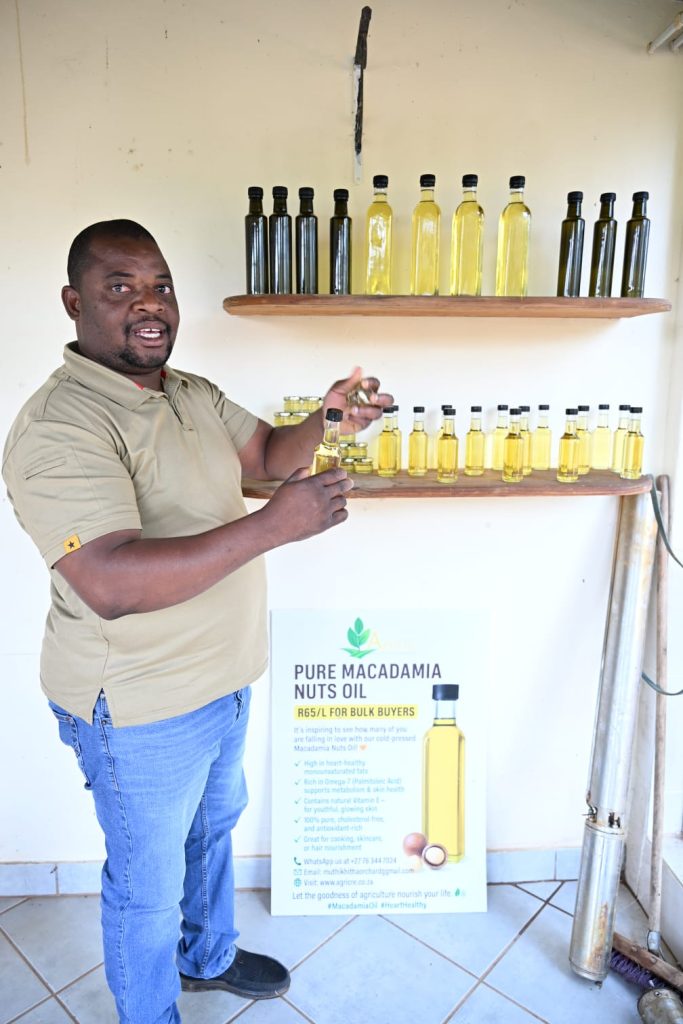
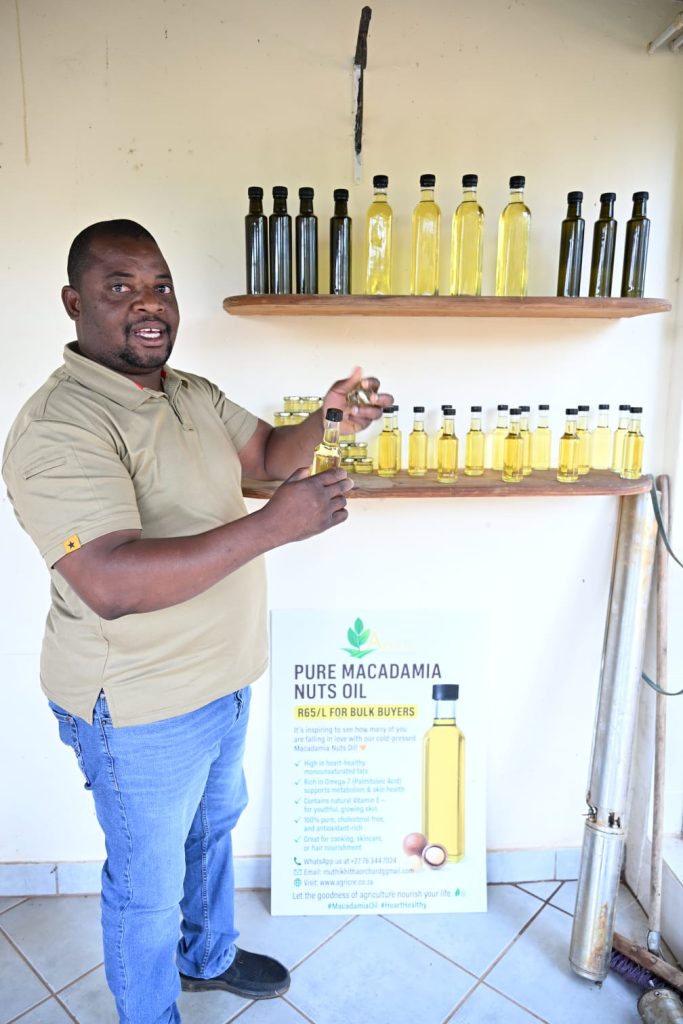
Muthikhitha with bottles of pure macadamia oil. (Photo supplied)

According to the dtic, the 27-hectare property has 11,700 macadamia trees with a production capacity of 37 tonnes of nuts. It employs six people permanently and as many as 20 seasonal workers.

“I realised that macadamia is the bestselling product of all the subtropical fruits in our area. The agroprocessing part is even more profitable, hence we have quickly moved into processing the nuts and producing pure macadamia nuts oil that is flying off our shelves,” he said.

Agricre has expanded beyond selling raw nuts into processing macadamia oil through cold pressing.

“There is a high demand for the oil because it is produced through cold pressing, meaning that you put the nuts in the machine and press, nothing is added. It is organic. And that is what the market is looking for. Consumers use it for cooking, skin and hair. Beauty parlours are our biggest customers,” Muthikhitha said.

The company is also trying to expand its footprint in domestic and international markets.

In October 2025, Muthikhitha participated in an exhibition in Johannesburg with dtic assistance and secured orders from Japan, Egypt and Saudi Arabia, according to the department.

Agricre is now experimenting with other products derived from macadamia nuts, including milk and flour, while making use of available land on the farm for crop and vegetable production.

“We are also experimenting with new products such as milk and flour that we can produce from our macadamia nuts as part of diversifying our offerings. We are utilising the space available on the farm for crash crops and vegetable production that my wife, Mashudu, who is our sales manager, is responsible for. We are happy to be making a modest contribution in creating employment for the people of Makhado, and it is our plan to grow this company and create more job opportunities,” Muthikhitha said.

INSIDE EDUCATION

The post From engineering to agriculture: Muthikhitha builds thriving macadamia business in Limpopo appeared first on Inside Education..

Uncategorized

Maile rejects claim that R230m GDE office rental bill came at expense of school funding

By Thapelo Molefe

Gauteng Education MEC Lebogang Maile has rejected claims that money meant for schools was spent on office accommodation, saying the Gauteng Department of Education (GDE) does not procure or lease office space.

Maile said office accommodation is procured and managed by the Gauteng Department of Infrastructure Development, which serves as the custodian of provincial immovable assets in terms of the Government Immovable Asset Management Act. The GDE, however, is responsible for rental payments for leased district office accommodation.

“The Gauteng Department of Education does not procure office accommodation, enter into lease agreements for such accommodation, or administer a budget for the procurement of office accommodation,” he said in a statement issued on Thursday.

Maile’s rejection follows claims by Democratic Alliance Gauteng education spokesperson Michael Waters that the provincial government spends more than R230 million a year on rented and operating costs for GDE district offices while schools face significant funding shortfalls.

Waters said in July that 10 of the GDE’s 15 district offices were housed in privately owned buildings, citing a written response by Maile to questions tabled in the Gauteng Provincial Legislature.

According to the information, the province spends R15.27 million a month, or R183.2 million a year, on rent for the 10 privately owned district offices.

A further R47.2 million is spent annually on municipal services, bringing the total to more than R230 million a year.

Waters questioned why government-owned buildings were not being used for the district offices, particularly while schools were facing funding pressures.

“The fact that two-thirds of the department’s district offices are housed in privately leased buildings raises serious questions about whether the Provincial Government is making the best use of its own property portfolio or unnecessarily enriching private landlords at taxpayers’ expense,” Waters said.

He said the spending was concerning because it came at a time when the GDE had reduced the per-learner allocation to affected Quintile 5 schools by about 64%.

“The Premier Panyaza Lesufi-led government cannot claim there is no money while spending millions of rand on leasing office space,” Waters said.

But the department said in its statement: “Any suggestion that the Gauteng Department of Education has spent money on office accommodation at the expense of school funding is mischievous and misleading.”

Maile said the GDE remains responsible for funding schools in accordance with the South African Schools Act and the National Norms and Standards for School Funding.

For 2026, the national target amounts are R1,835 per learner for Quintile 1 to 3 schools, R919 per learner for Quintile 4 schools and R315 per learner for Quintile 5 schools.

“The Gauteng Department of Education has not deviated from these prescribed funding requirements,” the department said.

“School funding has not been reduced or redirected by the Department for the procurement of office accommodation.”

The GDE has previously said the reduction in the Quintile 5 per-learner allocation was a realignment to nationally prescribed funding targets rather than an arbitrary cut to the education budget.

Waters has called for further investigation into why the district offices are housed in privately leased buildings and whether suitable government-owned properties could be used instead.

INSIDE EDUCATION

The post Maile rejects claim that R230m GDE office rental bill came at expense of school funding appeared first on Inside Education..

Uncategorized

NSFAS Board turns focus to stabilising scheme after administrator’s suspension

By Lebone Rodah Mosima

The National Student Financial Aid Scheme (NSFAS) Board says its immediate focus will be on stabilising the student funding scheme and strengthening governance after a Pretoria High Court ruling suspended the appointment of administrator Professor Hlengani Mathebula and reinstated the board.

“The NSFAS Board will resume its duties with immediate effect and will focus on stabilising the institution, strengthening governance, and fulfilling its statutory mandate to provide financial assistance to eligible students across South Africa,” it said in a statement.

The court on Friday interdicted Mathebula from continuing as NSFAS administrator pending the finalisation of Part B of the board members’ application, which seeks to have Higher Education and Training Minister Buti Manamela’s decisions to dissolve the board, place NSFAS under administration and appoint Mathebula as administrator reviewed and set aside.

Manamela dissolved the NSFAS board and appointed Mathebula as administrator in May.

The board welcomed the interim relief and its return to NSFAS’s governance structures.

“The NSFAS Board welcomes [Friday’s] judgment of the Pretoria High Court granting interim relief suspending the appointment of the NSFAS Administrator and reinstating the Board pending the final determination of Part B of the review application,” it said.

It said it had noted concerns and issues that had emerged publicly about the institution and would address them as a priority.

It said that where wrongdoing, misconduct or unlawful conduct was identified, appropriate action would be taken in accordance with the law and applicable governance processes.

“The Board further reaffirms its commitment to working constructively with the Minister of Higher Education and Training and all relevant stakeholders in addressing the challenges facing NSFAS and the broader higher education sector.”

The board said it would not comment further on the litigation while Part B remained before the court.

INSIDE EDUCATION

The post NSFAS Board turns focus to stabilising scheme after administrator’s suspension appeared first on Inside Education..

Pretoria-Tuine becomes Gauteng’s 39th School of Specialisation
Uncategorized

Pretoria-Tuine becomes Gauteng’s 39th School of Specialisation

By Lebone Rodah Mosima

Learners from Pretoria-Tuine Ingenieurskool van Spesialisasie demonstrated their practical technical and problem-solving skills during the school’s official launch as an Engineering School of Specialisation on Friday.

From fitting and machining to electrical systems, construction, plumbing and automotive technology, the Gauteng Department of Education said learners brought their technical training to life through a series of practical demonstrations.

Led by MEC Lebogang Maile, the department said the launch marked Gauteng’s 39th School of Specialisation, another step in creating pathways for young people to pursue technical careers and contribute to the province’s future.

“Pretoria-Tuine Ingenieurskool van Spesialisasie is opening new pathways for learners to turn talent into technical expertise and practical skills through Civil Technology, Mechanical Engineering, and Electrical Technology, with practical training in woodwork, plumbing, construction, fitting and machining, automotive, digital technology, power systems, and electronics,” the department said.

“By investing in specialised, hands-on education, Gauteng is empowering young people with the skills, confidence, and opportunities to build successful careers and contribute to the province’s growing economy.”

The department said the learners were applying their skills by building a storeroom for the technical centre, gaining hands-on experience in planning, measuring, building and problem-solving.

Maile also joined the learners, laying a brick with their guidance.

“This is what practical, skills-based education looks like,” the department said.

INSIDE EDUCATION

The post Pretoria-Tuine becomes Gauteng’s 39th School of Specialisation appeared first on Inside Education..