Uncategorized
By Charmaine Ndlela
Photos by Eddie Mtsweni
Basic Education Minister Siviwe Gwarube has paid tribute to South Africa’s 485 000 educators, saying their daily work in classrooms is helping to build the country’s future as World Teachers’ Day shines a spotlight on the support and working conditions teachers need to perform their duties.
“Today is National Teachers’ Day, and I want to say to almost half a million of you that we see you, we see your hard work, we see just how much you dedicate yourselves to building South Africa,” Gwarube said.
“I want you to remember that every single time you walk into a classroom, that you are building the future of this country brick by brick, learner by learner. We want to say sianibulela, sianishonipa, and we want to say we appreciate the work that you do.”
World Teachers’ Day is observed annually on 5 October to recognise the contribution of teachers and draw attention to the professional conditions that shape their work.
This year’s observance is particularly significant as it marks 60 years since the adoption of the 1966 International Labour Organisation (ILO)/UNESCO Recommendation concerning the Status of Teachers.
UNESCO’s 2026 theme, “Standing with teachers: 60 years of protecting the profession, advancing its status and shaping our futures”, calls for more than recognition of educators. It places the spotlight on whether education systems are providing teachers with the professional, material and institutional support they need.
The Department of Basic Education said it was continuing to strengthen the foundations of the education system, including early childhood development and Foundation Phase teaching.
Over the past year, the department registered more than 13 300 early childhood development centres against a target of 10 000.
The DBE said a R496 million fund had been established to create ECD spaces in KwaZulu-Natal, Limpopo and the Eastern Cape.
In addition, 10 000 Foundation Phase teachers are receiving targeted training in literacy and numeracy this year as the department works to strengthen the National Reading Literacy Strategy.
The interventions come as the education sector continues to grapple with challenges including learner performance, teacher workload, infrastructure, safety and the changing demands placed on educators.
Dean of Education at Rosebank International, Dr Shani Steyn, said World Teachers’ Day should be an opportunity to move beyond celebrating teachers and reflect on what it means to genuinely support the profession.
“Teaching is about far more than delivering curriculum. At its heart, it is relational work. Teachers see potential, build confidence, encourage curiosity and help young people make sense of themselves and the increasingly complex world around them,” Steyn said.
“Standing with teachers therefore means more than thanking them for what they do. It means recognising them as professionals, investing in their development, listening to their voices and ensuring that they are equipped and supported to respond to the changing needs of the learners and communities they serve.”
Steyn said teachers were working in increasingly complex classrooms while having to navigate technological developments, artificial intelligence, changing assessment approaches, learner wellbeing, neurodiversity and inclusive education.
She said teacher preparation therefore needed to extend beyond subject knowledge.
“This means that preparing teachers for the future cannot simply be about giving them subject knowledge and sending them into classrooms,” Steyn said.
“They need strong pedagogical knowledge, the ability to make sound professional judgements and the confidence to adapt their teaching so that different learners have meaningful opportunities to participate and succeed.”

The 60th anniversary of the international recommendation on the status of teachers also provides an opportunity to consider how educators are prepared before entering the profession and how they are supported throughout their careers.
“We need teachers who are knowledgeable, certainly, but also reflective, adaptable and willing to keep learning throughout their careers. The classroom will continue to change,” Steyn said.
“Good teacher education therefore cannot prepare graduates for one version of the classroom; it must prepare them to continue learning and responding as education itself evolves.”
Steyn said pathways into teaching should remain accessible while maintaining professional standards.
Rosebank International offers a Higher Certificate in Early Childhood Care and Education as an entry-level route for people interested in early childhood education, while students can progress through Bachelor of Education qualifications in Foundation Phase and Intermediate Phase Teaching.
“The journey to becoming a teacher does not always begin and end with a single qualification,” Steyn said.
“For some aspiring educators, a higher certificate may be that important first step. What matters is that we create meaningful pathways into the profession while maintaining the quality and professional standards that teaching demands.”
She said investing in teachers ultimately meant investing in learners.
“As we celebrate World Teachers’ Day, we should celebrate both those already serving in our classrooms and those preparing to join them. Standing with teachers means investing in the profession across the entire journey, from the aspiring student teacher to the experienced educator who continues to learn, adapt and lead,” Steyn said.
“Because when we invest in teachers, we are ultimately investing in every learner whose future they will help to shape.”
Meanwhile, the South African Democratic Teachers’ Union (SADTU) used World Teachers’ Day to call for stronger protection of teachers’ rights, improved working conditions and greater investment in public education.
SADTU said the theme was a reminder that the future of society was inseparable from the dignity, rights and working conditions of teachers.
The union paid tribute not only to school teachers but also to lecturers in higher education, education support personnel and early childhood development practitioners.
According to SADTU, the 1966 ILO/UNESCO Recommendation set out principles relating to teachers’ rights and responsibilities, initial teacher preparation, further education, recruitment, employment, and teaching and learning conditions.
It also promoted teachers’ participation in educational decision-making through consultation and negotiation with education authorities.
SADTU said the principles remained relevant as teachers faced a range of pressures in the education system.
The union highlighted the gender imbalance in the profession, saying that while the majority of teachers were women, men continued to dominate leadership positions.
It said women were also heavily represented in early childhood education, which plays a critical role in children’s academic, emotional and physical development, but that many ECD practitioners continued to struggle for recognition as teachers.
SADTU said the formalisation of the ECD sector by the Department of Basic Education was partly a result of its advocacy.
The union called for women teachers to be protected from harassment and discrimination and afforded equal opportunities to advance into leadership positions.
It also raised concerns about violence against teachers and the safety of educators in schools.
“No teacher should have to enter a classroom fearing for their lives,” SADTU said, calling for stronger measures to protect teachers and address the social conditions contributing to violence in schools.
The union said schools needed to be places of teaching, learning, safety and dignity rather than spaces where educators faced violence, intimidation or abuse.
SADTU further warned that teachers were bearing the impact of austerity measures and resource constraints, arguing that cuts to education budgets could affect the ability of educators to provide quality teaching.
Overcrowded classrooms, inadequate resources, insufficient support and growing administrative workloads were among the challenges identified by the union.
SADTU cited a University of Stellenbosch study which found that 50% of South African teachers were considering leaving the profession within a decade, with administrative burdens identified as a major source of stress.
The union said teachers could not be expected to continually do more with fewer resources while carrying the responsibility of preparing future generations.
It called for sustained investment in public education, saying education should be treated as a fundamental social investment rather than expenditure to be reduced when budgets come under pressure.
“Honouring teachers means ensuring decent working conditions, fair remuneration, safe schools, adequate resources, professional development, and meaningful participation in decisions that affect the education system and the teaching profession,” SADTU said.
The union also called for the restoration of the social status and dignity of teaching, saying teachers should be recognised as professionals whose expertise and commitment were essential to building a just, equal and prosperous society.
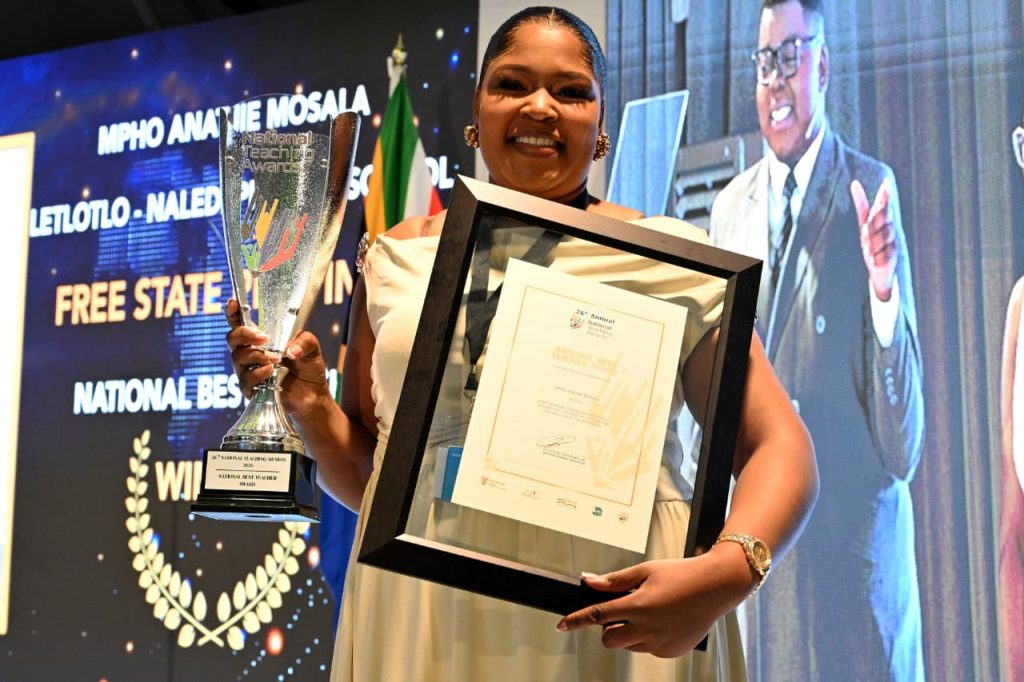
As the country marks World Teachers’ Day, SADTU also congratulated the educators recognised at the Department of Basic Education’s National Teaching Awards, saying the awards celebrate excellence, dedication and innovation in teaching and school leadership.
The union said it wanted to see more initiatives recognising teachers not only from government but also from the private sector.
INSIDE EDUCATION
The post World Teachers’ Day: Gwarube salutes 485 000 educators as calls grow for greater support appeared first on Inside Education..