Category: Uncategorized

Uncategorized

‘Siyaya eJapan, Tokyo here we come,’ say UJ sportsmen, women in SA squad

The 2021 Olympic Games are going ahead, and the University of Johannesburg (UJ) has a team of 13 – including students and alumni – selected for the South African team that will jet off to Tokyo, Japan, in July.

The University received the news last month when Team South Africa released its selected list of athletes and technical professionals who will represent the country in various sporting codes.

UJ Sport Senior Director Nomsa Mahlangu said the selected students, who will raise the UJ and South African flags high, include Jason van Rooyen, Cheswill Johnson, Kristen Paton and Toni Marks.

Mahlangu said the students will compete in athletics, hockey, long jump, and shotput.

The team members from the university include one staff member and seven alumni.

Mahlangu said it gives the institution immense pleasure to see their UJ student-athletes and staff as well as alumni become included in the selected South African squad that will travel to participate in the 2021 Tokyo Olympic Games.

“At UJ, we pride ourselves in producing talent that contributes to the growth of the South African sports community,” said Mahlangu.

There have been concerns that the Olympic Games may not go ahead, because of fears over the rising Covid-19 infections in the Tokyo.

However, the Olympics Committee said the games would continue while the International Olympic Committee Vice-President John Coates said they had all the plans and measures in place to protect the safety and security of athletes and the people of Japan, even if the city was under a state emergency.

“The advice we have got from the World Health Organisation and all of the scientific advice, is that all the measures we have outlined in the playbook, all those measures are satisfactory to ensure a safe and secure Games in terms of health, and that’s whether there is a state of emergency or not,” said Coates.

He added that Japan has long insisted that there was no question the Games, which should have taken place last summer, would be held and will be safe.

The post ‘Siyaya eJapan, Tokyo here we come,’ say UJ sportsmen, women in SA squad appeared first on Inside Education.

South Africa’s youth unemployment crisis – a ticking time bomb
Uncategorized

South Africa’s youth unemployment crisis – a ticking time bomb

A week ahead of the commemoration of National Youth Day in South Africa and 45 years after the massacre of school children during the Soweto Uprising of 1976, the country’s youth still suffer massive unemployment, extreme violence, and an outdated education system.

This is according to University of Johannesburg (UJ) Professor Leila Patel who said young people continue to grapple with the well-documented failings of the education system which has left many school-leavers unprepared or unable to access tertiary education or become entrepreneurs.

Lauren Graham, UJ Professor and associate at the Centre for Social Development in Africa said youth unemployment is one of South Africa’s most intractable challenges and has been made worse by the Covid-19 pandemic.

“Prior to the pandemic the unemployment rate, including people who had given up looking for work was just under 70% for people aged 15 to 24. A year later [in 2021] the rate had increased to 74%,” said Graham.

Adding that young people on the continent are the most affected by unemployment and underemployment and they are struggling to survive.

“They are poor and are stuck in ‘waithood’ –a prolonged period of suspension in which people’s access to social adulthood is delayed or denied,” she said.

READ: DA has requested the Free State government to hire unemployed engineering graduates in the province

Statistics South Africa (Stats SA) ‘s official unemployment rate rose to 32,6% between January and March (first quarter) of 2021 from 32,5% in the previous quarter. The Quarterly Labour Force Statistics (QLFS) places the country’s expanded unemployment rate, which includes discouraged workers, at 43,2% – an increase of 0,6 of a percentage point from the previous quarter.

According to the agency, these new unemployment figures show that young people are the most affected.

The Statistician General, Risenga Maluleke, said a major issue of concern remains the extremely high youth unemployment numbers.

The latest QLFS report shows that youth unemployment for those between 15 and 24 years sits at 74,7% when using the expanded definition of unemployment.

Maluleke said some young people have been discouraged with the labour market and they are also not building on their skills base through education and training.

“The reason we calculate youth unemployment for those between15 – 24 years is to be able to make international comparisons.

“This age group unemployment remains the highest in the country. Young people of that age group remain vulnerable to labour markets.

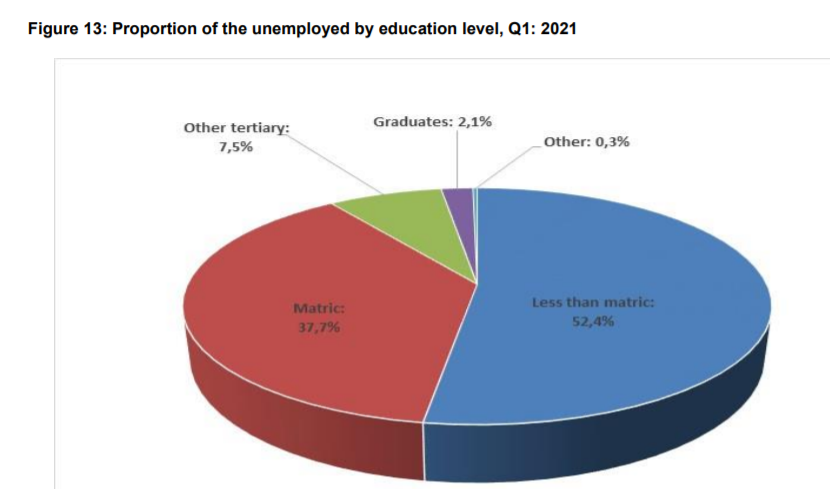
Maluleke said of the 7,2 million unemployed persons in the first quarter of 2021, 52,4% had education levels below matric, followed by those with matric at 37,7%.

He said only 2,1% of unemployed persons were graduates, while 7,5% had other tertiary qualifications as their highest level of education.

Maluleke said some young people have been discouraged with the labour market and they are also not building on their skills base through education and training.

“These young people are not in employment, education or training (NEET). The NEET rate serves as an important additional labour market indicator for young people.

“Of the 10.3 million young people aged between 15 and 24, 3.3 million are not in employment, education or training. This overall rate increased by 1,7 percentage points in the first quarter of 2021 compared to the last quarter of 2020,” said Maluleke.

The Quarterly Labour Force Statistics (QLFS) also shows that the NEET rate for women is higher than that of their male counterparts in both years.

Compared to the first quarter of 2020, the percentage of young persons aged 15–34 years who were not in employment, education or training increased by 1,9 percentage points from 41,7% to 43,6% in the first quarter of this year.

Maluleke said the NEET rate for males increased by 2,0 percentage points, while for females the rate increased by 1,7 percentage points in the first quarter of 2021.

The report also shows that when we compare quarter one of 2020 with the first quarter of 2021, more than four in every ten young females were not in employment, education or training.

READ: Dear graduate, you should take that ‘crappy’ job

Analysts say limited economic and educational prospects have exacerbated youth frustrations in the country.

Former Wits University Student Representative Council (SRC) deputy president and researcher in the EFF Parliamentary caucus Tokelo Nhlapo, said the National Treasury budget cuts led to 2021 Fees Must Fall protests around the country.

Nhlapo said the brutal killing of 35-year-old Mthokozisi Ntumba in March this year must be understood in the context of government’s systematic defunding of public universities and the fascist culture cemented by former Wits University Vice-Chancellor and former chair of Universities South Africa, Adam Habib.

Adding that over the past few years, students have protested against fee exclusion, insourcing of cleaning and security workers, decolonisation of universities and gender equality.

“Since the 2015/16 Fees Must Fall protests, one thing that been permanent at many of the student protests has been the violent repression of students’ voices through the deployment of private security and the South African Police Service, effectively criminalising protests at universities.

“The consequence has been the abandonment of democratic liberties through violence and repression in almost all public universities in South Africa,” said Nhlapo.

The post South Africa’s youth unemployment crisis – a ticking time bomb appeared first on Inside Education.
Uncategorized

Nine schools in the Northern Cape expected to reopen following Covid-19 cases

NYAKALLO TEFU| 

Nine schools in the Northern Cape are expected to reopen their doors on Monday after shutting down due to Covid-19 cases.

The Northern Cape Education Department has seen a major increase to see a rise in Covid-19 for a fourth consecutive week.

The Department last week recorded over 300 new Coronavirus cases which include the infection of learners, teachers, and staff.

“11 schools closed in the Northern Cape due to Covid-19 infections. Of these schools, nine are scheduled to reopen on Monday, 7 June 2021,” said department spokesperson Geoffrey Van Der Merwe.

READ: The Northern Cape sees sharp increases in Covid-19 infections in schools

This as the number of Covid-19 cases in the country continues to increase.

The Department of Health recorded 5074 new cases in the past 24-hours.

The Northern Cape province alone recorded 348 positive Covid-19 cases in the last week.

“These include 52 educators, 276 learners and 20 support staff at schools,” said Van Der Merwe.

Van Der Merwe said parents must ensure that they limit the movement and social interaction of their children in and around communities.

“This is evidence that our schools are mirrors of the rising infection rate in our communities. Parents must ensure that they limit the movement and social interaction of their children in and around their communities,” said Van Der Merwe.

Inside Education reported that teachers over the age of 40 are expected to be vaccinated. The Department of Health said more than 500 000 Johnson & Johnson vaccines have been secured for the education sector.

READ: Teachers over 40 to be vaccinated from Wednesday

The post Nine schools in the Northern Cape expected to reopen following Covid-19 cases appeared first on Inside Education.

Uncategorized

Teachers over 40 to be vaccinated from Wednesday

Teacher unions have confirmed that educators, cleaners and other support staff at public schools in South Africa will be vaccinated against the Covid-19 virus starting Wednesday this week.

Unions say at least 500,000 Johnson & Johnson vaccines have been secured for the education sector.

Inside Education saw a letter by the Head of Health in KwaZulu-Natal, Dr Sandile Tshabalala, addressed to the Head of Education Enock Nzama asking that he makes departmental coordinators available for planning meetings last week.

READ: Teachers set to be vaccinated in the next week

In the letter written on Thursday titled: Vaccination of educators, Tshabalala said the national department of education has confirmed that the J&J vaccines would be made available in the next week and that “most of which should be used for educators”

Media reports state that the doses are still awaiting approval from the food and drug administration.

Following consultations between the Department of Basic Education and various stakeholders, Naptosa Executive Director Basil Manuel said they anticipated that teachers aged 40 and above will start to receive their jabs from Wednesday.

“The efforts to secure a vaccine for education workers, not just teachers, have been successful,” Manuel.

Manuel added the Department of Health will confirm vaccination schedules and allocate sites according to each school district

“We are busy currently with the logistics around rolling that out to all the schools including governing body paid teachers, starting with those over the age of 40 and starting with public schools.”

READ: Teacher unions push to have teachers vaccinated in June

The post Teachers over 40 to be vaccinated from Wednesday appeared first on Inside Education.

Uncategorized

School District Agrees To Pay $3M In Bullied Child’s Suicide

THE parents of an 8-year-old boy who killed himself after being bullied repeatedly at an Ohio school have reached a tentative $3 million settlement with his school district.

The agreement announced Friday will go to the school board for Cincinnati Public Schools on Monday for approval in the Gabriel Taye case that dates to 2017.

The schools also agreed to actions to prevent a repeat of such bullying with such steps as training and supervising all staff on anti-bullying reforms and to working to identify repeat offenders, victims and locations. There will be two years of oversight of the district’s anti-bullying plan.

A memorial to Gabriel will also be placed at Carson School, the elementary school he attended.

 “In honor of Gabe, his family is using this settlement to protect current and future CPS students,” said the family’s lawyer, Al Gerhardstein. “We will make sure these reforms take root and end bullying throughout the CPS system.”

The Cincinnati Enquirer reported that attorney Aaron Herzig, a partner at the Taft law firm who represented the school district in the case, said a resolution was in everyone’s best interest.

“The defendants strongly believe that neither CPS, its employees, nor the school nurse were responsible for the tragic death of Gabriel Taye,” Herzig said.

“CPS embraces the goal of eliminating bullying within schools, as well as continuing to refine and improve reporting, management, and training processes related to incidents of bullying.”

The wrongful death lawsuit cited repeated examples of Gabriel and others being bullied at his elementary school. His parents contended that school officials knew about the bullying but were “deliberately indifferent,” allowing a “treacherous school environment.”

NBCNEWS

The post School District Agrees To Pay $3M In Bullied Child’s Suicide appeared first on Inside Education.

Uncategorized

Teachers set to be vaccinated in the next week

NALEDI SHOTA|

Teachers are set to be vaccinated within the next few weeks.

Inside Education has seen a letter by the Head of Health in KwaZulu-Natal, Dr Sandile Tshabalala, addressed to the Head of Education Enock Nzama asking that he makes departmental coordinators available for planning meetings today. 

Inside Education has confirmed the authenticity of the letter from two independent sources. 

In the letter written on Thursday titled: Vaccination of educators, Tshabalala said the national department of education has confirmed that the J&J vaccines would be made available in the next week and that “ most of which should be used for educators”

“The target group is basic education (all staff members of primary and secondary schools). It is expected that the dedicated vaccination sites for educators will be ready by Wednesday, 9th June 2021, and the vaccination period will be for two week,”  reads the letter.

Inside Education also understands that teacher unions are meeting with the Department of Basic Education today and the agenda is teacher vaccination. 

Inside Education reported on Tuesday that teacher unions had written to the national departments of health and education asking that teachers be prioritised for vaccination this month. 

READ: Teacher unions push to have teachers vaccinated in June

The teacher union leaders that spoke to Inside Education said ideally they wanted their members to be vaccinated before 26 July when all primary school learners and learners in special education needs schools are expected back in class daily. 

Basil Manuel, Naptosa Executive Director said, at the time, teachers must also be regarded as frontline workers because they come  into contact with large groups of people compared to the police, for example. 

While General Secretary of Sadtu, Mugwena Maluleke, also told Inside Education on Tuesday that a delay in vaccinating teachers may lead to education of learners being disrupted. 

The post Teachers set to be vaccinated in the next week appeared first on Inside Education.

Uncategorized

Nzimande clarifies NSFAS funding criteria

NALEDI SHOTA|

Higher Education, Science and Technology Minister Blade Nzimande said that students funded by the National Student Financial Aid Scheme (NSFAS) will not lose their funding if they change their course or move to another higher education institution, as long as they are still eligible for funding. 

Nzimande was responding to a parliamentary question, this week, by DA MP Tarabella Marchesi who asked, amongst other things,  whether the scheme stops funding students if they change universities.

In a press statement on Wednesday, addressing the same issue, Nzimande said that changing a course does not affect funding. 

“No, Nsfas does not stop funding because students change institutions.  Nsfas  funding stops when the student fails to meet the academic eligibility criteria and the N+ rule,” said Nzimande. 

The N rule is the minimum qualification completion time also known as regulation time specified by the institution for a programme of study funded by NSFAS. 

“ N+1 applies to first-time entering students first registered after December 2017, whilst N+2 applies to students who first registered before January 2018.

“If a student has transferred from any other public university, regardless of whether they were funded at that university, the number of years already registered for the qualification must be counted as part of the minimum qualification completion time,”  he said.

Students who qualify for NSFAS are those who are recipients of the SASSA grant, and whose combined household income is not more than R350 000 per year. And for students who are disable the combined household income must not exceed R600 000 per year for them to qualify for funding by the scheme. 

Recently, the NSFAS board told the portfolio committee on higher education that for this year the scheme had assessed 323 445 Technical and Vocational Education and Training college and 940 226 university students to be eligible for funding. 

The post Nzimande clarifies NSFAS funding criteria appeared first on Inside Education.

Uncategorized

Matric June exams scrapped

The Department of Basic Education has scrapped mid-year exams for matric pupils.

This was announced by Minister Angie Motshekga during a presentation to the Portfolio Committee on Basic Education.

Motshekga said the move is to allow Grade 12 pupils more time to cover the curriculum.

“We want to make up for the loss of time and for them to cover the curriculum. They did not go on holiday in March and most of the schools are giving extra classes.

“The June period of exams will be used to cover the curriculum. We also have a team monitoring Covid-19 infections on a daily basis,” Motshekga said.

The South African Democratic Teachers Union (Sadtu) General Secretary Mugwena Maluleke said learners have lost a lot of learning time due to the Covid-19 pandemic and lockdown which has put restrictions on how many can attend class at a time.

“Last year’s grade 11 pupils were hit hard by losing so much of the school year in 2020.

“Grade 11, in terms of the phased opening of schools, after those first couple of months in the first term, they didn’t return to school in 2020 until July,” he said.

Adding that the grade 12 class of 2021 was in a much more difficult situation than last year’s class.

Maluleke said grade 12 teachers had to work backward to help their learners catch up with the grade 11 syllabus.  “There is a serious backlog and the situation is very serious,” he added.

The minister said regarding the grade 12 class of 2021, the education authorities will try to keep these learners in school for as long as possible, in order to try to cover the gaps.

“They are grade 11s of 2020 and already the whole curriculum was not covered. They lost close to 60% of school time over the period,” said Motshekga.

Committee chair Bongiwe Mbinqo-Gigaba said all public-school learners lost 54% of teaching time.

 She said the committee noted the loss in learning hours that has already occurred in the 2021 school year, due to the academic year starting later.

“The majority of learners not attending five days of schooling per week as they were using a rotational system.

“This together with the loss of learning hours in 2020, does not bode well for our education system. We know and understand that it is not a South African phenomenon but a world-wide challenge, however we remain concerned,” Mbinqo-Gigaba emphasised.

She said this was quite a lot and it would not be easy to recover.

The post Matric June exams scrapped appeared first on Inside Education.

Uncategorized

Provinces gear up for the 2022 academic year as they open admission process in schools

NALEDI SHOTA|

Several provinces have opened the process of application for admissions in public schools for the 2022 academic year. 

The provincial departments of education that have already begun with this process have urged parents to apply on time to allow them enough time to prepare for the academic year next year.

This week, the Department of Basic Education released the academic calendar for coastal and inland schools. Coastal schools will open on 19 January while inland schools will do so on 12 January. 

READ: DBE releases 2022 school calendar

The Western Cape Department of Education was the first to kick off admissions in February and the process ended on 31 March. In a statement last month, the department said between the time admissions opened until they were closed in March it had recorded 408 672 applications. 

The Western Cape is one of the provinces that battle with an influx of learners into that province that it battles to place them in schools on time. For this academic year some learners in that province were only placed last month in schools.

The Northern Cape Department of Education opened online admissions on Tuesday for grades R, one and eight and it said on the first day it had already received 5600 applications. 

MEC of Education in the Northern Cape, Zolile Monakali, encouraged parents to be “responsible” and apply on time. 

“[Let’s] make sure we register our children on time so that the education system can open and run smoothly as we are preparing for the 2022 academic year,” said Monakali on Tuesday.

The KwaZulu-Natal Department of Education opened for admissions on 3 May and the process will run until 1 October. In Limpopo the process opened on 17 May to 30 July for walk-in registration, while the online registration, at selected schools, will run from Today until 6 August. The province is piloting online admission. 

Other provinces are yet to announce the start date of their admissions processes. 

Last month, the DA in Gauteng criticized the Gauteng Education for not having started with its admission process. 

In a statement, DA shadow MEC Khumo Ramulifho, urged MEC of education Panyaza Lesufi to open online admissions from last month and for the process to be concluded in October. 

“By moving the online admission earlier, this will ensure that no learner misses a day of schooling when the new academic year begins as all allocations will be done timeously,”  said Ramulifho at the time. 

However, the province is yet to announce when it will open the online application system for the 2022 academic year. Gauteng, just like the Western Cape, is one of the provinces that battles large numbers of learners applying at the province’s schools. Some learners were also just placed in schools at the end of March. 

The post Provinces gear up for the 2022 academic year as they open admission process in schools appeared first on Inside Education.

Uncategorized

DBE Portfolio Committee supports return to class full-time for primary and special education learners

NALEDI SHOTA 

The National Assembly Portfolio Committee on Basic Education has come out in support of the plans by the Department of Basic Education (DBE) to allow primary school learners and learners from special education needs schools to return to class daily. 

On Friday, DBE Minister Angie Motshekga gazetted that on 26 July learners in grade R to seven would return to class daily as well as grade R to 12 at special education needs schools.

Since the outbreak of Covid-19 last year, learners have been attending school on a rotational system in order for schools to adhere to Covid-19 regulations such as social distancing. 

On Monday the department appeared before the committee to, amongst other things, present its plans to allow all primary school learners and those at special education needs back at school daily next month. 

In the presentation, the department said last year alone primary school learners lost 54% of contact time, 23% of this was due to the total closure of schools during lockdown and about 27% was as result of rotational attendance. 

The department said Director General, Mathanzima Mweli, will be doing weekly one-on-one engagements with provinces to gauge the extent of readiness before 26 July.

Provinces will also be expected to report on their progress to comply with health protocols to minimise the spread of the virus, and this they would have to do weekly. 

DBE has said that it expects a pushback on its decision from various quarters including through litigation, but said it was having ongoing engagements with stakeholders and would also use science as a defence in litigation. 

In a statement, committee chairperson Bongiwe Mbinqo-Gigaba, said the committee supports the decision to have primary school learners returning to school full-time. 

“We support this decision as long as the DBE can ensure that there is a safe and secure environment to go back to school. I have noticed that there has been regress when the younger ones only have alternative days of schooling,” she said.

Mbinqo-Gigaba said the loss of learning hours in 2020 is not good for the education system. 

“We know and understand that it is not a South African phenomenon but a world-wide challenge, however we remain concerned.”

In the gazette, Motshekga said the return of the learners to class full-time would depend on the direction the pandemic is taking in district municipalities and the country. 

Motshekga has also told the committee that the DBE decisions on the return to school is done in consultation with the Department of Health and that  should the health department  advise otherwise if the country finds itself in third wave the DBE would  reconsider and revise its position regarding the daily return of learners.

On Sunday, President Cyril Ramaphosa announced that the country would return to level 2 of the lockdown as cases of Covid-19 are going up again. Ramaphosa said provinces such as Gauteng, Northern Cape , North West and Free State were already in the third wave. 

The post DBE Portfolio Committee supports return to class full-time for primary and special education learners appeared first on Inside Education.